A Beginner's Guide to Amateur (Ham) Radio
If you've ever wanted to talk to someone without the internet, a cell tower, or an expensive monthly bill, ham radio might be what you're looking for.
Jun 2, 2026
SHARE
Automate the telecom lifecycle
Get better quotes, launch sites faster, keep inventory accurate, and control spend.
If you've ever wanted to talk to someone across the country—or across the world—without the internet, a cell tower, or an expensive monthly bill, ham radio might be exactly what you're looking for. It's one of the oldest and most reliable forms of communication out there, and it's a lot more accessible than most people think.
What is a Ham Radio?
Ham radio—officially called amateur radio—is a hobby and public service that lets licensed individuals communicate over radio waves using designated frequencies. Unlike walkie-talkies or CB radios, ham radio gives you access to a massive range of frequencies and the ability to communicate locally, nationally, and even globally.
The word "ham" has a murky history. One popular theory is that early radio operators were called "hams" as a slang term, similar to how a theatrical overactor is called a "ham." Whatever the origin, the name stuck, and today there are millions of licensed ham radio operators worldwide.
Here's what makes ham radio different from other radios:
Range: Depending on your equipment and frequency, you can talk across town or across continents.
Variety of communication: Voice, Morse code, digital text, video, and even satellite communication are all fair game.
No monthly fees: Once you have your license and gear, the airwaves are free.
Self-reliance: Ham radio works without the internet or phone networks, making it uniquely resilient in emergencies.
Ham radio is a hobby, a skill set, and a community all wrapped into one.
Amateur Radio: A Hobby for the 21st Century
Why Use a Ham Radio?
There are a lot of reasons people get into ham radio, and they're as varied as the people who pick it up. Here are some of the biggest ones:
Emergency preparedness: When cell towers go down after a disaster, ham radio keeps working. Ham operators have provided critical communication during hurricanes, earthquakes, and other emergencies when other systems failed.
Long-distance communication: Want to chat with someone in Japan or Argentina? With the right setup, it's entirely possible — no internet required.
Community: Ham radio has a strong global network of operators who love connecting, helping each other out, and experimenting.
Technical learning: It's a fantastic gateway into electronics, radio wave theory, and antenna building. Many engineers trace their interest back to ham radio.
Contests and challenges: There are regular competitions where operators try to contact as many stations as possible in a set time. It's genuinely exciting.
Space communication: Believe it or not, ham operators can communicate through satellites and have even made contact with astronauts aboard the International Space Station.
Whether you're drawn in by the emergency communication angle, the technical side, or just the thrill of reaching someone thousands of miles away with a radio you built yourself—there's something in ham radio for you.
Who Uses Ham Radios?
Ham radio attracts an incredibly wide range of people. The amateur radio service is for qualified persons of any age who are interested in radio technique with a personal aim and without pecuniary interest. It presents opportunities for self-training, intercommunication, and technical investigations. In practice, that means:
Preppers and survivalists who want a reliable off-grid communication system
Hikers, campers, and outdoor adventurers who need dependable communication in remote areas
Emergency response volunteers who deploy during disasters to keep communities connected
Electronics and technology enthusiasts who love building and experimenting
Retirees looking for a stimulating hobby with a built-in worldwide community
Young people and students interested in science, technology, engineering, and math
Scouts and Ham Radio
One of the most exciting connections in the ham radio world involves Scouts. Jamboree-on-the-Air, or JOTA, is the largest Scouting event in the world, held annually the third full weekend in October. JOTA uses amateur radio to link Scouts and hams around the world, around the nation, and in your own community.
With no restrictions on age or on the number of participants, and at little or no expense, JOTA allows Scouts to contact each other by ham radio. The scale of this event is remarkable. In a typical year, more than 1 million Scouts participate with over 11,000 stations operated by 20,000+ amateur radio operators in operation from 150+ countries around the world.
JOTA is a spectacular opportunity to introduce Scouts to amateur radio. For many, this will be their first exposure to the world of ham radio. Some will go on to become hams, enjoying the hobby for a lifetime. A few will even find the basis of a career in science and technology.
Scout leaders can find detailed operator guides and resources at theScouting America JOTA Operators Guide to help prepare for this annual event.
Guidelines for Amateur Radio Operators
What is JOTA: Jamboree on the Air?
Getting Started with Ham Radios
Getting into ham radio is more straightforward than most people expect. Here's the basic path:
Step 1: Get Your License
The FCC requires a license to transmit on amateur radio frequencies under Part 97 of the Communications Act of 1934. Anyone may listen (receive signals) for free, with no paperwork required. But the moment you key up a microphone and transmit, you need a license.
In the U.S., there are three license classes. The higher the class of license, the more frequencies are available. Earning each higher class license requires passing a more difficult examination. Although regulated by the FCC, license exams are given by volunteer groups of amateur radio operators.
The three license levels are:
Technician: The entry-level license. To earn the Technician license requires passing one examination totaling 35 questions on radio theory, regulations, and operating practices. The license gives access to all amateur radio frequencies above 30 megahertz, allowing these licensees the ability to communicate locally and most often within North America.
General: The mid-level license, which opens up most HF bands for long-distance and global communication.
Amateur Extra: The top-tier license with full privileges across all amateur radio bands.
There is no minimum age. The youngest licensed operator in U.S. history was five years old. The FCC issues licenses to anyone who passes the exam, regardless of age.
Step 2: Study for the Exam
The exam is not as hard as it sounds. The Technician exam is 35 multiple-choice questions. The entire question pool is publicly available before you sit for the test. You need 26 correct answers (74%) to pass. Most people with 10–30 hours of focused study pass on their first attempt.
Continuously optimize your network
Step 3: Take the Exam
You can contact a Volunteer Examiner (VE) team in your community to make arrangements for being administered the examination. After you successfully complete the exam, the VEC collects your information and forwards it to the FCC for processing. Your operating authority begins when your license grant information appears on the amateur service licensee database.
U.S. licenses are good for 10 years before renewal, and anyone may hold one except a representative of a foreign government.
Step 4: Get Your First Radio
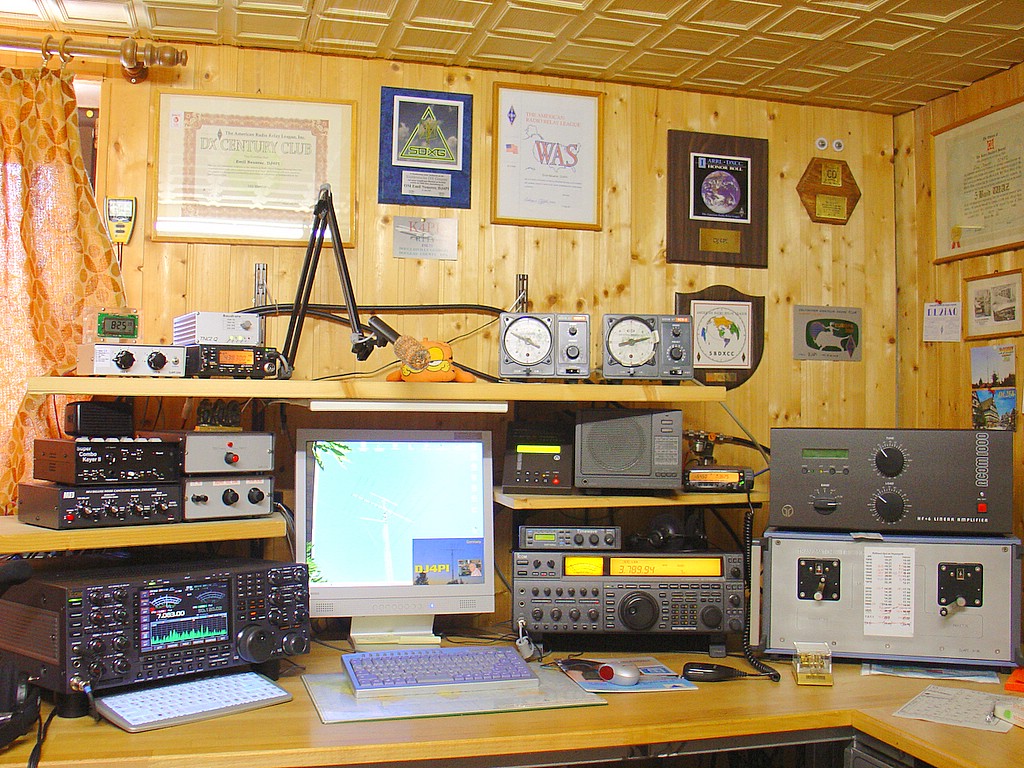
Once licensed, you'll need a radio. A handheld transceiver (called an HT) is the perfect beginner option:
Affordable (many entry-level HTs run $25–$100)
Portable and easy to use
Works great on the 2-meter and 70-centimeter bands that Technician licensees have access to
Connects to local repeaters that extend your communication range
As you grow in the hobby, you can upgrade to mobile radios for your car or a full base station at home.
Free study resources include:
HamStudy.org: Adaptive flashcard-style practice
HamExam.org: Full practice exams drawn from the real question pool
ARRL's online materials: The national association for amateur radio
Understanding Frequencies
Frequencies are the backbone of ham radio because they determine how far your signal travels, what conditions affect it, and what kind of communication you can do. Here's a quick breakdown of the key ranges:
HF (High Frequency, 3–30 MHz): The long-distance bands. HF signals can bounce off the ionosphere and travel around the world, which is why General and Extra class operators prize these frequencies for international contacts.
VHF (Very High Frequency, 30–300 MHz): Primarily used for local and regional communication. The popular 2-meter band (144–148 MHz) lives here. Great for connecting through repeaters.
UHF (Ultra High Frequency, 300–3000 MHz): The 70-centimeter band (420–450 MHz) is a UHF staple. Very common for local repeater networks, emergency communications, and digital modes.
The 2-meter band is one of the most popular and widely used VHF bands in amateur radio, known for its versatility in supporting a range of activities from local chatting to emergency communications.
A few key concepts to know:
Repeaters: Automated stations that receive your signal and retransmit it at higher power, dramatically extending your range.
Simplex: Direct radio-to-radio communication on a single frequency, no repeater involved.
Band plans: Understanding band plans is crucial for all amateur radio enthusiasts, as it ensures compliance with regulations and promotes effective communication.
Shared frequencies: All frequencies are shared. No frequency is assigned for the exclusive use of any amateur station. Station control operators cooperate in selecting transmitting channels to make the most effective use of the frequencies.
As your license class grows, your frequency access grows with it. Technician gets you on the air, General opens most HF privileges, and Amateur Extra gives you the widest access and the most flexibility across amateur radio bands.
Find a Repeater from RepeaterBook
Operating Your Ham Radio
You've got your license, you've got your radio—now what? Here's what day-to-day operation actually looks like.
Making your first contact:
Listen first: Before transmitting, always listen to make sure the frequency is clear. It's both good etiquette and good practice.
Identify yourself: Every transmission must include your call sign, either at the start, the end, or both. This is an FCC requirement.
Use plain language: You don't need to memorize a ton of codes to get started. Speak clearly and naturally.
Try a local repeater: Most new hams start by accessing a local repeater on the 2-meter or 70-centimeter band. It's the easiest way to connect with other operators in your area.
Common operating modes:
FM voice: The most beginner-friendly mode. Clear, easy audio, commonly used on VHF and UHF.
SSB (Single Sideband): Used on HF for long-distance voice contacts. A bit different from FM but standard for global communication.
Digital modes: Winlink (email over radio), FT8, PSK31, and others let you send text and data messages without the internet.
CW (Morse code): No longer required for licensing, but still widely used and respected in the ham community.
The phonetic alphabet is your friend. When spelling out call signs or words over the air, use NATO phonetics (Alpha, Bravo, Charlie, etc) to avoid confusion.
Q-codes are shorthand phrases borrowed from old telegraph days—QSL means "I confirm receipt," QTH means "my location," QRM means "interference from other stations." You'll pick these up quickly just by listening.
What is the Phonetic Alphabet?
Tips for Success
Ham radio is a hobby you can go as deep or as shallow as you want—but a few good habits early on will set you up well.
Join a local club: The ARRL's club finder at arrl.org/find-a-club connects you with operators in your area who love helping newcomers. Most clubs have regular nets (scheduled on-air meetups) that are perfect for getting reps.
Get on the air early: Don't wait until you feel "ready." You learn by doing. Make that first transmission.
Listen a lot: Tune around your local repeaters and HF bands just to hear how conversations go. You'll learn faster than reading any book.
Find an Elmer: In ham radio, an "Elmer" is an experienced operator who mentors beginners. They're everywhere in the community and genuinely love helping people get started.
Keep a log: Track your contacts, frequencies, and dates. It's good practice, and it's satisfying to look back on.
Study up on propagation: Understanding how weather, sunspot cycles, and the ionosphere affect your signal will make you a much more effective operator.
Upgrade your license: Once you've gotten comfortable as a Technician, consider studying for your General. With higher license classes, you can communicate worldwide using HF bands—no internet required.
Explore digital modes: Programs like WSJT-X open up a whole world of weak-signal digital communication that feels almost like magic.
Ham radio is one of those hobbies where the more you put in, the more you get out. Whether you're prepping for emergencies, chasing contacts around the globe, or just wanting a new technical challenge—there's a place for you on the airwaves. Get your license, key up that mic, and say hello to the world.
Featured Articles
Want to learn more about how Lightyear can help you?
Let us show you the product and discuss specifics on how it might be helpful.
Stay up to date on our product, straight to your inbox every month.