ChatGPT Nation: The States Leading (and Ignoring) the AI Boom
How are Americans really using AI? New survey reveals state-by-state trends, generational divides, and growing privacy concerns.

Mar 26, 2026
SHARE
Automate the telecom lifecycle
Get better quotes, launch sites faster, keep inventory accurate, and control spend.
As artificial intelligence (AI) becomes more deeply embedded in American life, public interest is soaring, along with new questions, concerns, and divides. From daily productivity to data centers and job market disruption, AI’s impact varies sharply by state and is leaving a growing national footprint. To uncover broader trends, we analyzed which states are most interested in AI tools and asked 1,000 Americans how AI is shaping their lives, and whether it’s helping or hurting.
Key Findings
Over 1 in 3 Americans (35%) — and a staggering 53% of Gen Z — now rely on AI-powered tools daily.
Despite widespread use, 81% fear AI’s ripple effects, from job displacement to deepfakes and skyrocketing energy consumption.
70% of Americans fear AI will hurt U.S. employment.
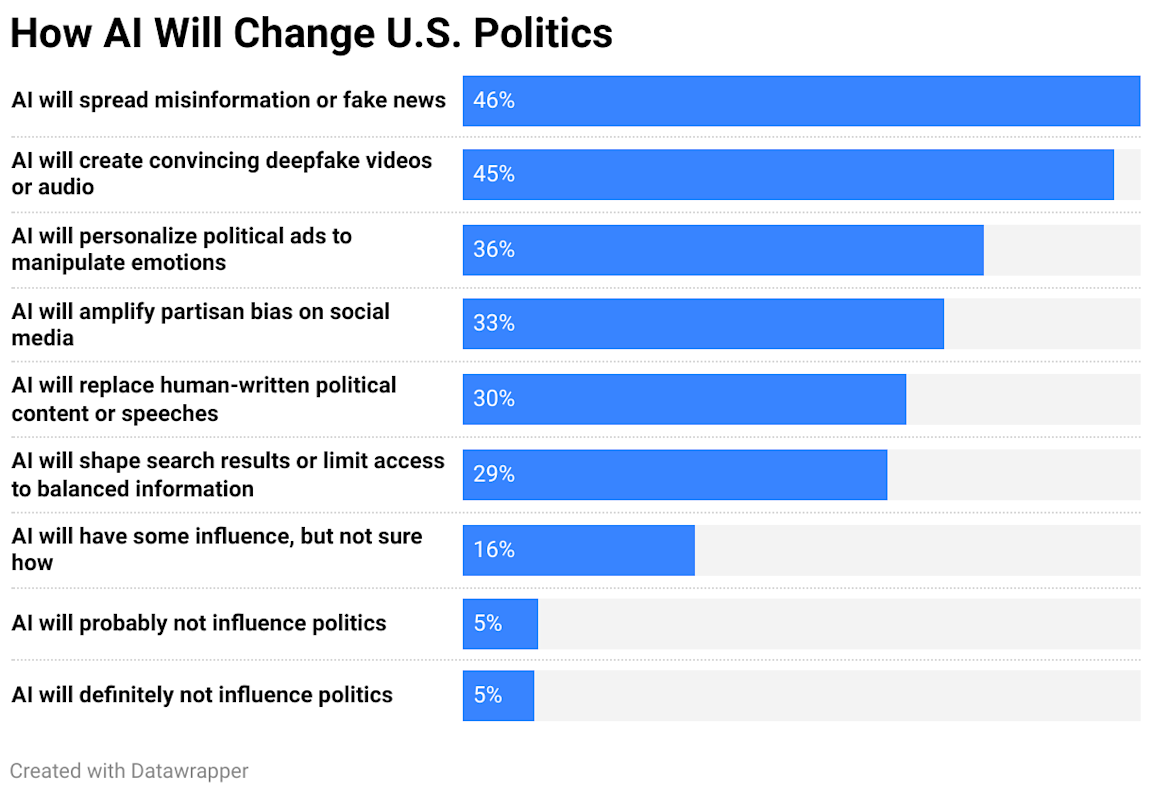
46% worry AI will destabilize elections and flood the internet with fake news.
More than half of Americans (53%) are calling for new laws to curb AI’s environmental impact.
1 in 5 Gen Zers grapple with daily anxiety over AI’s impact on their future careers.
One-third of Americans believe the lack of AI-ready infrastructure could cripple job performance and career growth.
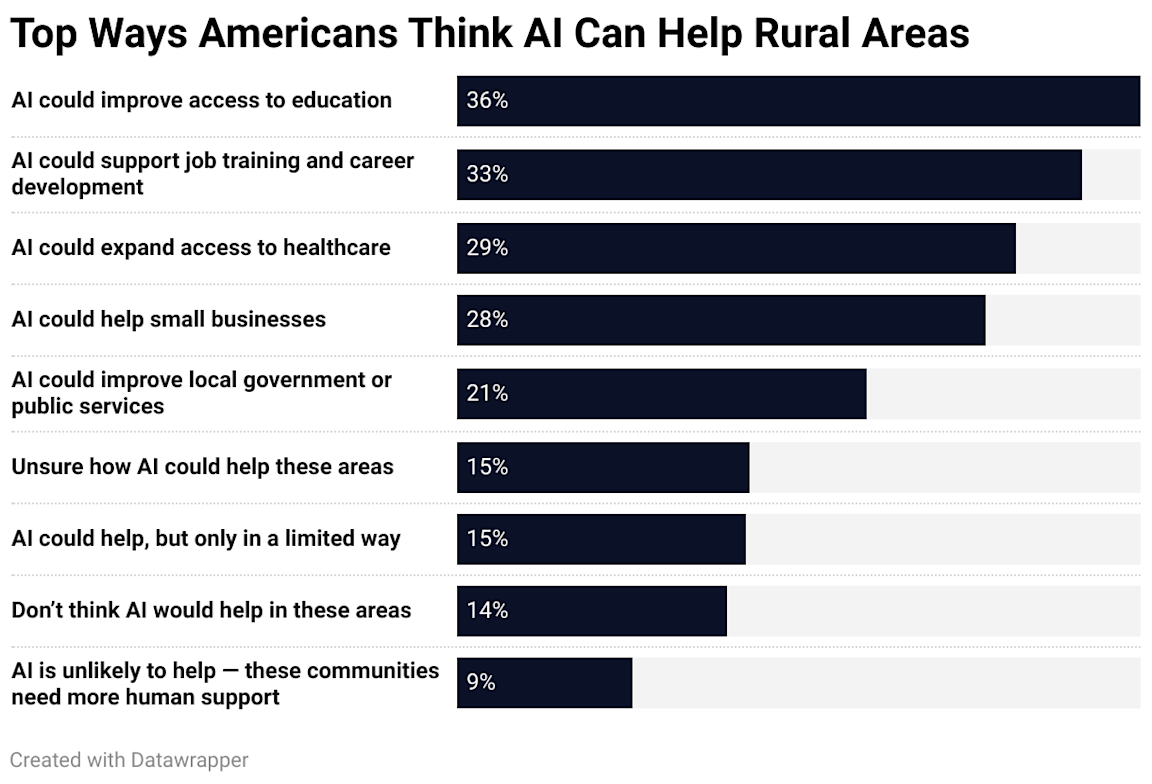
36% say AI could unlock educational opportunities for underserved and rural communities lacking teachers and resources.
Which States Are Leading the Nation in AI Interest?
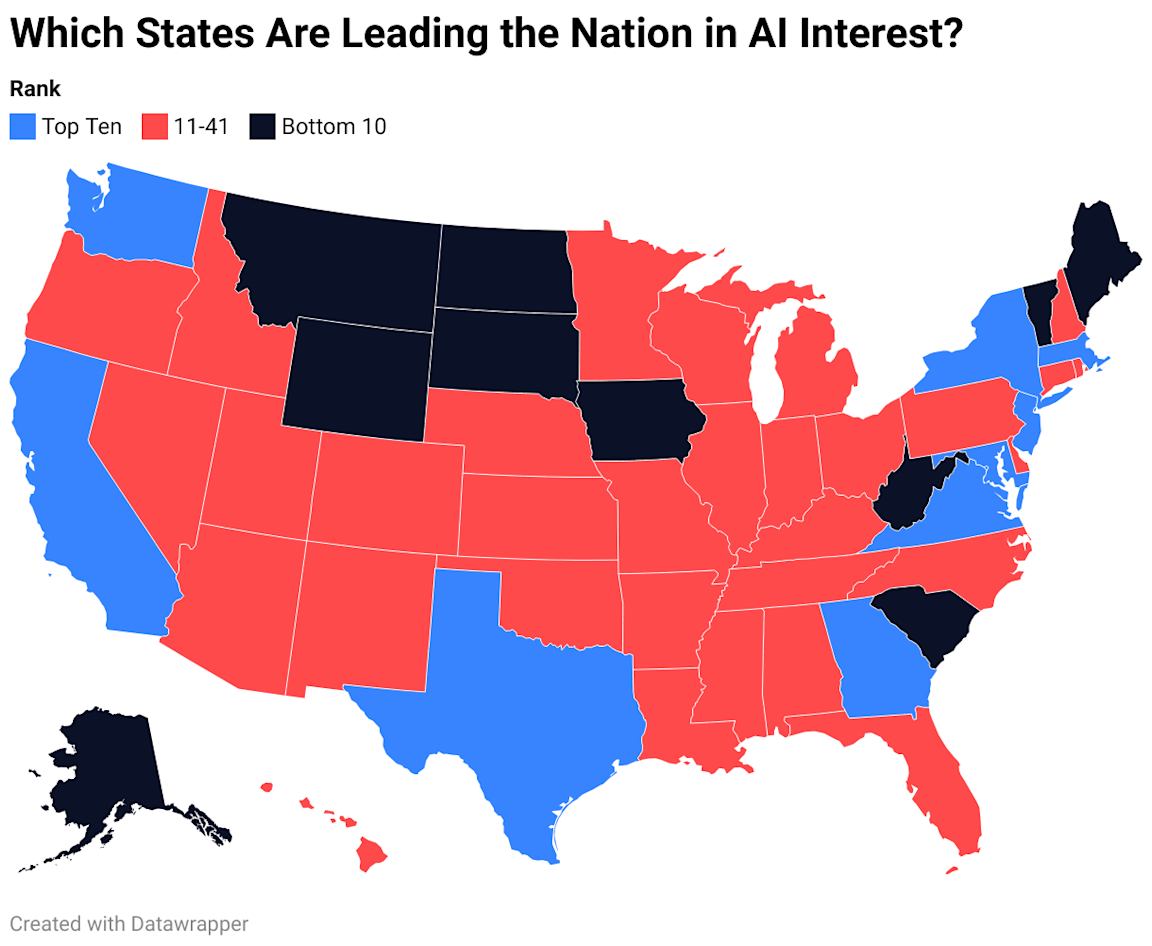
Data centers across the U.S. are working around the clock to process AI queries, but who’s actually fueling this surge in usage? According to Google Trends, interest in tools like ChatGPT varies dramatically across the country, revealing surprising regional hot spots for AI engagement.
Here’s the top 10 states leading the charge in AI engagement based on an AI Interest Index that factors in weighted, regional search data for ChatGPT, artificial intelligence, AI energy consumption, and AI learning.
1. New York - AI Interest Index: 0.9055
New Yorkers lead the nation in AI curiosity, but their focus goes beyond ChatGPT. While other states top the charts for ChatGPT searches, New York dominates in general interest around artificial intelligence and AI learning, scoring a perfect 100 in both.
2. Washington, D.C. - AI Interest Index: 0.7835
D.C. residents are all in on ChatGPT, tying for the top spot in related searches (100). But when it comes to AI’s environmental impact, interest plummets; searches about AI energy consumption didn’t even register.
3. California - AI Interest Index: 0.6255
The Golden State matches D.C. for peak interest in ChatGPT (100), yet trails in broader AI searches (33). Notably, Californians show a strong awareness of AI’s environmental cost, ranking second in AI energy consumption interest (82).
4. Massachusetts - AI Interest Index: 0.622
Bay Staters are enthusiastic ChatGPT users (89), but they stand out most for environmental concern, leading the nation in AI energy consumption searches (100) and earning them a top spot in AI interest.
5. Maryland - AI Interest Index: 0.5995
Maryland punches above its weight with high interest in ChatGPT (90) and AI energy use (70). While its AI learning score (43) trails the frontrunners, it still lands in the second tier.
6. Virginia - AI Interest Index: 0.564
Virginia mirrors neighboring Maryland in AI engagement, scoring 82 for ChatGPT, 66 for energy concerns, and 42 for AI learning, hinting at a possible regional trend.
7. New Jersey - AI Interest Index: 0.5625
The Garden State shows steady interest across the board: 91 for ChatGPT, 74 for AI energy consumption, and 39 for AI learning.
8. Washington - AI Interest Index: 0.5175
Could progressive politics shape AI awareness? Washington, a Democratic stronghold, shows high concern for AI energy consumption (74) and strong interest in ChatGPT (83).
9. Georgia - AI Interest Index: 0.495
Outside of California and D.C., Georgia ranks highest in ChatGPT interest (95). But when it comes to broader AI awareness, the state lags behind the leaders.
10. Texas - AI Interest Index: 0.491
Texas lags slightly behind the top tier of states in terms of interest in ChatGPT (87). Despite its status as a major state for the oil industry, Texans show surprisingly little interest in AI’s energy consumption (41).
Which States Couldn’t Care Less About AI Development?
Not every state is racing toward an AI-powered future. Based on Google Trends data and our AI Interest Index, these 10 states are the least engaged, starting with the lowest ranking.
1. Montana - AI Interest Index: 0.2315
Montana takes the bottom spot overall. While its ChatGPT interest isn’t the lowest (50), it ranks dead last for artificial intelligence searches (14) and, like many in the bottom 10, shows zero interest in AI energy consumption.
2. West Virginia - AI Interest Index: 0.241
This state shows the weakest interest in ChatGPT nationwide (45) and nearly the lowest for general AI (19). Its modest AI learning score (20) lifts it just above the very bottom.
3. Wyoming - AI Interest Index: 0.2625
Wyoming falls behind in both ChatGPT (48) and artificial intelligence (24). It ranks last in the country for AI learning interest, scoring just 15.
4. Alaska - AI Interest Index: 0.279
Tech stakeholders often champion AI as a tool to provide insights and basic support services to rural areas. That hasn’t done much to spark Alaska’s interest in AI-related searches (53 for ChatGPT, 21 for artificial intelligence, and 24 for AI learning).
5. Maine - AI Interest Index: 0.282
Despite Northeastern states occupying some of the top spots on the AI interest index, Maine is near the bottom, scoring just 54 for ChatGPT, 21 for AI, and 24 for learning. Like all states in the bottom 10, there is zero interest here in AI energy consumption.
6. Iowa - AI Interest Index: 0.2865
Iowa starts a mint-trend of less-populated Midwestern states with much interest in ChatGPT (56), artificial intelligence (21), or AI learning (24).
7. South Dakota - AI Interest Index: 0.291
South Dakota is yet another rural state with little interest in AI, outside of ChatGPT (57).
8. Vermont - AI Interest Index: 0.2935
Like Maine, Vermont underperforms in general AI interest (22) and ChatGPT (53), but posts a slightly stronger score (31) in AI learning.
9. South Carolina - AI Interest Index: 0.2965
South Carolina ranks slightly above the bottom tier of states in terms of interest in ChatGPT (58) and AI learning (23).
10. North Dakota - AI Interest Index: 0.307
Rounding out the bottom 10, North Dakota has the highest ChatGPT interest (62) of this group, but still struggles with broader engagement.
AI Tools Are a Daily Staple for 1 in 3 Americans
AI has become woven into daily life, with 35% of Americans now turning to ChatGPT, image generators, or smart tools like Siri and Alexa every single day. For some, it’s just asking a smart speaker a quick question. For others, AI powers multiple aspects of their routine. Here's how often Americans rely on AI:
17% use AI tools daily for less than an hour.
11% use them for one to three hours a day.
7% use AI for more than three hours.
It’s no surprise that older Americans remain the outliers, embracing AI at a much slower pace than younger generations:
Baby boomers: 41% have never used it, while 20% use it daily.
Gen X: 23% never, 31% daily;
Millennials: 13% never, 51% daily;
Gen Z: 9% never, 53% daily.
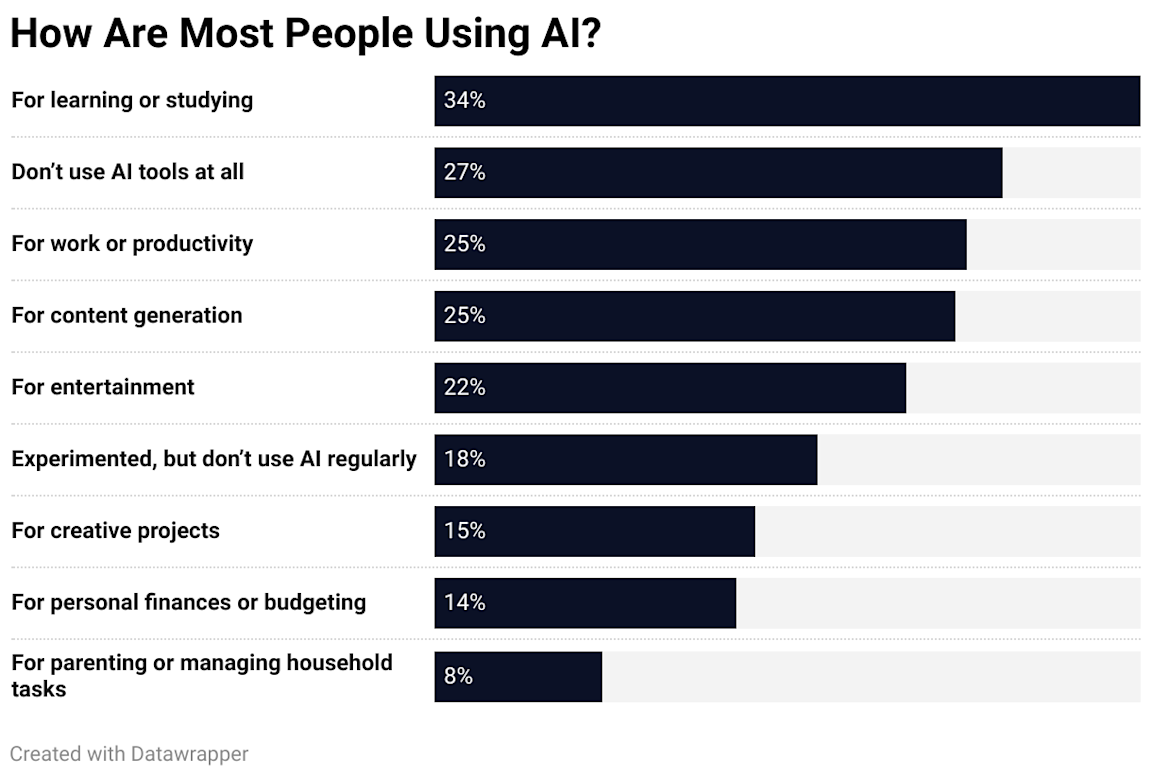
But AI usage isn’t one-size-fits-all. Some are using it to generate art and memes, while others rely on it for productivity, work, and study. From fun to functional, here’s how Americans are really using AI day to day.
Some are pushing the limits of creativity, turning to AI for even bolder and wilder requests:
Nearly 1 in 5 (18%) have used AI to win an argument.
13% are using AI to turn up the charm in their dating messages.
10% have outsourced naming a pet or baby.
8% have created a companion: a friend or significant other.
5% are using AI to “chat” with a religious figure.
If AI could perform any task flawlessly, Americans might outsource even more assignments. Here's what people are willing to offload to a perfectly reliable AI solution.
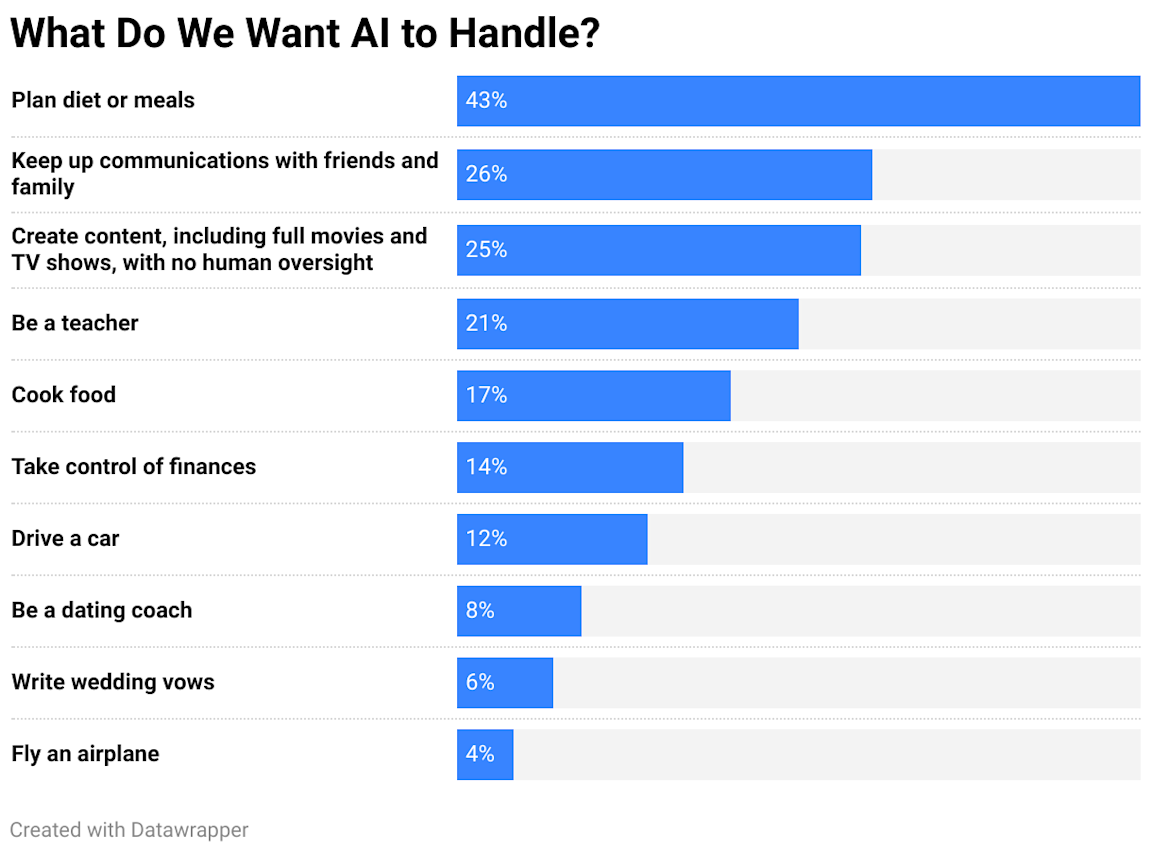
When it comes to using a fully optimized AI tool, Gen Zers are first in line. Nearly half of Gen Z — 47% — would trust AI for diet and meal planning, and 29% would trust it as a teacher. 1 in 5 would even be okay with AI tools driving their car, which is more than double the number of baby boomers (9%) who would say the same. Nearly 1 in 10 would even trust AI to write their wedding vows.
Continuously optimize your network
Does AI Have the Power To Improve Quality of Life in America?
So, is AI actually making life better, or is it just a tool for entertainment and homework shortcuts? 29% say AI has made life easier, and losing it would be disruptive. And for 1 in 10, that disruption would be extreme.
This number jumps for younger Americans. For almost half of Gen Z (48%), losing access to AI tools on which they rely would be a major disturbance. 42% of millennials say the same.
One reason losing access to AI tools would be so disruptive is their growing role in daily learning. Many Americans now depend on AI to grasp new concepts and make sense of complex topics.
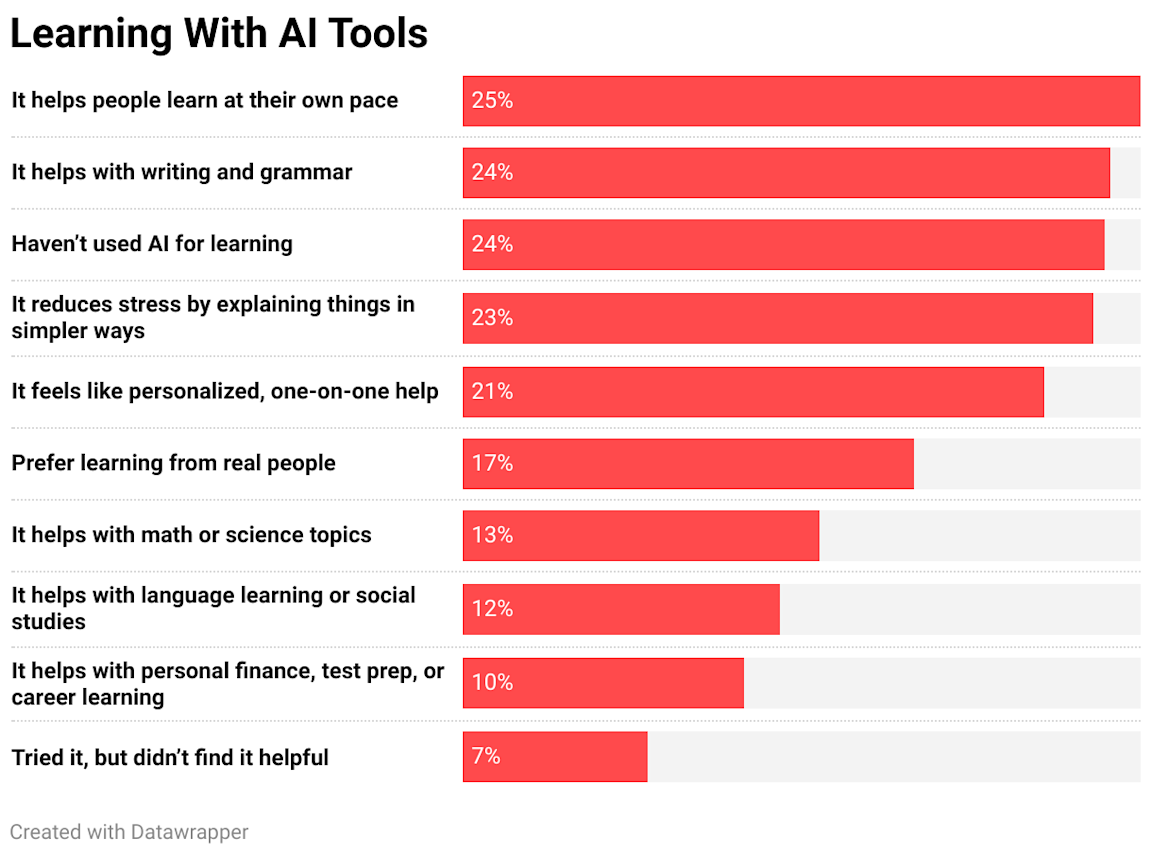
Nearly 2 in 5 Gen Zers say AI reduces stress by explaining things in simpler ways, and it provides better one-on-one help than traditional learning (38% and 37% respectively). Similarly, 35% of millennials say AI tools help them learn at their own pace.
They’re not alone either; many Americans see AI as the answer to support underserved communities with limited resources, particularly in education.
81% of Americans Worry About the Rapid Rise of AI
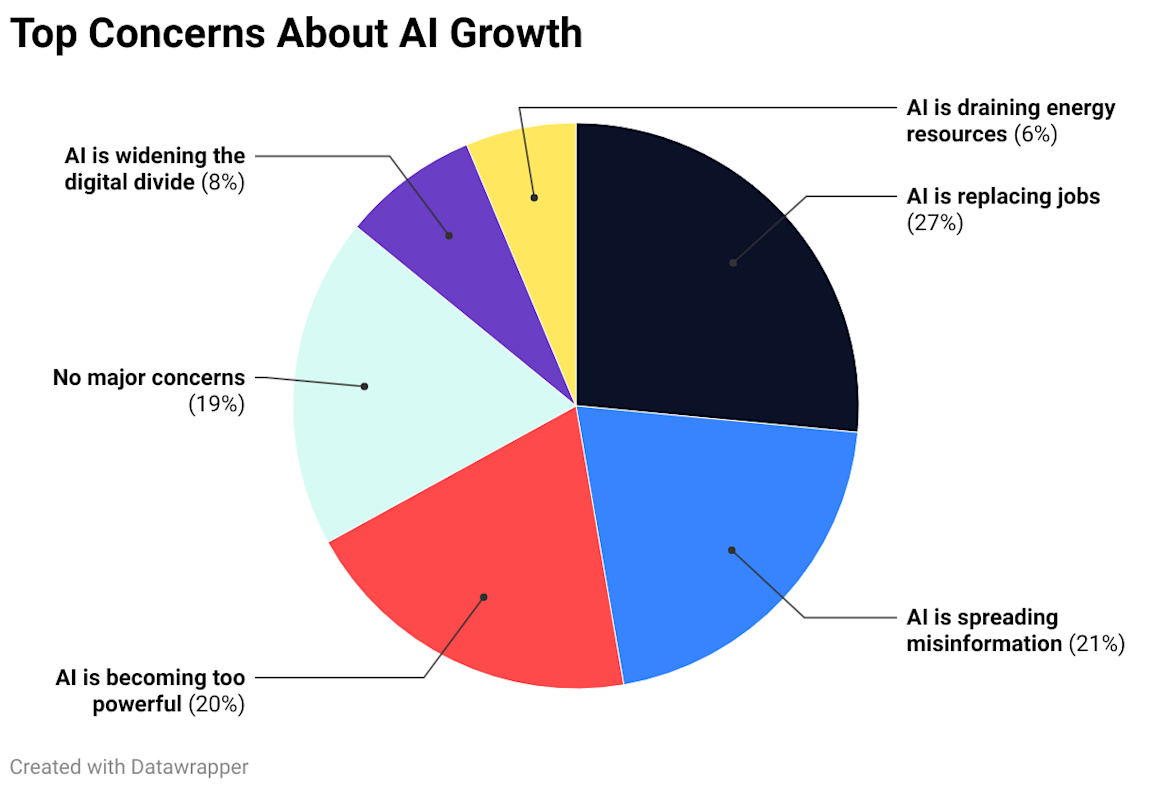
Despite its widespread adoption, AI is also fueling a wave of anxiety and concerns. Roughly 81% have at least one major hesitation about the technology's rapid rise. The top fear? Job loss.
The Job Market
Even with its many benefits, AI’s impact on the job market strikes a nerve, with 70% of Americans saying the technology will hurt employment in the U.S.
24% think it will create jobs at first, but cause long-term damage, and 46% believe it’s going to eliminate jobs, both in the short term and in the long run.
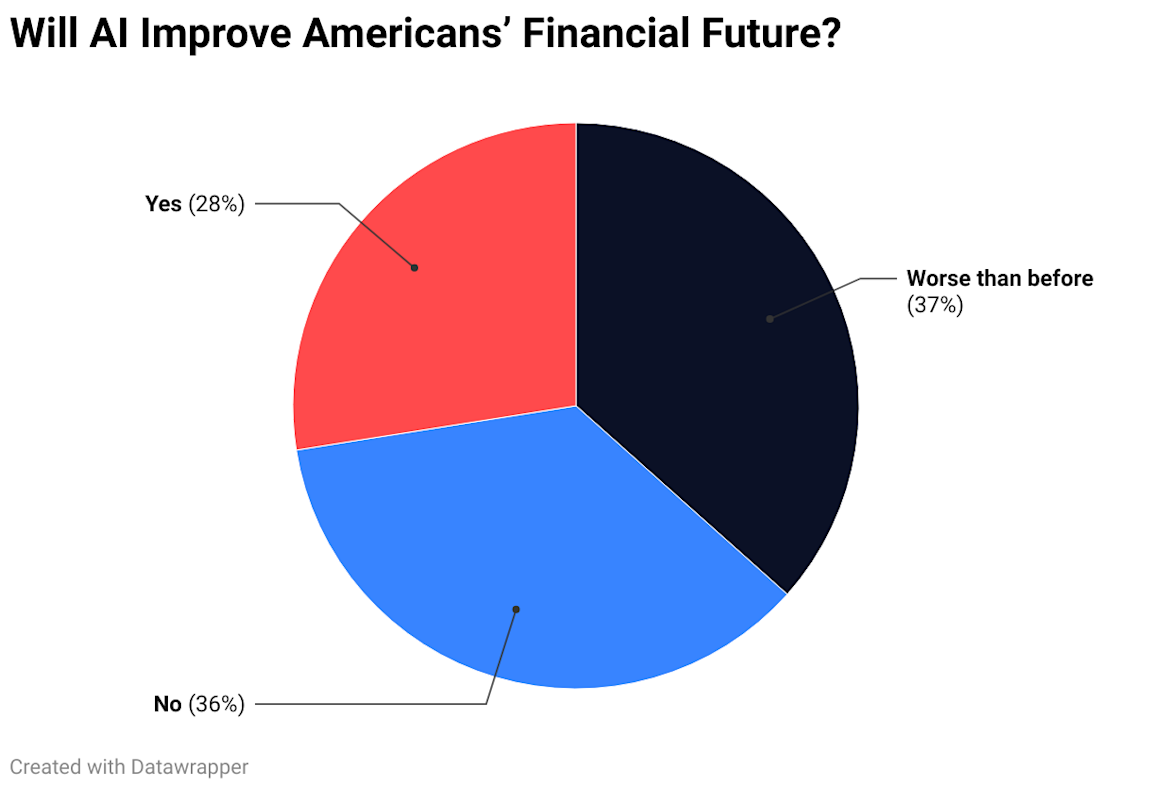
So, at the end of the day, do any Americans expect to earn more money and be better off financially because of AI?
That said, AI isn’t yet a top source of stress for most Americans — possibly because there’s no shortage of other worries competing for attention.
51% rarely feel anxious about AI-driven unemployment.
29% experience occasional stress about the issue.
Only 8% worry about it weekly.
12% experience daily stress over a jobless future.
For Gen Z, though, the fear hits harder: 1 in 5 experience daily anxiety about the possibility of AI taking their job.
Since most people aren’t worried about AI daily, the majority of workers aren’t upskilling with AI either. Only 1 in 10 are actively upskilling to stay competitive or get promoted in their field. 24% are training with AI but not for job-related reasons.
Again, Gen Zers seem to be the most proactive or simply motivated in this sphere. 67% are actively learning AI skills, and 44% have seen a financial or career boost by putting those skills to use.
The extent of these gains is rather limited, though. Only 14% of workers have seen a raise in their paycheck due to AI-related skills, with most being between $100-$250 extra per paycheck.
So, at the end of the day, it’s understandable why many workers are hesitant to upskill on AI. Over half of Americans — 51% — believe big corporations are going to benefit the most from AI and don’t see their effort being directly tied to their own gain.
Misinformation and Personal Data
76% of Americans worry that AI tools are collecting or misusing their personal information.
But the issue goes beyond individual privacy. At a broader level, Americans are alarmed by AI’s potential to fuel misinformation and deepfakes, especially when it comes to influencing U.S. elections and shaping political beliefs.
Environmental Impacts
AI — and the data centers behind it — is giving some Americans pause in terms of its environmental footprint. Among those aware of the issue, only 1 in 8 say they’re comfortable with the energy and water demands of AI. The rest are concerned, uncertain, or unaware, signaling a clear need for greater transparency, public education, and policy action.
Nearly 1 in 5 Americans believe AI’s environmental demands are a serious problem.
30% admit they’ve never even considered the issue.
The heavy demand for electricity and water raises a critical question: Who’s responsible for managing the resources needed to support AI’s rapid rise?
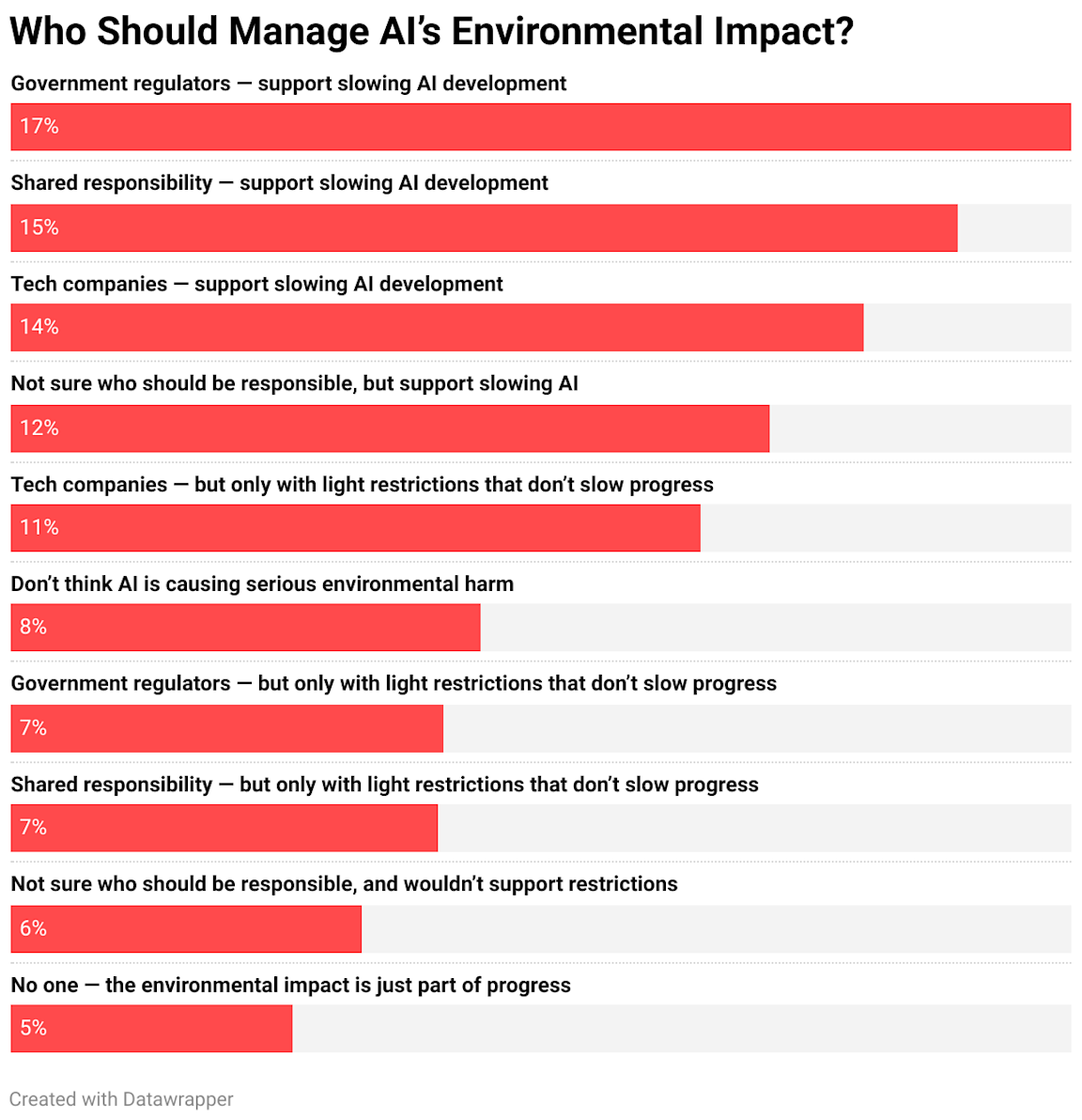
Does this mean people support more regulation in the industry? Yes, but opinions vary:
53% want government regulation to protect the environment.
34% say “maybe,” depending on the tradeoffs.
Only 13% oppose environmental protections altogether.
Younger Americans are much more supportive of environmental regulations for AI — 62% of Gen Zers and 57% of millennials want new lawsThough when it comes to who should take the lead, Americans are divided: 1 in 4 think the tech industry should take the lead, and another 25% say government regulators are best able to address the problems. 22% support shared responsibility between authorities and industry stakeholders.
That said, reform is in high demand as 48% of Americans don’t think that the environmental impact of AI is being taken seriously by those in power.
And while opinions on leadership vary, one message is clear: people want to slow things down.
43% say we should pause AI development to better understand its long-term impacts.
17% think we’ve already gone too far and need strict limits now.
Infrastructure
The issue of infrastructure brings real concerns to Americans, as 1 in 4 believe their state or area isn’t ready to handle the demands that increased AI usage brings.
For 1 in 5 Americans, inadequate AI infrastructure is a dealbreaker; they’d consider moving if their area can’t keep up. That urgency is even higher among Gen Z: 43% say they’d relocate if their region lacked the bandwidth, energy, or speed needed to support AI innovation.
Is this a real concern or just a misunderstanding of the technology? Data centers do need powerful internet connections and security in addition to electricity. Solutions like colocation data centers, where companies and other users buy server space rather than operating their own centers, can make AI operations more efficient.
To properly support the development of AI, reliable internet is a must for businesses and consumers alike. However, these centers have the resources to optimize AI operations to everyone’s benefit.
AI is no longer a distant concept. It's a daily reality reshaping how Americans work, learn, and connect. As public awareness grows, so does the demand for thoughtful regulation, clearer leadership, and smarter integration. The road ahead is uncertain, but one thing is clear: Americans want a future with AI that’s not just powerful, but responsible.
Methodology
This article draws on two data sources. First, we analyzed Google Trends to track AI-related energy use and interest across all 50 states, helping us rank state-level engagement with tools like ChatGPT and identify usage patterns.
Next, we surveyed 1,000 Americans from a mix of generations, income levels, and regions to understand how they use AI, what they know about it, and what concerns they have as AI becomes more embedded in daily life. The survey covered everything from entertainment and personal use to work and education, offering a broad, in-depth view of how Americans are experiencing and evaluating the rise of AI.
Fair Use Policy
Users are welcome to use the analyses and findings from this study for noncommercial purposes, such as academic research, educational presentations, and personal reference. However, when referencing or citing this article, please ensure proper attribution. Direct linking to this article is permissible and encouraged to provide readers with access to the primary source.
For commercial use or publication purposes — including but not limited to media outlets, websites, and promotional materials — please contact the authors for permission and licensing details. We appreciate your respect for intellectual property rights and adherence to ethical citation practices. Thank you for your interest in our research.
Featured Articles
Want to learn more about how Lightyear can help you?
Let us show you the product and discuss specifics on how it might be helpful.
Stay up to date on our product, straight to your inbox every month.