How to Do an Effective Telecom Expense Audit [Step-by-Step]
Discover how to slash telecom / ISP costs with our proven step-by-step audit process. Learn where you’re wasting money and how to optimize your expenses.

May 7, 2025
SHARE
Automate the telecom lifecycle
Get better quotes, launch sites faster, keep inventory accurate, and control spend.
It's Monday morning, and you're staring at an ISP invoice that somehow increased by 10% over last month. Nothing has changed with your services — at least nothing you authorized. Now you need to explain to your CFO how you'll cut telecom expenses by 15% before the next fiscal year.
This scenario frustrates many IT professionals. You're caught between unexpected cost increases and intense budget pressure from leadership.
Telecom services are notoriously complex. Vendors rarely share detailed breakdowns, and invoices often contain complex line items that require significant time to audit properly.
This step-by-step guide offers a straightforward solution. It breaks down exactly how to conduct a thorough telecom expense audit that uncovers hidden costs and eliminates unused services so you can negotiate better rates with your vendors.
At the end, we'll also show you how a solution like Lightyear can help you spend less time on telecom management while significantly reducing telecom costs.
1. Create a Comprehensive Network Inventory
Start by listing every telecom service your organization uses. This inventory gives you a clear view of what you're actually paying for.
Document all services across locations, including internet (dedicated circuits as well as broadband), voice (UCaaS, CCaaS, VoIP, SIP / PRI, etc.), WAN (SD-WAN, MPLS, ethernet private lines, wavelengths, etc.), and colocation. For each service, collect:
Vendor information (ISP, support contacts, account IDs, circuit IDs)
Contract details (addresses, start/end dates, notice periods, costs, terms, SLAs)
Technical specifications (bandwidth, transport, static IPs)
Additional information (managed equipment, special requirements)
Next, match each service to its invoice and contract. This cross-referencing process can reveal inactive services you're still getting billed for, such as circuits at vacated locations or phone lines for former employees.
Store all this information in a central database or spreadsheet so you can access it quickly during negotiations or budget discussions.
2. Analyze Your Contracts
With your inventory ready, examine what you're actually paying for by:
Gathering all telecom contracts and agreements across vendors
Noting expiration dates and auto-renewal clauses
Documenting early termination fees and penalties
Comparing contracted rates against actual billed amounts
Identify renegotiation opportunities, even mid-contract
Pay special attention to renewal notification windows, as the telecom industry thrives on auto-renewals. Vendors know that if you miss your window (typically 60-90 days before end date), they've secured another year of revenue at potentially inflated rates.
Even mid-contract, you often have leverage to improve contract terms if you're willing to extend the agreement or consolidate services. Discrepancies between contracted rates and actual bills are surprisingly common and can lead to immediate cost recovery.
3. Scrutinize Your Invoices
Now comes the detective work that often yields the quickest wins. Analyzing invoices often reveals immediate, significant cost savings opportunities that help you satisfy your CFO without affecting service delivery.
Collect 6 to 12 months of invoices for all services. This establishes a historical view and allows you to spot trends, identify irregular charges, and set a baseline for normal monthly expenses.
Create a tracking spreadsheet by service type and location to make patterns and anomalies more visible. Visualizing your data often reveals problems that might otherwise go unnoticed.
Look specifically for terminated services that are still appearing on your bill. Many organizations continue paying for phone lines or data services for employees who left months or even years ago.
Check that one-time charges match actual service changes you approved. Carriers rarely volunteer refunds for billing errors, so you have to proactively address overcharges.
4. Shop Your Rates Around
Telecom pricing varies significantly among customers, even for identical services. But you don't have to accept annual price increases without question.
Take these steps to benchmark your rates:
Research current market rates for similar services and volumes
Request quotes from alternative providers
Identify which of your services exceed market rates
Calculate potential savings from switching or renegotiating
Look for direct (Type 1) versus resold (Type 2) access to minimize markups. Knowing who is on net at your location can save you money but requires software or special knowledge to do so.
Understanding dedicated internet access pricing trends can also reveal significant savings. A dedicated 1Gbps connection that cost $1,500 monthly three years ago might be available for $800-900 today due to increased competition.
Telecom pricing typically decreases over time as infrastructure costs are amortized and competition increases. If your rates have been steadily climbing instead, you're likely overpaying — which means a bulk re-shopping strategy is essential.
Pro Tip: One way IT professionals get around the endless cycle of sales calls to shop pricing is to use a telecom agent or aggregator. However, be aware that most of these consultants have a limited number of relationships, harming their ability to serve global companies. On the other hand, Lightyear has access to 1,200+ vendors for all telecom services. With Lightyear, you leverage the industry's most current and robust dataset to receive the most exhaustive set of bids at the best prices every single time.
5. Estimate Potential Savings and Prioritize Optimization
Transform your audit findings into a strategic plan that delivers both immediate and long-term savings.
Document each cost-saving opportunity with specific amounts. Include current monthly costs, proposed new costs, and annual savings for each item. This detailed approach helps you gain support for more complex changes.
Instead of general statements about potential savings, show exact figures. For example: "Consolidating our DIA circuits from three carriers down to two will save approximately $187,000 annually while improving redundancy."
Prioritize your opportunities by savings potential and implementation difficulty. Some changes, like terminating unused services or correcting billing errors, deliver immediate savings with minimal disruption. Others, like migrating to new providers, offer larger long-term savings but require more resources and carry potential transition risks.
Develop a realistic implementation timeline that accounts for notice periods, installation delays, and your business calendar. Avoid network changes during your busiest seasons to minimize disruption.
Continuously optimize your network
6. Negotiate with Current Vendors and/or Implement New Services
Now put your findings to work through strategic vendor discussions and careful implementation planning. This is where preparation meets execution — and where many telecom expense management initiatives succeed or fail.
Contract Negotiation
Schedule review meetings with your current providers. Approach these conversations as business discussions rather than complaints. Vendors respond better when they see a chance to maintain or grow their relationship with you. For them, keeping an existing customer is almost always more profitable than acquiring a new one.
Prepare specific, data-driven negotiation points. Instead of general complaints about high costs, present concrete examples: "We're paying $1,200 monthly for this dedicated internet circuit, but recent quotes show market rates around $850 for the same bandwidth." This forces the carrier to respond with facts rather than vague assurances.
Request immediate removal of unauthorized or unused services. For active services, negotiate rate reductions based on competitive quotes you've received from other vendors. Consider consolidating services with fewer vendors for volume discounts.
Network Change Implementation Planning
When planning network changes, document these internet and WAN circuit implementation factors:
Record MPOE (Minimum Point of Entry) locations for all buildings
Define demarcation points where provider responsibility ends
Identify any extended demarcation needs for your equipment
Confirm equipment compatibility with current handoff types
Establish whether services will use Type 1 or Type 2 delivery models
Secure Rights of Entry approvals for installation work
Circuit installations rarely proceed without issues, so build buffer time and contingency plans into your timeline. The vendor's standard install interval often extends once you factor in permit delays, construction complications, and scheduling conflicts. Create a transition plan for maintaining service continuity during implementation, including fallback procedures.
Make sure to budget realistically for one-time costs like demarcation fees, cabling, and specialized installation requirements. Installation offers that initially appear to have no cost might not include construction charges to bring fiber to your building, or extended demarc fees to connect from the entry point to your network closet.
7. Lay Out a Plan to Improve Policies
Preventing future telecom expense bloat by addressing the root causes of telecom cost creep.
Create or update telecom usage policies for employees that clearly outline expectations, limitations, and consequences. This includes rules for international calling, personal use of company devices, and approved service levels. Having clear, documented policies provides a foundation for addressing special requests outside standard allowances.
Develop structured approval processes for new services and equipment that require proper business justification and proper sign-off. Without these guardrails, departments often procure redundant or unnecessary services that increase costs without a corresponding business value. Many service requests become less urgent when they require formal justification.
Pay special attention to employee changes. When someone leaves, their services should be immediately canceled. The savings from proper offboarding alone can be substantial.
8. Implement Ongoing Monitoring
Telecom expense management should be a continuous process, not a one-time project. The savings you've worked hard to achieve can quickly erode without consistent oversight.
Begin by establishing these monitoring systems:
Schedule monthly or quarterly invoice and usage pattern reviews
Create calendar alerts for contract renewal dates
Assign specific ownership of telecom expense oversight
Include telecom management in formal job responsibilities
When reviewing invoices, look beyond just paying bills. Track actual expenses against budgets, investigate unusual charges, and verify that negotiated rates appear correctly on invoices. Carriers often gradually increase rates through miscellaneous fees and surcharges.
Most telecom contracts require 60-90 days' notice to avoid auto-renewal. Start the renegotiation or provider evaluation process 6 to 9 months before expiration for maximum leverage. This gives you time to evaluate alternatives, conduct a mini-RFP if needed, and implement new service before the old one expires.
Assign telecom oversight to a specific person with the time and tools to do it properly. Without clear accountability, telecom management falls between departments until costs spiral out of control.
There’s an Easier Way to Manage and Reduce Your Telecom Expenses
While you can do all this work on your own, there's ultimately a better way. Managing telecom expenses doesn't have to mean maintaining messy spreadsheets, calling countless vendors for price comparisons, or tracking dozens of telecom invoices each month.
In fact, a comprehensive telecom audit is a core part of the onboarding process with Lightyear's Network Inventory Manager and Bill Consolidation products. This establishes a clean baseline and creates immediate value from day one of implementing our telecom expense management software.
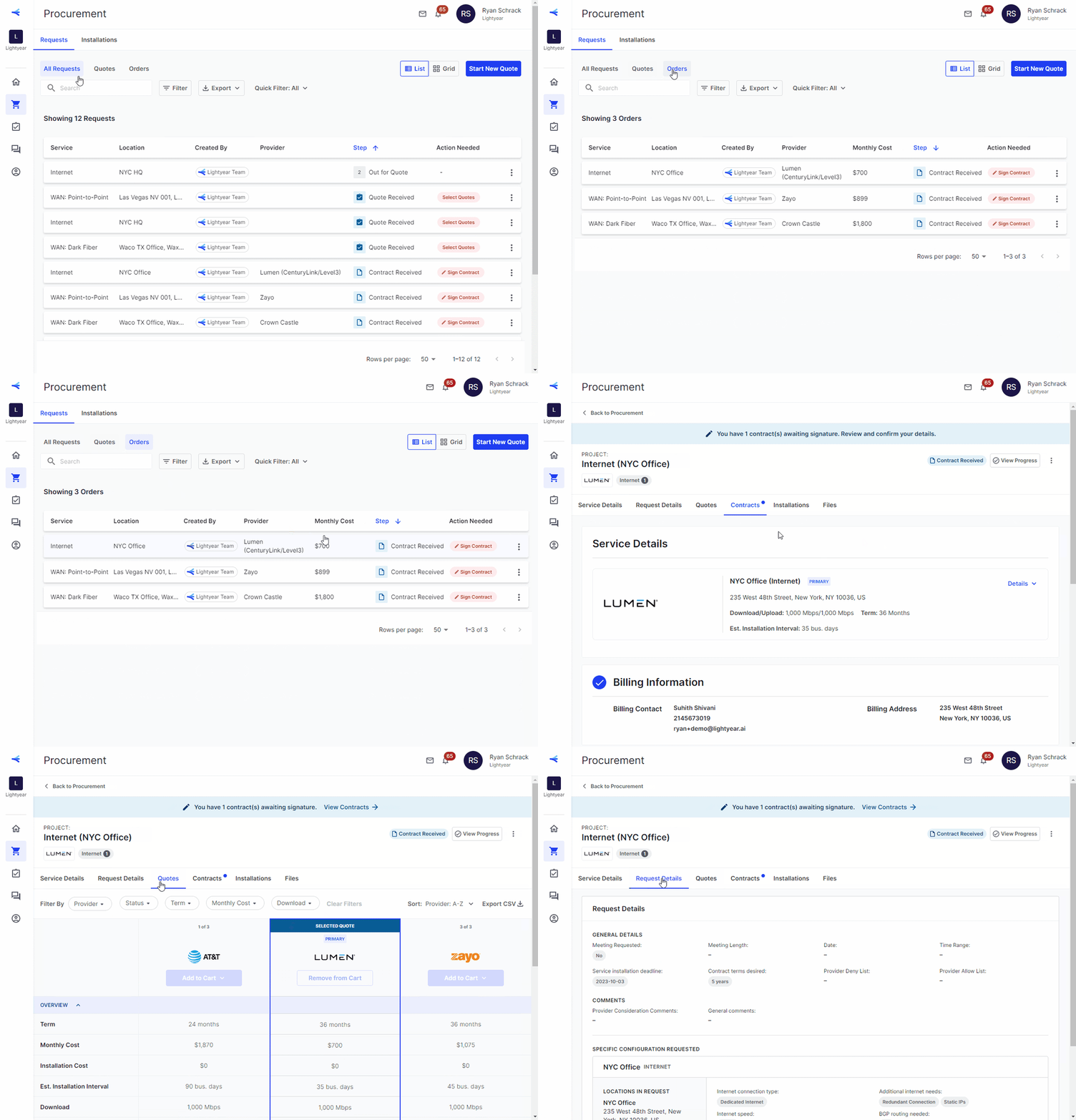
Lightyear’s Procurement platform automates RFP creation, quoting, install management, and more for internet, WAN, voice, and colocation services, significantly reducing time spent on procurement. Our network intelligence and pricing data ensures you select the optimal solution at the lowest cost.
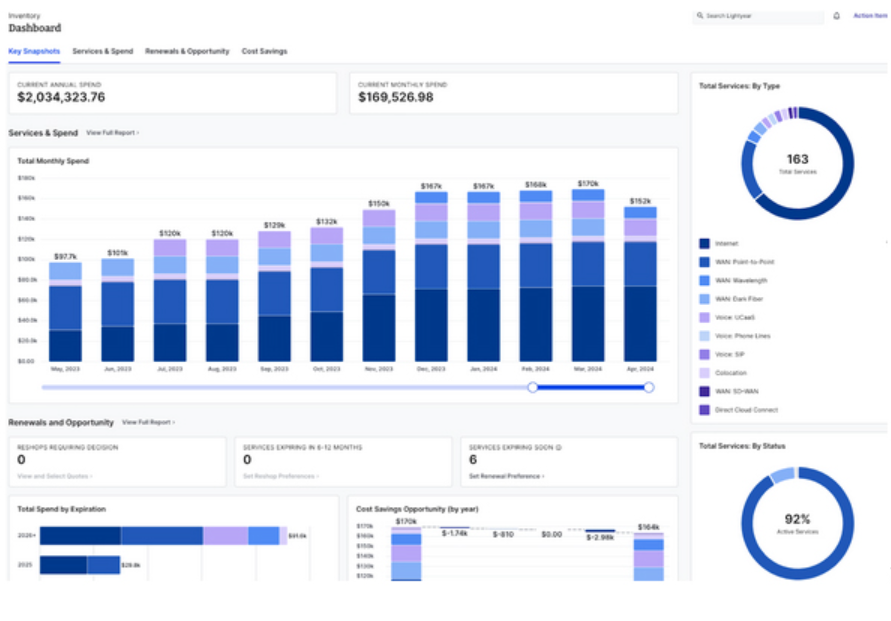
Our Network Inventory Manager creates a digital system of record for your entire telecom estate, tracking over 30 data points per service including static IPs, contract details, and account IDs. It also automates lifecycle management workflows such as MACD ticketing and renewal re-shopping.
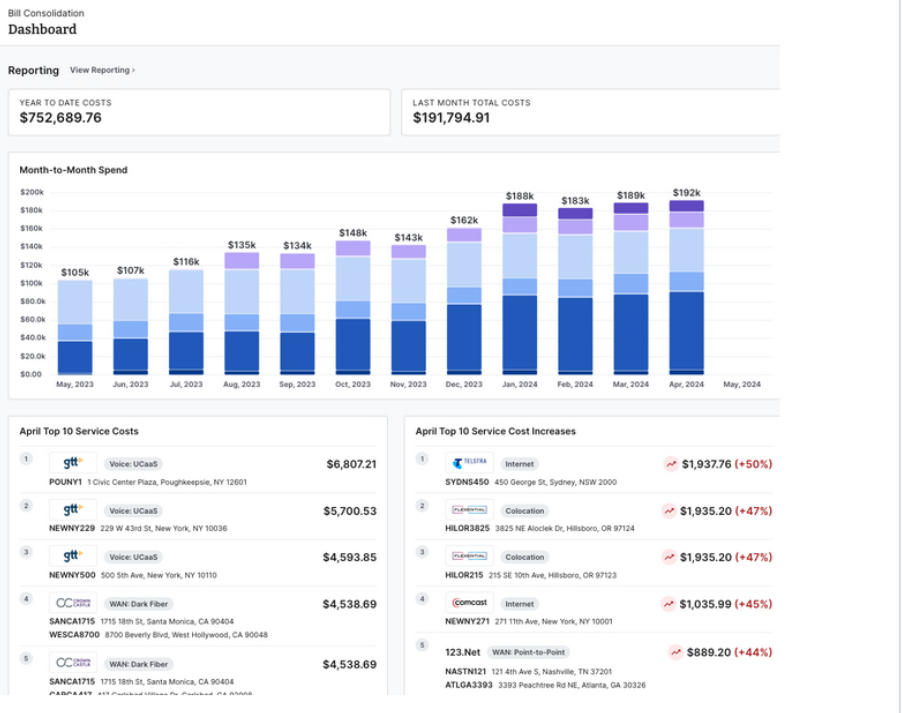
And with Bill Consolidation, you receive one consolidated statement for all telecom services. This eliminates the headache of tracking multiple invoices and handling individual audits while avoiding service disruptions.
Enterprises that leverage Lightyear across the full telecom lifecycle spend exponentially less time on telecom management while reducing costs significantly.
Automate your enterprise telecom lifecycle with software that leverages the best network and pricing intelligence on the market. Learn more about Lightyear here.
Featured Articles
Want to learn more about how Lightyear can help you?
Let us show you the product and discuss specifics on how it might be helpful.
Stay up to date on our product, straight to your inbox every month.