A Free Network Bandwidth Capacity Planning Spreadsheet
Plan your network growth confidently using our free bandwidth calculator spreadsheet with built-in formulas and usage scenarios.

Dec 23, 2025
SHARE
Automate the telecom lifecycle
Get better quotes, launch sites faster, keep inventory accurate, and control spend.
Most IT professionals know their network will eventually hit capacity limits, but predicting exactly when that happens creates a frustrating catch-22. You need concrete data to justify increased spending, yet by the time utilization problems become obvious to leadership, angry team members and system slowdowns have already damaged productivity.
We've seen countless IT teams struggle here. They know their network is "fine" today, but have no way to predict when it won't be. Good luck convincing executives that a $50K upgrade isn't just wishful thinking when you don't have concrete data to back it up.
This post shares a detailed bandwidth capacity planning spreadsheet that forecasts future needs based on user growth and application demands. You'll get the documentation and visuals needed to build compelling business cases for network investments. Of course, beyond bandwidth, other ISP metrics matter like packet loss, latency, and jitter.
We'll also show you the easiest way to automate your capacity planning and establish a digital system of record for all your telecom services.
Network Bandwidth Capacity Planning Spreadsheet [Free Download]
We’ve put together a network bandwidth capacity planning spreadsheet.
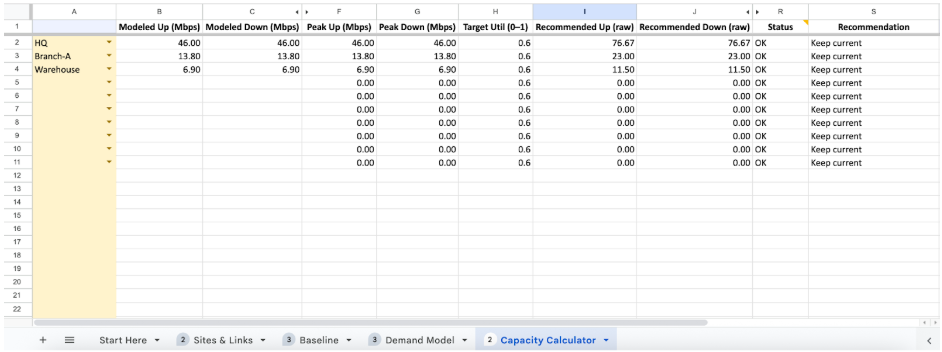
This sheet gives you a clear view of how much bandwidth each site actually needs. It turns a few key inputs (user counts, app mix, optional measured peaks) into modeled up/down demand, factors in protocol overhead, applies your target utilization, and then maps the result to common circuit tiers. You also get headroom at a glance and a simple OK/UPGRADE call so the next step is obvious.
Big picture, it helps you sanity-check vendor quotes, plan upgrades, and explain decisions to stakeholders. It works even if your monitoring is light, and it can fold in baseline data when you have it so recommendations stay grounded in reality.
With it, you’ll be able to answer questions like:
“Are our links big enough in the busy hour?”
“What tier should we order next?”
“How does adding more video/VoIP change the size?”
Continuously optimize your network
What You’ll Find in This Template
Sites & Links: Add each site’s users, current circuit speeds (up/down), and provider. Set your target utilization (default 60%) and headroom alert (default 20%).
Baseline (optional): Paste real metrics—avg and 95th percentile Mbps (up/down). Don’t have them? Skip it; the model still works.
Simple Demand Model: Estimate traffic with editable defaults + concurrency: Web/SaaS, VoIP (G.711), HD video, and File/Backup (enter GB/day and window to auto-calc Mbps). Includes 15% overhead for VPN/TLS. Outputs modeled up/down demand per site.
Capacity Calculator: Converts demand into right-sized links: Recommended capacity (Demand ÷ Target Util), rounded tier (100/200/500/1000/2000 Mbps), headroom %, and an upgrade flag when headroom falls below your alert.
A Better Way to Plan and Manage Your Networks
While capacity planning templates help you forecast bandwidth needs, they're only one piece of the puzzle. Static planning documents can quickly become outdated as your usage patterns change.
They also don't help you optimize the business side of your telecom services like ensuring you're getting competitive pricing, managing contract renewals before costly auto-renewals kick in, or consolidating multiple carrier relationships to reduce administrative overhead.
This is where a platform like Lightyear can help.
Lightyear helps you automate your telecom lifecycle with data-driven software, driving savings across procurement, inventory management, and bill payment.
Trusted by hundreds of enterprises, Lightyear:
Automates network RFPs and get the best pricing: Need to buy a new circuit to meet needs? Create your RFP digitally and Lightyear compile the best quotes for your needs!
Digitizes your system of record: Lightyear will organize an accurate digital record of every network service, vendor, and cost in your footprint, providing you fingertip access to 30+ data points per service and custom visualizations of your network.
Automates contract renewals and rebids: Gain transparency into contract details such as end dates, notice periods, and price escalations, with continuous cost optimization driven by automated re-bidding prior to any contract expirations. With Lightyear, you leverage over 1,000 vendor integrations and the industry’s most current and robust dataset to receive the most thorough set of bids at the best prices every single time.
Streamlines service management workflows: Open MACD, billing issue, and SLA breach tickets across all vendors behind a single pane of glass and let Lightyear handle the rest. Create custom reports to analyze costs, services, locations, vendors, and much more in just a few clicks.
Achieve continuous ROI: Fulsome network visibility, automated rebids, annual telecom expense audits, and efficient issue resolution will help you optimize network costs continuously (well in excess of industry deflation) and save a majority of the time you’d spend on tedious networking workflows.
Eliminate the headache of tracking and paying invoices: Consolidate telecom invoices into a single monthly bill to simplify work for your IT / finance teams, avoid service disruptions, and audit ISP billing.
Featured Articles
Want to learn more about how Lightyear can help you?
Let us show you the product and discuss specifics on how it might be helpful.
Stay up to date on our product, straight to your inbox every month.