AT&T Business vs Cox Communications: Which ISP Is Better?
Choosing between AT&T and Cox for your business internet? We compare their fiber and coax offerings, pricing, and SLAs to help you decide.


Choosing a business internet service provider is a major decision. Two of the most prominent names you'll encounter are AT&T Business and Cox Communications.
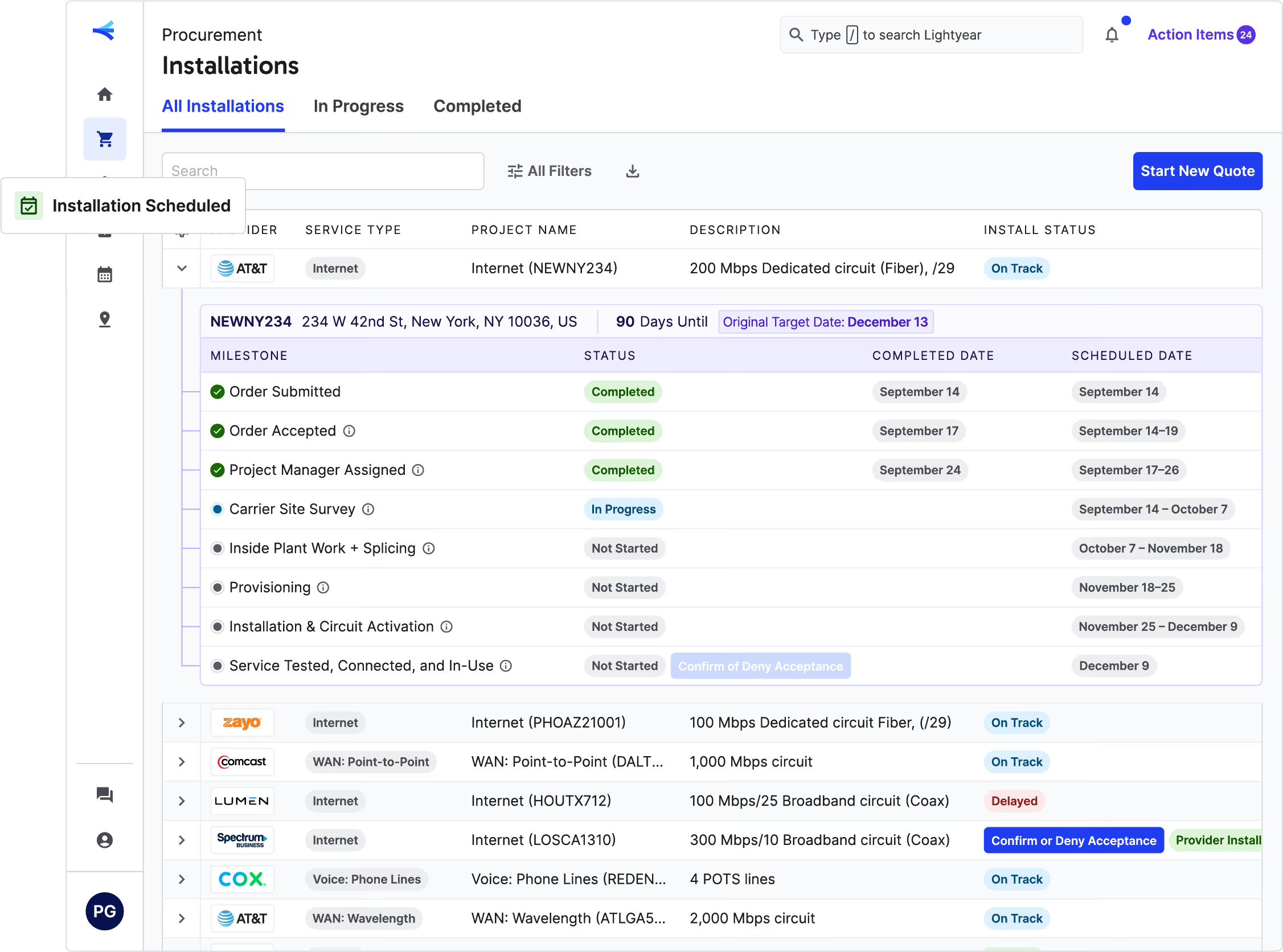
To help you determine which provider is the right fit for your company, we're comparing them head-to-head. Our analysis is powered by Lightyear's proprietary data, which includes aggregated benchmarks from over 70,000 real-world ISP quotes.
This gives us a unique view into key factors like pricing, installation timelines, and service delivery points. Keep reading for our detailed comparison, or if you're ready to explore provider options, you can begin our questionnaire to receive real-time quotes.
Overview of AT&T Business
AT&T is a well-established player in the telecommunications industry, with roots going back to 1885. Headquartered in Dallas, Texas, the company employs around 150,000 people and holds the 32nd spot on the Fortune 500 list.
Their operations extend globally, serving customers in 46 countries. One of their standout offerings is the AT&T Guarantee, which promises to proactively credit customers for downtime on their wireless and fiber networks.
The company also provides solutions for specific industries, such as healthcare and manufacturing, and places a strong emphasis on network-embedded security.
Overview of Cox Communications
Another major provider in the space is Cox Communications, which was established back in 1962. The company is headquartered in Atlanta, Georgia, and focuses its operations solely within the United States.
Despite its domestic focus, Cox is a significant enterprise with around 20,000 employees. This scale is reflected in its ranking as number 14 on the Fortune 500 list.
ISP Products
Dedicated Internet (DIA)
AT&T's Dedicated Internet and Cox's Business Dedicated Internet both provide symmetrical speeds over fiber, but their network scale and speed options differ. AT&T boasts a massive 1.1 million fiber route miles and offers speeds up to 1 Tbps. In contrast, Cox operates on a 44,000-mile fiber network with top speeds reaching 100 Gbps, and AT&T provides a slightly higher uptime SLA of 99.95% compared to Cox's 99.9%.
Our data shows that Cox typically offers more competitive pricing and faster installation for DIA services. On average, a Cox DIA installation takes 66 days, which is faster than the market average of 77 days. Their pricing also tends to be lower, coming in about 9% below average for 100 Mbps circuits and 10% below for 1 Gbps circuits.
AT&T, on the other hand, generally has longer installation timelines, averaging 89 days. Their DIA pricing is often higher than the market average—by about 8% for 100 Mbps and 27% for 1 Gbps circuits. It's also worth noting their service delivery approach; AT&T typically delivers service to the building's main point of entry (MPOE), while Cox often delivers directly to the customer's suite.
Please note that these are aggregate figures from our data.
Actual installation times and pricing can vary significantly based on your region and the specific DIA configuration you need.
For an exact comparison of AT&T Business, Cox Communications, and other top ISPs for your desired area, we recommend you fill out our questionnaire.
It uses the most comprehensive data set in the industry to provide you with accurate, real-time quotes.
DIA Pricing, Delivery and Install Days Compared
| Metric | AT&T Business | Cox Communications |
|---|---|---|
| 100Mb DIA Price vs Avg | +8% | -9% |
| 1Gb DIA Price vs Avg | +27% | -10% |
| Point of Delivery | MPOE | Suite |
| DIA Install Days | 89 | 66 |
The data in this table comes from Lightyear’s aggregated ISP quotes collected in 2024 and 2025 YTD.
- Install Days: how long it typically takes to deliver service.
- 100Mb Price vs Avg / 1Gb Price vs Avg: shows whether this ISP is cheaper or more expensive than the market average.
- Delivery Point: “Suite” means the ISP delivers service all the way to the company’s server room; “MPOE” means the circuit stops at the building’s minimum point of entry (typically the building's utility basement) and the tenant must handle the inside wiring.
Wireless
AT&T Business has a robust wireless portfolio, while Cox Communications does not currently offer wireless services. This makes the choice straightforward if wireless is a key requirement for your business.
AT&T’s main offerings are its "Internet Air - Standard" and "Internet Air - Premium" plans. These services run on the company's 5G and LTE networks, providing wireless broadband for everything from personal devices to fixed-site base stations.
The network's reach extends across the United States and into parts of Canada and Mexico. As part of its network evolution, AT&T is phasing out its older fixed wireless technology to concentrate on its 5G capabilities, and it provides a Wireless Service Agreement with a high-level SLA for its business customers.
Security
AT&T offers a comprehensive security portfolio with several distinct products. Their AT&T Dynamic Defense service provides proactive threat blocking, while AT&T Active Armor delivers 24/7 internet security that comes included with their business fiber plans. For securing remote workforces, they also provide Secure Service Active Edge, which extends network security to the edge.
Cox Communications, in contrast, focuses its security offerings on the small business segment with its Cox Business Essential Security product. This solution is built around three core functions: defending against cyberattacks, backing up critical files to the cloud, and restoring data to minimize downtime. While effective for its target audience, Cox does not currently offer enterprise-level security solutions comparable to AT&T's suite.
Broadband
AT&T's Business Fiber product delivers symmetrical speeds up to 5 Gbps over a pure fiber network, meaning your upload and download speeds are identical. This is a significant advantage for activities like video conferencing or large file transfers. In contrast, Cox Business Internet uses a Hybrid Fiber-Coax (HFC) network, which results in asymmetrical speeds; while downloads can reach 2 Gbps, uploads are capped at 100 Mbps.
Our data shows that AT&T also tends to be more competitive on installation and pricing. The average install time for AT&T broadband is 18 days, which is much faster than the market average of 28 days. Their pricing is also about 18% lower than average, while Cox's installation time is closer to the market average at 29 days, with pricing that is typically 5% higher.
Both providers offer plans with no data caps, so you don't have to worry about utilization limits. Cox provides a 99.50% uptime SLA for its broadband service, while we were unable to locate a specific uptime SLA for AT&T's business fiber product.
Broadband Pricing, Delivery and Install Days Compared
| Metric | AT&T Business | Cox Communications |
|---|---|---|
| Broadband Install Days | 18 | 29 |
| 500Mb Broadband Price | $130.55 | $166.40 |
| 500Mb Broadband Price vs Avg | -18% | +5% |
| Point of Delivery | MPOE | Suite |
The data in this table comes from Lightyear’s aggregated ISP quotes collected in 2024 and 2025 YTD.
- Install Days: how long it typically takes to deliver service.
- 500mb Price vs Avg: shows whether this ISP is more expensive than the market average.
- Delivery Point: “Suite” means the ISP delivers service all the way to the company’s server room; “MPOE” means the circuit stops at the building’s minimum point of entry (typically the building's utility basement) and the tenant must handle the inside wiring.
Ethernet
Cox Communications provides a dedicated Metro Ethernet service designed for connecting multiple locations. It supports various configurations, including point-to-point, hub-and-spoke, and multipoint, making it a good fit for organizations like school districts or businesses with satellite offices that need to link their sites securely.
AT&T's comparable offering is its Business Fiber product, which delivers high-speed symmetrical connectivity. While not marketed with the same specific Ethernet topologies as Cox, it provides a powerful point-to-point connection with speeds up to 5 Gbps over a pure fiber network.
The choice often depends on your network architecture. Cox's Metro Ethernet is built for businesses that need to create a private network across several sites, offering bandwidth from 1 Mbps to over 10 Gbps. In contrast, AT&T Business Fiber provides a straightforward, high-speed connection for individual locations.
POTS Replacement
AT&T provides a dedicated solution for modernizing legacy phone systems with its Phone for Business – Advanced service. This product is designed to convert analog lines for voice, fax, and point-of-sale terminals to a cloud-based system. It operates over your existing internet connection, regardless of the provider, and includes unlimited domestic calling.
For reliability, the service offers an optional LTE failover and comes with a 24-hour battery backup. It also supports critical specialty lines for fire alarms and elevators, meeting National Fire Protection Association (NFPA) 72 compliance. This makes it a comprehensive option for businesses needing to maintain these essential connections.
Cox Communications, on the other hand, does not publicly offer a comparable POTS replacement product. For companies specifically looking to transition their traditional phone lines to a modern, digital solution, AT&T presents the more direct and feature-rich path forward.
Other Key Features Compared
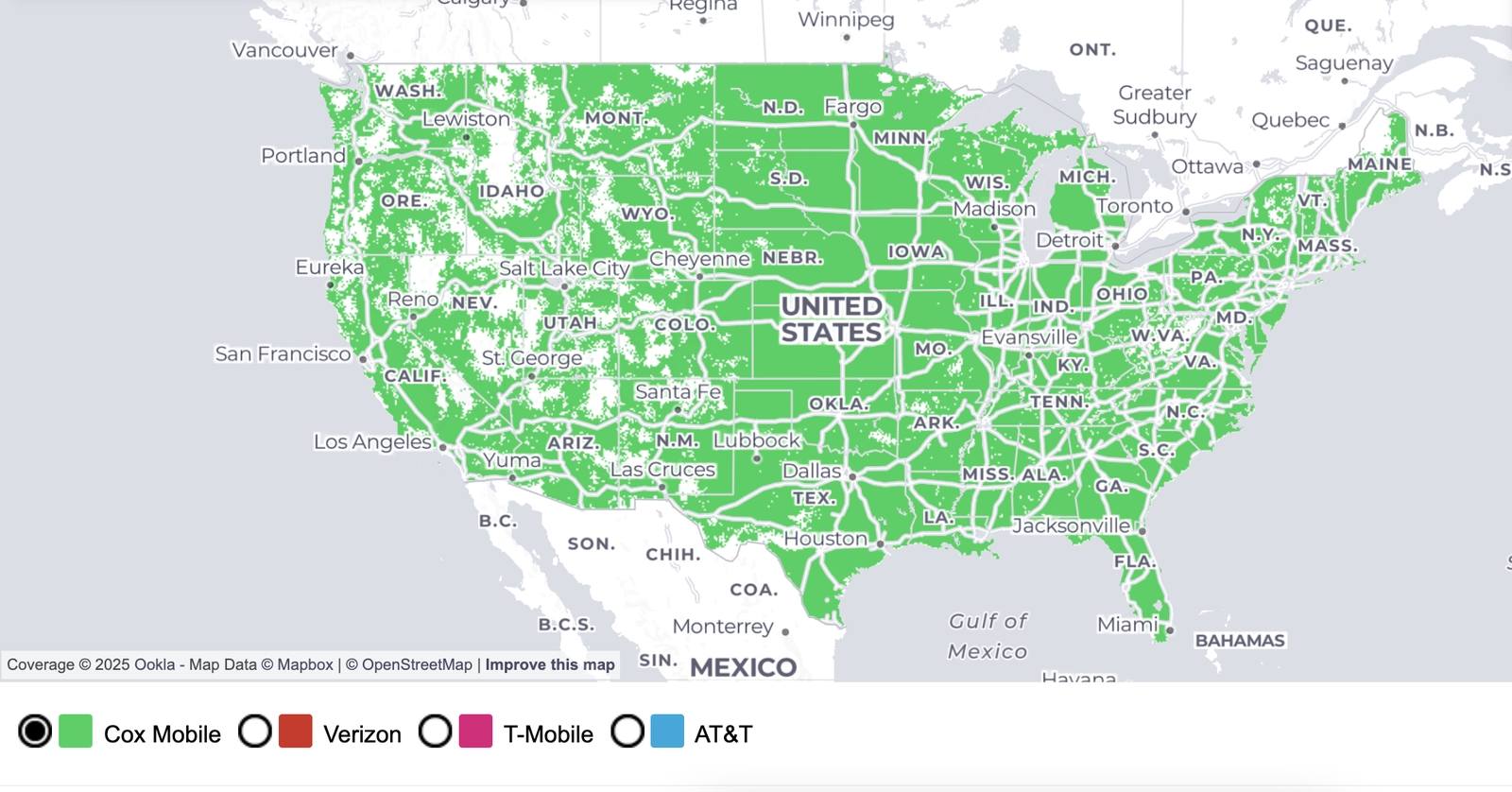
Geographic Coverage
AT&T has a significant global presence, offering services in 46 countries. This makes them a solid choice for businesses that operate internationally or have offices around the world.
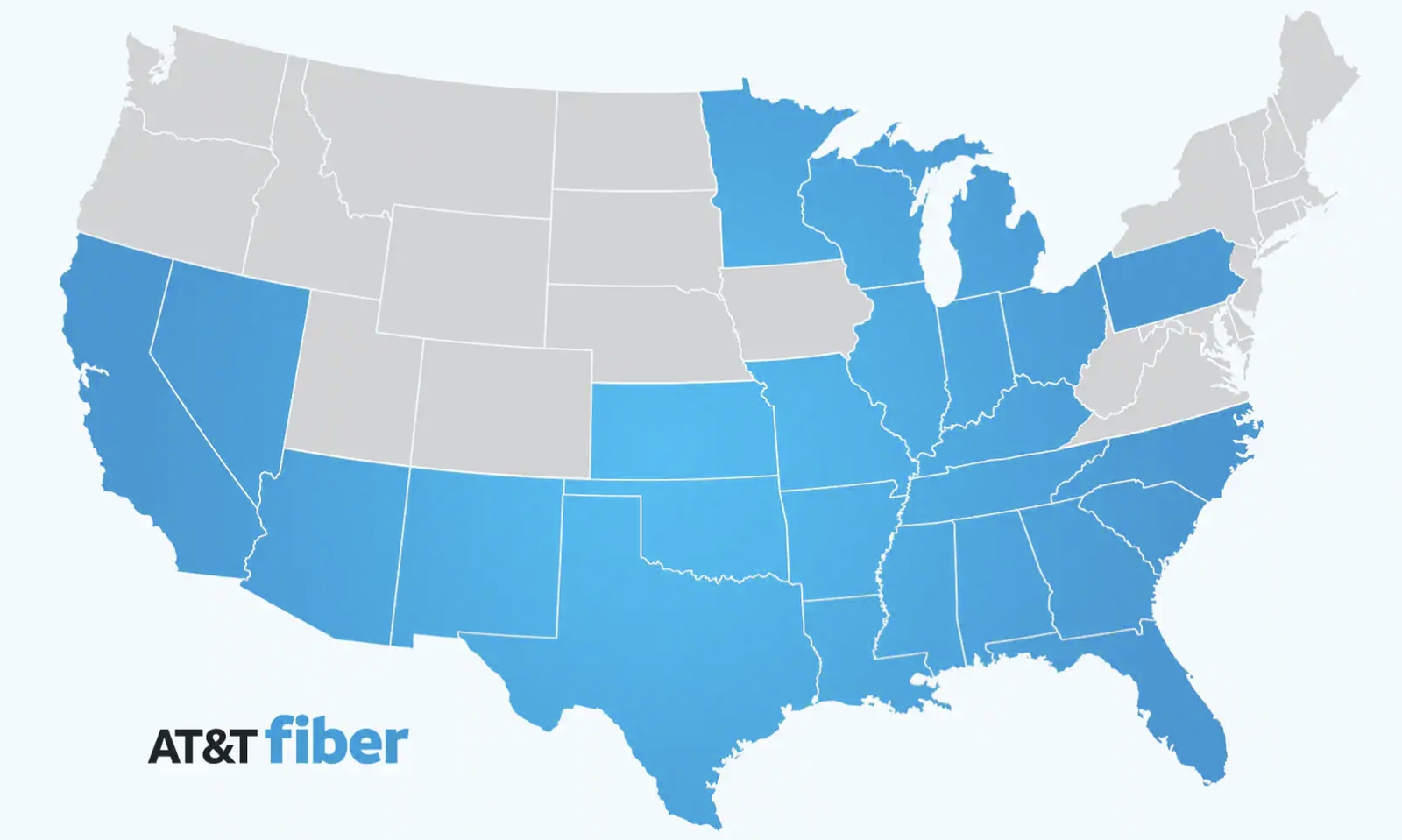
In contrast, Cox Communications concentrates its services exclusively within the United States. This makes them a practical choice for businesses whose operations are entirely domestic.
SLA
Both providers back their services with a Service Level Agreement (SLA), which is an uptime promise. For Dedicated Internet, AT&T guarantees 99.95% uptime, which is slightly higher than Cox's 99.9% guarantee.
In practical terms, AT&T's SLA allows for about 4.4 hours of downtime per year, while Cox's allows for 8.8 hours. Cox also has a 99.5% SLA for its broadband service, which translates to roughly 44 hours of potential downtime annually.
If a provider fails to meet their SLA, you are typically eligible for a credit on your bill, giving you some financial protection against outages.
Transport Types Available
AT&T uses a pure fiber network spanning 1,100,000 route miles. This provides symmetrical speeds, meaning uploads are as fast as downloads, which is great for demanding business tasks.
Cox uses a 44,000-mile Hybrid Fiber-Coax (HFC) network. This offers asymmetrical speeds—fast downloads but slower uploads—which is suitable for general business use like web browsing and email.
Ultimately, AT&T's fiber is built for heavy upload activities like video conferencing, while Cox's HFC network is a solid choice for less intensive internet needs.
Customer Support
AT&T Business offers support through phone, online chat, and a business portal. This gives you different ways to get help when you need it.
Cox Communications also provides support for its business customers through similar channels. Their team is set up to assist with technical and billing questions.
Both providers have large support operations. However, the quality of support can often vary by region and the nature of your issue.
Final Verdict: AT&T Business or Cox Communications?
Choosing between AT&T Business and Cox Communications depends heavily on your company's specific needs, particularly its geographic footprint and technical requirements.
AT&T is generally the better fit for global enterprises or businesses that need symmetrical fiber speeds, wireless services, and a comprehensive security suite.
Cox, on the other hand, is a strong choice for US-based companies. Our data shows they are often more competitive on price and installation speed for dedicated internet, making them a great option for businesses without heavy upload demands.
Ultimately, the right provider is the one that best matches your operational needs and budget. We recommend comparing quotes to make the most informed decision.
To make things even simpler, here’s a quick side-by-side look at how AT&T Business and Cox Communications stack up on the key points we've covered.
| Feature | AT&T Business | Cox Communications |
|---|---|---|
| Best For | Global companies or those needing symmetrical fiber speeds, wireless, and enterprise-grade security. | US-based companies looking for competitive pricing and faster installation on dedicated internet. |
| Geographic Coverage | Operates in 46 countries. | Operates only in the United States. |
| Dedicated Internet (DIA) | Symmetrical speeds up to 1 Tbps. Our data shows pricing is typically higher and installs are longer than average. | Symmetrical speeds up to 100 Gbps. Our data shows pricing is often lower and installs are faster than average. |
| Broadband Internet | Symmetrical fiber with speeds up to 5 Gbps. Typically faster installs and lower pricing. | Asymmetrical HFC with downloads up to 2 Gbps and uploads up to 100 Mbps. |
| Wireless | Offers a full portfolio of 5G and LTE wireless services. | Does not offer wireless services. |
| Security | Provides a comprehensive suite of enterprise-level security products. | Security offerings are focused on the small business segment. |
| POTS Replacement | Offers a dedicated product to modernize analog phone lines for voice, fax, and alarms. | Does not publicly offer a comparable product. |
Choose the Right ISP Today With Lightyear
The right internet service provider is the one that aligns with your specific business requirements, budget, and geographic locations. Evaluating these needs against provider offerings can be a complex process, but our software is designed to give you the data and clarity needed to make a confident choice. We help you move beyond high-level comparisons and get to exact, real-time quotes for your specific locations.
- Automated ISP Procurement: Our platform digitizes the entire RFP process. We use the industry’s largest proprietary dataset to show you best-fit providers and benchmarked rates side-by-side.
- Transparent Pricing & Negotiation: We proactively negotiate quotes on your behalf if they don’t align with our market data, making sure you never overpay for a circuit.
- Human + Software Support: You get a dedicated account representative to oversee installations, escalate support tickets, and manage ongoing changes, so you’re never left to manage carriers on your own.
Instead of spending weeks gathering quotes and comparing providers manually, you can get the information you need in a matter of minutes. If you're ready to find the right services at the right price without the hassle, you can schedule a demo of the Lightyear platform.
Let us show you the product and discuss specifics on how it might be helpful.
Schedule a Demo





Revolutionize Your Telecom Experience
Learn how you can get one step closer to optimal business efficiency for all your telecom services.