AT&T Business vs Spectrum Enterprise: Which ISP Is Better?
Choosing between two major ISPs for your business? We compare AT&T and Spectrum on services, pricing, and reliability to help you decide.


If you’re sourcing business internet, you’ve likely come across AT&T Business and Spectrum Enterprise. As two of the largest providers in the country, deciding between them can be a challenge.
To help you find the right fit, this comparison uses our proprietary data from over 70,000 ISP quotes, covering benchmarks like pricing, installation timelines, and delivery points.
Keep reading for our detailed breakdown. If you're ready to explore provider options now, you can begin our questionnaire to receive real-time quotes.
Overview of AT&T Business
AT&T Business is an established telecommunications provider with a history that dates back to its founding in 1885. Headquartered in Dallas, Texas, the company has a workforce of approximately 150,000 employees.
Reflecting its significant scale, AT&T is ranked 32nd on the Fortune 500 list and operates in 46 countries.
A key aspect of their service is the AT&T Guarantee, which proactively credits customers for downtime on both wireless and fiber networks. The company has also been recognized for customer satisfaction with large enterprise internet service by J.D. Power for eight consecutive years.
Overview of Spectrum Enterprise
Spectrum Enterprise is the business division of Charter Communications, which was founded in 1993. Headquartered in Stamford, Connecticut, the company has 89,000 employees, and its parent company is ranked 76th on the Fortune 500 list. Its services are primarily concentrated within the United States.
A notable aspect of their service is a 100% uptime SLA guarantee on core fiber and ethernet offerings. Spectrum Enterprise also provides solutions tailored by industry and business size, alongside managed services intended to simplify IT operations for customers.
ISP Products
Dedicated Internet (DIA)
AT&T's Dedicated Internet runs on its extensive 1.1 million-mile fiber network, offering speeds from 10 Mbps up to 1 Tbps. Spectrum’s Dedicated Internet Access (DIA) provides speeds from 20 Mbps to 100 Gbps and can be delivered over fiber, coax, or a hybrid fiber-coax connection.
Spectrum offers a slightly higher uptime guarantee with a 99.99% SLA, compared to AT&T's 99.95%. Our data shows Spectrum also installs DIA circuits a bit faster, averaging 73 days, which is just under the 77-day market average. AT&T installations typically take longer, around 89 days.
For pricing on 1Gb circuits, Spectrum tends to be more competitive, with rates 14% below the market average of $1.45 per Mbps, while AT&T's are 27% above. On 100Mb circuits, both providers are priced slightly higher than the market average of $7.80 per Mbps. Both offer a comparable suite of add-ons like managed routers, DDoS mitigation, and cloud connectivity.
Keep in mind that these numbers are aggregate figures. Actual installation times and pricing can vary based on your location and DIA configuration.
To get an exact comparison for your area between AT&T, Spectrum, and other top ISPs, our questionnaire draws from the most comprehensive data set in the industry to provide you with accurate quotes.
DIA Pricing, Delivery and Install Days Compared
The data in this table comes from Lightyear’s aggregated ISP quotes collected in 2024 and 2025 YTD.
- Install Days: how long it typically takes to deliver service.
- 100Mb Price vs Avg / 1Gb Price vs Avg: shows whether this ISP is cheaper or more expensive than the market average.
- Delivery Point: “Suite” means the ISP delivers service all the way to the company’s server room; “MPOE” means the circuit stops at the building’s minimum point of entry (typically the building's utility basement) and the tenant must handle the inside wiring.
Wireless
AT&T Business provides wireless service through its Internet Air product, which runs on its 5G and LTE networks for phones, personal devices, and fixed or mobile base stations. Their coverage extends across the US and into parts of Canada and Mexico, and they include a high-level SLA with their wireless service agreement. You can view AT&T's coverage map, but be aware it leads to their e-commerce site.
Spectrum Enterprise’s offering, Spectrum Mobile, is geared toward phones and personal devices and operates on Verizon's 5G network. A key distinction is that AT&T provides fixed wireless solutions for businesses, while Spectrum does not list a comparable product. We also could not find a public SLA for Spectrum Mobile. Their service is concentrated in the US, and Spectrum's coverage map is also available on their sales site.
Security
AT&T provides a suite of security products to protect business networks. Their Dynamic Defense service is designed for proactive threat blocking, while AT&T Active Armor offers 24/7 security included with their Business Fiber plans. For companies with remote workers, their Secure Service Active Edge product focuses on securing network access points.
Spectrum’s security solutions are segmented by business size. For smaller companies, the Spectrum Business Security Suite provides desktop protection through F-Secure and is included with their business internet service. For larger organizations, Spectrum Enterprise offers a more comprehensive set of managed services, including firewall and threat management solutions built on platforms like Fortinet and Cisco Meraki, cloud security options, and a subscription-based DDoS protection service.
Broadband
AT&T's broadband offering, AT&T Business Fiber, provides symmetrical speeds from 300 Mbps up to 5 Gbps over a full fiber network. In contrast, Spectrum Business Internet runs on a hybrid fiber-coax (HFC) connection, which means its speeds are asymmetrical—up to 1 Gbps for downloads but only 35 Mbps for uploads. Both services come with unlimited data usage.
Looking at our data, pricing is a key difference. Spectrum is significantly more competitive, with rates 43% below the market average, while AT&T is also well-priced at 18% below average. For installation, AT&T is slightly faster, averaging 18 days compared to Spectrum's 26 days; both are quicker than the 28-day market average.
Another important factor is the delivery point. Spectrum delivers service directly to your suite, which can simplify setup. AT&T typically terminates its circuit at the building's MPOE, meaning you may need to handle the internal wiring yourself. Spectrum also includes a 100% uptime SLA, whereas a public SLA for AT&T Business Fiber was not available.
Broadband Pricing, Delivery and Install Days Compared
The data in this table comes from Lightyear’s aggregated ISP quotes collected in 2024 and 2025 YTD.
- Install Days: how long it typically takes to deliver service.
- 500mb Price vs Avg: shows whether this ISP is more expensive than the market average.
- Delivery Point: “Suite” means the ISP delivers service all the way to the company’s server room; “MPOE” means the circuit stops at the building’s minimum point of entry (typically the building's utility basement) and the tenant must handle the inside wiring.
Ethernet
Spectrum Enterprise offers a suite of Ethernet Services designed for building high-performance private networks with speeds up to 100 Gbps. These services are meant to connect multiple business locations or link to data centers. Their offerings include point-to-point (EPL), point-to-multipoint (EVPL), and multipoint-to-multipoint (EP-LAN) configurations to support various WAN architectures.
AT&T’s fiber-based connectivity, by contrast, is centered on its Business Fiber product, which provides symmetrical broadband internet with speeds ranging from 300 Mbps to 5 Gbps. This service is built for direct internet access over a full fiber connection and comes with unlimited data usage. While Spectrum's Ethernet products are geared toward creating private WANs, AT&T's Business Fiber focuses on delivering high-speed internet to a single location.
POTS Replacement
Both AT&T and Spectrum offer solutions to replace traditional analog phone lines (POTS) with a cloud-based voice service. AT&T’s Phone for Business – Advanced and Spectrum’s Business Voice both provide unlimited domestic calling and can run over your existing internet connection, regardless of the provider.
A critical difference lies in their support for specialty lines. AT&T’s service is designed to support fire alarms, security systems, and elevators, and it is compliant with the National Fire Protection Association (NFPA) 72 code. In contrast, Spectrum explicitly prohibits the use of its voice service for fire and medical alarms, making AT&T the viable option for businesses that need to maintain these critical connections.
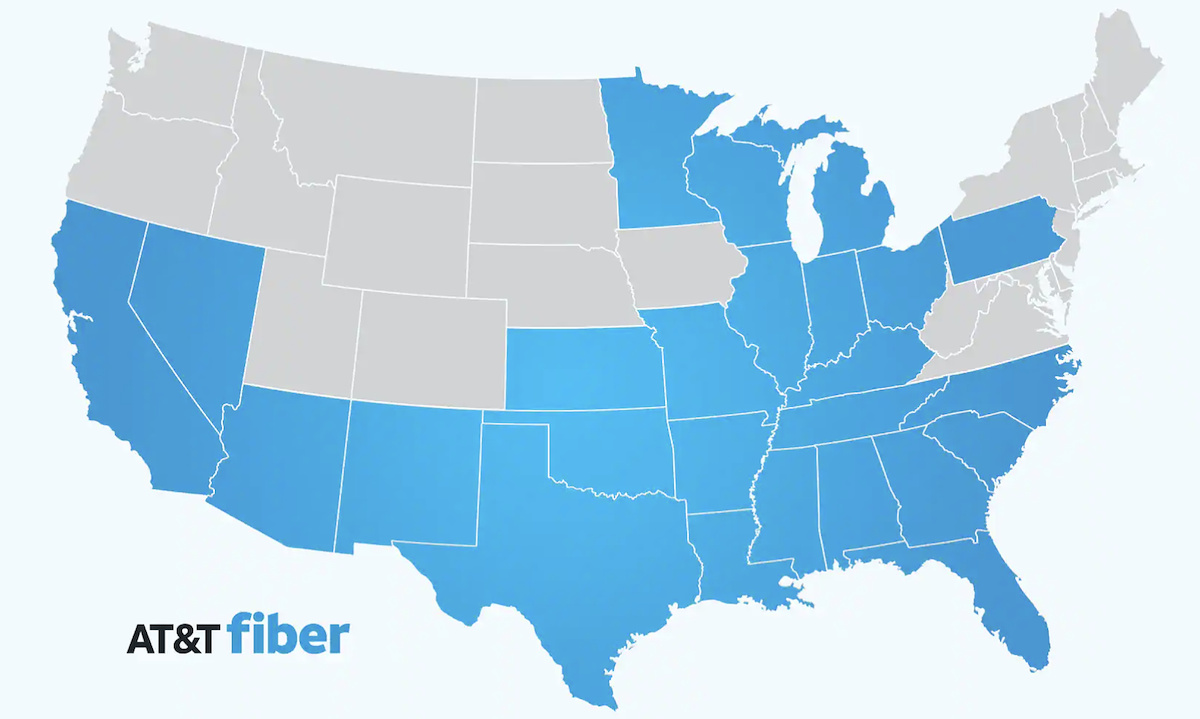
Other key distinctions include battery backup and availability. AT&T provides a 24-hour internal battery backup, significantly longer than Spectrum's 8-hour option. AT&T is also available nationwide in all 50 states, while Spectrum’s service covers 41 states.
Other Key Features Compared
Geographic Coverage
With a presence in 46 countries, AT&T Business offers significant global coverage. This makes them a solid option for companies with international offices needing unified service across multiple regions.
In contrast, Spectrum Enterprise concentrates its services entirely within the United States. This makes them a strong choice for businesses that operate exclusively in the US and don't need international connectivity.
SLA
Spectrum Enterprise offers a 100% uptime guarantee on its core fiber and a 99.99% SLA on DIA. AT&T Business provides a 99.95% SLA for its dedicated internet.
In practical terms, a 99.99% uptime means less than an hour of potential downtime per year. A 99.95% SLA allows for a few hours of downtime annually.
A key feature of the AT&T Guarantee is that it proactively credits your account for any service interruptions, which adds a layer of financial protection.
Transport Types Available
AT&T Business uses a full fiber-optic network covering 1,100,000 route miles. This provides symmetrical speeds, where uploads and downloads are equally fast, which is great for heavy business tasks like large file transfers.
Spectrum Enterprise runs on a hybrid fiber-coax network with 230,000 fiber route miles. This results in asymmetrical speeds—faster downloads than uploads—which works well for general business use like streaming and browsing.
In short, AT&T's all-fiber connection is built for upload-heavy activities, while Spectrum's network is a solid fit for businesses with more typical download needs.
Customer Support
AT&T has a strong record in customer support, earning J.D. Power awards for large enterprise customer satisfaction for eight consecutive years.
Spectrum Enterprise provides support through its managed services, which are designed to help simplify your IT operations.
A notable difference is the AT&T Guarantee, which proactively credits your account for downtime. Spectrum's support is built around its strong SLAs and managed service options.
Final Verdict: AT&T Business or Spectrum Enterprise?
Choosing between AT&T Business and Spectrum Enterprise depends on your company’s specific priorities, including geographic reach, performance needs, and budget.
AT&T is often the better fit for businesses with international locations or those requiring symmetrical fiber speeds for upload-heavy work. Their support for specialty lines also makes them the clear choice for organizations needing to connect fire alarms or elevators.
Spectrum Enterprise generally offers more competitive pricing, making it a strong option for US-based companies focused on cost savings. Their service is well-suited for businesses with typical download needs that value the convenience of in-suite installation.
To find the best fit, we recommend comparing direct quotes for your specific locations, as pricing and availability can vary significantly.
For a quick summary, here’s how AT&T Business and Spectrum Enterprise stack up on the key points we've covered.
Ultimately, the right provider depends on your specific needs. The best way to make a final decision is to see real numbers for your locations. At Lightyear, we can help you source, compare, and manage your telecom services with data-driven insights. Get started with our questionnaire to receive transparent quotes from AT&T, Spectrum, and other top providers in minutes.
Choose the Right ISP Today With Lightyear
Choosing the right ISP is a critical decision that hinges on your specific business needs, from budget to technical requirements. To make the right choice, you need clear, comparable data—not just marketing claims.
Our platform is built to provide exactly that. Instead of manually gathering quotes, Lightyear gives you the tools to compare providers with confidence. We help you:
- Automated Procurement: Compare benchmarked rates from top providers in one place using our automated platform.
- Transparent Negotiation: We proactively negotiate quotes to align with market data, so you can be confident you aren't overpaying.
- Service Breadth: Find all your connectivity options—DIA, broadband, wireless, and more—centralized for easy comparison.
If you're ready to make a data-driven decision for your next telecom purchase, we're here to help. Sign up for a demo to see how Lightyear can work for you.
Let us show you the product and discuss specifics on how it might be helpful.
Schedule a Demo





Revolutionize Your Telecom Experience
Learn how you can get one step closer to optimal business efficiency for all your telecom services.