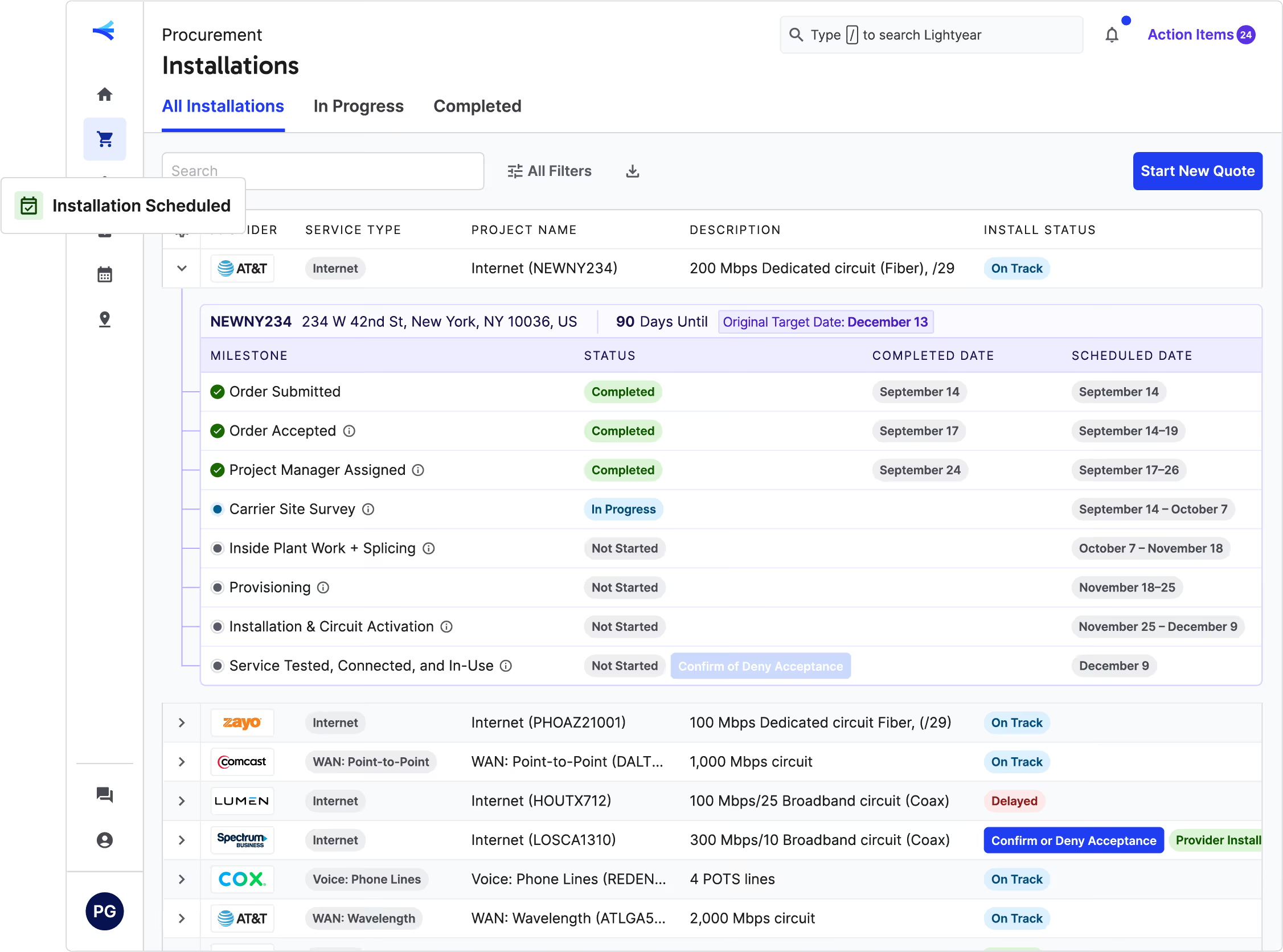
AT&T Business vs Verizon Business: Which ISP Is Better?
Which provider is right for your business? See how two major ISPs stack up on network performance, customer support, and cost.


When selecting a business internet service provider, AT&T Business and Verizon Business are two of the most prominent names you'll encounter. Both offer a wide range of connectivity services for companies of all sizes.
Choosing between them can be a challenge, so we're breaking down how they compare. This guide will help you determine which provider is the right fit for your specific business needs.
Our comparison is informed by Lightyear's proprietary data from over 70,000 real ISP quotes. We analyze key benchmarks like pricing, installation timelines, and service delivery points to give you a clear picture.
Keep reading for our detailed comparison. If you're ready to explore provider options now, you can begin our questionnaire to receive real-time quotes.
Overview of AT&T Business
AT&T Business is a major player in the telecommunications industry, with roots going back to its founding in 1885. Headquartered in Dallas, Texas, the company employs 150,000 people, serves 46 countries, and holds the 32nd spot on the Fortune 500 list.
A key differentiator is the AT&T Guarantee, which provides credits for network outages across its fiber and wireless networks. The company's focus on reliability is also reflected in its eight consecutive J.D. Power awards for customer satisfaction in large enterprise internet service.
Overview of Verizon Business
Verizon Business was founded in 2000 and is headquartered in New York, New York. The company has a significant global presence, with 105,000 employees serving 39 countries and ranking 31st on the Fortune 500 list.
The company differentiates itself by creating offerings for various client types, from small businesses to large enterprises and public sector groups. It also invests in new developments like private 5G networks and AI-powered assistants to support business operations.
ISP Products
Dedicated Internet (DIA)
Both AT&T and Verizon provide fiber-based dedicated internet with a similar suite of add-on services like DDoS mitigation and managed security. AT&T Dedicated Internet offers speeds up to 1 Tbps over its 1.1 million fiber route miles with a 99.95% uptime SLA, while Verizon Dedicated Internet Access provides speeds up to 100 Gbps across 900,000 fiber route miles with a higher 99.99% uptime SLA.
Lightyear's proprietary data shows key differences in pricing and installation. While both providers trend slightly above average for 100 Mbps circuits, Verizon is about 7% less expensive than the market average for 1 Gbps circuits, whereas AT&T is 27% more expensive. Installation timelines for both are also a bit longer than the 77-day industry average for DIA; Verizon averages 80 days, and AT&T averages 89 days.
Of course, these are just aggregate figures. Actual pricing and installation times can vary quite a bit depending on your location and the specific DIA configuration you choose. To get an exact comparison for AT&T Business, Verizon Business, and other top ISPs in your area, we recommend filling out our questionnaire, which uses the most comprehensive dataset in the industry.
DIA Pricing, Delivery and Install Days Compared
The data in this table comes from Lightyear’s aggregated ISP quotes collected in 2024 and 2025 YTD.
- Install Days: how long it typically takes to deliver service.
- 100Mb Price vs Avg / 1Gb Price vs Avg: shows whether this ISP is cheaper or more expensive than the market average.
- Delivery Point: “Suite” means the ISP delivers service all the way to the company’s server room; “MPOE” means the circuit stops at the building’s minimum point of entry (typically the building's utility basement) and the tenant must handle the inside wiring.
Wireless
Both AT&T and Verizon offer robust 5G and LTE wireless services for businesses. Their networks support mobile devices and fixed-site internet through products like AT&T Internet Air and Verizon's 5G Business Internet.
The two providers have similar coverage areas, spanning the US and parts of Canada and Mexico. While both offer a variety of plans, AT&T includes a wireless service agreement with a high-level SLA, a guarantee we did not find publicly available for Verizon's business wireless.
Additionally, both carriers are moving away from older Line of Sight (LOS) fixed wireless technology. They are instead focusing on their expanding 5G networks for fixed wireless access.
Security
AT&T bundles proactive security into its services, with products like AT&T Active Armor providing 24/7 protection that is included with its business fiber plans. For more advanced needs, AT&T Dynamic Defense is a proactive solution that blocks a high percentage of cyber threats, while Secure Service Active Edge focuses on securing remote network access.
Verizon Business offers a much more extensive and granular suite of security products. Their portfolio is built around modern security frameworks like SASE Management and Zero Trust Dynamic Access.
Verizon also provides a wide array of managed services, from DDoS Shield to Managed Detection and Response and Advanced SOC Services. This gives businesses the option to build a highly customized security stack or outsource monitoring to Verizon's teams, a different approach from AT&T's more integrated product bundles.
Broadband
Both providers offer fiber-based broadband internet with unlimited data. AT&T Business Fiber provides symmetrical speeds from 300 Mbps up to 5 Gbps, while Verizon's Fios Internet offers symmetrical speeds from 200 Mbps to 2 Gbps. Verizon also includes a 99.99% uptime guarantee, a detail we couldn't locate for AT&T's broadband service.
Our data shows that both companies install broadband faster than the 28-day industry average, with AT&T averaging 18 days and Verizon 24 days. In terms of cost, AT&T's pricing is about 18% below the market average, and Verizon's is about 5% lower. This makes both providers competitive options for business broadband.
Broadband Pricing, Delivery and Install Days Compared
The data in this table comes from Lightyear’s aggregated ISP quotes collected in 2024 and 2025 YTD.
- Install Days: how long it typically takes to deliver service.
- 500mb Price vs Avg: shows whether this ISP is more expensive than the market average.
- Delivery Point: “Suite” means the ISP delivers service all the way to the company’s server room; “MPOE” means the circuit stops at the building’s minimum point of entry (typically the building's utility basement) and the tenant must handle the inside wiring.
Ethernet
Verizon Business provides a comprehensive suite of Ethernet services, including E-Line for point-to-point connections and E-LAN for more flexible any-to-any network configurations. While specific details on a comparable AT&T Ethernet product weren't provided, Verizon's offerings are designed for businesses needing high-performance, private connectivity between locations.
A key feature of Verizon's service is its use of the shortest available network path to deliver traffic, ensuring efficiency and high performance. Businesses can also opt for a predefined path for predictable latency or a failover path to ensure application delivery during an outage.
In terms of scalability, Verizon offers a wide range of port speeds from 10 Mbps up to 100 Gbps. This is complemented by granular bandwidth increments, allowing companies to tailor their service to exact requirements and grow as needed.
POTS Replacement
AT&T provides a direct solution for replacing traditional phone lines with its Phone for Business – Advanced product. This service converts analog lines for voice, fax, and specialty systems like alarms and elevators to the cloud, using your existing internet connection. For added resilience, it offers optional LTE failover, a 24-hour battery backup, and is NFPA 72 compliant for life safety systems.
Verizon takes a different approach by not offering a dedicated, first-party POTS replacement product. Instead, the company refers customers to partners such as CSG or MarketSpark. These partners provide the solutions needed to handle specialty lines for fax, alarms, and elevators.
Other Key Features Compared
Geographic Coverage
AT&T Business has a wide reach, offering services in 46 countries around the globe. This extensive network helps connect businesses with international operations, providing a consistent service experience across different locations.
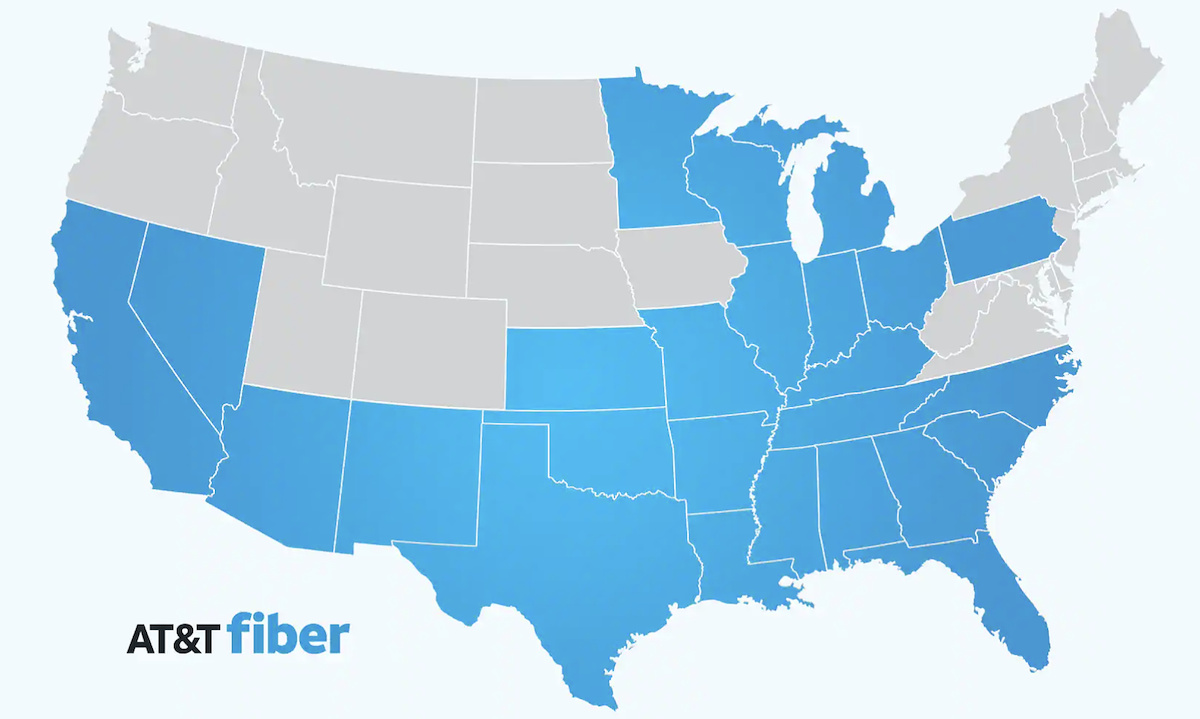
Verizon Business also has a strong international presence, serving businesses in 39 countries.
While its reach is a bit smaller than AT&T's, it still provides substantial global connectivity for many companies.
SLA
Both providers back their services with strong uptime guarantees, known as Service Level Agreements (SLAs). Verizon offers a 99.99% uptime SLA for its dedicated and Fios internet, while AT&T provides a 99.95% SLA for its dedicated internet.
In practical terms, a 99.99% uptime guarantee means you might face up to 53 minutes of downtime per year. A 99.95% guarantee allows for roughly 4.4 hours of downtime annually.
Additionally, AT&T offers its AT&T Guarantee, which provides service credits for network outages, adding another layer of accountability.
Transport Types Available
Both AT&T and Verizon build their networks on fiber optic technology. AT&T operates a vast network with 1,100,000 fiber route miles, compared to Verizon's substantial 900,000 fiber route miles.
When it comes to speed, AT&T offers up to 1 Tbps for dedicated internet and 5 Gbps for broadband. Verizon provides up to 100 Gbps for dedicated internet and 2 Gbps for its Fios service.
These options let you pick what's right for your business. A smaller office might be fine with lower speeds, but a large company with heavy data needs will want the faster, more powerful connections.
Customer Support
AT&T has a strong record for customer support, earning multiple J.D. Power awards for satisfaction among large enterprise clients. This highlights their focus on reliable service.
Verizon organizes its support teams by business size. This means you get help from people who understand the needs of small businesses, large enterprises, or public sector groups.
Both offer standard support channels, so your choice might come down to preferring a provider with satisfaction awards versus one with specialized teams.
Final Verdict: AT&T Business or Verizon Business?
Ultimately, the right choice between AT&T Business and Verizon Business depends on your company's specific priorities for cost, performance, and global reach.
AT&T is often a strong fit for large, global enterprises that value a proven track record. Its broader international presence, faster broadband installs, and multiple J.D. Power awards for customer satisfaction make it a reliable choice.
In contrast, Verizon may appeal more to businesses focused on cost-efficiency for high-speed dedicated internet and advanced security. It offers more competitive pricing on 1 Gbps DIA circuits, a slightly higher uptime SLA, and a more granular suite of modern security services.
To help you see the differences at a glance, we've put together a quick comparison table. This summarizes the key points from our analysis.
Choose the Right ISP Today With Lightyear
Deciding between AT&T and Verizon comes down to what your business values most—whether it's cost, performance, or specific features. Evaluating these options against your unique requirements is the key to finding the right fit.
Lightyear’s software is built to simplify this process. We use the industry's largest proprietary dataset to help you compare providers and find the best rates. Here’s how our platform can help:
- Automated Procurement: Compare benchmarked quotes from multiple ISPs in one dashboard.
- Transparent Pricing: We proactively negotiate quotes to match market data, helping you get a fair price.
- Network Inventory Management: After installation, we automatically track all your circuit data, contracts, and renewals.
To see how you can procure and manage your network with confidence, schedule a demo with Lightyear today.
Let us show you the product and discuss specifics on how it might be helpful.
Schedule a Demo





Revolutionize Your Telecom Experience
Learn how you can get one step closer to optimal business efficiency for all your telecom services.