AT&T Business vs Frontier Communications: Which ISP Is Better?
Deciding between AT&T and Frontier for your business? We compare their networks, pricing, and customer support to help you choose.


AT&T Business and Frontier Communications are two of the most prominent internet service providers for businesses in the United States. Both offer a variety of connectivity options designed to meet different organizational needs.
Choosing the right ISP is a critical decision, so we're comparing these two providers to help you determine which is a better fit for your company.
This comparison is powered by Lightyear's proprietary data, which contains aggregated benchmarks from over 70,000 ISP quotes. Our analysis considers key factors like pricing, installation timelines, and service delivery points to give you a clear, data-driven perspective.
Keep reading for our detailed comparison. If you're ready to explore your provider options now, you can begin our questionnaire to receive real-time quotes.
Overview of AT&T Business
With roots dating back to 1885, AT&T Business is one of the most established telecommunications providers. The company is headquartered in Dallas, Texas, and currently ranks 32nd on the Fortune 500 list.
Its global team of 150,000 employees provides services across 46 countries. A key differentiator for the company is the AT&T Guarantee, which offers service credits for downtime on both its fiber and wireless networks.
The company also emphasizes network-level security with its AT&T Dynamic Defense feature. This focus on service has earned it recognition from J.D. Power for customer satisfaction among large enterprise internet customers for eight consecutive years.
Overview of Frontier Communications
Frontier Communications has corporate roots that trace back to 1935. The company is headquartered in Dallas, Texas, and operates with a team of approximately 13,000 employees.
Its services are available in 25 states across the United States. Frontier focuses on providing 100% fiber-optic internet with symmetrical upload and download speeds, a significant benefit for businesses that rely on cloud applications and large file transfers.
The company also emphasizes network reliability, touting 99.9% uptime, and offers flexible options like month-to-month billing for some of its small business plans.
ISP Products
Dedicated Internet (DIA)
AT&T offers its Dedicated Internet product with a wide range of speeds from 10 Mbps up to 1 Tbps and a 99.95% uptime SLA. Frontier’s Dedicated Internet Access provides speeds from 5 Mbps to 100 Gbps and boasts a slightly higher 99.99% uptime SLA for its managed service. Both are fiber-based solutions with no utilization caps.
Based on Lightyear's data, Frontier is generally more cost-effective for DIA services. Its pricing for 100 Mbps and 1 Gbps circuits is 12% and 11% below the market average, respectively, while AT&T’s pricing is 8% and 27% above average for the same speeds.
Installation timelines also favor Frontier, which meets the industry average of 77 days. AT&T’s average installation takes longer at 89 days. Both providers offer a similar suite of add-ons like managed routers and security, delivering service to the building's main point of entry (MPOE).
Please keep in mind that these are aggregate figures, as actual pricing and installation times can vary based on your location and specific DIA configuration. For a precise comparison of AT&T Business, Frontier Communications, and other top ISPs in your area, we invite you to fill out our questionnaire. It’s powered by the industry's most comprehensive dataset and provides real-time quotes.
DIA Pricing, Delivery and Install Days Compared
The data in this table comes from Lightyear’s aggregated ISP quotes collected in 2024 and 2025 YTD.
- Install Days: how long it typically takes to deliver service.
- 100Mb Price vs Avg / 1Gb Price vs Avg: shows whether this ISP is cheaper or more expensive than the market average.
- Delivery Point: “Suite” means the ISP delivers service all the way to the company’s server room; “MPOE” means the circuit stops at the building’s minimum point of entry (typically the building's utility basement) and the tenant must handle the inside wiring.
Wireless
AT&T Business provides extensive 5G and LTE wireless services across the United States, with coverage extending into parts of Canada and Mexico. Their "Internet Air" products are designed to serve as a primary internet connection for fixed business locations.
Frontier Communications takes a different approach. The company does not offer a standalone wireless internet product, instead providing managed cellular failover solutions for its business customers. This means Frontier's wireless offering acts as a backup to a primary wired connection to ensure business continuity, with an SLA that is part of the broader managed service agreement.
Security
AT&T Business offers a multi-layered security portfolio with several distinct products. For example, AT&T Dynamic Defense provides proactive threat blocking, while AT&T Active Armor is included with their Business Fiber for 24/7 device protection. For businesses with remote teams, their Secure Service Active Edge product is designed to secure the network perimeter.
Frontier Communications, on the other hand, integrates security directly into its managed services. Their offerings include basic and advanced security bundles layered onto their Managed Dedicated Internet product. These bundles come with features like firewalls, Unified Threat Management (UTM), remote user VPN, and web filtering, all managed and monitored 24/7 by Frontier's team.
The primary difference lies in the approach. AT&T provides a suite of distinct security products that can be chosen based on specific needs, whereas Frontier bundles security as a managed feature of its connectivity services.
Broadband
Both providers offer fiber-based broadband with symmetrical speeds and no data caps. AT&T’s Business Fiber offers speeds from 300 Mbps up to 5 Gbps. Lightyear data shows AT&T’s broadband pricing is 18% below the market average, with an installation time of 18 days—beating the industry average of 28 days.
Frontier Business Fiber provides similar symmetrical speed tiers, reaching up to 7 Gbps in select markets. Due to limited quoting history, we’re not able to provide benchmark pricing or installation timelines for Frontier at this time. You can find the latest pricing for your location by filling out our questionnaire for a real-time quote.
Ethernet
Carrier Ethernet services are used to build private, high-speed networks connecting multiple business locations, such as linking a headquarters to branch offices. These services include Ethernet Private Line (EPL) for point-to-point connections and Ethernet Virtual Private Line (EVPL) for connecting one site to many.
Frontier Communications provides MEF-compliant Carrier Ethernet, an important industry certification that signals service quality and interoperability. Their offerings include both EPL and EVPL, as well as Optical Transport services with speeds reaching up to 100 Gbps for high-capacity needs.
AT&T also has a comprehensive portfolio of Ethernet solutions for enterprise networking. While specific product details vary, major providers like AT&T typically offer comparable EPL and EVPL services for building wide area networks (WANs).
POTS Replacement
Both companies offer solutions to replace aging analog phone lines (POTS). AT&T’s Phone for Business – Advanced and Frontier’s POTS Connect are designed to convert specialty lines like faxes, alarms, and elevators to a digital service. AT&T’s product uses your existing internet connection, regardless of the provider, and includes unlimited domestic calling.
A key difference lies in their features for critical systems. AT&T specifies a 24-hour battery backup and compliance with the National Fire Protection Association (NFPA) 72 standard, which is essential for fire and life-safety lines. Frontier’s solution includes LTE failover but does not publicly list details on battery backup or NFPA 72 compliance.
Availability is another major distinction. AT&T offers its POTS replacement service across all 50 states. Frontier’s offering is limited to its own enterprise markets, making AT&T the more accessible option for businesses with a national footprint.
Other Key Features Compared
Geographic Coverage
AT&T Business operates on a global scale, with a network that spans 46 countries.
Their wide-ranging presence is a key advantage for businesses with international offices.
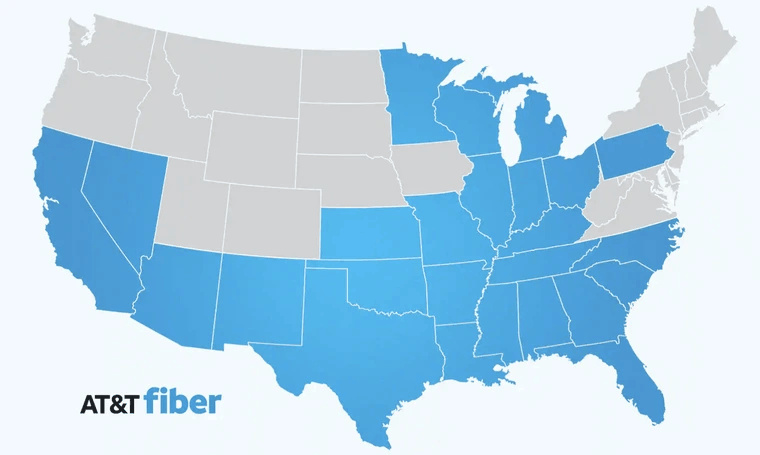
Frontier, on the other hand, focuses its operations within the United States.
Their network is available to businesses in 25 states, making them a strong choice for companies with a domestic footprint.
SLA
A Service Level Agreement (SLA) is a provider's promise for network uptime. For their managed dedicated internet, Frontier offers a 99.99% SLA, while AT&T provides a 99.95% SLA.
This might seem like a small difference, but it's significant. A 99.99% uptime means your service could be down for about 53 minutes per year, whereas 99.95% allows for over four hours of downtime.
If a provider fails to meet its SLA, they will typically issue a service credit on your next bill, compensating you for the unexpected outage.
Transport Types Available
Both AT&T and Frontier offer a variety of fiber-based internet speeds. This allows businesses to choose a plan that fits their specific needs, from basic web browsing to heavy data transfers.
AT&T Business operates an extensive fiber network spanning 1,100,000 route miles. Their high-speed options are ideal for large enterprises that require significant bandwidth for their operations.
Frontier Communications provides its services over a 180,000-mile fiber network. Their symmetrical speeds are well-suited for businesses that depend on cloud applications and video conferencing.
Customer Support
Both AT&T and Frontier offer dedicated support channels for their business customers. You can contact their teams for help with technical issues or questions about your account.
AT&T has a notable history of positive feedback. J.D. Power has recognized the company for customer satisfaction among large enterprise clients for eight consecutive years.
Frontier’s support is often built into its managed services. This approach includes 24/7 network monitoring and assistance as part of your overall service plan.
Final Verdict: AT&T Business or Frontier Communications?
Choosing between AT&T Business and Frontier Communications depends entirely on your company's specific needs, as each provider excels in different areas.
AT&T's global network makes it a strong fit for large, multinational corporations. Its broad service catalog is also ideal for businesses that need a single provider for diverse services like wireless and POTS replacement across the US.
Conversely, Frontier is an excellent choice for US-based companies prioritizing cost-effective dedicated internet. Their competitive pricing, faster average installation, and slightly higher uptime SLA are significant advantages for businesses where connectivity performance and value are key.
The best way to make a final decision is to compare pricing and availability for your specific business locations.
To help you see the differences at a glance, here’s a quick summary of how AT&T Business and Frontier Communications stack up in key areas.
Choose the Right ISP Today With Lightyear
The right ISP for your business comes down to your specific priorities. Whether you need global reach and a wide service catalog or cost-effective, high-performance domestic internet, the choice between AT&T and Frontier is a great example of how different providers serve different needs.
Our software is built to give you that clarity. Lightyear simplifies the entire process of finding and managing your telecom services. We help you by:
- Automated ISP Procurement: We digitize the RFP process, using the largest proprietary pricing dataset in enterprise telecom. This ensures you see best-fit providers and benchmarked rates side by side.
- Transparent Pricing & Negotiation: Lightyear proactively negotiates ISP quotes down if rates don’t align with market benchmarks, ensuring you never overpay.
- Service Breadth Across All ISPs: Whether you need DIA, broadband, LTE/5G, or colocation, our platform centralizes all your options in one place.
If you're ready to simplify your telecom procurement and find the best-fit provider for your business, sign up for a demo to see how Lightyear can work for you.
Let us show you the product and discuss specifics on how it might be helpful.
Schedule a Demo





Revolutionize Your Telecom Experience
Learn how you can get one step closer to optimal business efficiency for all your telecom services.