AT&T Business vs Zayo: Which ISP Is Better?
Deciding between business ISPs? We compare AT&T and Zayo on network, services, and support to help you choose the right provider.


AT&T Business is one of the most established internet service providers, while Zayo is known for its extensive fiber network infrastructure. Both offer a wide range of connectivity services for enterprises.
Choosing between them can be a complex decision for any IT leader. We're here to help you compare these two providers to find the right fit for your business needs.
Our comparison uses Lightyear's proprietary data, gathered from over 70,000 real-world ISP quotes. This gives us unique insight into aggregated benchmarks on pricing, installation timelines, and service delivery points.
You can continue reading for our detailed comparison of AT&T Business and Zayo. Or, if you're ready to explore your provider options now, you can begin our questionnaire to receive real-time quotes.
Overview of AT&T Business
With roots going back to 1885, AT&T is a foundational company in the telecom space. Headquartered in Dallas, Texas, it's a massive operation with 150,000 employees, a presence in 46 countries, and a rank of 32 on the Fortune 500 list.
Beyond its scale, AT&T offers some unique features like the AT&T Guarantee, which covers downtime on both its wireless and fiber networks. The company also emphasizes network-level security through its AT&T Dynamic Defense solution. This approach to service reliability has earned them multiple J.D. Power awards for customer satisfaction in the large enterprise space.
Overview of Zayo
Founded in 2007, Zayo is a telecommunications infrastructure provider headquartered in Boulder, Colorado. The company has approximately 3,500 employees and operates across 35 countries.
Zayo is known for its extensive global fiber infrastructure, which covers more than 148,000 route miles and connects over 1,700 data centers.
The company focuses on simplifying network management through automation. It provides a Network-as-a-Service (NaaS) platform and AI-driven tools for provisioning and monitoring.
ISP Products
Dedicated Internet (DIA)
AT&T's Dedicated Internet offers a wider spectrum of speeds, starting as low as 10 Mbps and scaling up to 1 Tbps. In contrast, Zayo's DIA product is geared toward higher bandwidth requirements, with options from 100 Mbps to 100 Gbps.
Both providers use their own fiber networks, but AT&T has a significantly larger footprint with 1.1 million route miles versus Zayo's 146,000. For service reliability, AT&T offers a clear 99.95% uptime SLA, while Zayo's contractual SLAs are defined in service agreements, with objectives starting at 99.9% availability.
Based on Lightyear's data, both providers have an average DIA installation time of 89 days, which is about 12 days longer than the market average. Pricing is where they differ more significantly; for a 1 Gbps circuit, Zayo's pricing tends to be 2% below the market average, whereas AT&T's is typically 27% higher.
Keep in mind that these are aggregate figures, and actual installation times and pricing can vary based on your region and specific DIA configuration. To get an exact comparison of AT&T Business, Zayo, and other top ISPs for your area, we recommend filling out our questionnaire. It uses the most comprehensive data set in the industry to provide you with precise, real-time quotes.
DIA Pricing, Delivery and Install Days Compared
The data in this table comes from Lightyear’s aggregated ISP quotes collected in 2024 and 2025 YTD.
- Install Days: how long it typically takes to deliver service.
- 100Mb Price vs Avg / 1Gb Price vs Avg: shows whether this ISP is cheaper or more expensive than the market average.
- Delivery Point: “Suite” means the ISP delivers service all the way to the company’s server room; “MPOE” means the circuit stops at the building’s minimum point of entry (typically the building's utility basement) and the tenant must handle the inside wiring.
Wireless
AT&T Business provides 5G and LTE wireless services across the US, with some coverage in Canada and Mexico. Their offerings include plans for mobile devices and fixed wireless solutions like AT&T Internet Air, which delivers service to a specific location.
Zayo’s role in wireless is fundamentally different, as they do not sell 5G or LTE services directly to businesses. Instead, Zayo provides the underlying fiber backhaul and connectivity that wireless carriers use to run their networks.
This means that while you would purchase a wireless plan from a provider like AT&T, Zayo is the infrastructure company working behind the scenes to make those services possible.
Security
AT&T Business offers a suite of security products to protect its network services. Its AT&T Dynamic Defense solution provides proactive threat blocking, while AT&T Active Armor adds 24/7 security for its Business Fiber customers. For businesses needing secure remote access, AT&T also provides Secure Service Active Edge.
Zayo’s security offering, on the other hand, centers on its DDoS Protection service. This service comes in Basic, Standard, and Advanced tiers, focusing on network-based monitoring and mitigation at the edge of Zayo's network. Higher tiers include proactive detection and access to a user portal for monitoring.
The key difference is in scope. AT&T provides a broad security portfolio covering various threats, while Zayo specializes in protecting against a specific type of attack rather than offering a full suite of general security tools.
Broadband
AT&T’s broadband product, AT&T Business Fiber, offers symmetrical speeds from 300 Mbps up to 5 Gbps with unlimited data. Lightyear’s data shows AT&T’s broadband pricing is approximately 18% below the market average, with an installation time of 18 days—notably faster than the 28-day industry average. Like its DIA service, AT&T delivers broadband to the building’s MPOE.
Zayo also offers broadband internet for business customers. Due to limited quoting history in our data, we’re not able to provide benchmark pricing or installation timelines at this time. You can find Zayo's latest pricing and get a direct comparison for your location by filling out our questionnaire.
Ethernet
Zayo provides Ethernet services such as EPL, EVPL, and ELAN for businesses needing to connect locations across North America and Europe. These are Layer 2 services built on Zayo's optical network, ideal for creating private wide area networks.
AT&T’s related offering is AT&T Business Fiber, which delivers symmetrical internet speeds from 300 Mbps up to 5 Gbps. This product provides high-speed internet access over a fiber connection with unlimited data.
The primary distinction is in the service type. Zayo focuses on MEF-style Ethernet transport for private networking, while AT&T Business Fiber is an internet access product delivered to a single location.
POTS Replacement
AT&T provides a direct solution for businesses looking to move away from traditional analog phone lines. Its AT&T Phone for Business – Advanced service converts voice, fax, and specialty data lines to a cloud-based system that runs over your existing internet connection, regardless of the provider.
For reliability, the service includes an optional LTE failover and a 24-hour battery backup. It is also NFPA 72 compliant, meaning it can support critical life-safety systems like fire alarms, elevators, and emergency boxes.
Zayo, in contrast, does not offer a branded, first-party POTS replacement product. Their focus is on core network infrastructure like SIP trunking and data services, which operate at a different layer than a dedicated analog-to-cloud conversion device.
Other Key Features Compared
Geographic Coverage
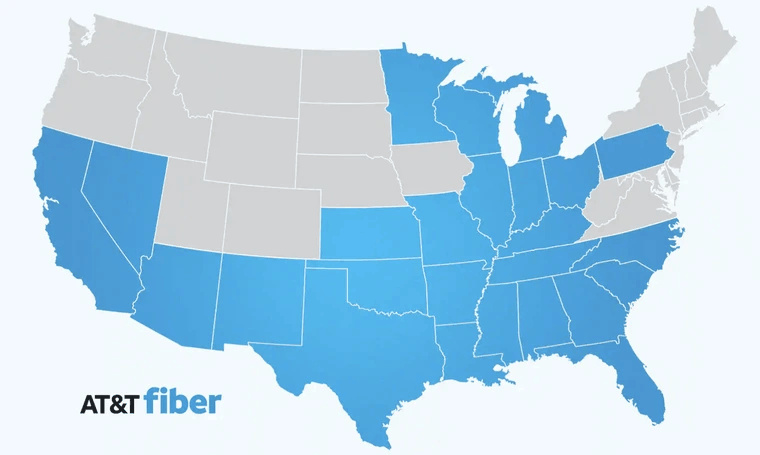
AT&T Business has a broad reach, offering services in 46 countries around the globe. This extensive network makes them a strong option for multinational corporations needing consistent connectivity across their international offices.
Zayo also has a significant international presence, though it's more focused.
The company operates in 35 countries, with its network infrastructure concentrated in North America and Western Europe.
SLA
AT&T offers a standard 99.95% uptime Service Level Agreement (SLA) for its dedicated internet. This is a formal guarantee of network availability.
Zayo’s SLAs are outlined in individual service agreements, with uptime objectives starting at 99.9%. The exact terms can vary depending on your specific contract.
In practical terms, AT&T's 99.95% SLA allows for about 4.4 hours of potential downtime per year, while Zayo's 99.9% objective means up to 8.8 hours of potential downtime annually.
Transport Types Available
AT&T Business uses its own fiber network, which spans 1,100,000 route miles. This extensive reach allows them to provide a broad range of speeds for various business uses.
Zayo also runs on its own fiber network, covering 144,000 route miles. The company focuses on high-speed services for businesses with demanding data needs.
In short, AT&T offers more flexibility for different business sizes, while Zayo is geared toward companies that require consistently high bandwidth for their applications.
Customer Support
AT&T Business provides customer support around the clock. You can reach them through phone, online chat, or their web portal, making it easy to get help whenever you need it.
Zayo also offers 24/7 support, primarily through its Tranzact portal and a dedicated Network Control Center. Their support team is geared toward technical users who manage network infrastructure.
The main difference is in their approach. AT&T offers broad support for all types of business users, while Zayo’s support is more specialized for network-focused teams.
Final Verdict: AT&T Business or Zayo?
Choosing between AT&T Business and Zayo comes down to your company's specific requirements. AT&T offers a comprehensive suite of services for a wide range of businesses, while Zayo specializes in high-capacity fiber infrastructure.
AT&T is often the better fit if you need a single provider for internet, wireless, and POTS replacement. Their broad portfolio and global reach are well-suited for businesses of all sizes looking for a one-stop shop.
In contrast, Zayo is an excellent choice for companies with sophisticated, data-heavy requirements. Consider them if your primary need is high-bandwidth fiber, private Ethernet networking, or connecting data centers.
Ultimately, the right provider depends on your location and technical needs. To see how they stack up for your business, we recommend using our questionnaire to compare real-time quotes.
Here’s a quick summary of how AT&T Business and Zayo compare across key areas:
Choose the Right ISP Today With Lightyear
Making the right choice between providers like AT&T Business and Zayo starts with a clear understanding of your own network requirements. Once you know what you need, the next step is to find the provider that aligns with your technical and financial goals.
That's where our software can help. Lightyear provides the data and tools to make an informed decision, so you can compare your options with confidence. Our platform helps you:
- Instantly see quotes from all available providers in your area, with pricing benchmarked against the market.
- Get the best possible rates with automated negotiations that ensure you don't overpay.
If you're ready to simplify your telecom procurement and find the right services for your business, schedule a demo of the Lightyear platform.
Let us show you the product and discuss specifics on how it might be helpful.
Schedule a Demo





Revolutionize Your Telecom Experience
Learn how you can get one step closer to optimal business efficiency for all your telecom services.