Cat 6 vs Cat 8 Ethernet: Enterprise Differences
Is Cat 8 worth the upgrade from Cat 6? We compare performance, cost, and ideal uses for enterprise networks, from the office to the data center.

The performance of your enterprise network often comes down to the physical cabling that connects it all together.
Two prominent standards for businesses are Category 6 (Cat 6) and the newer Category 8 (Cat 8). This guide compares them directly—looking at speed, bandwidth, and typical use cases—to help you make an informed infrastructure decision.
What is Cat 6 Ethernet?
Category 6, or Cat 6, has been a go-to standard for business networks for years, and for good reason. It strikes a great balance between performance and cost, making it a reliable choice for many applications.
- It supports data transfer speeds up to 10 Gigabits per second (Gbps) over short distances (up to 55 meters) and provides a standard bandwidth of 250 MHz.
- For distances up to 100 meters, the maximum for a standard Ethernet channel, Cat 6 reliably delivers 1 Gbps speeds, making it ideal for connecting workstations, VoIP phones, and access points.
- Compared to its predecessors, Cat 6 cables feature more tightly twisted wires and often include a plastic spline to separate the pairs, which significantly reduces crosstalk and interference.
- It is fully backward-compatible with previous standards like Cat 5 and Cat 5e, allowing for flexible upgrades within an existing network infrastructure.
What is Cat 8 Ethernet?
Category 8, or Cat 8, is a newer Ethernet cable standard designed for high-performance applications, primarily within data centers. It represents a major step up in data handling capabilities for short-range connections.
- It supports data transfer speeds of 25 Gbps or 40 Gbps over a maximum distance of 30 meters.
- Cat 8 offers a bandwidth of up to 2000 MHz, which is significantly higher than previous categories and necessary for its high-speed performance.
- These cables are always shielded (using S/FTP or F/FTP construction) to protect against crosstalk and electromagnetic interference in electrically noisy environments like server rooms.
- Its primary use case is for connecting servers to switches in a top-of-rack or end-of-row configuration within a data center.
Key Differences Between Cat 6 and Cat 8
While both are Ethernet cables, their design and purpose differ significantly. Let's break down the main distinctions.
Bandwidth Capacity
The most significant difference lies in bandwidth. Cat 6 provides a standard bandwidth of 250 MHz, which is sufficient for most business applications.
In contrast, Cat 8 offers a massive bandwidth of 2000 MHz. This wider frequency range allows it to handle the data volumes required for 25GBASE-T and 40GBASE-T speeds.
Cable Shielding
Cat 6 cables come in both unshielded (UTP) and shielded (STP) varieties, offering flexibility depending on the level of environmental interference.
Cat 8, however, is always shielded. Its construction (S/FTP) involves wrapping each twisted pair in foil and then covering the four pairs with an overall braid shield. This robust protection is necessary to prevent interference in dense data center environments.
Intended Application and Reach
Their use cases are fundamentally different. Cat 6 is a versatile cable for horizontal wiring in offices, connecting everything from computers to security cameras over distances up to 100 meters.
Cat 8 is a specialized, short-distance cable designed for data centers. Its 30-meter channel length is ideal for top-of-rack or end-of-row switch-to-server connections.
Performance and Speed Comparison
When you look at the numbers, the performance gap between Cat 6 and Cat 8 is stark. Here’s how their speed and capabilities stack up in practical terms:
- Speed vs. Distance Trade-off: Cat 6 is built for versatility, reliably delivering 1 Gbps speeds over the full 100-meter channel length common in office buildings. It can push up to 10 Gbps, but only for shorter runs (under 55 meters). Cat 8 is a specialist, delivering blistering 25 Gbps or 40 Gbps speeds, but its performance is strictly limited to a 30-meter distance.
- Data Throughput: The massive 2000 MHz bandwidth of Cat 8 is what enables its high-speed data transfer. This capacity is essential for connecting high-performance servers and switches in a data center. Cat 6’s 250 MHz bandwidth is more than adequate for standard business traffic like file transfers, video calls, and connecting user workstations.
- Application Performance: In a typical office, a Cat 6 connection provides ample performance for everyday tasks without creating bottlenecks. The performance of Cat 8 is designed for switch-to-server links where massive amounts of data are aggregated and moved between core network components. Using Cat 8 for a standard desktop PC would offer no practical performance benefit over Cat 6, as the endpoint device itself cannot use the extra capacity.
Cost Considerations for Cat 6 and Cat 8
When planning your budget, the price difference is significant. Cat 6 cables are considerably more affordable, making them a cost-effective choice for large-scale office deployments.
The higher price of Cat 8 is a direct result of its complex construction. It uses thicker copper conductors and mandatory, multi-layered shielding to achieve its high-frequency performance, which increases material and manufacturing costs.
Beyond the cabling, you also have to consider the associated hardware. Network equipment designed for Cat 8 speeds, like 25G/40G switches and compatible connectors, carries a much higher price tag than standard gigabit hardware.
For most enterprise environments outside of the data center, the investment in a Cat 8 infrastructure won't yield a return, as standard office hardware cannot take advantage of its capabilities.
Installation and Compatibility
From a practical standpoint, how these cables are handled during installation and how they fit into your existing setup are key factors.
- Physical Handling: Cat 6 cables are generally thinner and more flexible, making them easier to route through walls and conduits. Cat 8 cables are noticeably thicker and stiffer due to their mandatory shielding, which can make installation more difficult in tight spaces.
- Termination and Grounding: While both use the familiar RJ45 connector, Cat 8 requires compatible shielded connectors and meticulous termination to work correctly. Proper grounding is critical for Cat 8; if not done right, the shield can actually worsen interference. This is not a concern for unshielded Cat 6 cables.
- Backward Compatibility: Cat 8 is fully backward-compatible. You can plug a Cat 8 cable into a device with a Cat 6 port, but the connection will be limited to Cat 6 performance. The cable itself won't upgrade the speed of older hardware.
Making the Right Choice for Your Network
Choosing between Cat 6 and Cat 8 comes down to your specific application. It's not about which is "better," but which is right for the job.
For nearly all enterprise office environments, Cat 6 is the practical and cost-effective choice. It provides more than enough performance for workstations, VoIP phones, and access points, supporting speeds up to 10 Gbps over shorter distances and 1 Gbps up to 100 meters.
Cat 8 is a specialized solution built for the high-density, short-range connections inside a data center. Its 40 Gbps speed and 2000 MHz bandwidth are designed for switch-to-server links, not for wiring an entire office building.
Ultimately, your decision should align with your infrastructure needs. Selecting Cat 6 for general office use provides reliable performance without overinvesting in capacity you can't use. Reserve Cat 8 for its intended data center role to maximize your return on investment.
Need Help Managing Your Network? Lightyear Can Help
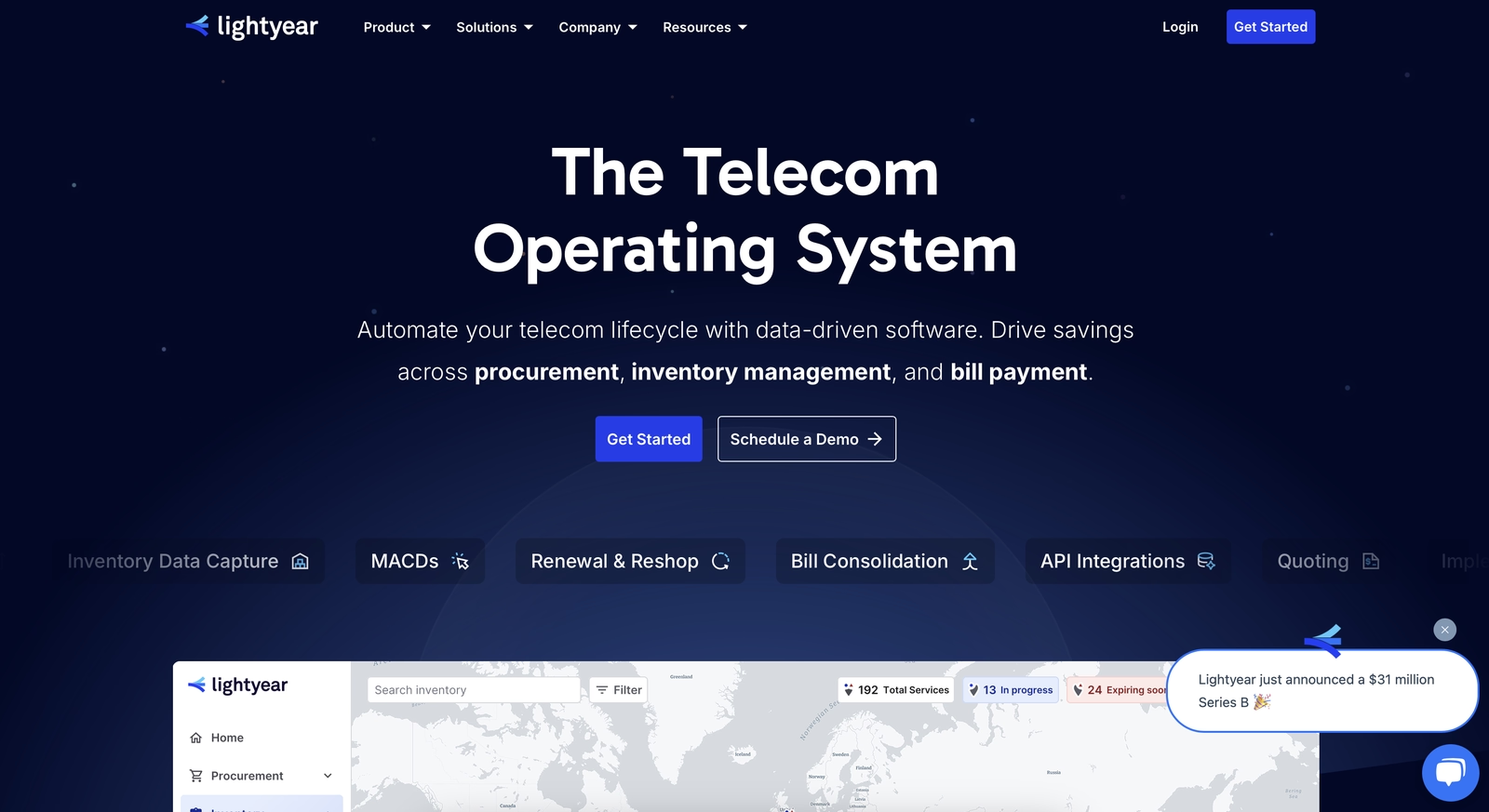
Choosing the right cabling is a key step, but managing the telecom services that run on it is an ongoing challenge. By automating network service procurement, inventory management, and bill consolidation, Lightyear helps the hundreds of enterprises who trust us achieve over 70% in time savings and 20% in cost savings.
Schedule a demo or get started with our questionare today.
Frequently Asked Questions about Cat 6 Ethernet vs CAT 8
Can I use Cat 8 to future-proof my office wiring?
While it seems logical, it's not practical. Cat 8's 30-meter distance limit makes it unsuitable for standard office layouts. Sticking with Cat 6 or Cat 6a is a more effective and cost-efficient strategy for future-proofing general enterprise networks.
What about Cat 7? Is it a good middle ground?
Cat 7 is not an officially recognized TIA standard for Ethernet, which can cause compatibility issues. For new installations, it's better to choose between the widely adopted Cat 6/6a standards or the specialized Cat 8 for its intended data center role.
Do both Cat 6 and Cat 8 support Power over Ethernet (PoE)?
Yes, both standards support PoE. Cat 8's thicker conductors and superior heat dissipation make it better suited for higher-power PoE applications, though this is typically only relevant within its specific data center use case where high-wattage devices are common.
Let us show you the product and discuss specifics on how it might be helpful.
Schedule a Demo




Revolutionize Your Telecom Experience
Learn how you can get one step closer to optimal business efficiency for all your telecom services.