Cox Communications vs Frontier Communications: Which ISP?
Is Cox's cable network or Frontier's fiber a better fit? We break down the differences in speed, cost, and reliability for your business.


Cox Communications and Frontier Communications are two of the largest internet service providers in the United States, each offering a range of connectivity options for businesses.
To help you decide which provider is a better fit for your needs, we're comparing them head-to-head. Our analysis is based on Lightyear's proprietary data from over 70,000 real-world ISP quotes, covering benchmarks like pricing, installation timelines, and service delivery points.
Continue reading for our detailed comparison of Cox and Frontier. If you're ready to see your specific provider options, you can begin our questionnaire to receive real-time quotes.
Overview of Cox Communications
As a major telecommunications provider, Cox Communications has been in business since its founding in 1963. The company is headquartered in Philadelphia, Pennsylvania.
With a large team of 190,000 employees, it is ranked 33rd on the Fortune 500 list. Its services are concentrated primarily within a single country.
The company is also known for some unique offerings, such as a five-year price lock guarantee for small businesses on certain plans. Additionally, they provide integrated firewall security that works with a business's internet connection without needing extra hardware.
Overview of Frontier Communications
Frontier Communications has a long history in the telecommunications industry, with corporate roots that trace back to 1935. Headquartered in Dallas, Texas, the company operates with a team of about 13,000 employees. While not on the Fortune 500 list, its services are available in 25 states across the U.S.
The provider emphasizes network stability, reporting 99.9% overall reliability and offering internet backup to maintain connectivity during an outage. Other notable aspects include symmetrical upload and download speeds on its fiber network and flexible month-to-month contracts for certain business plans.
ISP Products
Dedicated Internet (DIA)
Cox offers Ethernet Dedicated Internet (EDI) with speeds from 10 Mbps to 100 Gbps over fiber, coax, or a hybrid connection. Frontier provides Dedicated Internet Access with a similar speed range, from 5 Mbps up to 100 Gbps, delivered via its fiber network. Both services include a 99.99% uptime Service Level Agreement (SLA) and have no data caps, providing reliable, high-capacity connectivity for businesses.
According to Lightyear's data, Frontier's DIA installation timeline matches the 77-day market average, while Cox's is slightly longer at 82 days. For a 100Mbps circuit, both providers are cost-effective, with Cox's pricing typically 15% below the market average and Frontier's 12% below. At the 1Gbps speed tier, Frontier maintains a price advantage at 11% below average, while Cox's pricing aligns with the market average.
A key operational difference is the service delivery point. Cox often delivers connectivity directly to a customer's suite, whereas Frontier typically terminates service at the building's Main Point of Entry (MPOE), which could influence internal wiring requirements.
Keep in mind that these numbers are market-wide averages.
The actual installation time and price you'll see can change based on your location and the specific DIA service you need.
To get a precise comparison of Cox, Frontier, and other top ISPs for your business, you can fill out our questionnaire. It uses the industry's most complete dataset to give you real-time, accurate quotes.
DIA Pricing, Delivery and Install Days Compared
Here's what these metrics mean: "Install Days" is the time to deliver service, "100Mb Price vs Avg" and "1Gb Price vs Avg" show if the provider is more or less expensive than the market average, and "Delivery Point" defines if the provider handles inside wiring or leaves it to the tenant.
The data in this table comes from Lightyear’s aggregated ISP quotes collected in 2024 and 2025 YTD.
- Install Days: how long it typically takes to deliver service.
- 100Mb Price vs Avg / 1Gb Price vs Avg: shows whether this ISP is cheaper or more expensive than the market average.
- Delivery Point: “Suite” means the ISP delivers service all the way to the company’s server room; “MPOE” means the circuit stops at the building’s minimum point of entry (typically the building's utility basement) and the tenant must handle the inside wiring.
Wireless
Cox provides mobile service for personal devices through its xfinity mobile brand, which operates on Verizon's 5G network. This service is supplemented by a wide network of WiFi hotspots from Comcast and Xfinity modems, offering both LTE and 5G connectivity.
Frontier takes a different approach, focusing on business continuity rather than mobile plans for personal devices. The company provides a managed cellular failover service that acts as a backup internet connection for branch sites. If your primary wired connection fails, this service automatically keeps your business online.
This means the two providers aren't directly competing in the same wireless space. Cox's xfinity mobile is a solution for companies seeking mobile phone plans, while Frontier's offering is a network resiliency tool for businesses that need a reliable backup internet source.
Security
Cox Communications offers security through two main products based on business size. Its SecurityEdge product provides a first line of defense against online threats for most businesses. For larger organizations, the Managed Security suite delivers services like Managed VPN, Unified Threat Management (UTM), dedicated firewalls, and DDoS attack protection.
Frontier integrates its security features directly into its internet service as managed bundles. These packages, available in basic and advanced tiers, include a firewall, UTM, remote user VPN, and web filtering. A key part of Frontier's offering is the inclusion of 24/7 monitoring and management for these security services, layering them onto your primary connectivity.
Broadband
Cox provides its broadband service, Comcast Business Internet, over a Hybrid Fiber-Coax (HFC) network. This results in asymmetrical speeds, with plans offering up to 1.25 Gbps for downloads but only 35 Mbps for uploads, and includes a 1.2 TB monthly data cap. Lightyear's data shows Cox's broadband pricing is about 33% higher than the market average, and installation takes around 31 days, just over the 28-day average.
Frontier, on the other hand, delivers its Frontier Business Fiber product on a full fiber-optic network. This technology supports symmetrical speeds—meaning upload and download speeds are the same—with tiers reaching up to 7 Gbps in some areas and no data usage caps. Due to limited quoting history for this service, we’re not able to provide benchmark pricing or installation timelines at this time.
The primary distinction is the network type, which impacts speed symmetry and data limits. To find the most current pricing and availability for Frontier, Cox, and other broadband options for your business, you can get a new quote through our questionnaire.
Ethernet
Frontier offers MEF-compliant Carrier Ethernet services, including Ethernet Private Line (EPL) and Ethernet Virtual Private Line (EVPL). These products are designed for businesses that need to connect multiple sites, such as linking a headquarters to various branch offices.
The company also provides optical transport services with speeds up to 100 Gbps for very high-capacity data requirements. These Ethernet and transport services are generally available within Frontier's enterprise and wholesale service areas.
Cox's portfolio, in contrast, centers more on its Ethernet Dedicated Internet (EDI) product, which provides a single site with a dedicated connection to the internet. While Cox's EDI is a strong option for internet access, Frontier offers a more specialized suite of Carrier Ethernet products for complex, multi-location network configurations.
POTS Replacement
Cox offers its Comcast Business Voice service to replace Plain Old Telephone Service (POTS) lines for applications like fax, alarms, and point-of-sale systems. Frontier provides a similar solution with its POTS Connect product, designed for specialty lines including alarms, fax, POS, and elevators. A key difference is the connectivity requirement; Cox's service is bundled with its Business Internet to avoid certain fees, while Frontier's can operate more independently over an LTE or wired connection.
For business continuity, Frontier's solution includes LTE failover as a core feature, while it is an optional add-on for Cox. Cox specifies a 5-hour internal battery for its equipment, a detail not publicly available for Frontier. A critical distinction for safety systems is that Cox's voice service aligns with NFPA 72 code for fire alarms, whereas Frontier does not make this claim for its product.
Other Key Features Compared
Geographic Coverage
Cox Communications keeps its services focused on one country: the United States.
You'll find their network coverage available for businesses across the U.S., but not in other countries.
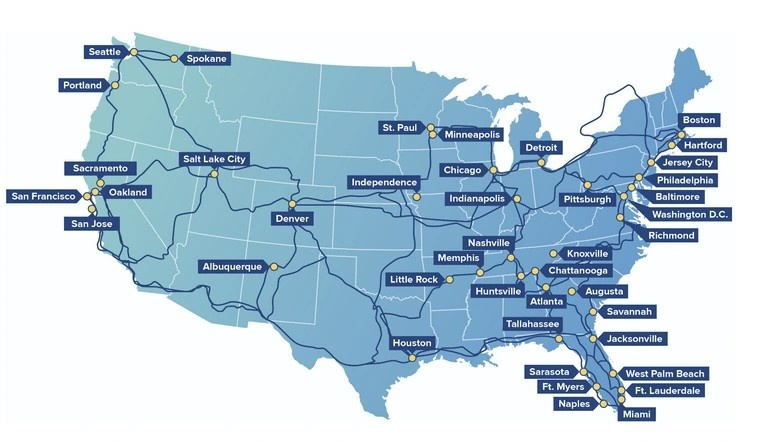
Frontier also keeps its services within the United States.
You can find their network in 25 states, giving them a more regional footprint.
SLA
For their dedicated internet products, both Cox and Frontier provide a Service Level Agreement (SLA) guaranteeing 99.99% uptime.
In simple terms, this is a promise that your service will be operational almost all the time. A 99.99% uptime allows for less than one hour of total downtime over the course of a year.
If your service experiences more downtime than the SLA allows, the provider will typically issue a service credit on your next bill.
Transport Types Available
Cox operates on a Hybrid Fiber-Coax (HFC) network with 200,000 fiber route miles. This setup provides a variety of speeds that work well for general business use, like streaming or web browsing.
Frontier’s network is primarily fiber-optic, covering 180,000 route miles. This technology delivers symmetrical speeds, making it ideal for tasks that require fast uploads, such as video conferencing.
While Cox is great for everyday data consumption, Frontier's symmetrical speeds are better suited for businesses that frequently upload large files or use cloud-based applications.
Customer Support
Cox offers 24/7 business support by phone, chat, and online. For their enterprise services, they provide dedicated support teams, which is helpful for complex setups.
Frontier also gives business clients round-the-clock customer support. This support is often tied to their managed services, so you get help from the team monitoring your network.
The key difference often lies in the specific plan you select. Both offer specialized support for higher-tier products, so your experience depends on the service level you buy.
Final Verdict: Cox Communications or Frontier Communications?
Choosing between Cox and Frontier comes down to your specific business needs and network priorities. Cox offers a broad range of services over its hybrid fiber-coax network, while Frontier specializes in high-speed, symmetrical fiber connectivity.
Cox is often a strong contender for businesses that prioritize download speeds for general operations and prefer service delivery directly to their suite.
In contrast, Frontier is an excellent choice for companies that rely on fast upload speeds for cloud applications or need to connect multiple sites with specialized Ethernet services.
The best way to make a final decision is to compare quotes for your exact location. Lightyear can help you get transparent pricing from both providers to see which is the better fit.
To make things easier, here’s a side-by-side look at how Cox and Frontier stack up across key areas we've discussed.
Choose the Right ISP Today With Lightyear
Ultimately, the best ISP for your business depends on your specific needs for speed, reliability, and cost. Evaluating these factors across different providers can be complex, but our platform is designed to make it simple.
Lightyear helps you make an informed decision by automating the procurement process. We provide tools that give you clarity on pricing and service options. Here’s how we can help:
- Automated ISP Procurement: We digitize the RFP process, using a massive pricing dataset to show you best-fit providers and benchmarked rates side-by-side.
- Transparent Pricing & Negotiation: Our platform proactively negotiates quotes down if they don't align with market data, helping you avoid overpaying.
- Human + Software Support: You get a dedicated account representative to oversee installations and support ongoing changes, so you’re not navigating it alone.
If you're ready to simplify how you buy and manage your network services, schedule a demo to see how Lightyear can work for you.
Let us show you the product and discuss specifics on how it might be helpful.
Schedule a Demo





Revolutionize Your Telecom Experience
Learn how you can get one step closer to optimal business efficiency for all your telecom services.