The Complete Guide to Dark Fiber Providers in 2026
Explore dark fiber pricing, IRUs, and provider options — and see how Lightyear automates network procurement for scalable enterprise growth.


Private networks have become essential for modern enterprises. As cloud workloads expand, data centers multiply, and bandwidth demand soars, you need infrastructure that can keep up. A dedicated fiber network delivers the scalability and high performance that mission-critical systems require.
Dark fiber gives you that control — high-capacity, low-latency connectivity you manage on your own terms. The right dark fiber provider can unlock unlimited bandwidth and more predictable uptime across your private fiber network.
The challenge? Finding the right option in a fragmented, opaque market. This guide explains what dark fiber providers really offer, how to compare them, and how Lightyear brings automation, visibility, and clarity to dark fiber services in 2026.
What Are Dark Fiber Providers?
A dark fiber provider delivers access to optical fiber infrastructure that’s already in the ground but not actively lit by a carrier. When you lease these strands directly, you’re gaining control over your own dark fiber network — a private, high-capacity backbone you can light and manage with your own equipment. This structure gives you complete authority over network management, routing, and security, unlike managed or “lit” network services where the provider controls the electronics and traffic.
Dark fiber providers differ in how they structure access, pricing, and network support:
- Infrastructure reach: Some focus on dense metro loops and splice points within cities, while others specialize in long-haul routes that span states or countries.
- Contract structures: Options range from long-term Indefeasible Rights of Use (IRUs), which secure access to dedicated fiber for decades, to short-term leases and international circuits.
- Flexibility: Many offer pure dark fiber, while others bundle managed maintenance or proactive monitoring for enterprises that want a hybrid approach to network operations.
- Integration: Some providers also own or interconnect with data centers and colocation sites, simplifying procurement and network design for cloud connectivity and wavelength services.
With dark fiber, you own both the design and performance of your fiber connectivity. You control upgrades, redundancy, and scalability — shaping your dedicated fiber infrastructure to match your organization’s evolving needs.
Comparing Dark Fiber Providers: Key Differentiating Factors
Choosing a dark fiber provider isn’t just about price — it’s about matching the right network solutions to your routes, uptime goals, and scalability needs. The leading dark fiber providers differentiate themselves through coverage, interconnection, and how much flexibility they give you to manage your own dark fiber network.
Geographic Availability
Coverage varies dramatically by region. In dense metros, dozens of providers compete for the same dark fiber routes, while smaller markets may only have a few. Lightyear’s network intelligence makes these gaps clear:
- Ottawa: about 42 providers including Bell Canada and Rogers.
- Waterloo: about 45 providers including Lumen and Frontier.
- Hamilton: about 55 providers such as Verizon and Bell.
- Montréal: around 50 providers including Bell, Fibrenoire, and Zayo.
- Vancouver: roughly 45 providers including TELUS, Comcast, and Lumen.
- Los Angeles: nearly 100 providers, the most extensive list in North America.
- Spring, TX: only 17 providers — proof that availability thins outside major fiber connectivity hubs.
- London: 100+ providers reflecting global network density.
- Phoenix: about 45 providers from CenturyLink to Cox.
These insights show why it’s critical to verify address-level service using a live network map instead of relying on broad marketing claims.
Pricing Models
Dark fiber doesn’t follow the standard broadband pricing tiers. Instead, cost depends on contract length, distance, and construction requirements:
- IRU agreements: High upfront CapEx, but you gain virtually unlimited bandwidth and guaranteed access for 20–30 years.
- Short-term leases: OpEx-driven and ideal for temporary or rapidly changing connectivity needs.
- Lit alternatives: Lower upfront cost but less control, since the carrier manages the optics and overall network design.
Scale and Interconnection Density
Providers with large metro footprints and dense data center interconnects deliver more value. Zayo and Lumen, for example, emphasize extensive route miles, cloud on-ramps, and on-net buildings across North America. Regional operators may serve fewer corridors but still provide niche dark fiber solutions that enhance redundancy and flexibility.
Maintenance and Support
Pure dark fiber is fully DIY — your team lights and manages the fiber optic network. Some service providers sell optional maintenance, proactive monitoring, or repair services to support ongoing network operations. These add convenience and reliability but also increase cost.
Why Sourcing Dark Fiber Is So Challenging
Even experienced IT and procurement teams struggle to source dark fiber services efficiently. The challenge isn’t just technical — it’s operational. Legacy procurement methods, opaque pricing, and disconnected data make it hard to build scalable network solutions that meet mission-critical needs.
Opaque Pricing
Few carriers publish rates, and quotes can vary dramatically by region and route. Without standardized visibility, comparing dark fiber products becomes guesswork.
Address-Level Availability
A provider’s public network map doesn’t guarantee your address is serviceable. Verifying dark fiber routes site by site often requires manual outreach, especially for long-haul or high-performance connectivity projects.
Slow Sales Cycles
Large Indefeasible Rights of Use (IRU) contracts can take months to finalize, delaying digital transformation initiatives tied to data center migrations or cloud expansion.
Manual Workflows
Procurement teams still rely on spreadsheets and inconsistent RFP formats across vendors. Managing dark fiber, wavelengths, and Ethernet services in parallel creates friction that slows progress instead of supporting uptime and scalability.
These inefficiencies explain why many enterprises fall back on lit internet services — even when dark fiber offers better long-term scalability, bandwidth, and control over network operations.
How Lightyear Fixes the Problem
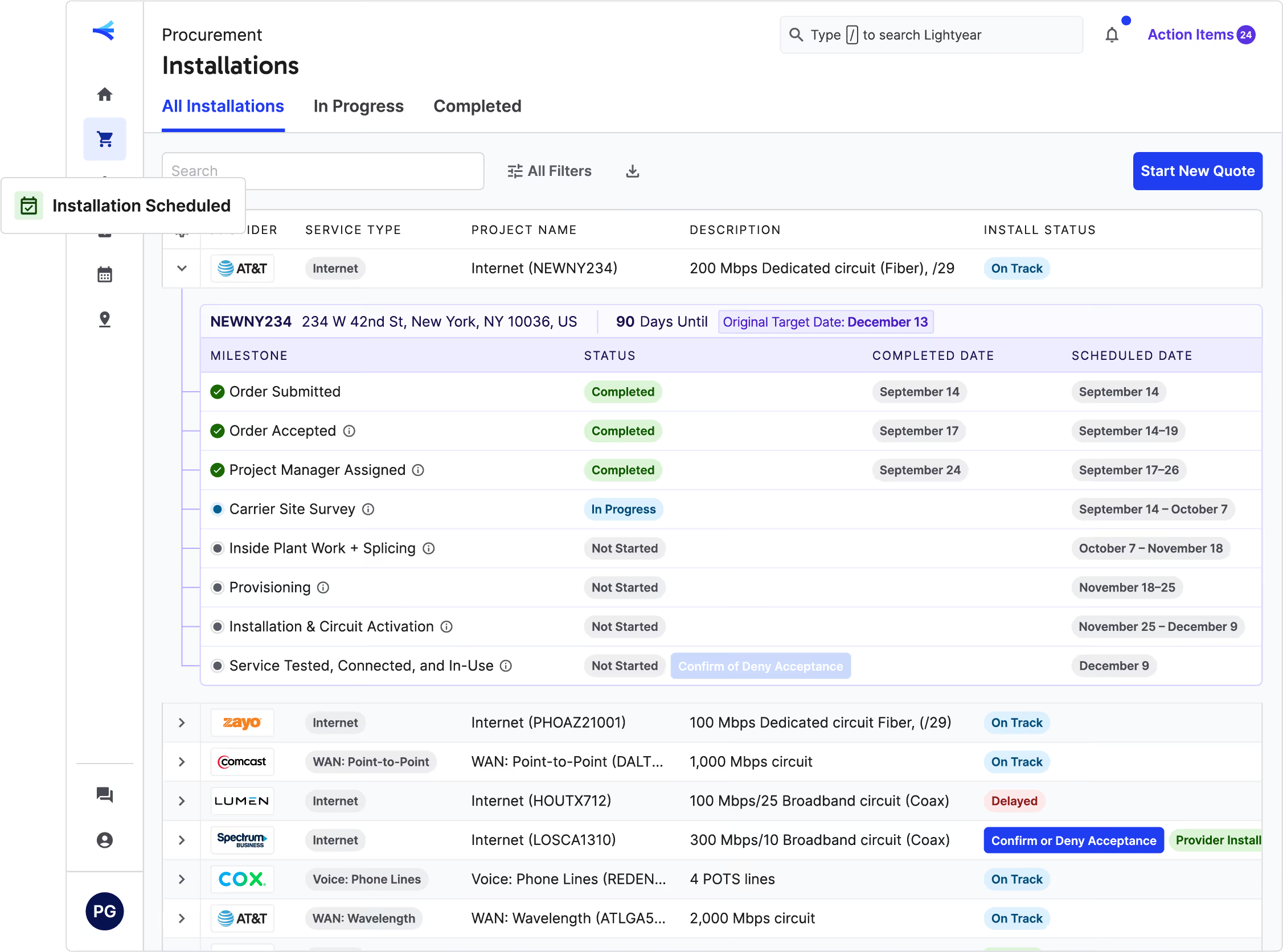
Lightyear acts as the modern operating system for telecom procurement. For dark fiber solutions, the platform replaces manual workflows with automation, real-time visibility, and expert support — helping you source dark fiber services faster and with complete confidence.
Here’s how it works:
- Automated RFPs: Generate, distribute, and collect dark fiber quotes in minutes — not months.
- Real-time network intelligence: Access data from more than 1,000 service providers to instantly check coverage, dark fiber routes, and pricing across metro and long-haul corridors.
- Side-by-side comparisons: Evaluate dark fiber solutions alongside broadband, Ethernet, and internet connectivity options to see true performance and cost trade-offs.
- Bulk procurement: Source multi-site networks across regions like the Tri-state area, broader Los Angeles Metro, and beyond — all in one workflow.
- Expert engineering and professional services: Get support for network design, upgrades, and implementation to align every decision with your growth strategy.
With Lightyear, what used to take quarters now takes hours — freeing your team to focus on strategy, scalability, and uptime instead of chasing quotes.
Use Case Snapshot: A Multi-Site Enterprise
Imagine an enterprise with offices in Ottawa, Vancouver, and Los Angeles. Comparing nearly 200 dark fiber providers across those cities once meant months of manual outreach and endless RFP threads.
With Lightyear, procurement leaders can upload all office addresses at once, run instant checks for on-net and near-net coverage, and see ranked results by cost and fit. Instead of chasing quotes from carriers like Verizon, Zayo, or Lumen, you get a unified view powered by the industry’s largest pricing dataset.
The result: a high-bandwidth, fiber optic network that meets your connectivity needs through a faster, data-driven procurement cycle — no spreadsheets required.
Stop Managing Dark Fiber in Spreadsheets with Lightyear
Your dark fiber network is too critical to manage through spreadsheets and manual RFPs. Lightyear turns complex, multi-vendor procurement into a single, automated workflow that gives you full visibility and control.
The platform connects you to more than 1,000 integrated service providers and uses over one million price quote data points to show the most accurate view of dark fiber routes, availability, and network services on the market. You can consolidate contracts, renewals, and billing in one system of record, simplify network operations, and align every upgrade with enterprise goals.
With automation and visibility, dark fiber becomes a driver of scalability, uptime, and high performance — not a procurement bottleneck.
See which dark fiber providers are live at your addresses today — schedule a demo with Lightyear to bring clarity and speed to your dark fiber strategy.
FAQs on Dark Fiber Providers
1. How much does dark fiber cost compared to lit services?
Dark fiber typically involves higher upfront costs but provides virtually unlimited bandwidth over the life of the contract. For enterprises with sustained, high data traffic, the right dark fiber product can deliver a lower total cost of ownership than managed or lit network services.
2. Can any business use dark fiber, or is it only for large enterprises?
While dark fiber is most common among large enterprises with heavy workloads — such as healthcare systems, financial institutions, and media companies — mid-size businesses are adopting it more often as fiber network expansion reaches new markets.
3. What happens if my site isn’t near an existing route?
If your location isn’t already connected to a provider’s dark fiber network, service providers may propose new construction. That adds cost and lead time. Lightyear helps you check availability upfront so you can avoid surprises before procurement begins.
4. Who manages the fiber once I lease it?
With dark fiber, you own and manage the network. Your IT team handles the optics, routing, and uptime. Some providers offer optional maintenance or proactive monitoring if you prefer shared responsibility for network management.
5. How does Lightyear help me choose the right option?
Lightyear compares dark fiber, DIA, Ethernet, and wavelength services side by side — showing cost, scalability, and performance trade-offs. You get the clarity to balance long-term flexibility with immediate connectivity needs.
Let us show you the product and discuss specifics on how it might be helpful.
Schedule a Demo





Revolutionize Your Telecom Experience
Learn how you can get one step closer to optimal business efficiency for all your telecom services.