Data Link Layer vs Network Layer Explained
Data Link Layer vs. Network Layer: A clear guide to their distinct roles in your network, helping you make smarter infrastructure choices.

When managing enterprise networks, a solid understanding of the OSI model is fundamental. Two of its most important components are the Data Link Layer (Layer 2) and the Network Layer (Layer 3), which are crucial for data transmission.
While these two layers work closely together, they perform very different functions and operate at different scopes within your network. Understanding their distinct roles is key to making informed decisions about your infrastructure and services.
This article provides a direct comparison of the Data Link Layer and the Network Layer, explaining their key differences in plain terms to help you navigate your telecommunications procurement and management.
What is the Data Link Layer?
The Data Link Layer, often called Layer 2, is responsible for moving data between two directly connected nodes within the same local network. Its primary goal is to ensure that data transmission over the physical link is reliable and error-free.
This layer takes the raw bitstream from the Physical Layer (Layer 1) and organizes it into structured units called frames. Here are its core functions:
- Physical Addressing: It uses Media Access Control (MAC) addresses to identify specific devices on a local network. Every network interface card (NIC) has a unique MAC address.
- Framing: It encapsulates network layer packets into frames, adding a header and a trailer that contain control information for delivery.
- Error Control: It performs error detection to identify and discard corrupted frames that may occur during physical transmission, often using a Frame Check Sequence (FCS).
- Flow Control: It manages the data transmission rate between two nodes to prevent a fast sender from overwhelming a slow receiver.
What is the Network Layer?
The Network Layer, or Layer 3, is responsible for routing data packets between different networks. Think of it as the postal service for your data. While the Data Link Layer handles local delivery on a single street, the Network Layer figures out how to get a package from a city in one state to a city in another.
Its primary purpose is to facilitate communication across network boundaries, a process known as internetworking. It achieves this through several core functions:
- Logical Addressing: It uses logical addresses, such as IP addresses, to identify devices on a network. Unlike the permanent MAC address, an IP address can change depending on the network the device is connected to.
- Routing: This is the layer's most critical function. It determines the best path for data to travel from its source to its destination across complex, interconnected networks by using routing protocols and tables.
- Packet Forwarding: After determining the route, the Network Layer forwards the data packets, which are called packets at this layer, from one router to the next along the path.
- Fragmentation: If a packet is too large to be transmitted over a subsequent network, Layer 3 can break it into smaller fragments, which are then reassembled at the destination.
Key Differences Between Data Link Layer and Network Layer
While they work together, their roles and operational boundaries are quite distinct. Here’s a breakdown of the main differences an IT buyer should know.
Scope and Function
The most significant difference lies in their operational scope. The Data Link Layer is concerned with data transfer between devices on the same local network segment, like computers connected to the same office switch.
In contrast, the Network Layer manages data routing across different, independent networks. It connects your office LAN to another branch office or the wider internet.
Addressing Scheme
Each layer uses a different type of address to identify devices. Layer 2 uses physical MAC addresses, which are permanently assigned to a device's network hardware.
Layer 3 uses logical IP addresses, which are assigned to devices and can change depending on the network they join. This system is what allows for routing data across the globe.
Data Handling
The way data is packaged also differs. At the Data Link Layer, data is organized into units called frames, which contain the MAC addresses for the local link.
At the Network Layer, data is handled in units called packets. These packets contain the IP addresses for the original source and final destination, which routers use to make forwarding decisions.
Hardware Devices
Different network hardware operates primarily at each layer. Switches are the most common Layer 2 devices; they use MAC addresses to forward frames to the correct device on a local network.
Routers are quintessential Layer 3 devices. They use IP addresses to route packets between different networks, making internet communication possible.
Importance of Data Link Layer in Networking
The Data Link Layer is the bedrock of local network reliability. Without its functions, data transmission over a physical link would be a chaotic and error-prone process. Its primary importance is creating a stable and orderly environment for devices on the same network to communicate effectively.
By managing MAC addresses and organizing data into frames, Layer 2 ensures information arrives at the correct device within your local area network (LAN). This is a fundamental requirement for any functional office or data center environment.
Its error-checking capabilities are also critical. By identifying and discarding corrupted data frames locally, it prevents faulty data from moving up the network stack and causing wider issues. This foundational stability is what allows higher layers, including the Network Layer, to operate reliably.
Role of Network Layer in Data Transmission
While the Data Link Layer manages local traffic, the Network Layer's role is to facilitate end-to-end data delivery across different networks. This function, known as internetworking, is what makes large-scale communication like connecting to the internet or linking branch offices possible.
The Network Layer is responsible for making routing decisions that guide data packets from their origin to their final destination, no matter how many networks they must cross. It effectively abstracts the complexity of the underlying local networks. This allows a device in one location to communicate with a server across the world without needing to know the details of the networks in between. Its focus is purely on logical path determination and forwarding packets toward their ultimate goal.
Challenges and Limitations of Each Layer
Neither layer is perfect, and each comes with its own set of operational challenges. Understanding these limitations is important for designing a resilient and efficient network.
Data Link Layer (Layer 2)
- Limited Scalability: Layer 2 networks are not designed for large-scale environments. As more devices are added, broadcast traffic can increase exponentially, leading to network congestion and performance degradation in what is known as a "broadcast storm."
- No Routing Capability: By design, the Data Link Layer cannot route traffic between different networks. Its operation is confined to a single broadcast domain, making it unsuitable for connecting separate locations without Layer 3 assistance.
- Security Vulnerabilities: This layer is susceptible to attacks like MAC spoofing, where an attacker can impersonate a legitimate device to intercept or disrupt traffic on the local network.
Network Layer (Layer 3)
- Increased Overhead: Each data packet at Layer 3 includes a header with IP addresses and other routing information. This adds overhead, consuming more bandwidth compared to simpler Layer 2 frames.
- Configuration Complexity: Managing IP addressing schemes and configuring routing protocols can be complex. Misconfigurations can lead to routing loops or network outages that are difficult to troubleshoot.
- Latency Introduction: The process of routing involves each packet being processed by multiple routers along its path. Each "hop" adds a small amount of delay, which can accumulate and impact the performance of real-time applications.
Making the Right Choice for Your Enterprise Network
Ultimately, the choice isn't between the Data Link Layer and the Network Layer—your enterprise network requires both to function. They are complementary, not competitors, each handling a distinct part of the data journey.
Your Layer 2 decisions will center on your local area network's performance, involving hardware like switches to connect devices within a single office. In contrast, your Layer 3 strategy determines how your business connects to the outside world, influencing your choice of internet services, WAN solutions, and routers.
A clear grasp of this distinction is fundamental for making sound procurement decisions. It allows you to accurately assess vendor offerings and build a network that is both efficient internally and reliably connected externally.
Need Help Managing Your Network? Lightyear Can Help
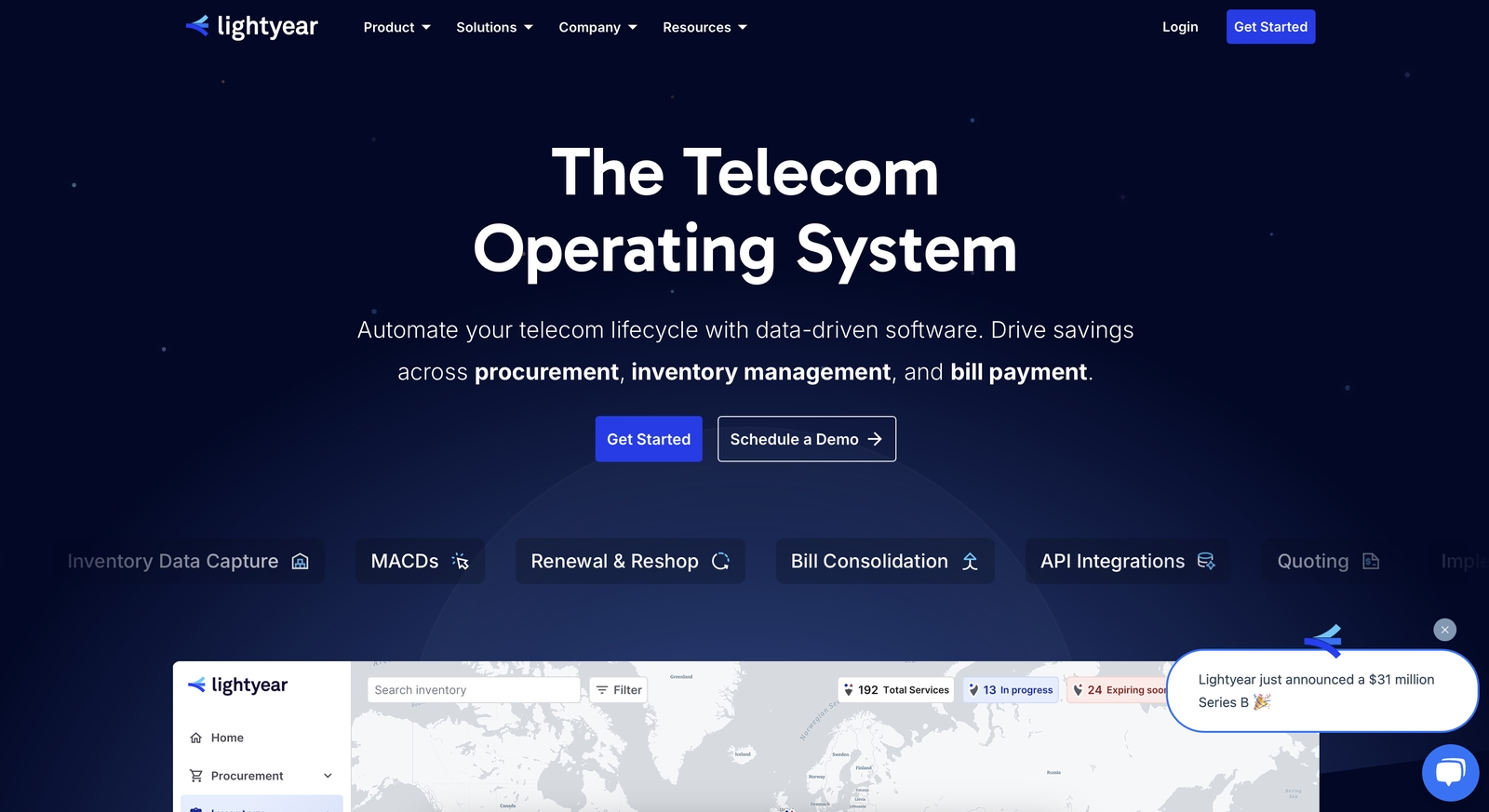
Whether you're dealing with Layer 2 or Layer 3 services, Lightyear simplifies the entire process by automating network service procurement, inventory management, and bill consolidation. The hundreds of enterprises who trust Lightyear achieve over 70% time savings and 20% cost savings on their network services.
Schedule a demo or get started with our questionnaire today.
Frequently Asked Questions about Data Link Layer vs Network Layer
Can a device have a MAC address but no IP address?
Yes. Every network device has a permanent MAC address from the factory. It only receives a temporary IP address when it joins a network. A simple Layer 2 switch, for instance, forwards traffic using MAC addresses and doesn't need an IP address itself.
How do VLANs relate to these layers?
VLANs (Virtual LANs) are a Layer 2 feature used to segment a physical network into multiple, isolated broadcast domains for better performance and security. However, for devices in different VLANs to communicate, a Layer 3 device like a router is required to route traffic between them.
Which layer is more important for network security?
Both are vital for a layered defense. Layer 2 security focuses on preventing unauthorized access within a local network. Layer 3 security uses firewalls and access control lists (ACLs) to filter traffic between different networks, protecting your internal infrastructure from external threats.
Let us show you the product and discuss specifics on how it might be helpful.
Schedule a Demo





Revolutionize Your Telecom Experience
Learn how you can get one step closer to optimal business efficiency for all your telecom services.