Ethernet vs FDDI: Comparing Network Technologies
Ethernet vs. FDDI: Which network technology is right for you? Learn the key differences in speed, cost, and topology to make an informed decision.

Selecting the right network technology is a critical decision for any business, directly impacting performance and scalability. Two prominent technologies you'll often encounter are Ethernet and Fiber Distributed Data Interface, or FDDI.
Though both were designed to transmit data across a network, they have fundamental differences in architecture, speed, and application.
This article will compare Ethernet and FDDI, providing the information IT and network managers need to understand their respective strengths and make informed infrastructure choices.
What is Ethernet?
Ethernet is the most common technology used to connect devices in a wired local area network (LAN). It establishes a standard set of rules that dictate how network devices format and transmit data, allowing other devices on the same network to recognize, receive, and process it.
Its widespread adoption is due to its reliability, cost-effectiveness, and scalability. Here are its core characteristics:
- Standardization: Ethernet is defined by the IEEE 802.3 standards, ensuring that networking equipment from different manufacturers can communicate without issue.
- Data Transmission: It sends data in packets called frames. Each frame contains source and destination addresses, along with error-checking mechanisms to ensure data arrives intact.
- Physical Media: While it once used coaxial cables, modern Ethernet primarily runs on twisted-pair copper cables and fiber optic cables for higher speeds and longer distances.
- Speed and Evolution: The technology has evolved significantly, with speeds scaling from 10 Mbps to 1 Gbps, 10 Gbps, and even 400 Gbps to meet modern data demands.
What is FDDI?
Fiber Distributed Data Interface, or FDDI, is a local area network (LAN) standard designed for data transmission over fiber optic cables. It was once a popular choice for large-scale campus and metropolitan area network backbones due to its high reliability and extended reach.
- Dual-Ring Architecture: FDDI uses two independent, counter-rotating rings for data transmission. If the primary ring fails, the network automatically reconfigures to use the secondary ring, providing excellent fault tolerance.
- Token-Passing Protocol: To send data, a device must wait to receive a special frame called a "token." This token-passing method prevents the data collisions that can occur on other types of networks.
- Physical Media: While it can run on copper cabling, FDDI is optimized for multi-mode fiber optic cables, enabling network segments to span very long distances.
- Standard Speed: FDDI operates at a fixed speed of 100 Mbps.
Key Differences Between Ethernet and FDDI
While both technologies connect network devices, their underlying designs create significant operational differences. Let's break down how they diverge in topology, data handling, and reliability.
1. Network Topology
Ethernet networks are most commonly arranged in a star topology, where all devices connect to a central switch or hub. This setup is flexible and easy to manage.
In contrast, FDDI is defined by its dual-ring topology. Data flows in opposite directions on two separate rings, a design that is fundamental to its operation.
2. Data Transmission Method
Ethernet uses a method called CSMA/CD (Carrier Sense Multiple Access with Collision Detection). Devices "listen" to the network and transmit only when it's clear, but if two devices send data simultaneously, a collision occurs, and the data must be resent.
FDDI avoids collisions entirely with its token-passing system. A device can only transmit data when it possesses the network "token," ensuring only one device sends data at a time.
3. Fault Tolerance
FDDI has built-in fault tolerance. If the primary ring is damaged, the network automatically uses the secondary ring to keep data flowing, ensuring high availability.
Standard Ethernet does not have this inherent redundancy. Achieving similar fault tolerance requires implementing additional protocols like the Spanning Tree Protocol (STP) to manage redundant paths and prevent network loops.
Performance and Speed Comparison
When it comes to raw speed, the two technologies are in different leagues. Ethernet has evolved dramatically over the years, while FDDI's speed is a relic of its era.
- Ethernet Speed: Modern Ethernet offers a wide spectrum of speeds, from 1 Gbps for standard office use to 100 Gbps and even 400 Gbps for data centers and network backbones. This scalability allows it to meet nearly any performance requirement.
- FDDI Speed: FDDI operates at a fixed speed of 100 Mbps. While this was considered high-speed when it was introduced, it is now significantly slower than what modern business applications demand.
- Performance Consistency: Because FDDI uses a token-passing system, its performance is highly predictable, even under heavy network traffic. In contrast, older Ethernet could slow down due to data collisions, though modern switched Ethernet has largely solved this problem.
Cost Considerations for Ethernet and FDDI
From a budget perspective, the financial implications of choosing one over the other are significant. The widespread adoption of Ethernet has made it a far more economical choice for modern networks.
- Hardware and Labor: Ethernet components like switches and network cards are mass-produced, making them inexpensive and widely available. Its ubiquity also means that installation and maintenance are straightforward, resulting in lower operational expenses.
- Legacy Costs: FDDI hardware, on the other hand, is legacy technology. Components are rare, difficult to source, and carry a high price tag. The specialized expertise needed to manage an FDDI network also makes maintenance and support more costly.
- Cabling: While high-speed Ethernet uses fiber optic cables, its ability to run on inexpensive twisted-pair copper cabling for many standard deployments gives it a significant cost advantage over FDDI, which is optimized for more expensive fiber.
Use Cases and Applications
The practical applications for these two technologies reflect their respective eras and capabilities. Given their differences in speed, cost, and architecture, their roles in a business network are distinct.
- Ethernet: Thanks to its scalability and cost-effectiveness, Ethernet is the standard for virtually all modern networking. It powers everything from small office local area networks (LANs) connecting computers and printers to the high-speed backbones of data centers and wide area networks (WANs).
- FDDI: This is a legacy technology whose role is primarily historical. In its prime, it was a reliable choice for campus and metropolitan network backbones where uptime was critical. Today, its application is limited to maintaining older infrastructures that have not yet been upgraded to modern Ethernet standards.
Making the Right Choice for Your Network
When deciding between Ethernet and FDDI, the choice for any modern business is straightforward. The key differences in performance, cost, and application make one the clear successor to the other. Here’s a simple breakdown to guide your decision:
- For New Deployments: Ethernet is the undisputed standard. Its vast range of speeds, from 1 Gbps to 400 Gbps, supports everything from office LANs to data center backbones.
- For Existing Infrastructure: FDDI’s relevance is limited to maintaining legacy systems. If you have an active FDDI network, the goal should be planning a migration to an Ethernet-based infrastructure.
- Budget and Support: Ethernet hardware is inexpensive and readily available, with a large pool of technicians skilled in its management. FDDI components are costly, difficult to find, and require specialized knowledge.
Ultimately, for any new network build or upgrade, Ethernet provides the performance, scalability, and financial sense required for today's business operations.
Need Help Managing Your Network? Lightyear Can Help
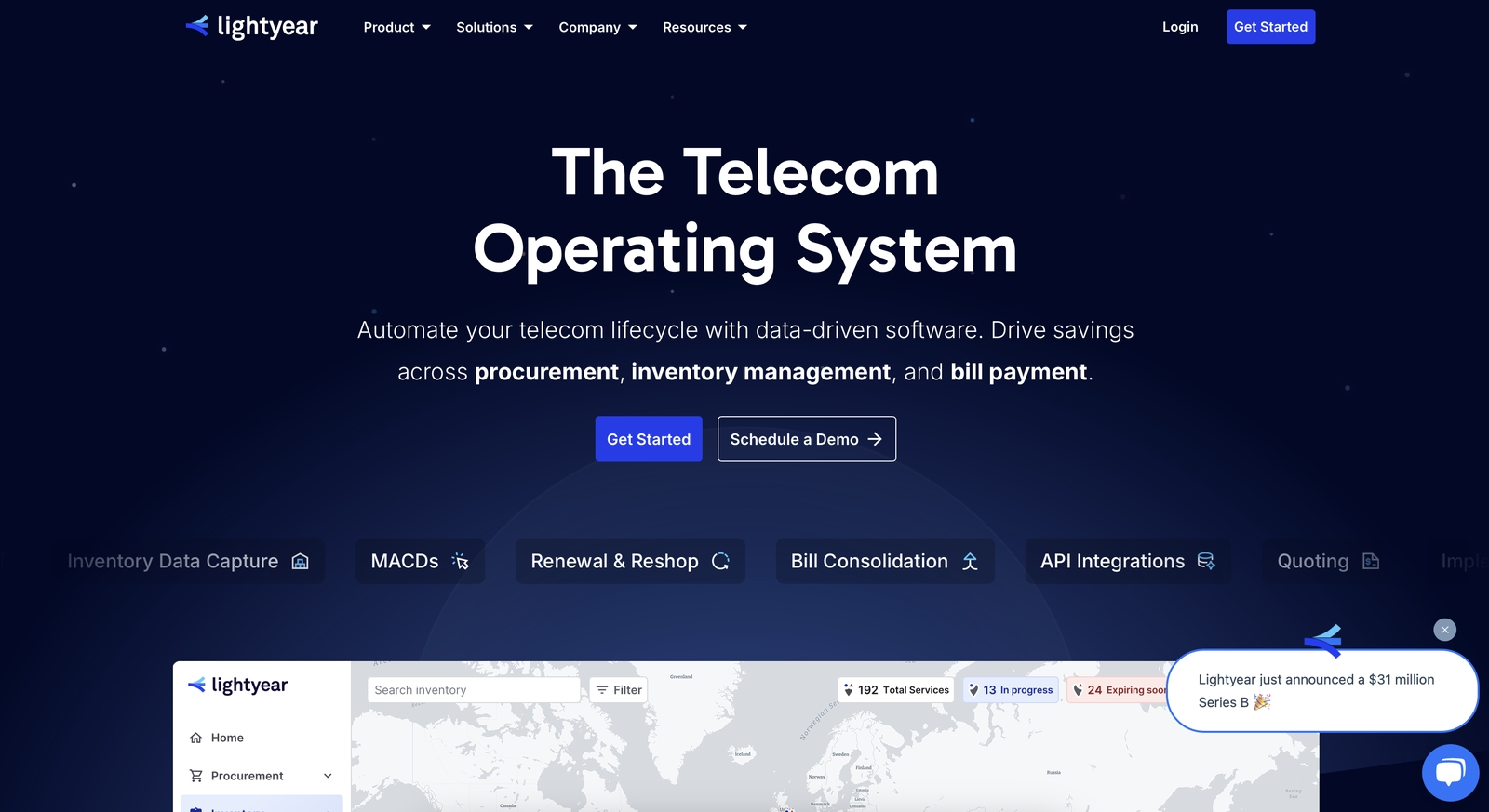
Choosing the right network technology is just the first step; the next is procuring and managing those services efficiently.
By automating network service procurement, inventory management, and bill consolidation, Lightyear removes the complexity of infrastructure management. Enterprises that use Lightyear save over 70% in time and 20% in costs on their network services.
Schedule a demo or get started with our questionnaire today.
Frequently Asked Questions about Ethernet vs FDDI
Can FDDI be upgraded to match Ethernet speeds?
No, FDDI's speed is fixed at 100 Mbps by its standard. Achieving higher speeds requires a full migration, replacing the FDDI hardware with modern Ethernet components. It is not possible to simply upgrade the existing FDDI infrastructure to perform faster.
Is FDDI more secure than Ethernet?
Not inherently. While its token-passing system prevents data collisions, it offers no special protection against modern security threats. Network security relies on firewalls, encryption, and access controls, which can be implemented on both Ethernet and FDDI networks.
Why was FDDI's dual-ring design so important?
The dual-ring architecture provided automatic failover. If the primary ring was damaged, the network would instantly reroute traffic to the secondary ring. This built-in redundancy was a key advantage for networks where uptime was critical, long before modern Ethernet resiliency became standard.
Can you mix Ethernet and FDDI devices on the same network?
Yes, but it requires a network bridge or router that can translate between the two different protocols. This approach is most commonly used to support a phased migration from a legacy FDDI backbone to a new Ethernet infrastructure without causing major service disruptions.
Let us show you the product and discuss specifics on how it might be helpful.
Schedule a Demo





Revolutionize Your Telecom Experience
Learn how you can get one step closer to optimal business efficiency for all your telecom services.