Ethernet vs Infiniband: AI Workload Comparison
Choosing between Ethernet and Infiniband for AI? Learn the key differences in speed, latency, and cost to find the best fit for your enterprise network.

As artificial intelligence and high-performance computing (HPC) become more central to business operations, the underlying network fabric is more important than ever. For IT leaders, the choice often comes down to two powerful contenders: Ethernet and InfiniBand.
Both are capable technologies, but they have key differences in performance, scalability, and cost that directly impact AI workloads. This guide offers a straightforward comparison to help you decide which networking solution is right for your infrastructure.
What is Ethernet?
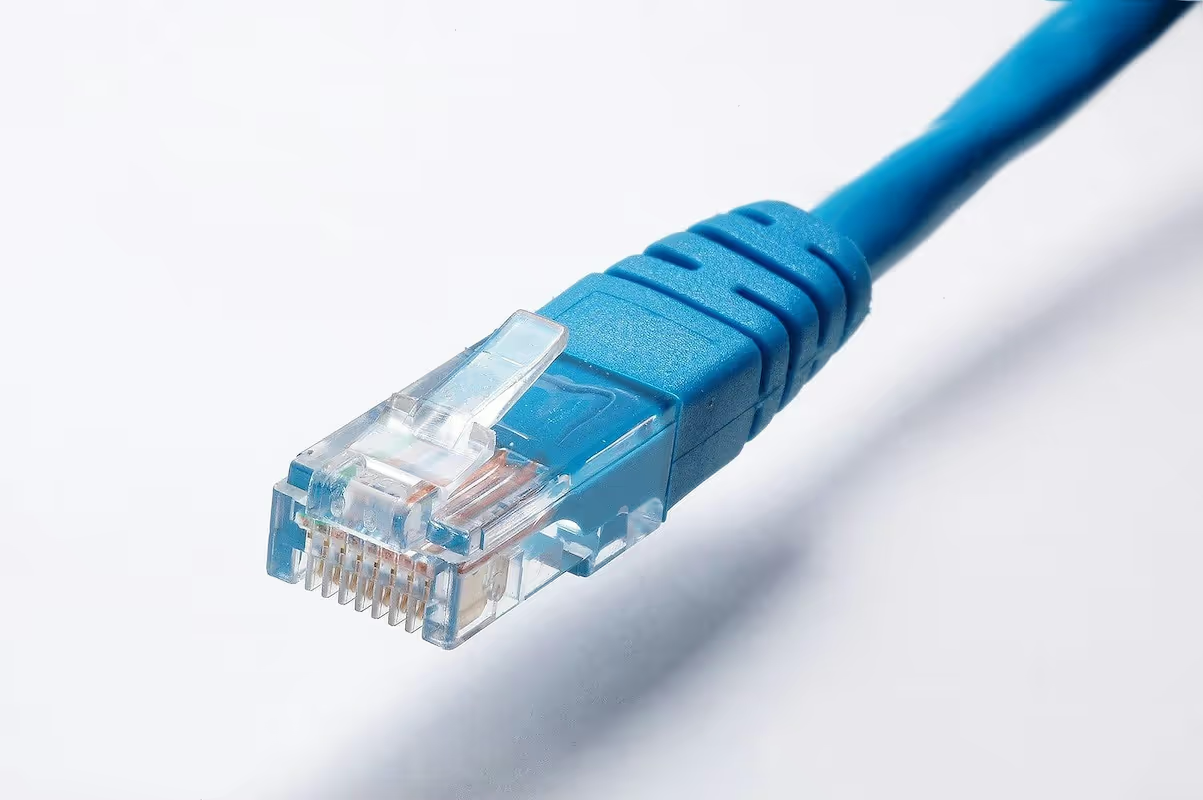
You've almost certainly encountered Ethernet before; it's the technology behind the familiar network cable you plug into your computer or router. For decades, it has been the dominant standard for local area networks (LANs) in offices, data centers, and homes worldwide. It defines the rules for how devices connect and transmit data over a wired network.
- Standardization: It’s governed by the IEEE 802.3 standards, which ensures interoperability between equipment from different manufacturers.
- Data Transmission: Ethernet works by breaking data into smaller pieces called frames or packets. Each device on the network has a unique Media Access Control (MAC) address, which is used to send and receive these packets correctly.
- Versatility: While originally designed for office LANs, its speed and reliability have led to its adoption in demanding environments, including modern data centers.
- Speed Evolution: Ethernet speeds have grown exponentially, from early 10 Megabits per second (Mbps) connections to today’s 400 Gigabits per second (Gbps) and even faster standards, keeping pace with growing data demands.
What is Infiniband?
While Ethernet is a household name, InfiniBand is a more specialized technology built from the ground up for high-performance computing (HPC). It’s a network interconnect designed to connect servers, storage systems, and other data center components with maximum throughput and minimal delay, making it a popular choice for demanding AI workloads.
- Purpose-Built for Performance: Unlike the more general-purpose Ethernet, InfiniBand was specifically created for environments like supercomputing clusters where low latency is the top priority.
- Low-Latency Communication: Its signature feature is Remote Direct Memory Access (RDMA), which allows servers to exchange data directly from their memory. This bypasses the slower operating system and significantly reduces processing overhead.
- High Bandwidth: It offers extremely high data transfer rates, with standards like HDR (200 Gbps) and NDR (400 Gbps) commonly used in performance-intensive systems.
- Separate Standard: InfiniBand is governed by the InfiniBand Trade Association (IBTA) and is not an extension of the Ethernet protocol.
Ethernet vs Infiniband: Key Differences
While both technologies connect servers and storage, they operate on fundamentally different principles. These differences affect everything from latency to how the network is managed.
Latency and Protocol Overhead
InfiniBand is engineered for ultra-low latency. It achieves this using Remote Direct Memory Access (RDMA), which allows network adapters to transfer data directly between server memories without involving the main processor or operating system.
Traditional Ethernet, on the other hand, processes data through the TCP/IP software stack. This adds steps and increases latency, though modern extensions like RoCE (RDMA over Converged Ethernet) aim to close this gap.
Network Management
Ethernet is the industry standard, making its management straightforward with widely available tools and expertise. It operates on a plug-and-play basis for most common uses.
InfiniBand requires a more specialized approach. The network relies on a Subnet Manager to initialize the fabric, assign local IDs, and calculate routing tables, adding a layer of administrative overhead.
Congestion Control
InfiniBand was designed as a lossless fabric from the start. It uses a credit-based flow control mechanism to ensure that a destination port only receives data when it has the buffer space, effectively preventing congestion-related packet loss.
Ethernet has adapted to handle congestion in data centers with standards like Data Center Bridging (DCB), but it was not originally built with lossless transport as a core requirement.
Performance in AI Workloads
When it comes to AI and machine learning, network performance directly translates to how quickly models can be trained and results can be generated. The technical architecture of each fabric creates distinct advantages depending on the specific workload.
- Large-Scale AI Training: For training massive, distributed AI models, InfiniBand often has an edge. These tasks require constant, synchronized communication between hundreds or thousands of GPUs. InfiniBand’s native low-latency design and lossless fabric are built for this, helping to reduce model training times significantly.
- Ethernet's Performance: High-speed Ethernet, especially with RDMA over Converged Ethernet (RoCE), is a powerful and capable alternative for many AI applications. For inference workloads, which are less sensitive to network latency, or for training smaller models, 400G Ethernet provides more than sufficient performance.
- Job Completion Time: The key performance difference often appears in overall job completion time for the most demanding tasks. In environments running huge, parallel AI jobs, the slight latency advantage of InfiniBand, compounded over millions of transactions, can shorten processing cycles. For more generalized AI applications, modern Ethernet delivers ample throughput.
Cost Considerations
When it comes to budget, Ethernet is typically the more cost-effective choice. Because it is a widely adopted standard, hardware like switches, cables, and network interface cards (NICs) is available from a large number of vendors, driving prices down through competition.
InfiniBand hardware, on the other hand, is produced by fewer manufacturers and is generally more expensive. As a specialized technology, its components carry a premium price tag.
Operational costs are also a factor. The talent pool for managing standard Ethernet networks is vast, while finding engineers with deep InfiniBand expertise can be more challenging and costly. However, for massive AI clusters, the higher initial investment in InfiniBand may be justified if its performance significantly shortens model training times, leading to a lower total cost of ownership over the long run.
Scalability and Future-Proofing
Beyond the initial cost, it's crucial to consider how your network will grow with your AI ambitions. Both technologies offer paths to scale, but their approaches differ significantly, impacting long-term flexibility.
- Ethernet Scalability: As the universal standard for enterprise networking, Ethernet offers broad interoperability. Scaling an Ethernet fabric is often simpler because it easily integrates with existing infrastructure. Its roadmap is aggressive, with 800G and 1.6T speeds on the horizon and industry groups like the Ultra Ethernet Consortium working to optimize it specifically for AI.
- InfiniBand Scalability: InfiniBand is designed for high-density scaling within a self-contained cluster. It excels at growing large, tightly-coupled AI systems. While its roadmap also includes faster speeds, its future is tied to maintaining a performance lead over the rapidly advancing and more open Ethernet ecosystem.
Making the Right Choice for Your Enterprise
The decision between Ethernet and InfiniBand isn’t about which is universally better, but which is the right fit for your specific AI strategy and budget. Your choice will depend on the nature of your workloads and your operational priorities.
For organizations running the most demanding, large-scale distributed training models, InfiniBand's low-latency architecture offers a distinct performance advantage that can shorten job completion times. This may justify its higher hardware and management costs.
Conversely, for a wider range of AI applications, including inference or smaller model training, high-speed Ethernet provides excellent performance at a more accessible price point. Its standardization simplifies integration with existing infrastructure and widens the talent pool for network management.
Ultimately, evaluate your workload’s sensitivity to latency, your budget, and your long-term scaling plans to select the most practical networking fabric for your enterprise.
Need Help Managing Your Network? Lightyear Can Help
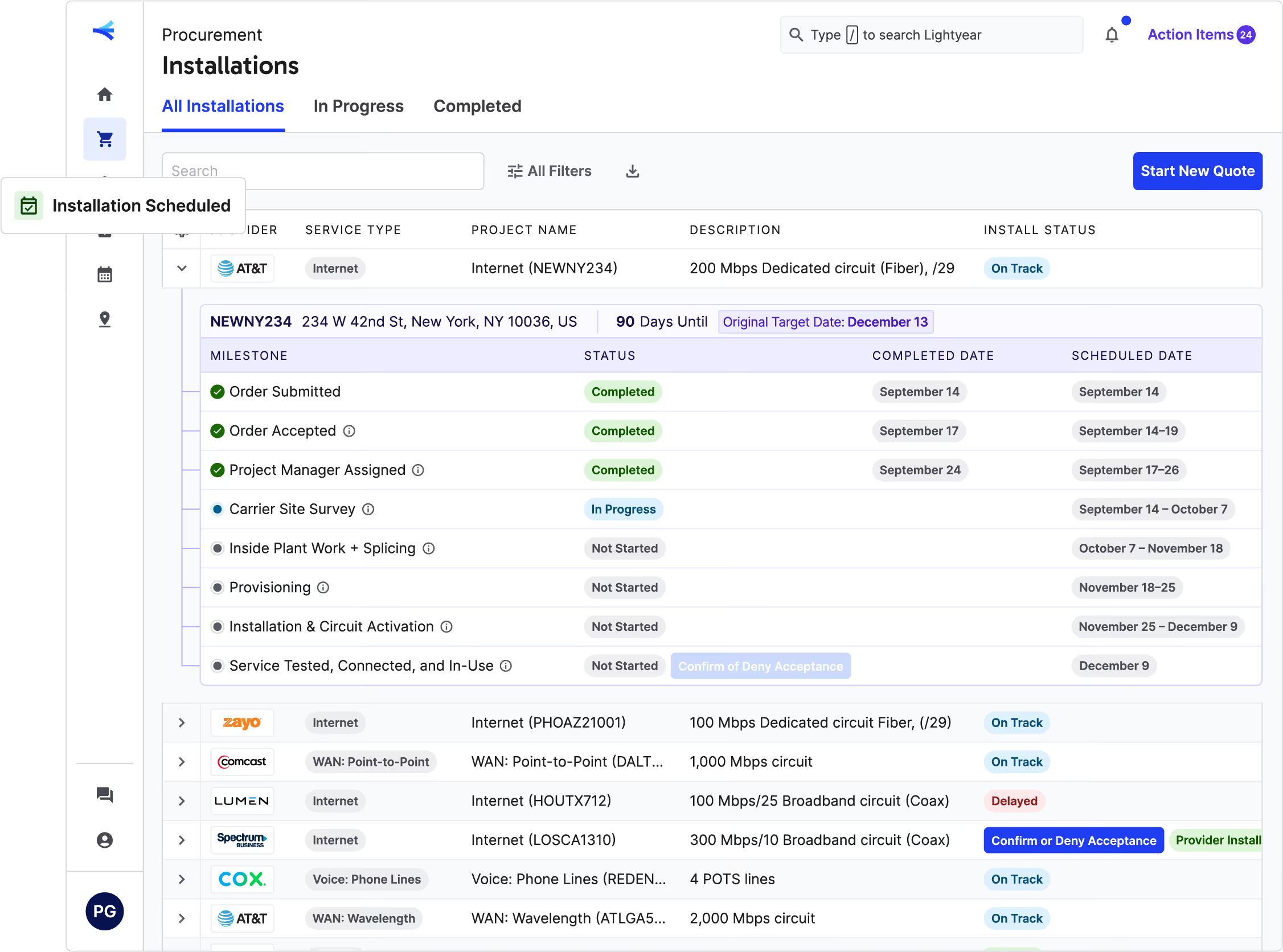
Once you've decided between Ethernet and InfiniBand, the next challenge is procuring and managing the infrastructure. By automating network service procurement, inventory management, and bill consolidation, Lightyear takes the pain out of telecom infrastructure management.
The hundreds of enterprises who trust Lightyear achieve 70%+ time savings and 20%+ cost savings on their network services. Schedule a demo or get started with our questionare today.
Frequently Asked Questions about Ethernet vs Infiniband AI Workloads
Can I use both Ethernet and InfiniBand in the same network?
Yes, but they typically serve different roles. You might use an InfiniBand fabric for your high-performance AI cluster and connect that cluster to the broader data center network using an Ethernet gateway. They are not directly interoperable within the same fabric.
Is RoCE (RDMA over Converged Ethernet) a good substitute for InfiniBand?
RoCE brings InfiniBand-like RDMA capabilities to Ethernet, closing the performance gap. While InfiniBand often maintains a slight latency advantage in massive clusters, RoCE provides a powerful, high-performance alternative that integrates more easily with existing Ethernet infrastructure.
Does choosing InfiniBand create vendor lock-in?
It can be a concern. The InfiniBand market has fewer hardware vendors compared to the vast Ethernet ecosystem. This can limit component choice and pricing competition, making it important to consider your long-term vendor strategy when making a decision.
Let us show you the product and discuss specifics on how it might be helpful.
Schedule a Demo





Revolutionize Your Telecom Experience
Learn how you can get one step closer to optimal business efficiency for all your telecom services.