Ethernet vs PROFINET: Network Protocol Differences
Ethernet is the network, PROFINET is the protocol. Our guide clarifies the difference and helps you decide what your industrial network requires.

For IT and operations teams, the terms Ethernet and PROFINET often appear in the same conversations, leading to natural questions about how they differ. While they are closely related, they serve distinct functions within a network architecture.
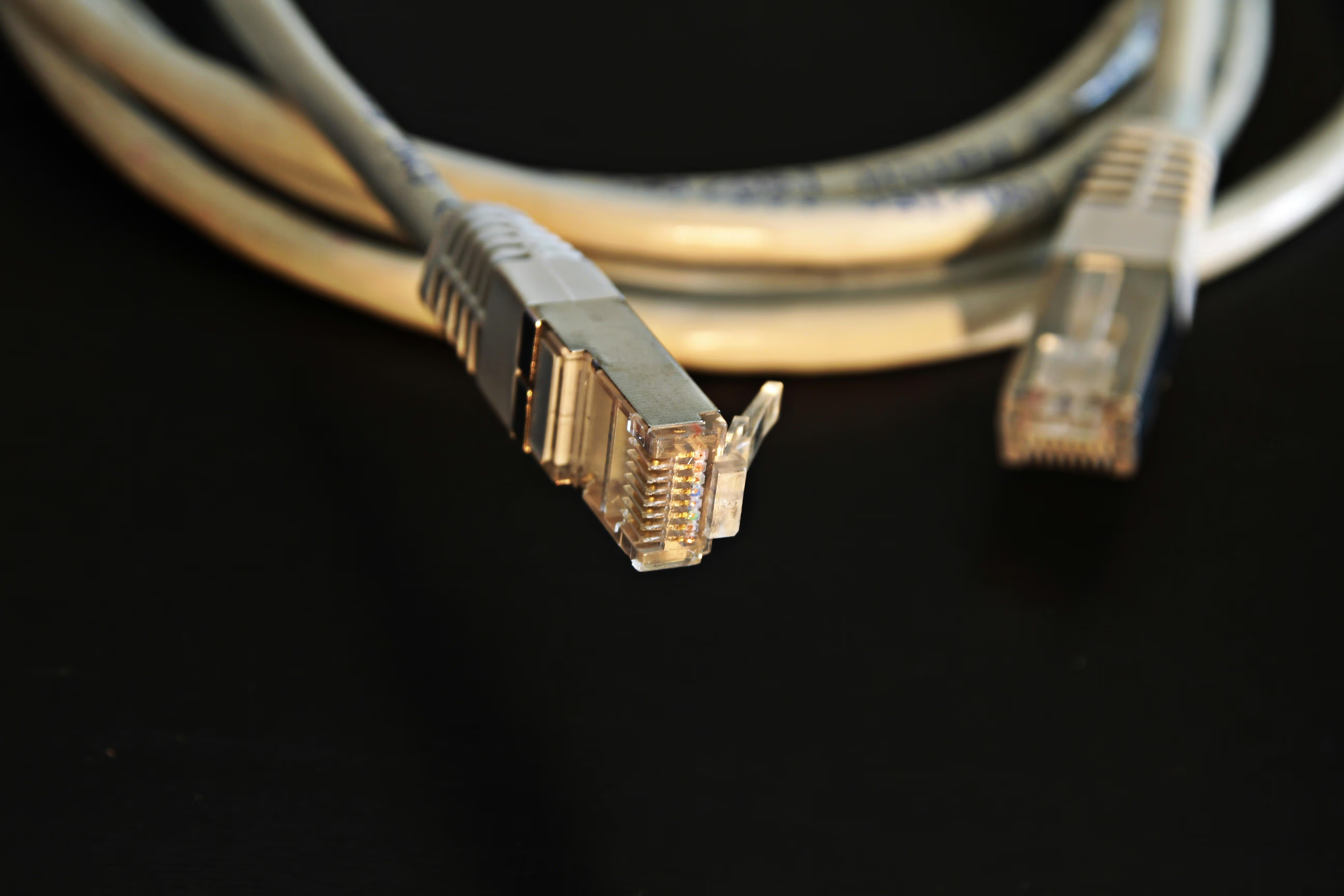
Ethernet is the foundational technology that defines the physical and data link layers of most modern networks—the cables, switches, and basic data transmission rules. PROFINET, however, is an application-level protocol that runs on top of standard Ethernet to meet the demanding requirements of industrial automation, like controlling robotics or manufacturing lines.
Understanding this distinction is critical for making informed infrastructure decisions. This article breaks down the key differences between the two, their specific use cases, and how they work together to support both corporate and industrial operations.
What is Ethernet?
At its core, Ethernet is a family of wired networking technologies for local area networks (LANs), metropolitan area networks (MANs), and wide area networks (WANs). It provides the fundamental rules for how devices connect and share information over a wired connection.
- Standardized Protocol: Governed by IEEE 802.3 standards, it ensures networking hardware from different manufacturers can communicate reliably.
- Physical and Data Link Layers: It operates at the first two OSI model layers, defining specifications for cables (Layer 1) and rules for transferring data frames via MAC addresses (Layer 2).
- Packet-Based Communication: Data is sent in units called frames, each containing source and destination addresses, the data payload, and error-checking information.
- Hardware Dependent: The system relies on physical components like Ethernet cables, network interface cards (NICs), and switches to connect devices and direct traffic.
What is PROFINET?
PROFINET is an industrial communication standard built to exchange data between controllers and devices in automated environments. It uses standard Ethernet technology as its foundation but adds rules to ensure messages arrive precisely when needed for time-sensitive industrial processes, like robotics and assembly lines.
- Real-Time Performance: It is engineered for deterministic communication, ensuring data packets are delivered within a predictable, fixed timeframe. This is crucial for controlling machinery where split-second timing matters.
- Conformance Classes: The protocol offers different performance levels, from non-critical data transfer to high-speed, synchronized motion control, making it adaptable to various factory floor requirements.
- IT Integration: Because it runs on standard Ethernet hardware, PROFINET can coexist with regular office and data traffic on the same network infrastructure, simplifying management for IT teams.
Ethernet vs PROFINET: Key Differences
While both technologies can operate on the same physical network, their fundamental goals lead to key operational differences that IT leaders should understand.
1. Performance and Data Prioritization
Standard Ethernet typically relies on TCP/IP for data transmission, which is reliable but not always timely. It operates on a "best-effort" basis, where data packets can face delays if the network is congested.
PROFINET, on the other hand, prioritizes its own traffic. For time-critical tasks, it bypasses the standard TCP/IP layers and sends data directly using Ethernet frames, ensuring its messages get precedence over general office traffic.
2. Determinism vs. Best-Effort Delivery
This leads to the biggest distinction: determinism. PROFINET is a deterministic network, meaning data is guaranteed to arrive within a precise, predictable time window—often measured in microseconds.
Standard Ethernet is non-deterministic. While fast, it cannot offer the same guarantee of timing, which is unacceptable for synchronized processes like motion control where a millisecond delay can cause a system failure.
3. Hardware Specifications
Although PROFINET uses standard Ethernet hardware, it often requires industrial-grade components to function reliably in harsh environments.
This includes specialized switches that can manage PROFINET’s real-time data channels and ruggedized, shielded cabling designed to resist electromagnetic interference, vibration, and extreme temperatures common on a factory floor.
Use Cases for Ethernet
Ethernet is the workhorse of modern business connectivity, supporting a wide range of applications across corporate environments where real-time precision is not the primary requirement.
Its most common use is building local area networks (LANs) to connect employee computers, printers, and servers. In data centers, high-speed Ethernet provides the essential fabric for linking storage arrays and compute resources, handling massive data flows efficiently.
The technology also serves as the foundation for unified communications, supporting Voice over IP (VoIP) phone systems and video conferencing. Finally, it provides the crucial link for wide area network (WAN) and internet access, connecting the entire organization to external resources and cloud services.
Use Cases for PROFINET
PROFINET's applications are centered entirely within industrial automation, where its real-time capabilities are essential. It serves as the communication backbone for factory floors, connecting programmable logic controllers (PLCs) to the devices they manage, from sensors to robotic arms.
A primary use case is in motion control systems, such as synchronizing multiple motors on an assembly line or coordinating drives in a high-speed packaging machine. In these scenarios, precise timing is not just beneficial—it's a requirement for operational success.
The protocol is also critical in process automation for industries like chemical manufacturing or food and beverage. It manages the data flow between sensors, valves, and control systems to maintain stable and predictable operations where quality depends on exact timing.
Choosing Between Ethernet and PROFINET
Deciding between Ethernet and PROFINET is not an either/or choice for your entire organization. It’s about matching the right technology to the specific application based on its unique requirements.
- Assess the primary function. For connecting office computers, printers, servers, and providing internet access, standard Ethernet is the correct and cost-effective choice. Its performance is more than sufficient for typical business data traffic.
- Evaluate the need for real-time communication. If an application involves synchronized motion control or high-speed automation where timing must be predictable down to the microsecond, PROFINET is necessary. Standard Ethernet cannot provide this level of determinism.
- Consider the physical environment. PROFINET systems typically require industrial-grade hardware, including rugged switches and shielded cables, to function reliably in harsh factory conditions with electrical interference and temperature extremes.
- Plan for coexistence. A key point for IT teams is that both protocols can run on the same physical network. This allows you to manage industrial controls and corporate data traffic within a unified infrastructure, reducing complexity.
Final Thoughts on Ethernet and PROFINET
Ultimately, Ethernet and PROFINET are not competitors but complementary technologies designed for different jobs. Ethernet is the backbone of your corporate network, handling everything from email to video calls with reliable, high-speed performance.
PROFINET builds on that foundation, adding the real-time precision required to run a modern factory floor. For IT leaders, the key is recognizing that both can coexist on the same infrastructure, allowing for unified management of both office and industrial networks. The decision comes down to the application: if it needs guaranteed timing, choose PROFINET.
Need Help Managing Your Network? Lightyear Can Help
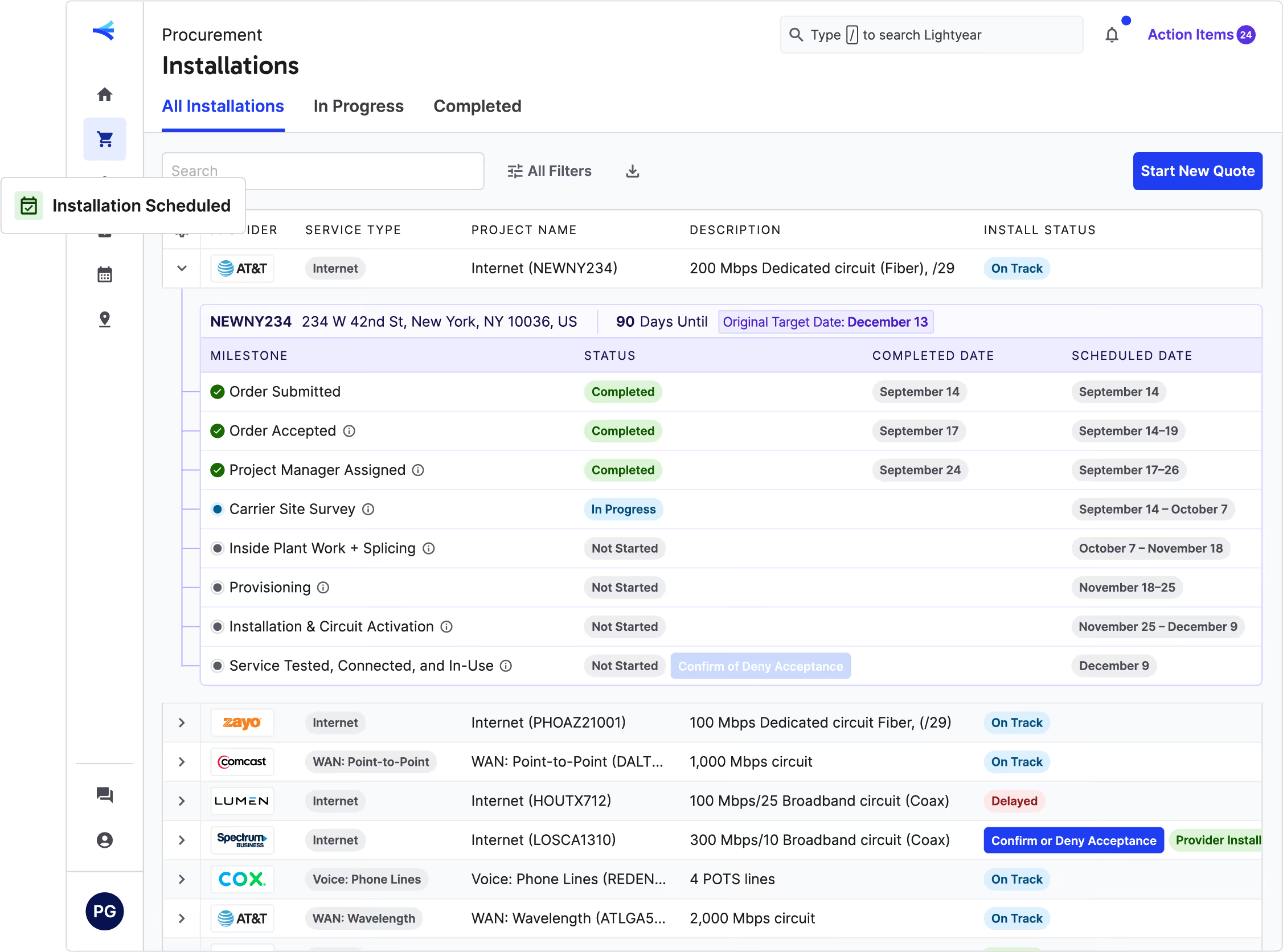
Whether your network runs on Ethernet, PROFINET, or a combination, managing the underlying services can be complex. By automating network service procurement, inventory management, and bill consolidation, Lightyear takes the pain out of telecom infrastructure management.
The hundreds of enterprises who trust Lightyear achieve 70%+ time savings and 20%+ cost savings on their network services.
Schedule a demo or get started with our questionare today.
Frequently Asked Questions about Ethernet vs PROFINET
Can I use my existing office Ethernet cables for PROFINET?
While PROFINET uses standard Ethernet technology, it's best to use industrial-grade, shielded cables. These protect against electrical interference and physical stress common in factory environments, ensuring the network's reliability and performance for critical tasks.
Is PROFINET more expensive than a standard Ethernet setup?
Initially, yes. PROFINET requires specialized, ruggedized hardware like switches and cables, which costs more than standard office equipment. This investment ensures the reliability and precise timing needed for industrial automation, preventing costly production failures.
Do I need special software to manage a PROFINET network?
Yes, you'll need specific engineering tools to configure and commission PROFINET devices and controllers. While it runs on standard network hardware, its management is handled through dedicated industrial automation software, not typical IT network monitoring tools.
How does PROFINET handle network security?
PROFINET includes security features like a "secure boot" for devices and role-based access control. Because it operates on your standard network, it also benefits from traditional IT security measures like firewalls and VLANs to protect the industrial environment.
Let us show you the product and discuss specifics on how it might be helpful.
Schedule a Demo





Revolutionize Your Telecom Experience
Learn how you can get one step closer to optimal business efficiency for all your telecom services.