Fast Ethernet vs Gigabit: Enterprise Network Comparison
Choosing between Fast Ethernet and Gigabit? This guide compares speeds (100 Mbps vs. 1000 Mbps) to help you select the right enterprise network.

When setting up or upgrading your company's network, you'll encounter different types of Ethernet connections. Two of the most common standards you'll see are Fast Ethernet and Gigabit Ethernet.
While both serve the same fundamental purpose, their primary difference is data transfer speed. Understanding this distinction is key to choosing the right infrastructure for your business needs and budget.
What is Fast Ethernet?
Fast Ethernet is a version of the Ethernet networking standard that supports a data transfer rate of up to 100 megabits per second (Mbps). Officially known as IEEE 802.3u, it represented a major leap forward from the original 10 Mbps Ethernet when it was introduced. While no longer the standard for new, high-performance networks, it remains relevant in many existing systems and for specific applications where high bandwidth isn't a primary concern.
- Speed: It operates at a maximum speed of 100 Mbps, which is suitable for basic tasks like email, light web browsing, and connecting low-demand devices.
- Cabling: It most commonly uses Category 5 (Cat5) twisted-pair cables but is also compatible with newer Cat5e and Cat6 cabling.
- Common Applications: You'll often find Fast Ethernet in older office buildings, budget-conscious network setups, or connecting peripheral devices like printers and some VoIP phones.
What is Gigabit Ethernet?
Gigabit Ethernet is the successor to Fast Ethernet, delivering data transfer speeds ten times faster. Officially standardized as IEEE 802.3ab, it has become the go-to for modern business networks because it can comfortably handle today's demanding data traffic. This standard provides the robust bandwidth required for high-performance tasks, making it a fixture in nearly all contemporary IT infrastructures.
- Speed: It operates at 1000 Mbps, or 1 gigabit per second (Gbps). This capacity is essential for smooth video conferencing, quick transfers of large files, and running cloud-based applications without bottlenecks.
- Cabling: It requires at least Category 5e (Cat5e) cabling to function. However, Category 6 (Cat6) or newer cables are recommended to guarantee optimal performance and reduce potential network interference.
- Common Applications: Gigabit Ethernet is the standard for connecting workstations, servers, and network-attached storage (NAS) in modern offices and data centers.
Fast Ethernet vs Gigabit Ethernet: Key Differences
While the most obvious difference is speed, several other factors distinguish these two standards, impacting your network's performance, budget, and long-term viability.
1. Performance and Throughput
The tenfold speed increase of Gigabit Ethernet translates directly to real-world efficiency. A 1 GB file that takes over a minute to transfer on a Fast Ethernet connection can be moved in about eight seconds on a Gigabit network.
This difference becomes critical when multiple users are accessing cloud applications, participating in video calls, or backing up data simultaneously. Furthermore, Gigabit Ethernet offers superior full-duplex capability. It can send and receive data at 1000 Mbps at the same time, providing a total bandwidth of 2000 Mbps, whereas Fast Ethernet is limited to a total of 200 Mbps.
2. Cost Considerations
Historically, Fast Ethernet held a significant cost advantage. Today, that gap has nearly closed. The price for Gigabit-capable switches, routers, and network cards has become the industry standard, making them highly affordable.
The primary cost variable now lies in the cabling. If your facility has older Cat5 wiring, upgrading to Cat5e or Cat6 to support Gigabit speeds will be an added expense. For any new installation, however, the marginal cost increase for Cat5e/Cat6 cabling is minimal, making Gigabit the more practical investment.
3. Future-Proofing Your Network
Opting for Gigabit Ethernet is a strategic move to future-proof your infrastructure. As your business adopts more data-intensive applications, cloud services, and connected devices, network demands will only grow.
Installing a Fast Ethernet network might offer small initial savings, but it risks becoming a performance bottleneck that requires a more expensive replacement down the line. Building your network on a Gigabit foundation ensures it can handle future growth and technological advancements without needing a premature and disruptive overhaul.
Benefits of Fast Ethernet
While Gigabit Ethernet is the modern standard, Fast Ethernet still offers practical advantages in specific situations, especially when managing costs and existing infrastructure.
- Cost-Effectiveness: It is fully compatible with older Category 5 (Cat5) cabling. If your building is already wired with Cat5, using Fast Ethernet allows you to avoid the cost and disruption of pulling new cables for devices that don't need higher speeds.
- Sufficient for Low-Demand Devices: It provides more than enough bandwidth for peripherals like printers, many VoIP phones, and simple IoT sensors. For these applications, Gigabit speed is unnecessary, making Fast Ethernet a perfectly suitable and economical choice.
- Lower Power Consumption: On average, Fast Ethernet hardware consumes less power than Gigabit hardware. While the difference per device is small, it can add up to modest energy savings in deployments with hundreds of endpoints.
Benefits of Gigabit Ethernet
For any modern business, the advantages of Gigabit Ethernet are directly tied to operational efficiency and the ability to support current and future technologies.
- Greater Employee Productivity: With speeds that eliminate lag, employees spend less time waiting for files to transfer or cloud applications to load. This directly translates to more efficient workflows and less frustration across the team.
- Robust Support for Modern Applications: It provides the necessary bandwidth for data-heavy operations like high-definition video conferencing, running complex cloud-based CRM or ERP systems, and processing large datasets without performance degradation.
- Reduced Network Congestion: In offices with numerous connected devices, Gigabit Ethernet prevents network bottlenecks. This ensures a stable and reliable connection for all users, even during peak usage times.
- Quicker Data Backups and Recovery: The high throughput significantly shortens the time needed for data backups. More importantly, it allows for faster data restoration, improving your business's recovery time objective (RTO) in a disaster scenario.
Choosing the Right Ethernet for Your Business
Making the right choice comes down to a practical assessment of your company's specific operational needs, budget, and growth plans.
1. Evaluate Your Existing Cabling and Hardware
Start by auditing your current infrastructure. The type of cabling installed in your facility is often the deciding factor.
If you have Cat5e or newer cables, Gigabit Ethernet is the logical choice for performance. If you're working with older Cat5, you can use Fast Ethernet for less critical connections or budget for a cabling upgrade to support higher speeds.
2. Map Your Device and Application Requirements
Next, consider the specific demands of your devices. Not every piece of equipment requires a high-speed connection.
Workstations, servers, and wireless access points need Gigabit speeds to prevent bottlenecks. In contrast, peripherals like printers and many VoIP phones function perfectly on Fast Ethernet, which can be a cost-effective solution for those specific endpoints.
3. Align with Your Company's Future Goals
Finally, look at your business roadmap. A network built for today might not support your needs tomorrow.
If your company is expanding or adopting more cloud-based tools, standardizing on Gigabit Ethernet is essential. This approach ensures your network can support future demands without requiring a costly overhaul.
Final Thoughts on Ethernet Choices
The decision between Fast and Gigabit Ethernet is often straightforward. For any new network or performance-sensitive area, Gigabit Ethernet is the default choice. Its superior speed supports modern applications and prepares your infrastructure for future growth, making it a wise long-term investment.
However, Fast Ethernet remains a practical option for specific use cases. It is perfectly adequate for low-demand devices like printers or in areas with existing Cat5 cabling where an upgrade isn't cost-effective. A hybrid approach often yields the most efficient and economical network.
Need Help Managing Your Network? Lightyear Can Help
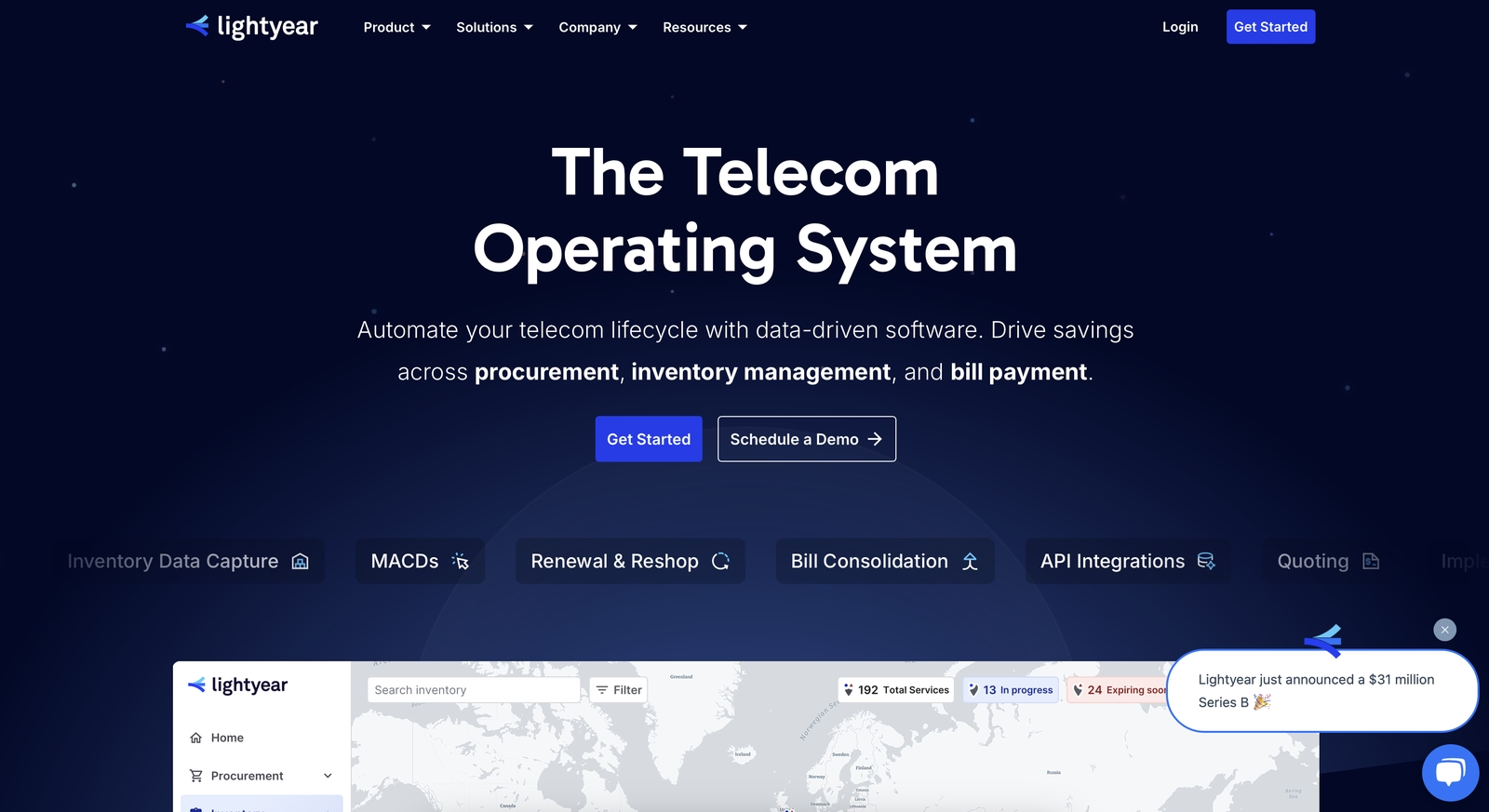
Choosing between Fast and Gigabit Ethernet is just the first step. Lightyear helps with what comes next by automating network service procurement, inventory management, and bill consolidation, taking the pain out of managing your telecom infrastructure.
Enterprises that use Lightyear save over 70% in time and 20% in costs on their network services. Schedule a demo or get started with our questionnaire today.
Frequently Asked Questions about Fast Ethernet vs Gigabit
Can I mix Fast Ethernet and Gigabit Ethernet devices on the same network?
Yes. Modern network switches use auto-negotiation to connect to each device at its highest supported speed. A Gigabit switch can serve both 100 Mbps and 1000 Mbps devices at the same time, with each operating at its own maximum rate.
If I plug a Fast Ethernet device into a Gigabit switch, will it run faster?
No, the device will still operate at its maximum speed of 100 Mbps. A network connection is only as fast as its slowest component. To achieve Gigabit speeds, the device, its network card, the switch, and the cabling must all be Gigabit-capable.
Will upgrading to Gigabit Ethernet make my Wi-Fi faster?
It often does, especially with modern Wi-Fi 5 or 6 access points. The wired connection to your access point can be a bottleneck. A Gigabit connection ensures your Wi-Fi hardware has enough bandwidth to deliver the fastest possible speeds to your wireless devices.
Let us show you the product and discuss specifics on how it might be helpful.
Schedule a Demo





Revolutionize Your Telecom Experience
Learn how you can get one step closer to optimal business efficiency for all your telecom services.