Frontier Communications vs Granite: Which ISP Is Better?
Choosing an ISP for your business? We compare Frontier and Granite on network, services, and pricing to help you make the right choice.


Frontier Communications is one of the largest internet service providers in the US, offering a mix of fiber and DSL services. Granite Telecommunications provides voice, data, and other communications products primarily to multi-location businesses and government agencies.
Choosing between major providers can be a complex decision for any business. To help you find the right fit, we're comparing Frontier and Granite on the points that matter most to enterprise buyers.
Our comparison is powered by Lightyear's proprietary data from over 70,000 real-world ISP quotes. This gives us a unique view into aggregated benchmarks for pricing, installation timelines, and service delivery points.
Keep reading for our detailed comparison of Frontier vs. Granite. If you're ready to explore provider options for your specific needs, you can begin our questionnaire to receive real-time quotes.
Overview of Frontier Communications
Frontier Communications is a long-standing provider in the telecommunications industry, with corporate roots that go back to 1935. The company operates from its headquarters in Dallas, Texas, with about 13,000 employees. It provides service in 25 states across the United States, though it is not a Fortune 500 company.
According to its enterprise site, Frontier's business offerings focus on reliability and support. The company provides managed services for networks, internet backup to maintain connectivity during outages, and flexible month-to-month contracts.
Overview of Granite
Granite Telecommunications was founded in 2002 and is headquartered in Quincy, Massachusetts. The company has approximately 2,200 employees and provides services in the United States and Canada. While not a Fortune 500 company, Granite supports over 85 Fortune 100 clients.
The company focuses on communications for multi-location businesses and government agencies. A unique aspect is Granite Labs, its innovation arm for developing new technologies. Granite does not have a public coverage map, instead providing location serviceability information through its AccessExpress tool.
ISP Products
Dedicated Internet (DIA)
Frontier provides its own Dedicated Internet Access product directly to customers over its fiber network. Granite functions as an aggregator, sourcing DIA from multiple carriers through its AccessExpress platform to offer a single point of contact across different regions.
With Frontier, businesses can get speeds ranging from 5 Mbps to 100 Gbps. Both providers offer a 99.99% uptime SLA, though Granite's published agreement applies to its on-net services, with off-net performance tied to the underlying carrier.
Looking at our real-world quote data, installation timelines are similar. Frontier's average DIA installation takes 77 days, which matches the market average, while Granite is slightly quicker at 72 days.
Pricing is where the two diverge more significantly. Lightyear data shows Frontier's DIA pricing is typically 11-12% below the market average, while Granite's aggregated services are priced at a premium, costing 8% to 21% more than average for 100 Mbps and 1 Gbps circuits.
Please note that these are aggregate figures, and timing can vary significantly based on the region and DIA configuration. For an exact comparison of Frontier Communications, Granite, and other top ISPs for your desired area, please fill out our questionnaire, which uses the most comprehensive data set in the industry.
DIA Pricing, Delivery and Install Days Compared
The data in this table comes from Lightyear’s aggregated ISP quotes collected in 2024 and 2025 YTD.
- Install Days: how long it typically takes to deliver service.
- 100Mb Price vs Avg / 1Gb Price vs Avg: shows whether this ISP is cheaper or more expensive than the market average.
- Delivery Point: “Suite” means the ISP delivers service all the way to the company’s server room; “MPOE” means the circuit stops at the building’s minimum point of entry (typically the building's utility basement) and the tenant must handle the inside wiring.
Wireless
Frontier's wireless service is primarily designed as a cellular failover option, acting as a backup to keep your connection live if the primary internet goes down. It is offered as part of their managed network services in the US.
Granite takes a broader approach, offering wireless solutions that can serve as either a primary connection or a backup across the US and Canada. Their portfolio includes fixed wireless access (FWA), managed mobility, and multi-carrier SIMs, allowing them to source the best available LTE or 5G service in a given area.
For both providers, performance depends on the underlying mobile carrier. Frontier's service level agreement (SLA) is part of its managed service contract, while Granite's SLAs are tied to the specific carrier providing the service.
Security
Frontier integrates security directly with its Managed Dedicated Internet service, offering basic and advanced bundles. These packages include traditional security features such as a firewall, Unified Threat Management (UTM), and remote user VPN, all managed and monitored 24/7 by Frontier's team.
Granite's approach centers on a more modern framework with its Secure Access Service Edge (SASE) and Managed Network Services. This model incorporates security components like SD-WAN and Zero Trust principles directly into the network architecture.
Essentially, Frontier layers security on top of its connectivity products. Granite, in contrast, provides security as an integral part of its managed SASE and SD-WAN platforms, which is often preferred by organizations needing to manage security policies across many locations.
Broadband
Frontier offers its own Frontier Business Fiber product directly to customers over its fiber network. This service provides symmetrical speeds up to 7 Gbps in some markets and cites 99.9% reliability. Due to limited quoting history, we’re not able to provide benchmark pricing or installation timelines at this time, but you can get the latest pricing for your location by filling out our questionnaire.
Granite, on the other hand, acts as a managed aggregator for its broadband service, sourcing connectivity from various carriers across the US and Canada. This allows them to offer speeds up to 5 Gbps over fiber, coax, or fixed wireless, depending on what's available at a given address. Granite's uptime SLA is dependent on the underlying carrier.
Lightyear's data shows that Granite's aggregated broadband services are priced at a premium, costing about 29% more than the market average. Installation timelines are also longer, averaging 41 days compared to the market average of 28 days.
Ethernet
Frontier provides its own MEF-compliant Carrier Ethernet services, including Ethernet Private Line (EPL) and Ethernet Virtual Private Line (EVPL). These are delivered directly over Frontier's network, with Optical Transport options available up to 100 Gbps within their service footprint.
Granite, in contrast, functions as a managed aggregator for its Ethernet offerings. They provide Dedicated and Carrier Ethernet by partnering with various underlying carriers across the United States and Canada, depending on location.
The key difference for buyers is the service delivery model. With Frontier, you are contracting directly for service on their infrastructure. With Granite, you get a managed solution that can consolidate services from multiple carriers under a single agreement, with ordering and visibility handled through their Granite360 and AccessExpress platforms.
POTS Replacement
Both Frontier and Granite offer solutions to replace traditional analog phone lines, often called Plain Old Telephone Service (POTS). Frontier’s POTS Connect and Granite’s EPIK are designed to support critical specialty lines for systems like alarms, fax machines, and elevators, using either a wired internet connection or LTE for backhaul.
A significant point of difference lies in compliance for life-safety equipment. Granite’s EPIK solution is explicitly NFPA 72 compliant, a critical standard for fire alarm systems. Frontier does not publicly claim this for its POTS Connect service. Granite also confirms its solution includes a battery for power backup, a detail not specified for Frontier's product.
Availability is another factor. Granite offers its POTS replacement service nationwide in the US, whereas Frontier’s is limited to its enterprise markets.
Other Key Features Compared
Geographic Coverage
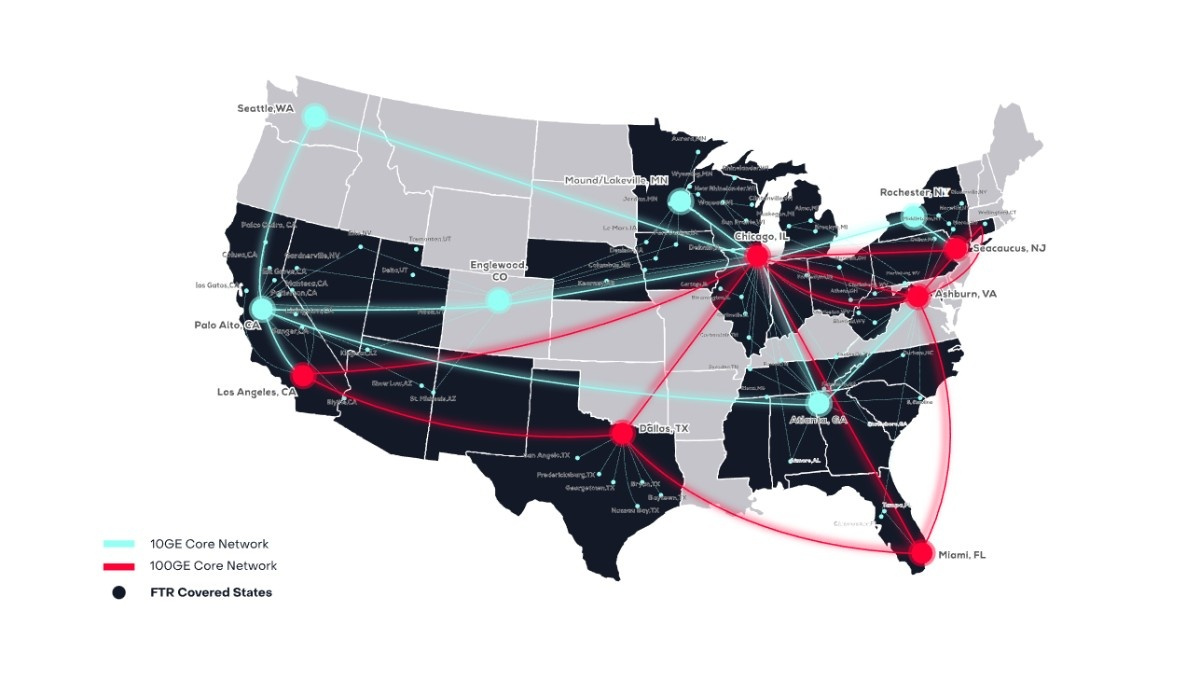
Frontier Communications provides service within the United States. Their network is available in 25 states, so they are more of a regional provider rather than a fully nationwide one.
Granite provides services across the United States and Canada.
They don't offer a public coverage map. Instead, you can check service availability for specific addresses through their AccessExpress tool.
SLA
Both Frontier and Granite offer a 99.99% uptime Service Level Agreement (SLA) for their dedicated internet services. This is a promise about how reliable their connection will be.
So what does that mean for you? A 99.99% uptime guarantee means the service should not be down for more than about 53 minutes over an entire year.
It's important to note that while Frontier's SLA applies to its own network, Granite's guarantee often depends on the underlying carrier providing the service, since they aggregate from multiple providers.
Transport Types Available
Frontier operates its own large fiber network, covering 180,000 route miles. This infrastructure allows them to offer high-speed fiber optic services directly to businesses.
In contrast, Granite is an aggregator and doesn't own its own fiber routes. They source connections from many different carriers, providing access to various transport types like fiber, coax, and wireless.
Frontier's direct fiber is great for high-demand business uses. Granite's approach offers flexibility by finding the best available service for each location, suiting a wide range of needs.
Customer Support
Frontier provides customer support directly for the services on its network. Since they own the infrastructure, their team handles any issues from start to finish.
Granite acts as your single point of contact for support. They manage all the different carriers your services might use, so you only have one number to call.
The main difference is who you talk to. With Frontier, you work directly with the network provider. With Granite, you get a consolidated support team that deals with all the underlying carriers for you.
Final Verdict: Frontier Communications or Granite?
Your choice between Frontier and Granite depends on your business's structure and priorities. Frontier is a direct network provider, so you buy services that run on their own infrastructure. In contrast, Granite is an aggregator that manages services from many different carriers under a single contract.
Frontier is often a strong choice for businesses operating within their 25-state footprint that prefer to contract directly with the network owner. Our data shows their DIA pricing is typically below the market average.
Granite is built for multi-location businesses that need service across the US and Canada. They simplify operations by providing one point of contact for billing and support, which is valuable when dealing with multiple underlying carriers.
To make things even simpler, here’s a quick side-by-side look at how Frontier and Granite stack up on the key points we've covered.
Choose the Right ISP Today With Lightyear
Choosing the right ISP means matching a provider's strengths to your specific business needs. If you're looking for a data-driven way to make that decision, Lightyear's platform automates the procurement process. We help you find the right fit by giving you the data to compare providers side-by-side. Our software offers:
- Automated Procurement: We use the largest proprietary pricing dataset in telecom to show you best-fit providers and benchmarked rates.
- Transparent Pricing: Our team proactively negotiates quotes to make sure they align with market benchmarks, so you don't overpay.
- Complete Service Options: You can compare all connectivity types—DIA, broadband, wireless, and more—from every available provider in one place.
By centralizing quoting, negotiation, and service management, we make telecom procurement simpler and more transparent. If you're ready to find the best internet services for all your locations without the usual hassle, schedule a demo with Lightyear to get started.
Let us show you the product and discuss specifics on how it might be helpful.
Schedule a Demo





Revolutionize Your Telecom Experience
Learn how you can get one step closer to optimal business efficiency for all your telecom services.