Gigabit vs 10 Gigabit Ethernet Comparison
Gigabit vs. 10 Gigabit Ethernet: Which is right for your business? Our guide compares speed, cost, and use cases for IT decision-makers.

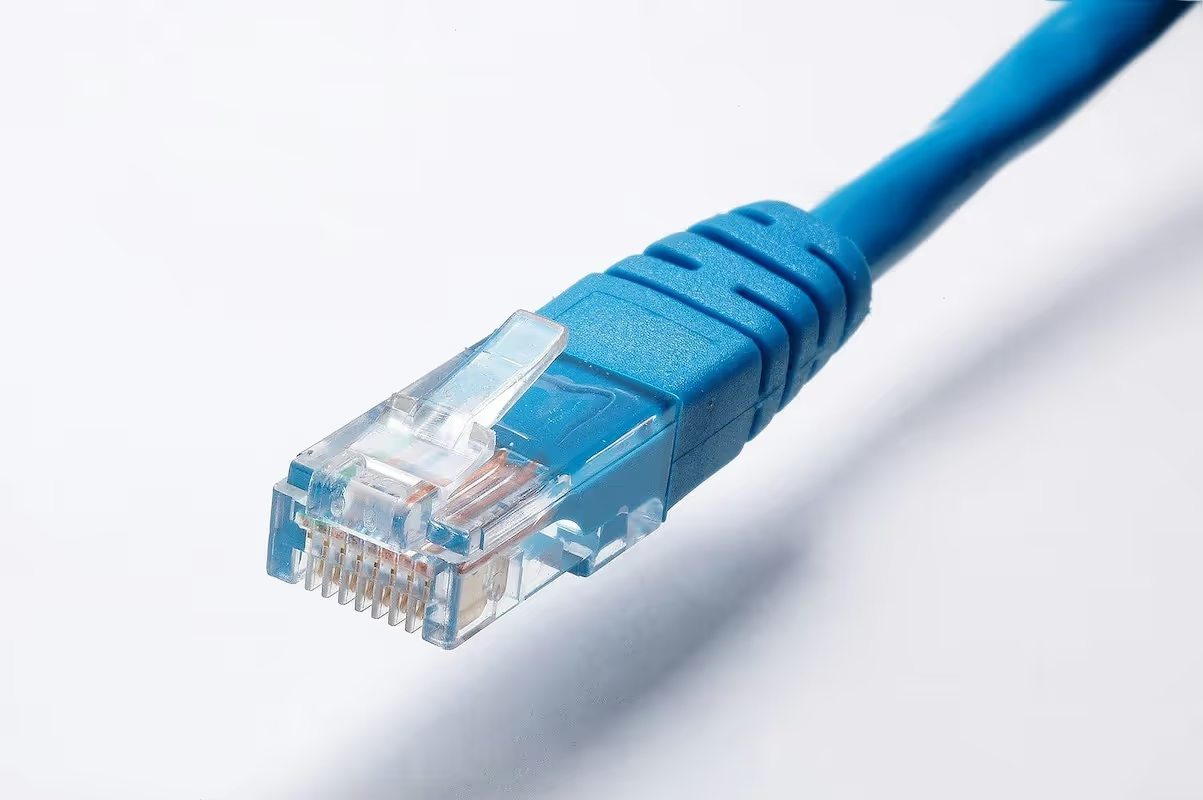
When building or upgrading your business's network, choosing the right Ethernet speed is a critical decision. Two common standards you'll frequently encounter are Gigabit Ethernet (1 GbE) and its much faster successor, 10 Gigabit Ethernet (10 GbE).
Understanding the differences in performance, cost, and use cases between them is essential for making an informed investment. This guide offers a clear comparison to help you decide which networking speed best supports your organization's current and future demands.
What is Gigabit Ethernet?
Gigabit Ethernet, often abbreviated as 1 GbE, is a widely adopted networking standard that defines data transmission at a rate of 1 gigabit per second (Gbps). It became the successor to Fast Ethernet, offering a tenfold increase in speed and performance for local area networks (LANs). For many businesses, it serves as the baseline for reliable, high-speed connectivity.
- Speed: At 1 Gbps (or 1,000 Mbps), it comfortably handles common business tasks like high-definition video streaming, VoIP calls, and transferring large files across a local network.
- Cabling: It typically runs on affordable and readily available copper cabling, specifically Category 5e (Cat5e) or higher, making it easy to implement in existing infrastructure.
- Standardization: It is defined by the IEEE 802.3ab standard, ensuring interoperability between networking equipment from different manufacturers.
What is 10 Gigabit Ethernet?
As its name suggests, 10 Gigabit Ethernet (10 GbE) is the next evolution in Ethernet technology, delivering speeds ten times faster than its predecessor. It operates at a rate of 10 gigabits per second (Gbps), making it a powerful solution for networks with high-bandwidth requirements, such as data centers and enterprise backbones.
- Speed: At 10 Gbps, it is designed to handle demanding workloads like large-scale virtualization, storage area networks (SANs), and high-performance computing.
- Cabling: Achieving full performance requires more advanced cabling. It typically runs on Category 6a (Cat6a) or higher copper cables for shorter distances and is commonly deployed over fiber optic cables for longer runs.
- Standardization: The standard for 10 GbE is defined by IEEE 802.3ae for fiber and later amendments for copper, ensuring broad compatibility across networking hardware.
Key Differences Between Gigabit and 10 Gigabit Ethernet
While the most obvious difference is a tenfold increase in speed, several other technical distinctions separate 1 GbE and 10 GbE.
1. Performance and Throughput
The jump from 1 Gbps to 10 Gbps is more than just a number; it represents a massive increase in network capacity. This higher throughput allows 10 GbE to handle simultaneous, high-bandwidth tasks without creating data traffic jams, a common issue on congested 1 GbE networks.
2. Latency
Beyond raw speed, 10 GbE also delivers lower latency. This means data packets take less time to travel across the network, a critical factor for applications like storage area networks (SANs), virtualization, and real-time data analytics where even millisecond delays can impact performance.
3. Power and Cooling Requirements
Another key consideration is the hardware's operational footprint. 10 GbE equipment, particularly switches and network interface cards (NICs), typically consumes more power and generates more heat than 1 GbE hardware. This can impact energy costs and may require additional cooling solutions within your server room or network closet.
Benefits of Gigabit Ethernet for Enterprises
For many organizations, Gigabit Ethernet remains the go-to standard for good reason. Its primary advantage is its cost-effectiveness and widespread compatibility. Most modern offices are already wired with Category 5e cabling, making deployment simple and affordable without requiring a major infrastructure overhaul. This allows for easy connection of workstations, printers, and other endpoint devices across the entire business.
Furthermore, 1 GbE provides ample bandwidth for the majority of daily business operations. It easily handles tasks like VoIP calls, accessing cloud applications, and HD video conferencing, ensuring smooth performance for most employees. It strikes a practical balance between performance and cost, serving as a reliable backbone for general office connectivity.
Finally, the lower power consumption of 1 GbE hardware translates directly into reduced operational expenses. Less energy use and heat generation mean lower utility bills and cooling requirements, contributing to a more favorable total cost of ownership, especially at scale.
Advantages of 10 Gigabit Ethernet in Business Networks
While Gigabit Ethernet is a solid performer for general office use, 10 Gigabit Ethernet is built for the data-heavy workloads that are becoming standard in modern enterprises. It provides the necessary capacity to prevent network bottlenecks, especially in the core of your network where traffic from many users converges.
This higher throughput is essential for connecting servers, storage area networks (SANs), and network-attached storage (NAS) devices. It ensures that functions like large-scale data backups, virtualization, and real-time analytics run smoothly without slowing down other business operations.
For departments that rely on moving massive files—such as video production, engineering, or research—10 GbE directly supports productivity by reducing transfer times. This makes it a foundational technology for organizations preparing for future growth in data consumption.
Cost Considerations for Gigabit vs 10 Gigabit Ethernet
When budgeting for a network upgrade, the price difference between 1 GbE and 10 GbE extends beyond the initial hardware purchase. Several factors contribute to the total cost of ownership for each standard, making the financial comparison more nuanced.
- Hardware and Equipment: The most direct cost difference is in the equipment itself. Switches, routers, and network interface cards (NICs) built for 10 GbE speeds carry a higher price tag than their 1 GbE counterparts due to more advanced internal components.
- Cabling and Installation: Gigabit Ethernet can often run on existing Cat5e wiring, making deployment a low-cost project for many businesses. In contrast, achieving reliable 10 GbE performance typically requires an investment in new Cat6a or fiber optic cabling, which involves higher material and labor costs.
- Operational Expenses: The higher power consumption of 10 GbE hardware translates directly into increased utility bills. Over time, these energy and potential cooling costs add to the network's operational budget, a key consideration for calculating the total cost of ownership.
Making the Right Choice for Your Network Needs
Ultimately, the choice between 1 GbE and 10 GbE depends on a careful assessment of your organization's specific data demands, future growth plans, and budget.
Gigabit Ethernet remains a perfectly suitable and cost-effective solution for standard endpoint connectivity, supporting everyday office tasks for most employees without issue.
However, if your operations involve data-intensive applications, server-to-storage traffic, or a high-density user environment, investing in 10 GbE for your network core is a forward-thinking move to prevent performance bottlenecks.
Many businesses find success with a hybrid model: deploying 1 GbE to user workstations while using a 10 GbE backbone to connect servers and switches. This balanced approach optimizes both cost and performance across your infrastructure.
Need Help Managing Your Network? Lightyear Can Help
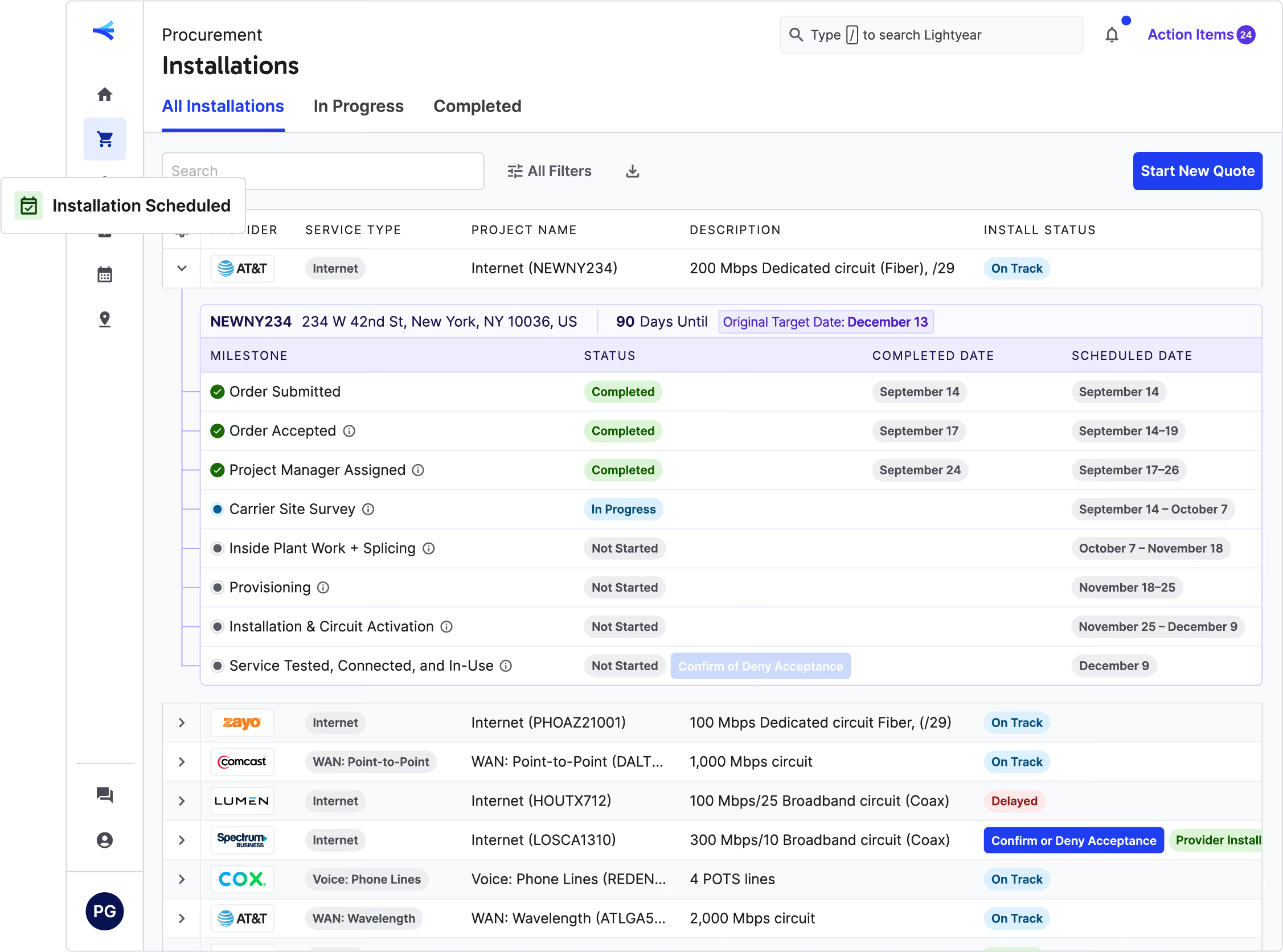
Deciding between 1 GbE and 10 GbE is just the first step. Lightyear's platform helps you procure the right connectivity with data-driven intelligence, ensuring you get the best option at the best price for your business needs.
By automating network service procurement, inventory management, and bill consolidation, Lightyear takes the pain out of telecom infrastructure management. The hundreds of enterprises who trust Lightyear achieve 70%+ time savings and 20%+ cost savings on their network services.
Schedule a demo or get started with our questionnaire today.
Frequently Asked Questions about Gigabit Ethernet vs 10 Gigabit
Can I run 10 Gigabit Ethernet over my existing Cat5e cables?
While technically possible for very short distances, it is not recommended for reliable performance. To avoid data errors and achieve full speed, upgrading to Cat6a or fiber optic cabling is the best practice for any professional installation.
Is 10 GbE overkill for a small business?
For most small businesses with standard office tasks, yes. Gigabit Ethernet provides more than enough speed for daily operations. 10 GbE becomes relevant only if your business handles large data files, video editing, or has high-density server traffic.
Do I need to upgrade my entire network to 10 GbE at once?
Not at all. A common strategy is upgrading only the core of your network—like connections between servers and switches—to 10 GbE. You can keep Gigabit Ethernet for connecting individual workstations, creating a cost-effective hybrid network.
My internet speed is only 1 Gbps. Will 10 GbE make it faster?
No, 10 GbE only speeds up your internal network (LAN) and will not increase your internet speed. While local file transfers will be faster, your connection to the outside world is limited by your internet service plan.
Let us show you the product and discuss specifics on how it might be helpful.
Schedule a Demo





Revolutionize Your Telecom Experience
Learn how you can get one step closer to optimal business efficiency for all your telecom services.