Gigabit Ethernet vs Ethernet: Enterprise Network Comparison
Confused about Ethernet vs. Gigabit Ethernet? Learn the key differences in speed and performance to choose the right network for your business.

When discussing wired networks, the term 'Ethernet' is foundational. It refers to the standard technology used to connect devices in a wired local area network (LAN), from office computers to printers.
So, where does Gigabit Ethernet fit in? It’s not a competing technology, but simply a faster version of the Ethernet standard. This article will compare them to help you make informed decisions for your enterprise network.
What is Ethernet?
At its core, Ethernet is a set of rules, or a protocol, that governs how data packets are transmitted over a local area network (LAN). It’s the fundamental technology that enables wired communication between devices like computers, switches, and printers within a specific physical area.
- Standardization: Ethernet is formally defined by the IEEE 802.3 standard, which ensures that networking hardware from different vendors can communicate reliably.
- Physical Connection: It operates over physical cables—most commonly twisted-pair copper or fiber optic—to create a stable and secure connection.
- Common Speeds: Before faster versions became common, "Fast Ethernet" was the prevailing standard, offering data transfer speeds of up to 100 megabits per second (Mbps).
This speed is suitable for many basic business operations, including email, web browsing, and sharing smaller documents.
What is Gigabit Ethernet?
Gigabit Ethernet, often called GigE, is a faster iteration of the Ethernet standard. It was developed to meet the growing demands of modern applications and increased data traffic on local networks.
Its primary distinction is speed. Gigabit Ethernet transmits data at a rate of 1 gigabit per second (Gbps), which is 1,000 Mbps—ten times faster than the 100 Mbps Fast Ethernet standard mentioned earlier.
- Higher Throughput: By operating at 1 Gbps, it significantly reduces network congestion and latency, making it ideal for transferring large files and supporting bandwidth-intensive applications.
- Governing Standards: It is defined by the IEEE 802.3z standard for fiber optic cable and the 802.3ab standard for twisted-pair copper wiring.
- Backward Compatibility: Gigabit Ethernet hardware is backward compatible with older 10/100 Mbps equipment, which allows for more flexible and gradual network upgrades.
Key Differences Between Ethernet and Gigabit Ethernet
While both are built on the same foundational technology, the main distinctions come down to performance, hardware needs, and how data is physically transmitted across the wires.
1. Speed and Performance
The most obvious difference is speed. Gigabit Ethernet offers a maximum throughput of 1,000 Mbps, a tenfold increase over the 100 Mbps of Fast Ethernet.
This boost in bandwidth means the network can handle significantly more traffic from more devices at once without causing bottlenecks or slowdowns.
2. Cabling and Hardware Requirements
To achieve gigabit speeds, your network infrastructure must be up to the task. While Fast Ethernet can operate on older Category 5 (Cat5) cabling, Gigabit Ethernet requires at least Category 5e (Cat5e) or higher, like Cat6, for stable performance.
Furthermore, every component in the data path—including network interface cards (NICs), switches, and routers—must be gigabit-capable. A single 10/100 Mbps device will limit that part of the network to the lower speed.
3. Data Transmission Method
The two standards also differ in how they use the physical wiring inside an Ethernet cable. A standard cable contains four twisted pairs of wires.
Fast Ethernet uses only two of these pairs: one for sending data and one for receiving. Gigabit Ethernet uses all four pairs simultaneously, allowing it to send and receive data at the same time, which greatly increases its total data capacity.
Benefits of Using Gigabit Ethernet
Upgrading to Gigabit Ethernet brings more than just a speed bump; it translates into tangible improvements across your business operations. It provides the foundation for a more efficient and resilient network.
- Improved Productivity: With faster data transfers and smoother application performance, teams spend less time waiting and more time working. This is especially noticeable when handling large datasets or accessing cloud-based tools.
- Enhanced Collaboration: It provides the stable, high-capacity bandwidth needed for reliable video conferencing, VoIP calls, and real-time document sharing, connecting teams without frustrating lag or dropped connections.
- Future-Proofs Your Network: Adopting Gigabit Ethernet prepares your infrastructure for future growth in data volume and the number of connected devices, providing a foundation that can support new technologies without requiring another immediate overhaul.
Cost Considerations for Ethernet vs. Gigabit Ethernet
When evaluating the costs, it's important to look at the complete picture. While Fast Ethernet hardware is technically cheaper, the price gap for Gigabit-capable equipment has narrowed significantly over the years.
The primary cost driver for an upgrade is often the hardware itself. Gigabit switches, routers, and network interface cards (NICs) typically carry a higher price than their 10/100 Mbps counterparts. However, most modern business-grade equipment now comes standard with gigabit ports, making this less of a factor for new purchases.
Cabling can also add to the expense if your current infrastructure uses older Cat5 wires, which would need replacement. For new installations, the cost difference between the required Cat5e and the superior Cat6 cabling is often minimal, making the better cable a sensible investment for future needs.
Use Cases for Ethernet and Gigabit Ethernet
The right choice depends entirely on what your teams do day-to-day. Here’s a breakdown of common scenarios where each standard fits best.
Fast Ethernet (100 Mbps)
This speed is perfectly suitable for environments with lighter, more traditional network demands. It remains a practical option for:
- Small Offices: Where primary activities are limited to email, web browsing, and sharing small documents.
- Specific-Use Devices: Connecting peripherals like printers or scanners that don't require high bandwidth.
- Guest Networks: Providing basic internet access to visitors without straining the primary corporate network.
Gigabit Ethernet (1 Gbps)
This is the standard for most modern businesses that need robust performance to support daily operations. Key use cases include:
- Data-Intensive Work: Transferring large files like design mockups or video assets, and performing regular data backups.
- Real-Time Communication: Ensuring smooth, high-quality VoIP calls and HD video conferences without lag or dropped connections.
- Cloud and SaaS Applications: Providing fast, reliable access to cloud-based platforms and software that are central to business workflows.
Making the Right Choice for Your Network
Choosing between Fast Ethernet and Gigabit Ethernet ultimately comes down to your specific operational needs and future growth plans. While both provide reliable wired connectivity, their performance capabilities are distinct.
For most businesses today, Gigabit Ethernet is the clear standard. The minimal cost difference for new hardware and cabling is a small price for a network that can handle large file transfers, high-quality video calls, and cloud applications without slowdowns.
However, Fast Ethernet remains a viable, cost-effective solution for less demanding tasks, such as connecting printers or setting up a basic guest network. The key is to assess your daily data traffic and application requirements. Investing in Gigabit Ethernet is not just about current speed; it’s about building a network foundation that supports your company’s needs for years to come.
Need Help Managing Your Network? Lightyear Can Help
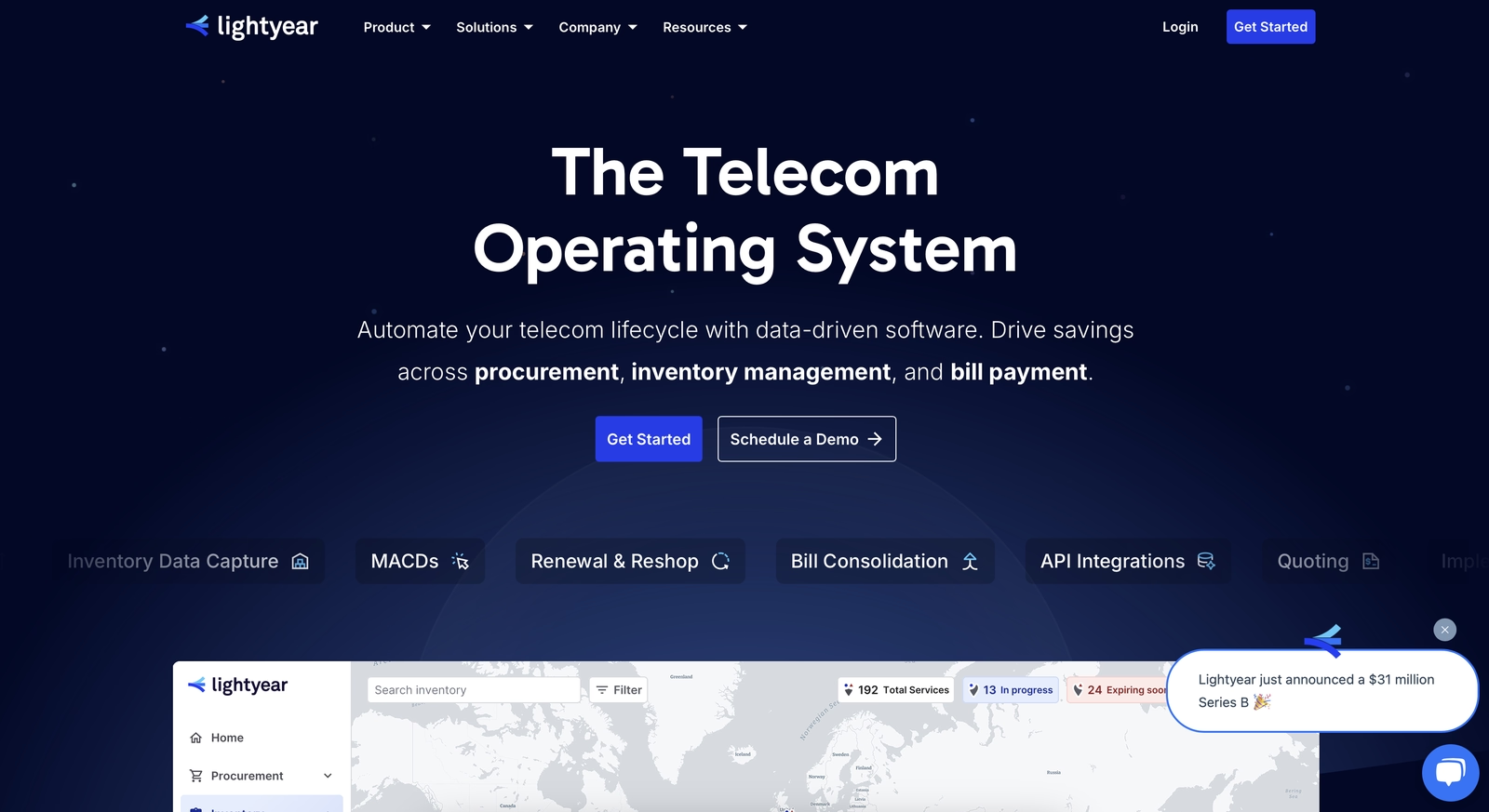
Choosing the right network hardware is a critical first step, but managing your telecom services efficiently is the next challenge.
By automating network service procurement, inventory management, and bill consolidation, Lightyear removes the complexity from infrastructure management. The hundreds of enterprises who trust Lightyear achieve 70%+ time savings and 20%+ cost savings on their network services.
Schedule a demo or get started with our questionare today.
Frequently Asked Questions about Gigabit Ethernet vs Ethernet
Can I mix Gigabit and Fast Ethernet devices on the same network?
Yes, you can. Gigabit hardware is backward compatible. However, any connection between a gigabit device and a 100 Mbps device will operate at the slower speed. To get full gigabit performance, all components in the data path must be gigabit-capable.
Is there anything faster than Gigabit Ethernet?
Absolutely. Multi-Gigabit Ethernet, including 2.5 Gbps, 5 Gbps, and 10 Gbps (10 GigE) speeds, are becoming more common in enterprise environments. These faster standards support even more demanding applications and a higher density of connected devices.
Does Gigabit Ethernet require a special internet plan?
Not necessarily. Gigabit Ethernet refers to your local network (LAN) speed. While it allows you to take full advantage of a gigabit internet plan from your ISP, your internal network will still run at 1 Gbps even with a slower internet connection.
Let us show you the product and discuss specifics on how it might be helpful.
Schedule a Demo





Revolutionize Your Telecom Experience
Learn how you can get one step closer to optimal business efficiency for all your telecom services.