Internet Protocol vs Transmission Control Protocol Explained
What's the difference between TCP and IP? Learn how IP routes data packets and TCP ensures they arrive correctly. A clear guide for IT decision-makers.

Transmission Control Protocol (TCP) and Internet Protocol (IP) are two of the most important rules governing how data travels across the internet. They are so frequently used together that they are often referred to as a single unit: the TCP/IP suite.
Despite this pairing, they are separate technologies that handle very different tasks. This article will explain the specific role each protocol plays, how they collaborate, and what that means for your network's performance and reliability.
What is Internet Protocol (IP)?
The Internet Protocol (IP) is the set of rules responsible for routing and addressing packets of data so they can travel across networks and arrive at the correct destination. Its main function is to deliver these data packets from a source device to a destination device using their respective IP addresses.
Here’s a breakdown of its core responsibilities:
- Addressing: IP assigns a unique numerical label, known as an IP address, to every device on a network. This functions like a mailing address, ensuring data is sent to the right computer or server.
- Packetization: It breaks down larger messages into smaller, manageable pieces called packets. Each packet is stamped with a header containing crucial information, including the source and destination IP addresses.
- Routing: IP determines the path data packets take across the internet. It forwards packets from one router to the next until they reach their final destination.
- Connectionless Delivery: IP is a connectionless protocol, meaning it sends packets without first establishing a connection. It focuses solely on addressing and routing, without guaranteeing the order or successful delivery of the packets.
What is Transmission Control Protocol (TCP)?
The Transmission Control Protocol (TCP) is a connection-oriented protocol that works directly with IP to add a crucial layer of reliability. While IP handles the addressing and routing, TCP focuses on making sure the data arrives intact and in the correct sequence.
It manages the conversation between the source and destination devices. Its primary functions include:
- Connection Establishment: Before any data is sent, TCP establishes a reliable connection between the two devices using a process called a three-way handshake. This confirms both devices are ready to communicate.
- Sequencing and Reassembly: TCP numbers each packet it sends. This allows the receiving device to reassemble the packets in the original order, even if they arrive out of sequence.
- Error Detection and Correction: It checks for corrupted or lost packets. If an error is detected or a packet goes missing, TCP requests a retransmission from the source, guaranteeing data integrity.
- Flow Control: TCP manages the speed of data transfer to prevent a fast sender from overwhelming a slow receiver, which helps avoid network congestion and data loss.
Key Differences Between IP and TCP
While they work as a team, TCP and IP have fundamentally different jobs that are important to understand when managing your network. Here’s a direct comparison of their primary distinctions.
1. Connection vs. Connectionless
TCP is a connection-oriented protocol. Before transmitting data, it performs a three-way handshake to establish a reliable link between the sender and receiver. This initial setup confirms that both ends are ready for communication.
IP, by contrast, is connectionless. It sends data packets individually without establishing a prior connection. This "best-effort" delivery model is efficient for routing but offers no guarantee that the packets will arrive or that the recipient is even available.
2. Reliability and Error Handling
Reliability is TCP’s main contribution. It includes mechanisms for error detection and correction. If a packet is lost or arrives corrupted, TCP requests a retransmission, ensuring the integrity of the final data.
IP is inherently unreliable. It does not perform any error checking on the data payload or attempt to recover lost packets. Its only job is to route the packet; if a packet gets dropped by a router along the way, IP does not have a process to resend it.
3. Data Order and Sequencing
TCP guarantees that data is delivered in the correct order. It assigns a sequence number to each packet, allowing the receiving device to reassemble the data exactly as it was sent.
IP does not manage packet order. Since each packet is routed independently, they can take different paths and arrive out of sequence. Without TCP working alongside it, the data at the destination could be jumbled and unusable for many applications.
How IP Works in Networking
The Internet Protocol works by guiding individual data packets across interconnected networks. This entire process is managed by routers, which act as the traffic directors for data traveling between different networks.
When a router receives a data packet, it reads the destination IP address located in the packet's header. The router does not know the full path the packet will take to its final destination.
Instead, it consults its internal routing table. This table contains information that points to the most efficient next "hop"—or the next router in the path—to send the packet to. The packet is then forwarded accordingly.
This hop-by-hop forwarding repeats across many routers until the packet reaches the local network of the destination device. Once there, it is delivered to the specific machine. Since each packet is handled independently, IP itself does not track the journey or confirm arrival.
How TCP Ensures Reliable Communication
While IP handles the delivery of individual packets, TCP manages the entire communication session to guarantee reliability. It achieves this through a structured process of connection management, data verification, and flow control from start to finish.
Before any data is exchanged, TCP initiates a three-way handshake. The sender transmits a SYN (synchronize) packet, the receiver responds with a SYN-ACK (synchronize-acknowledgment), and the sender replies with an ACK (acknowledgment), formally opening the connection.
During transfer, each data packet is assigned a sequence number. The receiver sends back an acknowledgment (ACK) for the packets it receives, confirming their arrival. If the sender does not get an ACK within a set time, it automatically retransmits the missing packet.
TCP also manages data flow using a "receive window." The receiver communicates how much data it can accept at one time, preventing the sender from sending too much data too quickly and overwhelming its buffer.
Once the data transfer is complete, TCP uses a similar handshake process to formally terminate the connection. This orderly shutdown confirms that all data has been successfully transmitted and received before the line is closed.
Real-World Applications of IP and TCP
The TCP/IP suite is the backbone for most internet services, but different applications lean more heavily on one protocol's strengths over the other. The choice depends entirely on whether reliability or speed is the primary goal for the application.
- Web Browsing and Email: Applications where data integrity is non-negotiable rely on TCP. When you load a webpage (HTTP/S) or send an email (SMTP), TCP works with IP to ensure every single packet arrives correctly and is assembled in the right order. A missing packet could break a website or corrupt a message, so TCP’s error correction is critical.
- File Transfers (FTP/SFTP): Downloading software or transferring large business files also requires TCP’s reliability. It guarantees that the received file is a perfect, bit-for-bit copy of the original. Without it, files could arrive incomplete or damaged, making them unusable.
- VoIP and Live Streaming: In contrast, real-time services like voice calls or video streaming prioritize speed over perfect accuracy. These applications use IP for routing but often pair it with a protocol other than TCP. The delay caused by TCP re-sending a lost packet would create noticeable lag. A minor, momentary glitch in a video stream is less disruptive than a long buffer.
Making the Right Choice for Your Enterprise
Understanding the distinction between TCP and IP isn't about choosing one over the other. Instead, it’s about recognizing how they work together to support your enterprise applications. The protocol combination is determined by the application itself, not by a network administrator's choice.
For business operations that depend on perfect data accuracy—like financial systems, file transfers, and email—TCP’s reliability is essential. Your network strategy should focus on ensuring stable connectivity to support these functions.
For real-time services like video conferencing or VoIP, where speed is more important than perfect data transmission, applications often use IP with other protocols. In these cases, your focus shifts to minimizing latency. A clear grasp of this relationship helps you better manage network performance, troubleshoot issues, and invest in the right infrastructure.
Need Help Managing Your Network? Lightyear Can Help
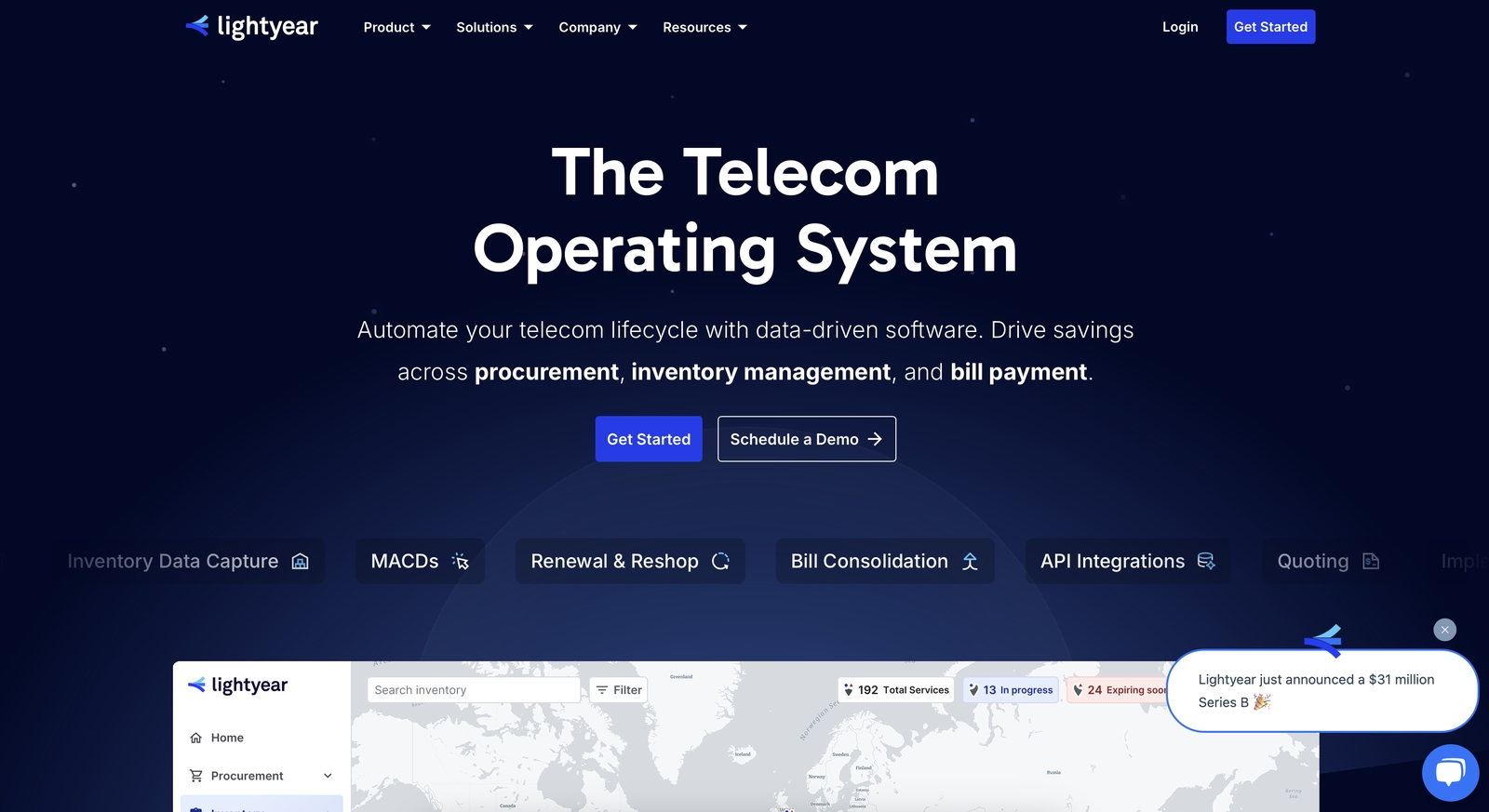
While your applications rely on TCP and IP to function, managing the underlying network services is where the real complexity lies. Lightyear simplifies this by automating procurement, inventory, and billing for your entire telecom infrastructure.
By automating network service management, the hundreds of enterprises who trust Lightyear achieve 70%+ time savings and 20%+ cost savings. Schedule a demo or get started with our questionare today.
Frequently Asked Questions about Internet Protocol vs Transmission Control Protocol
Can you use TCP without IP?
No, TCP is specifically designed to run on top of the Internet Protocol. IP provides the fundamental addressing and routing that TCP relies on to create its reliable, connection-oriented sessions. The two are inseparable in the standard TCP/IP networking model.
What is UDP and how does it relate?
User Datagram Protocol (UDP) is a common alternative to TCP. It also uses IP for routing but is connectionless and doesn't check for errors. This makes it faster than TCP and ideal for real-time applications like VoIP or online gaming where speed is critical.
Are there different versions of IP?
Yes, the two main versions are IPv4 and IPv6. IPv4 is the older standard and its addresses are nearly exhausted. IPv6 uses a longer address format to provide a vastly larger pool of addresses, ensuring the internet can continue to grow with new devices.
Which protocol determines the speed of my connection?
Neither protocol directly determines your connection's bandwidth, which is set by your internet service plan. However, TCP's error-checking adds overhead that can slow data transfer, while protocols like UDP prioritize speed over reliability by skipping these checks.
Let us show you the product and discuss specifics on how it might be helpful.
Schedule a Demo





Revolutionize Your Telecom Experience
Learn how you can get one step closer to optimal business efficiency for all your telecom services.