L2 vs L3 MPLS: Enterprise Network Differences
L2 or L3 MPLS? Learn the key differences in how your provider manages routing and how much control you have over your enterprise network.


If you're building a wide area network (WAN) for your enterprise, you'll eventually face a choice between Layer 2 (L2) and Layer 3 (L3) MPLS. Both technologies provide secure and high-performance connectivity across multiple locations, but they are not interchangeable.
The core difference comes down to control and complexity—specifically, who manages the routing for your network. This article will compare L2 and L3 MPLS to help you determine which service model best fits your company's technical resources and business requirements.
What is L2 MPLS?
L2 MPLS, or Layer 2 MPLS, is a service where a provider connects your business locations at the data link layer (Layer 2) of the OSI model. This essentially creates a single, unified local area network (LAN) that spans across multiple geographic sites. With this setup, the service provider manages the transport infrastructure, but your IT team retains full control over the IP routing (Layer 3).
- Customer-Managed Routing: You are responsible for your own IP addressing scheme and routing policies, giving you complete autonomy over your network's Layer 3 configuration.
- Protocol Flexibility: Because it operates at Layer 2, this service can carry any Layer 3 protocol, not just standard IPv4 or IPv6 traffic.
- Simplified Provider Role: The provider’s responsibility is limited to delivering a reliable connection between your sites, acting like a large virtual Ethernet switch.
What is L3 MPLS?
L3 MPLS, or Layer 3 MPLS, is a service where the provider takes on the responsibility of routing traffic between your sites. In this model, the provider manages the network at the IP layer (Layer 3), acting as a partner in your network infrastructure. They handle the IP addressing and routing configurations, which can simplify your internal IT workload.
Your team simply connects its local networks (LANs) at each site to the provider's network, and the provider ensures that data gets to the correct destination. This approach is often preferred by companies that want to offload the complexities of managing a wide area network.
- Provider-Managed Routing: The service provider controls the routing table and manages all IP routing between your locations.
- Simplified Network Management: Your IT team doesn't need to configure or maintain complex routing protocols across the WAN.
- Peer-to-Peer Model: The provider's network and your network "peer" with each other, exchanging routing information to direct traffic efficiently.
Key Differences Between L2 MPLS and L3 MPLS
While both services connect your sites, the main distinctions lie in how they handle routing, network design, and overall management. Understanding these differences is crucial for choosing the right fit.
1. Routing Control and Responsibility
The most significant difference is who manages the network's routing. With L2 MPLS, your IT team is in the driver's seat. You control the IP addressing scheme and all routing policies between your locations.
In an L3 MPLS model, you hand over these responsibilities. The service provider manages the routing configurations, directing traffic between your sites according to the agreed-upon design.
2. Network Topology and Design
L2 MPLS gives you the flexibility to design your own network topology, such as hub-and-spoke or full mesh. It essentially creates a single virtual LAN spanning all your sites, giving you granular control.
L3 MPLS simplifies this by using a peer-to-peer model. Each of your sites connects to the provider's network, and the provider handles the complex "any-to-any" connectivity in their core network.
3. Scalability and Management Overhead
As your business grows, L2 MPLS can become more complex. Adding a new site requires your team to manually update routing tables to integrate it into the network.
L3 MPLS scales more easily from a management perspective. To add a new site, you simply establish a connection to the provider's network, and they handle the rest of the routing integration.
Benefits of Using L2 MPLS
For organizations with the in-house expertise and a clear vision for their network architecture, L2 MPLS offers several distinct advantages. It puts your IT team in full control, allowing for a highly customized and flexible WAN environment.
- Complete Network Autonomy: You retain full command over your network's routing, IP addressing, and Quality of Service (QoS) policies. This is ideal for teams that need to implement specific configurations without provider involvement.
- Protocol-Agnostic Transport: Because it functions at the data link layer, L2 MPLS can carry any type of traffic, including non-IP protocols. This is critical for businesses running legacy applications or specialized systems.
- Simplified Provider Management: The service provider's role is straightforward: deliver reliable Layer 2 connectivity. This clear separation of duties can simplify troubleshooting when issues arise, as you can quickly determine if a problem is internal or with the carrier.
Benefits of Using L3 MPLS
For businesses looking to offload network complexity, L3 MPLS offers compelling advantages by shifting management responsibilities to the provider. This model is particularly beneficial for organizations that prefer to focus their IT resources on core business functions rather than intricate WAN management.
- Reduced IT Workload: Your team is freed from the burden of configuring and maintaining complex routing protocols across the WAN. The provider handles all routing, allowing your staff to focus on other strategic projects.
- Simplified Scalability: Adding new sites is significantly faster. You simply connect the new location to the provider's network, and they manage the integration into the routing fabric, ensuring seamless any-to-any connectivity.
- Robust Service Level Agreements (SLAs): Since the provider controls the end-to-end traffic path, they can offer stronger performance guarantees for latency, jitter, and packet delivery, providing a more predictable network experience.
- Built-in Redundancy: L3 MPLS providers typically design their core networks with inherent redundancy. This means traffic is automatically rerouted in case of a link failure, improving network resilience without requiring any action from your team.
Choosing the Right MPLS for Your Business
Making the right choice depends on a clear assessment of your organization's capabilities, needs, and future goals. The best fit comes down to balancing control with convenience.
Evaluate Your In-House IT Resources
The first question to ask is about your team. Do you have network engineers with the expertise and time to manage a complex WAN routing environment?
If your IT staff is lean or focused on other priorities, an L3 service is a practical choice that offloads significant work. If you have a dedicated networking team that prefers hands-on management, L2 MPLS keeps you in command.
Assess Your Need for Network Control
Next, consider how much authority you need over your network traffic. Do you run specialized applications, require non-IP protocols, or have specific security policies?
L2 MPLS offers the freedom to implement these custom configurations directly. For businesses that just need reliable any-to-any IP connectivity, the simplicity of an L3 service is often sufficient.
Consider Your Growth and Scalability Needs
Finally, think about your company's expansion plans. How quickly do you anticipate adding new locations to your network?
L3 MPLS is built for easier scaling, as the provider handles the integration of new sites. An L2 network requires more manual configuration from your team with each addition, which can slow down deployment.
Final Thoughts on L2 MPLS vs L3 MPLS
The decision between L2 and L3 MPLS ultimately comes down to a trade-off between network control and operational simplicity. There is no single "better" option; the right choice is entirely dependent on your organization's specific circumstances and technical requirements.
L2 MPLS is the ideal solution for businesses with skilled in-house network teams that require granular control over routing and support for non-IP protocols. It provides maximum flexibility but demands more hands-on management.
In contrast, L3 MPLS is a great fit for companies that want to reduce their IT workload and simplify network expansion. By handing over routing to the provider, you gain easier scalability and robust performance guarantees.
By carefully evaluating your team's expertise, your need for direct network control, and your future growth plans, you can confidently select the MPLS service that best aligns with your business objectives.
Need Help Managing Your Network? Lightyear Can Help
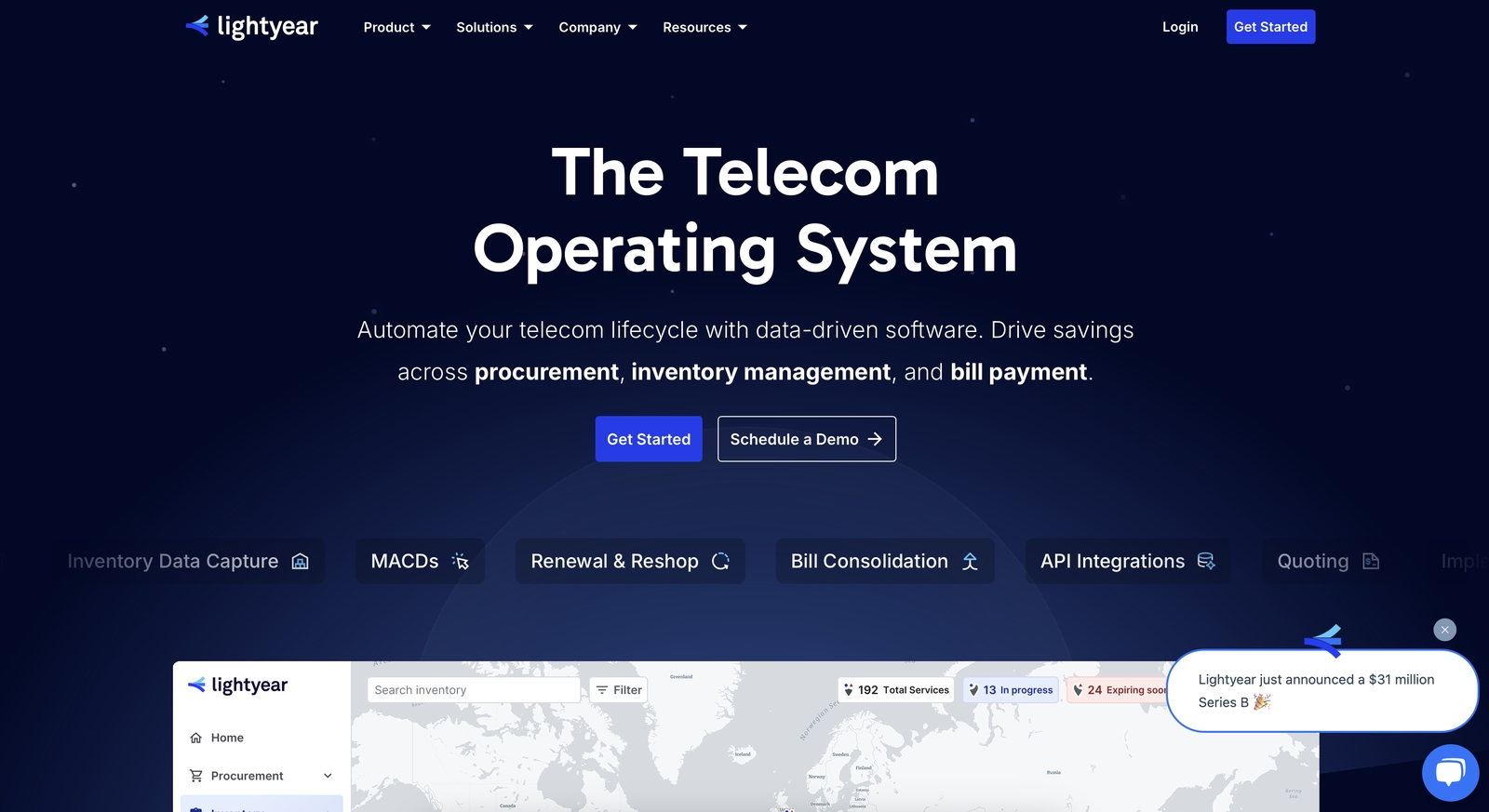
Once you've decided between L2 and L3 MPLS, the next step is procuring and managing your circuits. By automating network service procurement, inventory management, and bill consolidation, Lightyear takes the pain out of telecom infrastructure management.
The hundreds of enterprises who trust Lightyear achieve 70%+ time savings and 20%+ cost savings on their network services. Schedule a demo or get started with our questionare today.
Frequently Asked Questions about L2 MPLS vs L3 MPLS
Is L2 MPLS cheaper than L3 MPLS?
Not always. While L3 services may have a higher monthly fee for management, L2 requires significant in-house expertise and equipment, which increases your total cost of ownership. The most cost-effective option depends on your specific network design and internal resources.
Can I use both L2 and L3 MPLS in my network?
Yes, a hybrid approach is common. Businesses often use L3 MPLS for standard inter-office connectivity while using L2 MPLS for specific sites like data centers that require more granular control or support for non-IP protocols. This allows for a flexible network.
Which is better for connecting to the cloud?
Both can connect to cloud providers. L3 MPLS often simplifies the process, as the provider manages the routing directly to the cloud exchange. With L2, your team handles the BGP peering and configuration, offering more control but requiring more technical expertise.
Let us show you the product and discuss specifics on how it might be helpful.
Schedule a Demo





Revolutionize Your Telecom Experience
Learn how you can get one step closer to optimal business efficiency for all your telecom services.