Latency vs Round-Trip Time: Network Differences
What's the difference between latency and round-trip time? Learn how these two critical network metrics affect your IT infrastructure and performance.


When discussing network performance, the terms latency and round-trip time (RTT) are often used interchangeably. While they are closely related, they measure two distinct aspects of how long it takes for data to travel across a network.
In simple terms, latency is the time it takes for a data packet to make a one-way trip to its destination. Round-trip time, on the other hand, is the total time required for that packet to travel to the destination and for an acknowledgment to return to the source.
For IT and network teams, understanding this distinction is fundamental for diagnosing performance issues and making informed decisions about telecom services. This article will clarify each concept, how they are measured, and what they mean for your operations.
What is Latency?
Latency, often called delay, is the time it takes for a single data packet to get from its starting point to its destination. Think of it as a one-way street for your data. Several factors can contribute to this travel time, each adding milliseconds to the journey.
- Propagation Delay: This is the time it takes for a signal to travel across the physical distance of the network medium, like fiber optic cable. The longer the distance, the higher the latency.
- Transmission Delay: This relates to the size of the data packet and the bandwidth of the connection. It's the time required to push all the packet's data onto the network link.
- Processing Delay: Each network device, like a router or switch, that handles the packet needs time to process it—reading its header and deciding where to send it next.
- Queuing Delay: If a network is congested, packets have to wait in line (a queue) at a router before being forwarded. This waiting time adds to the total latency.
What is Round-Trip Time (RTT)?
While latency measures a one-way trip, Round-Trip Time (RTT) measures the full, two-way journey of a data packet. It’s the total time from the moment a packet leaves its source, reaches its destination, and an acknowledgment signal returns to the origin. Because it accounts for the complete round trip, RTT provides a more practical measurement for many applications, as it reflects the user's actual wait time for a response.
RTT is influenced by the same factors as latency, but it specifically includes:
- The outbound trip: The time it takes for the initial data packet to travel from the source to the destination.
- Destination processing: The time the destination server or device takes to process the request and prepare a response.
- The return trip: The time it takes for the acknowledgment or response packet to travel back to the source.
Latency vs Round-Trip Time: Key Differences
While the two terms are closely linked, their key differences lie in what they measure and the insights they provide for network management.
1. Measurement Scope
The most fundamental difference is the scope. Latency measures a one-way trip, accounting only for the time it takes a packet to travel from source to destination. It is a component of the larger RTT measurement.
RTT, however, measures the full round trip. Crucially, this includes the time the destination server takes to process the request and generate a response, a factor that latency alone does not capture.
2. Diagnostic Value
This difference in scope gives each metric a distinct diagnostic purpose. RTT provides a complete picture of the delay a user experiences, making it a practical benchmark for application performance.
High latency directly points to a problem on the network path, such as congestion or physical distance. High RTT, on the other hand, could be caused by high latency or a slow, overloaded server at the destination. This makes latency a more precise tool for isolating network-specific issues.
3. Path Symmetry
RTT provides a single value for the entire two-way journey. This inherently assumes the path is symmetrical—that the travel time to the destination is the same as the travel time back.
In reality, network routing can be asymmetrical, meaning the return path may be longer or more congested. Measuring one-way latency can help identify these asymmetries, which RTT would otherwise obscure.
How Latency Affects Network Performance
High latency is a direct drag on network performance, impacting applications that depend on timely data delivery. Even delays measured in milliseconds can degrade the user experience, especially for real-time services.
For example, in VoIP and video conferencing, high latency causes jitter and lag. This results in choppy audio, out-of-sync video, and dropped calls, making communication difficult.
Latency also affects the responsiveness of cloud applications and SaaS platforms. Every click or action requires a data packet to travel to a server and back. High one-way latency means every interaction feels sluggish, reducing productivity.
While large file transfers are more dependent on bandwidth, latency still determines how quickly the transfer begins and how fast acknowledgments are received, influencing the overall task completion time.
How Round-Trip Time Impacts User Experience
Since RTT measures the complete two-way journey, it directly shapes the user's perception of how responsive an application is. It’s the tangible delay between a user's action, like clicking a button, and receiving a functional response from the system.
For web-based services, high RTT results in slow page loads and sluggish interactions. Every request to load an image, submit a form, or run a search is subject to this round-trip delay, making the entire experience feel slow.
In transactional systems, such as e-commerce or financial platforms, a high RTT can lead to frustrated users and abandoned processes. This delay directly impacts productivity for internal teams and can affect revenue for customer-facing applications.
Tools to Measure Latency and RTT
To effectively manage your network, you need to be able to measure these metrics accurately. Several common tools are available to help IT teams diagnose performance issues and get a clear picture of network health.
- Ping: This is the most fundamental command-line tool. It sends a small data packet to a specific server and measures the total time it takes for a response to return. The result is a direct measurement of the Round-Trip Time (RTT) to that destination, making it perfect for quick checks.
- Traceroute (or tracert): This tool provides a more detailed view by mapping the entire path a packet takes to its destination. It lists every “hop” (i.e., router) along the way and measures the RTT to each one. This is invaluable for pinpointing exactly where in the network path delays are occurring.
- Network Performance Monitoring (NPM) Platforms: For continuous and large-scale analysis, businesses rely on dedicated NPM software. These platforms automatically track RTT, latency, jitter, and packet loss across multiple locations and services, providing historical data and alerts to identify problems proactively.
Making Informed Decisions for Your Network
Understanding the difference between latency and RTT is more than a technical exercise; it’s fundamental to making sound telecom procurement and management choices.
When evaluating providers, low latency figures suggest a high-quality, direct network path. This metric is a strong indicator of the raw performance of the connection itself.
However, RTT provides a more complete picture of real-world application responsiveness because it includes server processing time. A high RTT might point to a slow server, not necessarily a poor network connection.
By measuring both, your team can accurately diagnose performance bottlenecks. This distinction allows you to determine if an issue lies with your network provider or your application infrastructure, helping you invest resources effectively and hold the right vendors accountable.
Need Help Managing Your Network? Lightyear Can Help
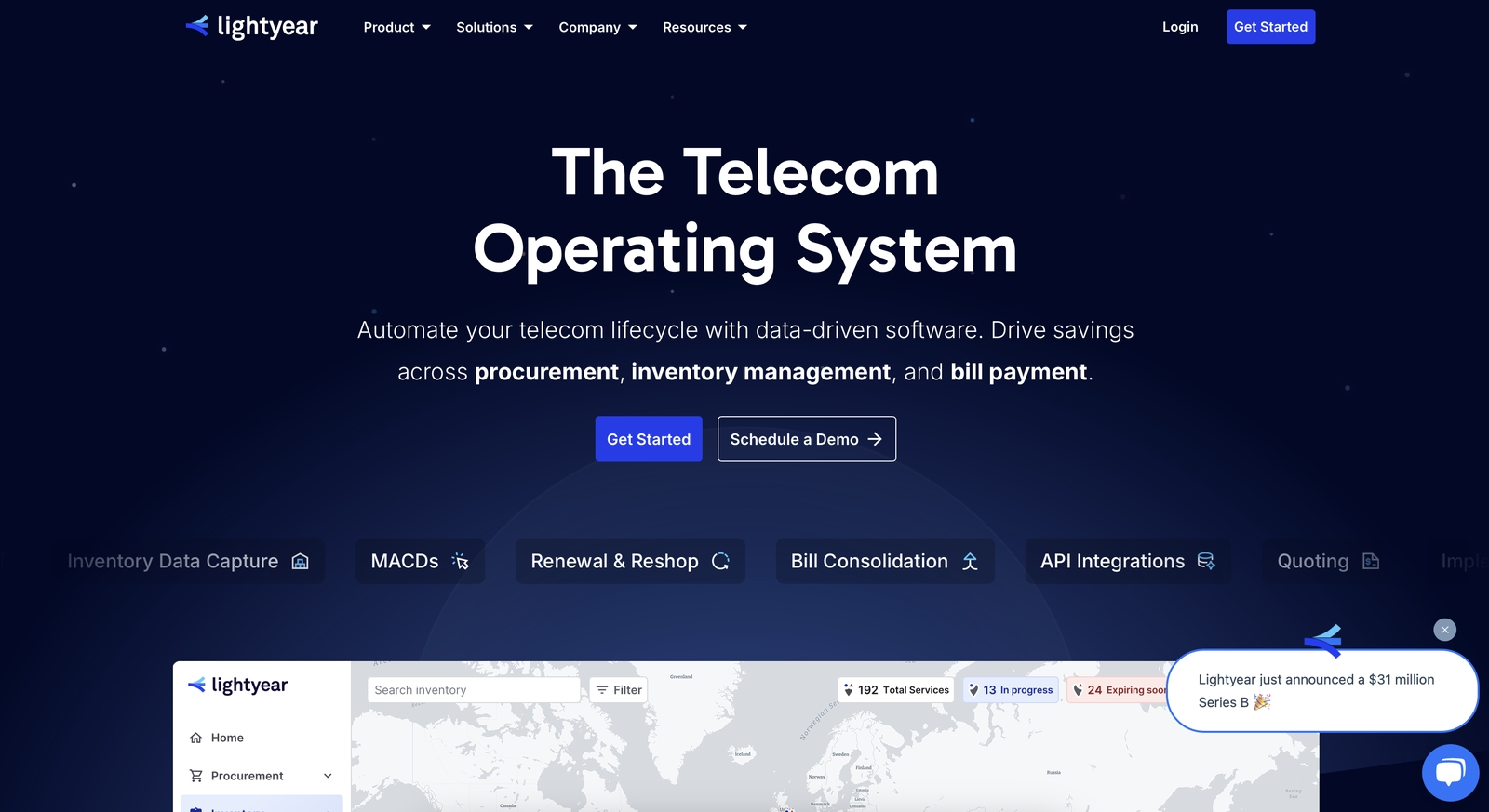
Making the right network decisions to minimize latency and RTT starts with having the right data. Lightyear's platform helps you procure and manage network services with clarity, giving you access to over 1,200 carriers to find the optimal connection for your needs.
By automating network procurement and inventory management, Lightyear helps enterprises save over 70% of their time and reduce costs by up to 20%.
Schedule a demo or get started with our questionnaire today.
Frequently Asked Questions about Latency vs Round-Trip Time
Which metric is more important to track?
It depends on your goal. Latency is better for diagnosing network path health, as it isolates the travel time. RTT is more useful for measuring end-user experience because it includes the server's processing time, reflecting the total wait time.
Can you have low latency but high RTT?
Yes. This combination usually indicates that the network path is efficient, but the destination server is slow to respond. The delay isn't from the travel time but from the server processing the request before sending a response.
Does more bandwidth reduce latency?
Not directly. Bandwidth is about capacity (how much data can be sent), while latency is about speed (how fast it travels). Adding more bandwidth won't reduce latency caused by physical distance, but it can help reduce queuing delays on congested links.
Let us show you the product and discuss specifics on how it might be helpful.
Schedule a Demo





Revolutionize Your Telecom Experience
Learn how you can get one step closer to optimal business efficiency for all your telecom services.