Lumen Technologies vs Cox Communications: Which ISP Is Better?
Choosing a business ISP? We compare Lumen's fiber network with Cox's cable and fiber services to help you find the right provider.


Lumen Technologies and Cox Communications are two of the largest internet service providers in the United States, each offering a wide range of connectivity options for businesses.
Choosing between them can be a complex decision, so we're breaking down how they compare on key factors that matter to your business.
Our comparison uses Lightyear's proprietary data, gathered from over 70,000 real-world ISP quotes, to provide benchmarks on pricing, installation timelines, and delivery points.
Keep reading for our detailed comparison. Or, if you're ready to explore provider options for your specific needs, you can begin our questionnaire to receive real-time quotes.
Overview of Lumen Technologies
Lumen Technologies, founded in 1930, is a major telecommunications provider with a significant global presence. Based in Monroe, Louisiana, the company is a Fortune 500 firm (ranked 292) with 28,000 employees and operations in 60 countries.
The company is recognized for its focus on building infrastructure ready for artificial intelligence and its large-scale network. It runs the #1 peered global network and has an in-house team, Black Lotus Labs®, dedicated to threat intelligence.

Overview of Cox Communications
Cox Communications, founded in 1962, is a telecommunications company with deep roots in the United States. From its headquarters in Atlanta, Georgia, the company's team of 20,000 employees serves customers exclusively within the U.S.
Despite its domestic focus, Cox is a major player in the industry, ranking 14th on the Fortune 500 list. This scale makes it a key provider for businesses seeking connectivity solutions across the nation.
ISP Products
Dedicated Internet (DIA)
Both Lumen and Cox offer Dedicated Internet Access over fiber with speeds ranging from 10 Mbps to 100 Gbps and no utilization caps. A primary distinction is the uptime guarantee: Lumen provides a 99.99% SLA, while Cox offers a 99.9% SLA. Lumen's network is also significantly larger, spanning 340,000 fiber route miles to Cox's 44,000.
Based on Lightyear's data, both providers install DIA faster than the 77-day industry average, with Cox averaging 66 days and Lumen 68. On pricing, Cox tends to be more competitive; for a 100 Mbps circuit, Cox is about 9% below the market average, while Lumen is 3% above. This trend continues at 1 Gbps, where Cox is 10% below average and Lumen is 3% below.
Both providers offer valuable add-ons like static IPs, BGP routing, and managed security. A practical installation difference is that Lumen typically delivers to a building's main point of entry (MPOE), whereas Cox often delivers directly to the customer's suite.
It's important to remember that the numbers we've shared are averages from across our dataset.
Real-world installation times and pricing can vary based on your building's location and the specific DIA configuration you need.
To see how Lumen, Cox, and other providers stack up for your exact requirements, we recommend you fill out our questionnaire. It uses the most comprehensive data in the industry to give you a true comparison.
DIA Pricing, Delivery and Install Days Compared
| Metric | Lumen Technologies | Cox Communications |
|---|---|---|
| 100Mb DIA Price vs Avg | +3% | -9% |
| 1Gb DIA Price vs Avg | -3% | -10% |
| Point of Delivery | MPOE | Suite |
| DIA Install Days | 68 days | 66 days |
The data in this table comes from Lightyear’s aggregated ISP quotes collected in 2024 and 2025 YTD.
- Install Days: how long it typically takes to deliver service.
- 100Mb Price vs Avg / 1Gb Price vs Avg: shows whether this ISP is cheaper or more expensive than the market average.
- Delivery Point: “Suite” means the ISP delivers service all the way to the company’s server room; “MPOE” means the circuit stops at the building’s minimum point of entry (typically the building's utility basement) and the tenant must handle the inside wiring.
Wireless
Lumen provides a Wireless WAN service that uses the 4G LTE and 5G networks of T-Mobile, Verizon, and AT&T. This multi-carrier approach allows businesses to use the service as a primary or backup connection anywhere in the United States.
Cox Communications, on the other hand, does not offer a wireless product for business customers. For companies specifically looking for a wireless WAN solution, Lumen is the only provider of the two.
Security
Lumen provides a comprehensive suite of enterprise-grade security products called Lumen Cybersecurity Solutions. These services include advanced options like DDoS mitigation, managed firewalls, and SASE, many of which are powered by their in-house threat intelligence team, Black Lotus Labs®.
Cox, on the other hand, offers Cox Business Essential Security, a product specifically designed for small businesses. Its approach focuses on three core functions: defending against cyberattacks, backing up business files to the cloud, and restoring data to minimize downtime.
The key distinction for buyers is the target customer. Lumen caters to large organizations with complex security needs, while Cox provides a foundational security package for small businesses.
Broadband
Cox offers Cox Business Internet, a broadband service delivered over a Hybrid Fiber Coax network with a 99.5% uptime SLA. The service comes in several tiers with speeds ranging from 300 Mbps up to 2 Gbps, all with no data caps. Based on Lightyear's data, Cox's installation time of 29 days is right in line with the 28-day industry average, while its pricing is about 5% above the market average.
Lumen also provides a broadband internet product for businesses. However, due to limited quoting history in our dataset, we’re not able to provide benchmark pricing or installation timelines at this time. This means that while both offer the service, our data provides a clearer picture of what to expect from Cox on average.
Since broadband availability and pricing are highly dependent on location, the best way to compare providers is with a direct quote. You can fill out our questionnaire to find the latest pricing from Lumen, Cox, and other providers for your building.
Ethernet
For businesses seeking Ethernet services, the choice between these two providers is clear, as Lumen no longer offers an Ethernet product. This leaves Cox as the sole provider for this type of connectivity.
Cox's offering, called Metro Ethernet Services, is designed to securely link multiple locations. It's a flexible solution that supports point-to-point, hub-and-spoke, and multipoint setups, which is ideal for organizations like school districts or companies with several branch offices. With bandwidth options ranging from 1 Mbps to over 10 Gbps, the service provides a practical way to give remote employees high-speed, secure access to a private LAN.
POTS Replacement
Lumen offers a dedicated POTS replacement product, while Cox Communications does not publicly advertise a comparable service. This makes the decision simple for businesses looking to transition their traditional phone lines, especially those used for critical safety systems.
Lumen’s solution, Cloud Communications Specialty Lines, is a fully managed service designed for systems like fire alarms, elevators, and security gates. It is compliant with NFPA 72 standards for fire alarm signaling, a key requirement for many businesses. The service includes equipment, installation, and unlimited domestic long-distance calling.
For reliability, Lumen's product can operate over any third-party internet connection and includes multi-carrier cellular failover for backup connectivity. It also offers options for a 12 or 24-hour internal battery pack to keep systems running during a power outage. The service is available in the U.S. and select international markets.
Other Key Features Compared
Geographic Coverage
Lumen has a significant global presence, with operations in 60 countries. This makes them a solid option for international businesses looking for a single provider for their global locations.
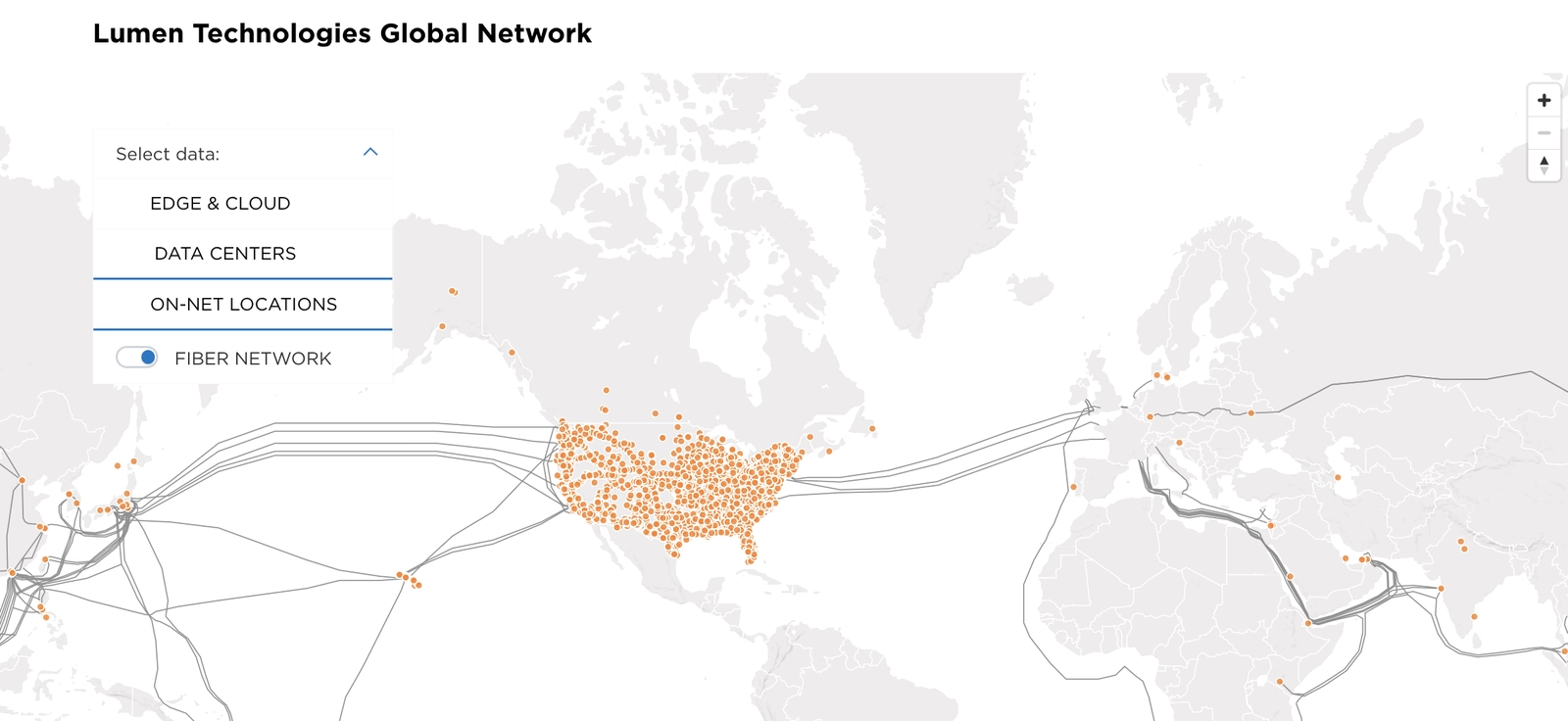
Cox Communications, on the other hand, operates solely within the United States. This domestic focus makes them a practical partner for businesses with locations inside their U.S. service footprint.

SLA
Lumen guarantees 99.99% uptime for its Dedicated Internet, while Cox offers a 99.9% SLA for the same service. For its broadband product, Cox provides a 99.5% uptime guarantee.
What does this mean in practice? A 99.99% SLA translates to about 53 minutes of potential downtime per year. In contrast, a 99.9% SLA allows for nearly nine hours of downtime annually.
For businesses that depend on a stable connection, Lumen's stronger guarantee offers more reliability. This difference is a key factor when choosing your provider.
Transport Types Available
Lumen's network is all-fiber, covering 340,000 route miles for consistent performance. Cox uses a Hybrid Fiber Coax network and maintains 44,000 fiber route miles.
Both providers offer dedicated internet speeds from 10 Mbps up to 100 Gbps. This range gives businesses the flexibility to pick a plan that matches their operational needs.
Lower speeds work well for small teams, while gigabit connections support heavy use like large file transfers. The fastest speeds are for large enterprises with very high data demands.
Customer Support
When it comes to customer support, both Lumen and Cox offer dedicated teams to help their business clients.
Lumen provides support through a global operations center, which is ideal for large organizations that need around-the-clock assistance.
Cox Business offers U.S.-based support with options tailored for different business sizes, making it a practical choice for companies operating within their service areas.
Final Verdict: Lumen Technologies or Cox Communications?
Choosing between Lumen and Cox ultimately comes down to your business's specific priorities. Lumen is often the better fit for large, international organizations that require a global network and the highest possible uptime guarantee.
In contrast, Cox Communications is a strong choice for U.S.-based businesses seeking more competitive pricing on dedicated internet and a straightforward security package for smaller teams.
Your decision will likely hinge on factors like your geographic footprint, budget, and how critical a 99.99% SLA is to your daily operations.
To get a clear, data-driven comparison for your exact locations, we recommend you fill out our questionnaire to see real-time quotes from both providers.
Lumen vs. Cox: At a Glance
Still weighing your options? Here’s a quick side-by-side look at how Lumen and Cox stack up on the key features we've covered.
| Feature | Lumen Technologies | Cox Communications |
|---|---|---|
| Best For | Global enterprises needing high uptime | U.S.-based businesses seeking competitive pricing |
| Geographic Coverage | Global (60 countries) | United States only |
| DIA Uptime (SLA) | 99.99% | 99.9% |
| DIA Pricing | Slightly above market average | Below market average |
| Network | All-fiber | Hybrid Fiber Coax |
| Security | Enterprise-grade suite (DDoS, SASE) | Small business essentials |
| Wireless WAN | Yes, multi-carrier 4G/5G service | No |
| Ethernet | No | Yes, Metro Ethernet Services |
| POTS Replacement | Yes, a dedicated, compliant solution | No |
| Customer Support | Global operations center | U.S.-based support |
Choose the Right ISP Today With Lightyear
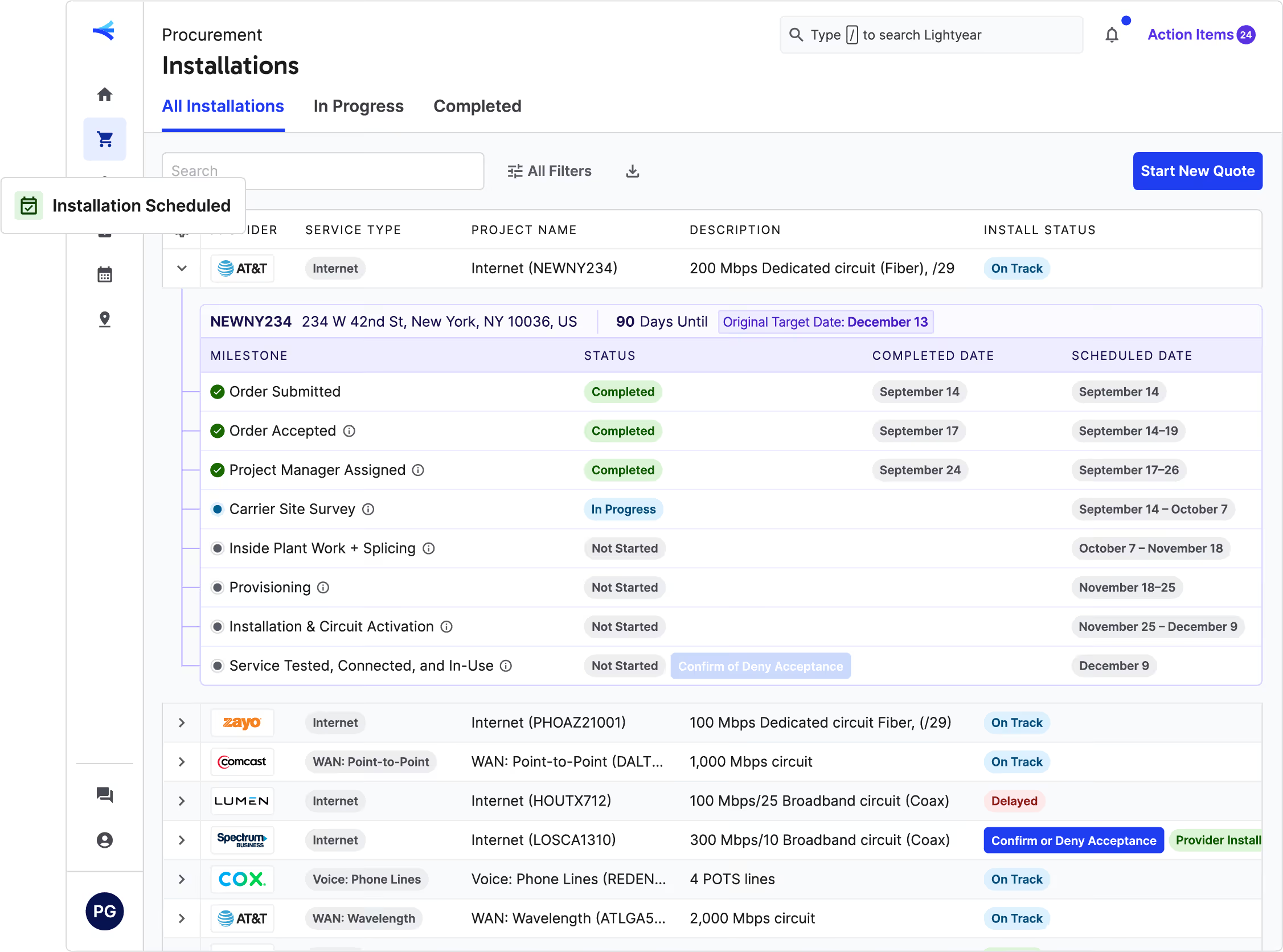
Making the right choice between providers like Lumen and Cox starts with a clear understanding of your own requirements. If you're looking for a data-driven way to manage this process, the Lightyear platform can help. Our software automates the telecom lifecycle, from finding the right provider to managing your services after installation. Here’s a look at what we do:
- Automated Procurement: Our platform digitizes the RFP process, letting you compare benchmarked quotes from multiple providers in one place.
- Proactive Negotiation: We automatically negotiate quotes that are above market rates, making sure you get a fair price.
- Lifecycle Management: After installation, our software tracks all your circuit information and contracts, giving you a single source of truth for your network inventory.
Ready to simplify your telecom procurement and management? Schedule a demo to see how Lightyear can work for you.
Let us show you the product and discuss specifics on how it might be helpful.
Schedule a Demo





Revolutionize Your Telecom Experience
Learn how you can get one step closer to optimal business efficiency for all your telecom services.