Comparing Metro Ethernet and MPLS for Enterprises
Choosing between Metro Ethernet and MPLS? This guide compares their advantages and disadvantages to help you decide on the best fit for your enterprise.


Choosing the right network technology to connect your business's multiple locations is a critical decision for any IT leader. Two popular and reliable options for building a wide area network (WAN) are Metro Ethernet and Multiprotocol Label Switching (MPLS).
While both can provide secure, high-performance connectivity, they differ significantly in their underlying architecture, scalability, and cost. This guide will break down the advantages and disadvantages of each to help you determine the best fit for your enterprise's specific needs.
What is Metro Ethernet?
Metro Ethernet is a network service that connects business locations within a metropolitan area, essentially extending your local area network (LAN) across a city. Think of it as a high-speed, private connection that uses the familiar Ethernet standard you already use for your internal office network. This makes it a straightforward way to link offices, data centers, and other sites that are geographically close but too far for a direct cable connection.
Here are some of its core characteristics:
- Layer 2 Connectivity: It operates at Layer 2 of the OSI model (the data link layer). This means it forwards traffic based on MAC addresses, which can simplify network management and integration with your existing LAN.
- Standardized Technology: Because it uses standard Ethernet protocols and interfaces, connecting your equipment is typically straightforward and requires minimal new hardware.
- Scalable Bandwidth: Service providers offer Metro Ethernet with a wide range of bandwidth options, often from 1 Mbps to 100 Gbps or more, which can be easily adjusted as your business needs grow.
- Flexible Configurations: It comes in several service types, including point-to-point (E-Line), point-to-multipoint (E-Tree), and multipoint-to-multipoint (E-LAN), offering flexibility for different network designs.
What is MPLS?
Multiprotocol Label Switching (MPLS) is a routing technique used by service providers to create private, high-performance networks. Unlike services that rely on the public internet, MPLS directs traffic along predetermined paths within a provider's network. This method is highly reliable for connecting geographically dispersed offices, data centers, and cloud resources with guaranteed performance.
- Layer 2.5 Functionality: MPLS operates between Layer 2 and Layer 3 of the OSI model. This unique position allows it to carry virtually any kind of traffic, including IP packets and Ethernet frames, making it highly versatile.
- Label-Based Forwarding: Instead of performing a complex network address lookup at every hop, routers in an MPLS network use short labels to forward packets. This process is efficient and reduces latency across the network.
- Built-in Quality of Service (QoS): It excels at managing network traffic by prioritizing data packets. This means critical applications like VoIP or video conferencing receive the bandwidth they need for consistent performance.
- Private and Secure Connectivity: Traffic on an MPLS network is isolated from other customers and the public internet, creating a secure, private WAN without requiring end-to-end encryption, though it can be added for more security.
Metro Ethernet vs MPLS: Key Differences
While both services provide private connectivity, their fundamental designs lead to important distinctions in how they operate, what they cost, and where they are best deployed. Understanding these differences is key to selecting the right foundation for your company's network.
1. Geographic Scope
The most significant difference lies in their intended reach. Metro Ethernet is specifically designed to connect locations within a single metropolitan area, making it ideal for linking offices and data centers across a city.
MPLS, in contrast, is built for wide area networking. It connects geographically dispersed sites across the country or even around the globe, creating a single, cohesive network over long distances.
2. Network Control and Management
As a Layer 2 service, Metro Ethernet functions as an extension of your LAN. This gives your IT team direct control over the IP routing (Layer 3) between your sites, offering more hands-on management possibilities.
MPLS is a managed Layer 3 service where the provider handles the routing and traffic paths within its network. This simplifies WAN management for your team but provides less direct control over the underlying network infrastructure.
3. Traffic Prioritization
MPLS networks have Quality of Service (QoS) built into the service. This allows the provider to prioritize critical application traffic, like VoIP or video conferencing, ensuring consistent performance for those services.
While QoS can be applied over a Metro Ethernet connection, it is not an inherent feature of the service itself. It must be configured and managed on your own equipment at the network edge.
Advantages of Metro Ethernet
For businesses operating primarily within a single city, Metro Ethernet offers several compelling benefits that translate to lower costs and simplified operations.
- Cost-Effectiveness: Metro Ethernet is often more affordable than MPLS for high-bandwidth connections. It uses standard Ethernet interfaces, which helps reduce hardware costs and avoids the need for specialized, expensive routers.
- Simplified Management: Since it functions as an extension of your LAN, your IT team can manage it with familiar tools. This reduces operational complexity and gives you direct control over your network's routing policies.
- High Performance: The service delivers dedicated, high-speed connectivity with very low latency. This is ideal for bandwidth-heavy tasks like data backups or accessing local cloud resources within the same metro area.
- Easy Scalability: Increasing your bandwidth is typically a simple process. Your provider can often adjust your capacity without requiring a major hardware overhaul, allowing your network to grow with your business.
Advantages of MPLS
- High Reliability with SLAs: As a carrier-managed service, MPLS is typically backed by stringent Service Level Agreements (SLAs). This provides guaranteed uptime and performance metrics, offering a level of dependability that is critical for business operations.
- Superior Geographic Scalability: For businesses with a national or global footprint, MPLS is the ideal choice. Adding new office locations to the network is a straightforward process, as the provider handles all the complex routing needed to connect distant sites.
- Guaranteed Application Performance: The inherent Quality of Service (QoS) gives priority to essential applications like voice, video, and critical software. This prevents network congestion from impacting the performance of your most important tools.
- Flexible Any-to-Any Connectivity: MPLS naturally supports a mesh topology, allowing any site to communicate directly with any other site on the network. This improves efficiency and reduces latency for decentralized organizations.
Disadvantages of Both Metro Ethernet and MPLS
Despite their reliability, both technologies come with a few common downsides related to cost and deployment that are important to consider.
- High Costs: Both are premium services with a higher price tag than standard business internet. You are paying for dedicated, guaranteed performance, and the monthly cost reflects that.
- Long Lead Times: Getting a new circuit installed is not a quick process. Carriers often take 60-120 days to provision a Metro Ethernet or MPLS connection, which can delay site openings.
- Contract Inflexibility: These services usually come with long-term contracts of one to three years. This can make it difficult to adapt to business changes, like moving an office or adjusting bandwidth, without penalties.
- Complex Sourcing: The procurement process for both can be slow and manual. Comparing quotes from different providers and managing contracts for multiple locations is a significant administrative challenge.
Making the Right Choice for Your Business
Choosing between Metro Ethernet and MPLS ultimately comes down to your company's specific geographic footprint and performance requirements. There is no single "best" option, only the right fit for your operational needs.
If your business operates primarily within one metropolitan area, Metro Ethernet is often the more practical and cost-effective solution. It provides high-speed, scalable connectivity and allows your IT team to retain direct control over network routing, much like an extension of your local network.
Conversely, if your organization is spread across multiple cities, states, or countries, MPLS is the superior choice for building a cohesive wide area network. Its greatest strengths lie in its ability to provide reliable, any-to-any connectivity and guarantee performance for critical applications like voice and video through its built-in Quality of Service (QoS).
Your final decision should be guided by a clear assessment of your application priorities, budget, and how widely distributed your locations are. By carefully weighing these factors, you can select the network foundation that best supports your business goals now and in the future.
Need Help Managing Your Network? Lightyear Can Help
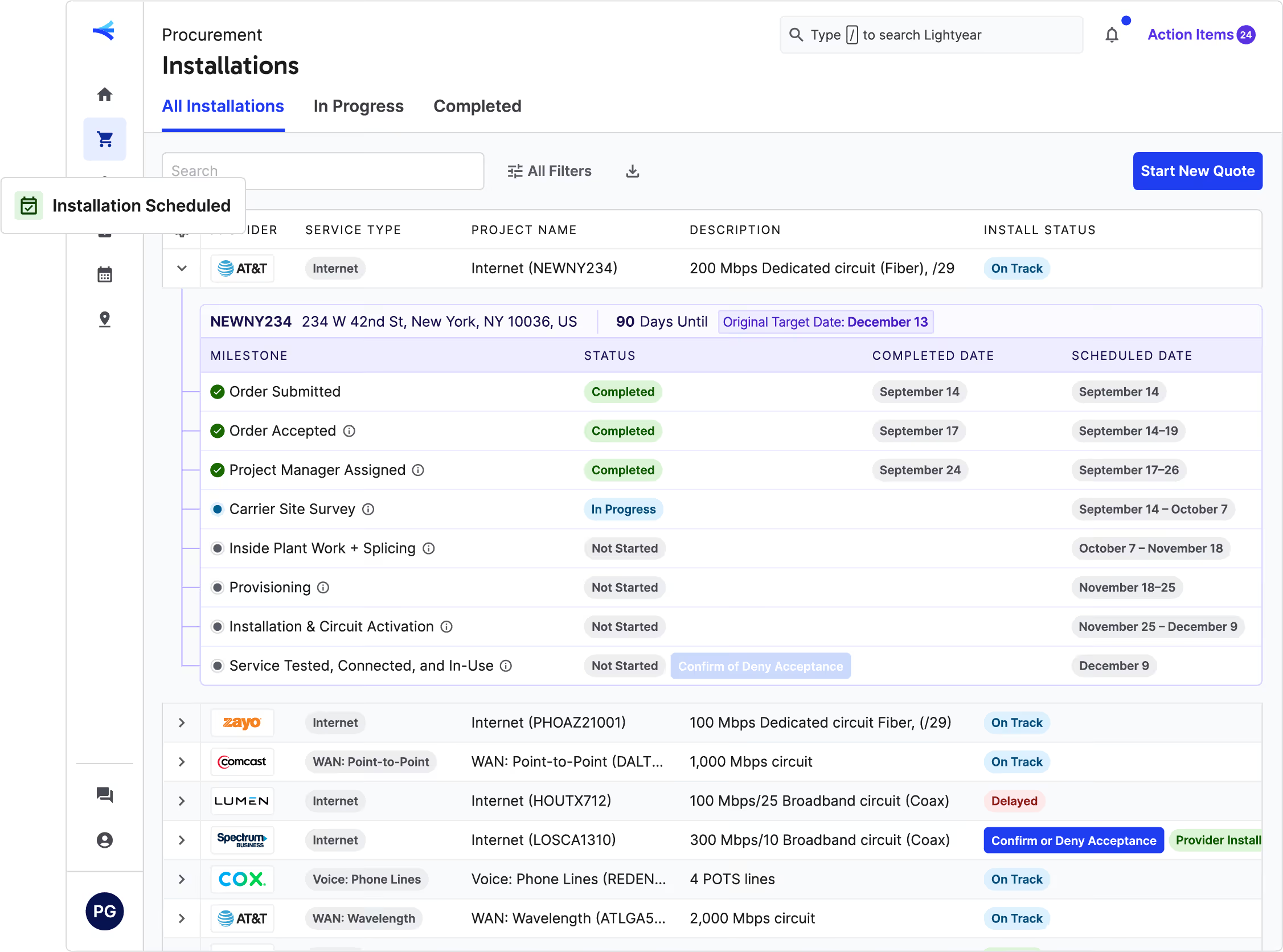
Whether you choose Metro Ethernet or MPLS, the next step is navigating the complex procurement process. By automating network service procurement, inventory management, and bill consolidation, Lightyear takes the pain out of managing your telecom infrastructure.
The hundreds of enterprises who trust Lightyear achieve over 70% time savings and 20% cost savings on their network services.
Schedule a demo or get started with our questionnaire today.
Frequently Asked Questions about Metro Ethernet vs MPLS: The Advantages and Disadvantages of Each
Can I use both Metro Ethernet and MPLS in my network?
Yes, a hybrid network is a common strategy. You can use Metro Ethernet for high-bandwidth, low-cost connectivity between sites in the same city, and then use MPLS to connect these metropolitan area networks to your national or global locations for broader reach.
Which is better for connecting to cloud services like AWS or Azure?
MPLS often provides more reliable cloud access through private on-ramps offered by carriers. Metro Ethernet is also a strong option if the cloud provider's data center is within the same metro area, offering very high-speed, low-latency local connections to their services.
Is my data automatically encrypted with these services?
No, neither service typically includes end-to-end encryption by default. While they provide private connections that are separate from the public internet, you are responsible for implementing your own encryption, such as an IPsec VPN, for maximum data security.
How does SD-WAN fit in with Metro Ethernet and MPLS?
SD-WAN is an overlay technology that works on top of connections like Metro Ethernet and MPLS. It adds intelligent traffic routing, allowing you to combine different circuits to improve application performance, increase reliability, and manage your network more efficiently from a central platform.
Let us show you the product and discuss specifics on how it might be helpful.
Schedule a Demo





Revolutionize Your Telecom Experience
Learn how you can get one step closer to optimal business efficiency for all your telecom services.