MPLS vs BGP: Comparing Network Protocols for Enterprises
MPLS and BGP are key to enterprise networking but do different jobs. Learn how they compare to help you build a better network for your business.


For any business with multiple locations, building a reliable and efficient wide area network (WAN) is a foundational requirement. Two terms that frequently come up in these discussions are Multiprotocol Label Switching (MPLS) and Border Gateway Protocol (BGP).
While they both play crucial roles in directing network traffic, they operate at different levels and solve different problems. This article will compare MPLS and BGP, explaining what each protocol does, their key differences, and how they can work together to support your enterprise network.
What is MPLS?
Multiprotocol Label Switching (MPLS) is a routing technique used in high-performance telecommunications networks. It directs data from one node to the next based on short path labels rather than long network addresses, which speeds up traffic forwarding and avoids complex lookups in a routing table.
- Layer 2.5 Operation: MPLS functions between Layer 2 (Data Link) and Layer 3 (Network) of the OSI model, allowing it to support various network protocols.
- Label-Based Forwarding: Instead of performing an IP lookup at every hop, MPLS assigns a label to data packets. Routers use this simple label to make quick forwarding decisions.
- Private Connections: It is a popular technology for creating secure, private connections between multiple business locations, effectively building a unified enterprise WAN.
- Traffic Engineering: The protocol gives network administrators control over traffic paths, which helps prioritize critical data like voice or video for better performance.
What is BGP?
Border Gateway Protocol (BGP) is the routing protocol that makes the internet work. It manages how data packets are routed between the large, independent networks—known as autonomous systems (AS)—that form the internet's backbone. BGP's main function is to find the most efficient paths for traffic to travel from its source to its destination across these different networks. It is the standard protocol for exchanging routing information between organizations and service providers.
- Exterior Gateway Protocol (EGP): BGP is the primary EGP used today. It is designed for routing between autonomous systems, not within them.
- Layer 4 Operation: While it directs Layer 3 (Network) traffic, BGP itself communicates over TCP (a Layer 4 protocol), which provides a reliable session for exchanging large routing tables.
- Path-Vector Routing: It makes routing decisions based on paths, network policies, and rule-sets. BGP analyzes the full path to a destination and selects the best one based on administrator-defined policies.
- Scalability: BGP is built to handle the enormous scale of the internet, managing a global routing table with hundreds of thousands of routes.
MPLS vs BGP: Key Differences
While both protocols manage data traffic, their fundamental purposes and methods are quite distinct. Here are the primary ways they differ.
1. Scope and Use Case
MPLS is used within a single service provider's network to create private WAN connections for an enterprise. Its main job is to efficiently connect a company's various locations.
BGP, on the other hand, operates on a global scale. It is the protocol used to exchange routing information between large, independent networks (autonomous systems) that make up the public internet.
2. Routing Logic
MPLS makes forwarding decisions using simple labels attached to data packets. This label-swapping technique is fast because routers don't need to perform a full IP address lookup.
BGP uses a more complex method called path-vector routing. It analyzes the entire path to a destination across multiple networks and selects the best route based on administrative policies and specific path attributes.
3. Connection Model
MPLS is connection-oriented, meaning it establishes a predetermined virtual path for traffic to follow from end to end. This provides predictable performance and quality of service.
BGP is fundamentally connectionless. While it uses a reliable TCP connection to share routing tables, the actual data packets are routed independently from hop to hop across the internet.
Benefits of Using MPLS
For enterprises, an MPLS network offers distinct advantages that improve operational performance and reliability.
- High Reliability: Providers often back MPLS circuits with Service Level Agreements (SLAs), contractually guaranteeing uptime and performance metrics like latency and packet loss. This is a level of assurance the public internet doesn't offer.
- Superior Quality of Service (QoS): The ability to prioritize traffic ensures real-time applications like VoIP and video conferencing run smoothly. This prevents common issues like call jitter or lagging video streams.
- Inherent Security: Because traffic is isolated on a private network, it is not exposed to the public internet. This provides a strong layer of security for sensitive data without the overhead of managing VPNs.
Benefits of Using BGP
While BGP is the protocol of the public internet, enterprises can use it for significant strategic advantages, especially when managing their own internet connectivity.
- Greater Redundancy: By connecting to multiple internet service providers (a practice known as multi-homing), BGP can automatically reroute traffic if one provider experiences an outage. This creates a highly resilient connection to the internet.
- Optimized Traffic Flow: BGP gives you control over how data enters and leaves your network. You can influence routing decisions to select the most efficient paths, reducing latency and improving application performance for your users.
- Provider Independence: When you manage your own BGP routing, you gain the flexibility to switch or add ISPs without being locked into their specific IP address space. This simplifies network management and contract negotiations.
Choosing Between MPLS and BGP
The decision isn't about picking one protocol over the other, but rather understanding which tool is right for the job. In many enterprise networks, the answer is using both for different, complementary purposes. Here’s how to think about it.
1. Choose MPLS for Private WAN Connectivity
If your main goal is to securely connect multiple business locations into a single, high-performance private network, MPLS is the standard solution. It is built for reliable site-to-site connectivity where you need guaranteed quality for internal applications like VoIP or data sharing between offices.
2. Use BGP for Internet Resiliency and Control
BGP is the protocol to use when your focus is on managing a robust and redundant connection to the public internet. If your business requires its own block of IP addresses and connects to multiple internet service providers (ISPs) for failover, BGP gives you the control to manage those links effectively.
3. How They Work Together
A common strategy for large businesses is to use both protocols. An enterprise might use an MPLS network to link all its branch offices and data centers together for secure, internal communication. At the network edge, typically at a central data center, the company would then use BGP to manage its connections to the internet, ensuring high availability for all its users and public-facing services.
Final Thoughts on MPLS and BGP
Understanding the difference between MPLS and BGP is key to building an effective enterprise network. They are not competing technologies, but rather specialized tools that solve different problems.
Think of MPLS as the solution for creating a private, high-performance network to link your business locations, ensuring quality for internal applications.
BGP, on the other hand, is the protocol for managing your connection to the public internet, giving you control and redundancy when using multiple service providers.
For many organizations, the best approach uses both: MPLS for reliable internal connectivity and BGP for resilient internet access, forming a complete network strategy.
Need Help Managing Your Network? Lightyear Can Help
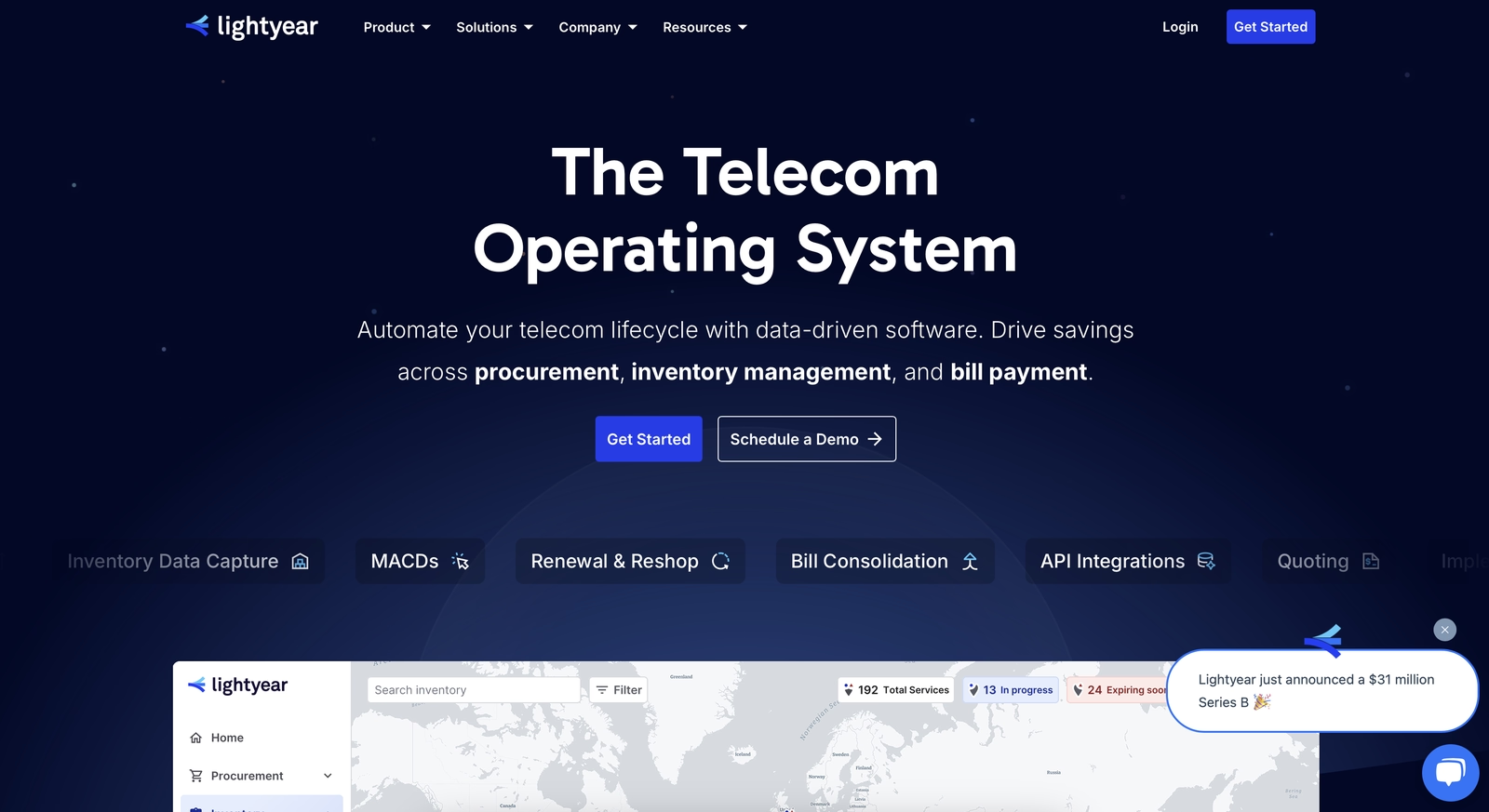
Whether you choose MPLS, BGP, or a hybrid approach, Lightyear simplifies managing your network services. By automating procurement, inventory management, and bill consolidation, we take the pain out of your telecom infrastructure.
The hundreds of enterprises who trust Lightyear achieve over 70% time savings and more than 20% cost savings on their network services.
Schedule a demo or get started with our questionnaire today.
Frequently Asked Questions about MPLS vs BGP
Is MPLS being replaced by SD-WAN?
Not entirely. While SD-WAN is a popular alternative offering flexibility over any connection type, many businesses run it over MPLS to combine its agility with the guaranteed performance of a private circuit. They often serve complementary roles in a hybrid network strategy.
Do I need my own Autonomous System Number (ASN) to use BGP?
Yes, if you plan to connect to multiple ISPs (a practice called multi-homing), you will need a public ASN from a Regional Internet Registry. This number uniquely identifies your network on the internet and is essential for managing your own routing policies.
Which is more expensive, MPLS or BGP?
MPLS circuits generally have a higher cost per megabit than standard internet due to their private nature and performance SLAs. BGP itself is a protocol, but its implementation requires paying for multiple internet connections, which can also be a significant investment.
Let us show you the product and discuss specifics on how it might be helpful.
Schedule a Demo





Revolutionize Your Telecom Experience
Learn how you can get one step closer to optimal business efficiency for all your telecom services.