MPLS vs DIA: Comparing Enterprise Network Solutions
Choosing between MPLS and DIA? This guide compares both on performance, security, and cost to help you find the right fit for your enterprise network.


Choosing the right network infrastructure is a critical decision for any enterprise, directly impacting performance, security, and cost. Two prominent options often at the center of this discussion are Multiprotocol Label Switching (MPLS) and Dedicated Internet Access (DIA).
While both provide business-grade connectivity, they operate on fundamentally different principles and are suited for different use cases. This article will break down the key differences between them, helping you determine which solution best fits your organization's needs.
What is MPLS?
Multiprotocol Label Switching (MPLS) is a networking technology for building private, high-performance wide area networks (WANs). It operates on a carrier's private network infrastructure, not the public internet, creating a more controlled and secure environment for connecting enterprise locations. Think of it as a private highway system for your company's data.
- Private Pathways: MPLS establishes dedicated virtual circuits between your sites. This keeps your traffic isolated from the congestion and security risks of the public internet.
- Label-Based Routing: Instead of looking up a complex IP address at every stop, MPLS assigns a simple "label" to data packets. Routers forward traffic based on these labels, which is a highly efficient process.
- Quality of Service (QoS): Because it is a managed, private network, carriers can prioritize traffic. This guarantees performance for critical applications like voice and video, ensuring low latency and jitter.
What is DIA?
Dedicated Internet Access (DIA) provides a private, uncontended connection from your business directly to the public internet. Unlike standard business broadband, which is often shared among multiple users in an area, a DIA circuit is exclusively for your organization's use, ensuring consistent performance.
- Guaranteed Bandwidth: Your connection isn't shared with other subscribers. If you pay for a 1 Gbps circuit, you receive that full bandwidth without the performance dips common on shared networks during peak hours.
- Symmetrical Speeds: DIA offers identical upload and download speeds. This is critical for tasks like hosting servers, using cloud applications, or frequent video conferencing.
- Service Level Agreement (SLA): DIA connections are backed by an SLA that guarantees specific levels of uptime, latency, and packet delivery, providing a reliable foundation for business operations.
MPLS vs DIA: Key Differences
While both offer high-performance connections, they differ significantly in their underlying architecture, security posture, and typical cost.
1. Network Path and Security
MPLS operates on a carrier's private backbone, creating an isolated network for your sites. Since your data never touches the public internet, it provides inherent security for inter-office traffic.
In contrast, DIA provides a dedicated on-ramp to the public internet. While the circuit to your building is private, all data eventually travels over the public network, necessitating robust security measures like firewalls and VPNs.
2. Performance and Reliability
With MPLS, carriers can apply Quality of Service (QoS) to prioritize traffic types like voice or video across the entire network path. This results in highly predictable, low-latency performance between your connected locations.
A DIA connection's SLA guarantees bandwidth and uptime for your link to the internet. However, once your data hits the public internet, that performance is no longer guaranteed, as it is subject to general internet congestion.
3. Cost and Scalability
MPLS is generally the more expensive option due to the private infrastructure and hands-on management from the provider. Adding new sites can also be a more complex and costly process.
DIA is typically more cost-effective, providing high bandwidth for a lower price point. It is also simpler to scale up your bandwidth as your internet needs grow.
Benefits of MPLS
For businesses that depend on consistent network performance for site-to-site connectivity, MPLS provides several distinct advantages beyond its basic architecture.
- High Reliability: Because it operates on a private network, MPLS delivers exceptional uptime, backed by comprehensive carrier SLAs. This controlled environment minimizes the packet loss and jitter that can disrupt real-time applications like VoIP or video conferencing.
- Guaranteed Application Performance: The technology allows for granular traffic engineering. You can assign different priority levels to various applications, guaranteeing that critical systems always have the resources they need to function smoothly, regardless of other network traffic.
- Simplified WAN Management: The service provider manages the complex core network routing between your locations. This reduces the operational burden on your internal IT staff and creates a more stable WAN environment.
Benefits of DIA
For organizations with a strong reliance on public cloud services and the internet, DIA offers a compelling set of advantages. It provides a direct, high-capacity link to the digital world, making it a practical foundation for modern business operations.
- Excellent Cloud Connectivity: DIA is perfectly suited for cloud-first environments. It provides a direct and efficient pathway to public cloud platforms and SaaS applications, which are accessed over the internet.
- Cost-Effective Bandwidth: You generally get more bandwidth for your money with DIA compared to MPLS. This makes it an economical choice for businesses that need to support heavy data transfers, large file uploads, and other high-throughput activities.
- Simpler Procurement and Management: DIA circuits are a more standardized offering from a wider variety of providers. This often results in faster deployment times and less complex vendor management than building out a private MPLS network.
Choosing Between MPLS and DIA
The right choice depends entirely on your specific business needs, particularly how your organization uses cloud services and connects its various locations. The decision often comes down to your primary traffic patterns.
When to Choose MPLS
MPLS is the superior option if your primary need is connecting multiple physical sites with high reliability. It's ideal for businesses with significant inter-office data transfer, especially for applications like VoIP or internal software that require stable, low-latency performance.
Organizations in finance or healthcare often select MPLS for its private network path, which helps meet stringent security and compliance standards for internal traffic.
When to Choose DIA
DIA is the practical choice for businesses that operate heavily in the public cloud. If your daily operations depend on SaaS platforms and accessing services over the public internet, a high-capacity DIA circuit provides the direct connectivity you need.
It is also a strong fit for single-location companies or those where site-to-site traffic is not a major concern, offering a great balance of performance and cost.
Final Thoughts on MPLS and DIA
The decision between MPLS and DIA ultimately comes down to your primary traffic patterns. MPLS excels at providing a private, controlled path for reliable site-to-site connectivity, making it a strong choice for businesses with significant internal data exchange.
In contrast, DIA offers a high-capacity, direct connection to the public internet, which is ideal for cloud-heavy operations. Many modern enterprises find value in a hybrid model, using both technologies to support different application needs. Evaluating your specific requirements is the key to choosing the right foundation for your network.
Need Help Managing Your Network? Lightyear Can Help
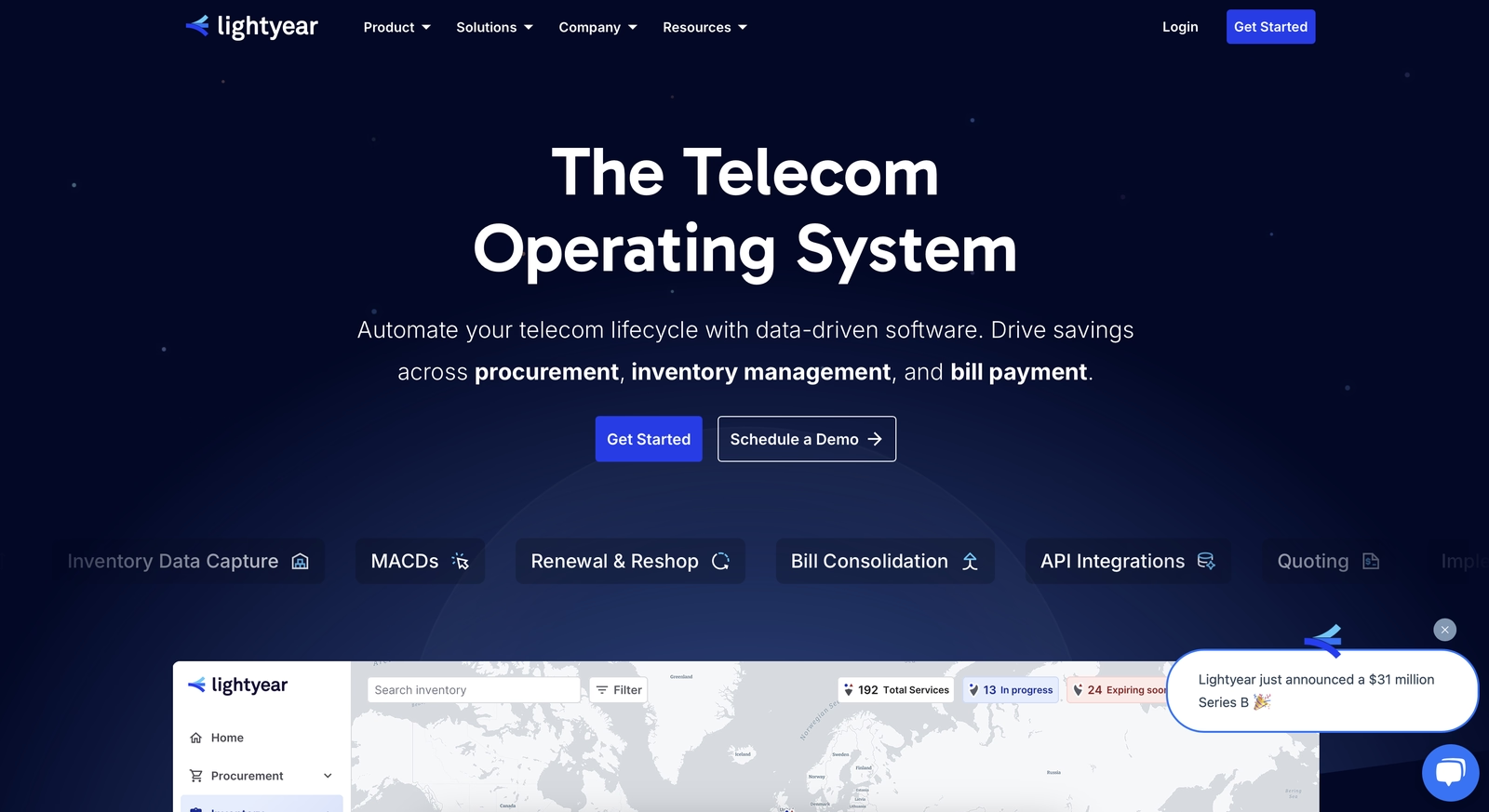
Deciding between MPLS and DIA is just the first step. Lightyear simplifies the entire lifecycle by automating network service procurement, inventory management, and bill consolidation, helping you easily compare options from over 1,200 carriers and manage your chosen solution.
The hundreds of enterprises who trust Lightyear achieve 70%+ time savings and 20%+ cost savings on their network services. Schedule a demo or get started with our questionnaire today.
Frequently Asked Questions about MPLS vs DIA
Can I use MPLS and DIA together?
Absolutely. Many businesses use a hybrid approach, using MPLS for reliable site-to-site connections and a separate DIA circuit for general internet and cloud access. This model balances performance with cost-effectiveness, giving you the best of both worlds.
How does SD-WAN relate to MPLS and DIA?
SD-WAN is an overlay technology that can manage traffic across various connections, including both MPLS and DIA. It adds a layer of intelligence, allowing you to route application traffic over the best available path, whether it's private or public.
Is MPLS becoming obsolete?
Not at all. While cloud adoption has boosted DIA's popularity, MPLS remains the standard for applications requiring guaranteed performance and private connectivity. Its reliability is still unmatched for specific use cases like real-time voice and critical internal systems.
Which is better for supporting a remote workforce?
DIA is generally the more practical choice. Since remote employees connect over the public internet, a high-capacity DIA circuit at your data center provides the necessary bandwidth for VPNs and cloud application access, ensuring smooth performance for your team.
Let us show you the product and discuss specifics on how it might be helpful.
Schedule a Demo





Revolutionize Your Telecom Experience
Learn how you can get one step closer to optimal business efficiency for all your telecom services.