MPLS vs Hybrid WAN: Enterprise Network Solutions
Deciding between MPLS and Hybrid WAN? We compare the two on cost, security, and performance to help you choose the right enterprise network solution.


For any business with multiple locations, choosing the right network architecture is a critical decision that impacts performance, security, and cost. Two common approaches that often come up in these discussions are Multiprotocol Label Switching (MPLS) and a Hybrid Wide Area Network (WAN).
While both can connect your enterprise sites, they operate on different principles and offer distinct advantages. This article will break down the key differences between MPLS and Hybrid WAN to help you determine which solution is the right fit for your organization's needs.
What is MPLS?
Multiprotocol Label Switching (MPLS) is a networking technology that has long been a staple for enterprise connectivity. It creates a private, dedicated network to connect your various business locations, essentially building a private highway for your data that is separate from the public internet.
This approach ensures reliable and predictable performance for your critical applications. Here’s a quick rundown of its core attributes:
- Private Connectivity: MPLS circuits are not on the public internet, offering a high level of security and privacy for data in transit.
- Guaranteed Performance: Because it's a dedicated network, MPLS comes with service-level agreements (SLAs) that guarantee uptime, low latency, and minimal packet loss.
- Traffic Prioritization: It allows for Quality of Service (QoS), meaning you can prioritize time-sensitive traffic like VoIP or video conferencing over less critical data.
What is Hybrid WAN?
A Hybrid WAN takes a more flexible approach by combining two or more different types of network connections—such as MPLS, broadband internet, and 4G/5G LTE—into a single, unified network. Instead of relying on one type of circuit, it creates a blended infrastructure that balances performance and cost. This architecture is often managed through a centralized controller, like an SD-WAN overlay, that intelligently directs traffic based on application priority and network conditions.
- Mixed Connections: It actively uses multiple transport services at the same time, allowing businesses to pair the reliability of a private line with the affordability of public internet.
- Intelligent Routing: Traffic can be dynamically routed across the most appropriate path. For example, critical business applications might be sent over MPLS, while bulk data or guest Wi-Fi uses a broadband connection.
- Increased Bandwidth: By aggregating multiple links, a Hybrid WAN can provide greater overall bandwidth than a single connection could offer alone.
Comparing MPLS and Hybrid WAN: Key Differences
When you get down to the nuts and bolts, the main distinctions between these two architectures come down to cost, flexibility, and how they handle performance and security.
Cost Structure
MPLS is a premium service with a higher cost-per-megabit due to its private infrastructure and performance guarantees. In contrast, a Hybrid WAN can be more budget-friendly by mixing dedicated lines with less expensive public broadband connections.
Flexibility and Scalability
Deploying or changing an MPLS circuit often involves long lead times from carriers. Hybrid WAN provides more agility, as adding a new broadband or wireless link to a location is typically a much faster and simpler process.
Security Approach
Because MPLS traffic is isolated from the public internet, it offers inherent security. A Hybrid WAN sends data over public networks, requiring security measures like encrypted tunnels and firewalls, often managed through an SD-WAN overlay.
Performance and Reliability
MPLS provides highly predictable performance backed by carrier SLAs for uptime and latency. While Hybrid WAN performance can fluctuate on its public links, it offers resiliency by design, automatically rerouting traffic if one connection fails.
Benefits of MPLS for Enterprises
For enterprises that depend on high-stakes applications, the stability of MPLS offers distinct operational advantages. It creates a controlled environment where performance isn't just a goal, but a guarantee built into the service.
- Consistent Application Performance: Beyond just speed, MPLS provides very low network jitter. This is critical for real-time applications like financial transaction systems or centralized ERPs, where even slight variations in delay can disrupt operations.
- Simplified Network Management: Because MPLS is a managed service from a carrier, it reduces the burden on your internal IT team. The provider is responsible for managing the complex core network and meeting the SLA, offering a single point of contact for support.
- Reliable Global Reach: Major MPLS carriers have extensive international networks, providing a dependable way to connect offices across the globe with uniform performance and security policies.
Advantages of Hybrid WAN for Businesses
On the other hand, a Hybrid WAN offers a modern set of benefits geared toward flexibility and cost-efficiency, making it a strong choice for businesses adapting to cloud services and dynamic operational needs.
- Cost-Performance Optimization: By intelligently routing traffic, you can use affordable broadband connections for general internet and cloud access while reserving more expensive private links for sensitive, high-priority data. This blend significantly reduces overall connectivity costs.
- Improved Cloud Access: Hybrid WAN is ideal for organizations that rely heavily on cloud applications (SaaS). It can send cloud traffic directly to the internet instead of backhauling it through a central data center, which reduces latency and improves application responsiveness.
- Increased Network Resiliency: Using multiple carriers and connection types creates built-in redundancy. If one link fails or experiences poor performance, traffic is automatically and instantly rerouted to a working connection, minimizing downtime.
Choosing Between MPLS and Hybrid WAN: Factors to Consider
The best network architecture for your business isn't a one-size-fits-all answer; it comes down to your unique operational requirements. Here are the key factors to weigh when making your decision.
1. Your Application Profile
Start by analyzing the applications your business depends on. If you run real-time services like VoIP, video conferencing, or transaction-heavy platforms where low latency and minimal jitter are essential, the guaranteed performance of MPLS is a strong fit.
If your operations are heavily centered on cloud-based applications (SaaS) and general internet traffic, a Hybrid WAN provides more efficient, direct access to those resources.
2. Geographic Footprint and Scalability
Consider the location and number of your sites. MPLS provides a robust and uniform way to connect a handful of major corporate offices, especially on a global scale.
For organizations with many smaller, widely dispersed branches or those planning rapid site expansion, a Hybrid WAN offers greater agility. Adding new broadband or wireless connections is typically faster and more straightforward than provisioning new MPLS circuits.
3. IT Management and Resources
Finally, evaluate your internal IT capacity. MPLS is a carrier-managed service, which offloads the complexity of network maintenance and troubleshooting from your team.
A Hybrid WAN, typically managed via an SD-WAN overlay, gives your team granular control over traffic routing and security policies but requires the in-house expertise to manage it effectively.
Making the Right Choice for Your Network Needs
Ultimately, the decision between MPLS and a Hybrid WAN hinges on your specific business priorities. There's no single "best" answer, only the right fit for your applications, budget, and operational model. To simplify your choice, consider these final points:
- Choose MPLS if: Your primary need is guaranteed, predictable performance for sensitive, real-time applications. If your operations cannot tolerate any latency or jitter and security is paramount, the dedicated nature of MPLS is worth the investment.
- Choose Hybrid WAN if: Your organization relies heavily on cloud applications, requires the flexibility to add new sites quickly, and needs to optimize network costs. It offers a resilient and agile infrastructure for modern, distributed businesses.
- It's not always either/or: Remember that a Hybrid WAN can include MPLS as one of its connection types. You can use MPLS for your headquarters or data center while connecting smaller branches with more affordable broadband, getting a balanced solution.
Need Help Managing Your Network? Lightyear Can Help
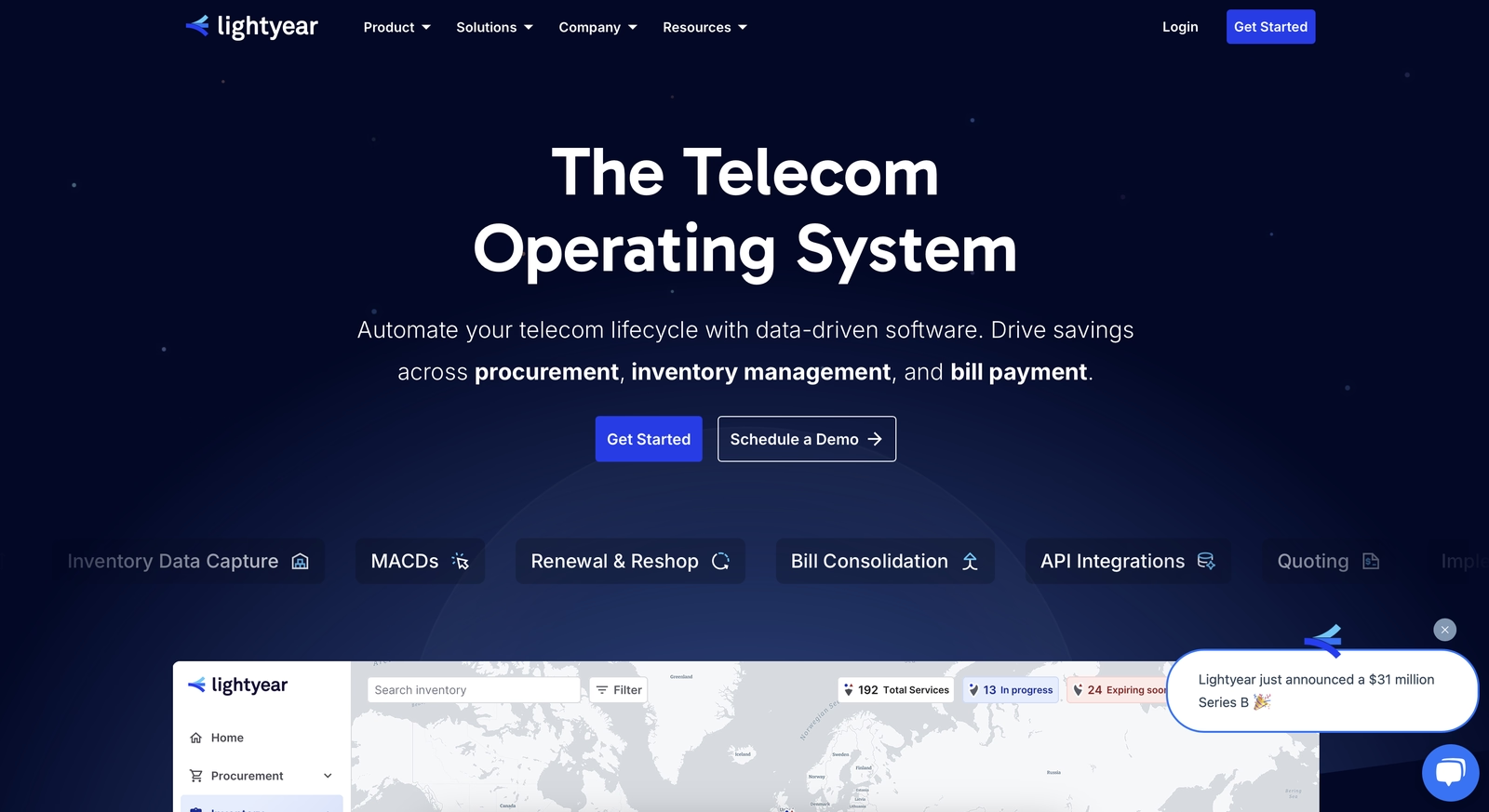
Deciding between MPLS and Hybrid WAN is just the first step. Lightyear automates what comes next by handling the procurement, inventory, and billing for your network services.
By automating the process, the hundreds of enterprises who trust Lightyear achieve over 70% time savings and 20% cost savings on their network services. Schedule a demo or get started with our questionnaire today.
Frequently Asked Questions about MPLS vs Hybrid WAN
Can I use SD-WAN with just an MPLS network?
Yes, you can. SD-WAN can be deployed over any type of connection, including MPLS circuits. This allows you to gain intelligent traffic routing and centralized management capabilities while still using your private, high-performance MPLS backbone for connectivity.
Is a Hybrid WAN inherently less secure than MPLS?
Not necessarily. While MPLS is private by default, a well-configured Hybrid WAN uses strong encryption (like IPsec tunnels) to secure data over public internet links. When implemented correctly with an SD-WAN overlay, it can meet stringent security requirements.
What is the process for migrating from MPLS to a Hybrid WAN?
Migration is typically phased. You can start by adding broadband or LTE links at key sites and layering an SD-WAN solution over your existing MPLS. This allows you to gradually shift traffic and test performance before decommissioning any MPLS circuits.
Let us show you the product and discuss specifics on how it might be helpful.
Schedule a Demo





Revolutionize Your Telecom Experience
Learn how you can get one step closer to optimal business efficiency for all your telecom services.
