MPLS vs IP Routing: Enterprise Network Solutions
MPLS vs. IP Routing: Which is right for your enterprise network? Learn the key differences in performance, security, and cost to make a smart choice.


For any business with multiple locations, connecting them all with a reliable and high-performing network is a fundamental need.
Two common approaches for building these wide area networks (WANs) are Multiprotocol Label Switching (MPLS) and standard IP routing.
This guide will compare them directly, breaking down the key differences in performance, cost, and flexibility to help you make an informed decision for your organization.
What is MPLS?
Multiprotocol Label Switching (MPLS) is a data-routing technique that directs traffic using short path labels instead of complex network addresses. It functions as a private network service from a telecom carrier, designed to provide reliable, high-speed connections for business-critical applications. MPLS works by pre-determining the most efficient path for data to travel across the provider's network, ensuring consistent performance and uptime.
- Private and Secure: Traffic on an MPLS network is isolated from the public internet, creating a secure, private environment for your data.
- Quality of Service (QoS): It allows for the prioritization of traffic, ensuring that critical applications like VoIP or video conferencing receive the necessary bandwidth without interruption.
- Carrier-Managed: The network provider is responsible for managing the infrastructure, routing, and maintenance, reducing the operational burden on your IT team.
What is IP Routing?
IP Routing, or Internet Protocol routing, is the process that directs data packets from their source to their destination across the public internet. It operates on a hop-by-hop basis, where each router along the path independently decides where to send the packet next based on its destination IP address. This method forms the backbone of the global internet, connecting countless networks together.
- Public Network: Traffic travels over the shared public internet, which means it competes with all other internet traffic.
- Best-Effort Delivery: Unlike the dedicated paths in MPLS, IP routing doesn't guarantee performance. Packet delivery and speed can fluctuate based on network congestion.
- Decentralized Management: The network path is not predetermined. Instead, it's dynamically calculated by routers across the internet, which can lead to variable routes and performance.
Key Differences Between MPLS and IP Routing
While both connect your sites, they do so in fundamentally different ways. These differences directly impact performance, cost, security, and how easily you can manage your network.
1. Performance and Reliability
MPLS provides predictable performance backed by Service Level Agreements (SLAs). Because it operates on a private network with predetermined routes, you get consistent speed and low latency for your applications.
IP routing, on the other hand, sends traffic over the public internet. This means performance is "best-effort" and can vary depending on overall network congestion.
2. Cost
There is a significant cost difference between the two. MPLS is a premium, managed service and is priced accordingly, making it the more expensive option.
IP routing leverages standard business internet connections, which are widely available and generally much more cost-effective.
3. Security
MPLS networks are inherently secure because your traffic is completely isolated from the public internet. It functions like a private lane on a highway.
With IP routing, data travels across the public internet. To achieve a similar level of security, you typically need to implement additional measures like VPNs to encrypt the traffic.
4. Flexibility
IP routing offers greater agility. You can quickly add a new site to your network with a standard internet connection.
MPLS can be more rigid. Provisioning new circuits or making changes often requires working with the carrier and can involve longer lead times.
Benefits of MPLS for Enterprises
For enterprises that depend on consistent network uptime and application performance, MPLS offers several distinct advantages that go beyond basic connectivity.
- Guaranteed Application Performance: With Service Level Agreements (SLAs), business-critical applications like VoIP and SaaS platforms operate reliably without disruption. This translates to consistent performance and a better user experience for employees and customers.
- Reduced IT Workload: Because the service is fully managed by the carrier, your IT team is freed from the complexities of network routing and maintenance. This allows them to focus on strategic projects rather than day-to-day network troubleshooting.
- Simplified Network Architecture: MPLS provides a cohesive, private network that simplifies connecting multiple offices and data centers. This creates a predictable and manageable WAN infrastructure as your organization grows.
Advantages of IP Routing for Businesses
IP routing offers a compelling alternative for businesses that value flexibility and cost-efficiency. It's particularly well-suited for organizations that rely heavily on cloud applications and need to adapt their network quickly.
- Lower Total Cost: IP routing uses standard business internet connections, which are significantly more affordable than private MPLS circuits. This approach avoids expensive carrier contracts and allows you to use a wider range of cost-effective hardware.
- Greater Agility and Speed: New sites can be brought online in days instead of the weeks or months often required for MPLS provisioning. This speed allows your network to keep pace with business growth and changing location needs.
- Direct Cloud Access: Since it operates over the public internet, IP routing provides a direct and efficient path to cloud-based services and SaaS applications. This avoids the complex backhauling of traffic to a central data center that can occur with some MPLS setups.
- Vendor Diversity: You are not tied to a single provider. This freedom allows you to select the best available internet service provider (ISP) for each specific location, optimizing for both cost and performance across your network.
Choosing Between MPLS and IP Routing
The right choice depends on your organization's specific priorities, budget, and application needs. Here’s how to determine which path fits your business.
1. When to Choose MPLS
Opt for MPLS if your business cannot tolerate any performance degradation for its critical applications. This is often the case in industries like finance or healthcare, where consistent uptime and latency are essential for operations.
If you need guaranteed quality for real-time services like VoIP or video conferencing and prefer a carrier-managed solution with built-in security, MPLS provides that stable foundation.
2. When to Choose IP Routing
IP routing is the more practical choice for organizations that prioritize agility and cost-efficiency. If your business relies heavily on public cloud applications, IP routing offers a direct and low-cost path to those services.
It's also ideal for companies that need to add or change locations quickly and are comfortable managing their own security layers, such as VPNs, over public internet connections.
3. Considering a Hybrid Approach
It’s important to know that this isn't an all-or-nothing decision. Many modern networks use a hybrid strategy to get the best of both worlds.
You can use reliable MPLS circuits for your headquarters or data centers while connecting smaller branch offices with more affordable IP routing. This approach, often managed through an SD-WAN solution, allows you to balance performance requirements with your budget.
Final Thoughts on MPLS vs IP Routing
The decision between MPLS and IP routing comes down to your organization's core priorities. There isn't a single "best" answer, only the right fit for your specific operational needs and budget.
If your business relies on applications where performance cannot be compromised, such as real-time financial transactions or VoIP, the guaranteed service levels of MPLS are a strong fit. It provides a stable, private network foundation.
Conversely, if your organization values agility, rapid deployment for new sites, and direct access to cloud services, IP routing offers a more cost-effective and flexible path. This approach is well-suited for businesses with a modern, cloud-centric IT strategy.
As networks evolve, many businesses find value in a hybrid model that combines both approaches to balance cost and performance. Ultimately, understanding your application traffic and site-specific requirements is the key to making a sound investment for your network's future.
Need Help Managing Your Network? Lightyear Can Help
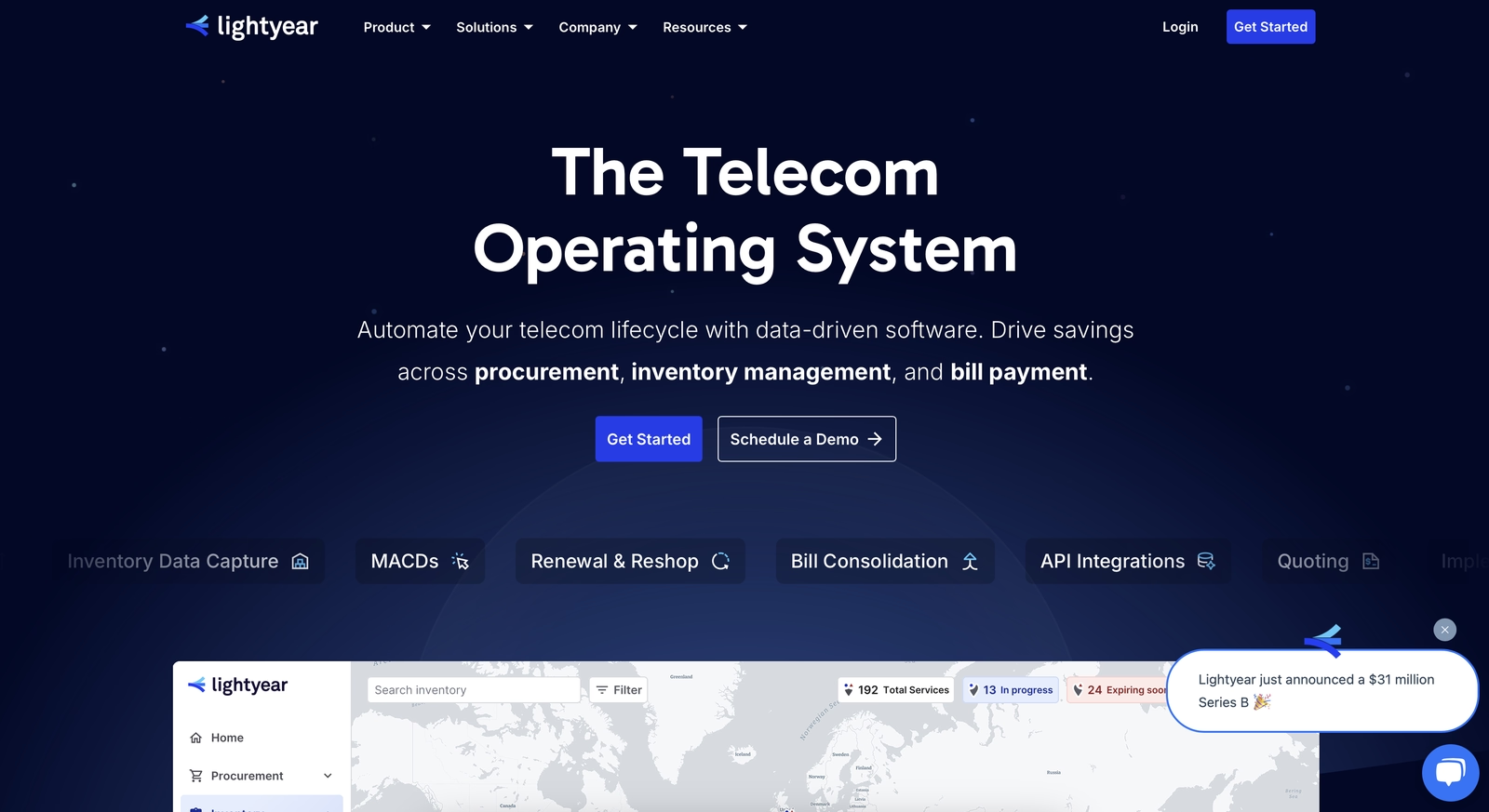
Whether you choose MPLS, IP routing, or a hybrid approach, managing the procurement and lifecycle of your network services can be complex. Lightyear simplifies this by automating network service procurement, inventory management, and bill consolidation, helping you find the right solution for each site.
The hundreds of enterprises who trust Lightyear achieve over 70% time savings and 20% cost savings on their network services. Schedule a demo or get started with our questionare today.
Frequently Asked Questions about MPLS vs IP Routing
Is SD-WAN the same as IP routing?
No, they are related but different. SD-WAN is an overlay technology that uses one or more underlying connections, like IP routing or MPLS, to intelligently steer traffic based on application policies. It adds a layer of management on top of your connections.
Do I still need a firewall with MPLS?
Yes. While MPLS isolates your traffic from the public internet, you still need firewalls. They protect your network at any internet breakout points and secure traffic between internal network segments, which is a critical security best practice.
Can I get a Service Level Agreement (SLA) with IP routing?
Not in the same way as MPLS. You can get an SLA for the uptime of your business internet circuit from your ISP. However, this doesn't guarantee performance like latency or packet loss across the public internet, which is what an MPLS SLA provides.
Let us show you the product and discuss specifics on how it might be helpful.
Schedule a Demo





Revolutionize Your Telecom Experience
Learn how you can get one step closer to optimal business efficiency for all your telecom services.