MPLS vs Site-to-Site VPN: Network Solutions Comparison
Choosing between MPLS and a Site-to-Site VPN? This guide compares cost, security, and performance to help you decide on the right network solution.

Connecting multiple business locations securely and efficiently is a fundamental challenge for any growing enterprise. When your teams need to share data and access internal resources across different sites, you need a wide area network (WAN) solution that is both reliable and secure.
Two popular options for building a private WAN are Multiprotocol Label Switching (MPLS) and site-to-site Virtual Private Networks (VPNs). This article will compare them directly, looking at their performance, security, cost, and scalability to help you decide which is the right fit for your organization's needs.
What is MPLS?
Multiprotocol Label Switching, or MPLS, is a routing technique used by telecommunications providers to create private, high-performance networks. Think of it as a private highway for your company's data, built and managed by a carrier and kept separate from the public internet. It works by assigning short labels to data packets, allowing routers to forward traffic based on these simple labels instead of performing complex IP address lookups. This makes data transfer fast and efficient.
- Private and Secure: MPLS circuits are isolated from the public internet, providing an inherent layer of security for your data in transit.
- Guaranteed Performance: Carriers offer Service Level Agreements (SLAs) that guarantee uptime, latency, and packet delivery, ensuring reliable connectivity.
- Quality of Service (QoS): It allows you to prioritize critical applications like VoIP or video conferencing, ensuring they always have the resources to function smoothly.
What is Site-to-Site VPN?
A site-to-site VPN, on the other hand, creates a secure, encrypted connection between two or more office networks over the public internet. Instead of a private line from a carrier, it builds a protected “tunnel” for your data to travel through. This allows the local area networks (LANs) at different locations to communicate with each other as if they were a single network, all while using your existing internet connections.
- Uses Public Internet: VPN traffic travels over your standard business internet service, which means performance can be affected by public internet congestion.
- Encrypted Tunnel: It relies on strong encryption protocols, most commonly IPsec, to protect the confidentiality and integrity of data in transit.
- Hardware Dependent: Establishing a connection requires compatible network hardware, such as routers or firewalls, at each site to create and maintain the VPN tunnel.
MPLS vs Site-to-Site VPN: Key Differences
When you're weighing these two options, the decision often comes down to a few critical factors: performance, cost, and how you manage your network.
Performance and Reliability
MPLS offers dedicated bandwidth with carrier-backed Service Level Agreements (SLAs), guaranteeing uptime and low latency for critical applications. In contrast, a site-to-site VPN's performance is dependent on the public internet, which can experience congestion and unpredictable delays.
Cost
There's a significant cost difference between the two. MPLS is a premium service with higher monthly recurring charges for its private, managed circuits. VPNs are far more cost-effective, as they simply use your existing business internet connections, with primary costs being the internet service and network hardware.
Security Model
Both options are secure, but they achieve it differently. MPLS security is based on network isolation; your traffic never touches the public internet. A VPN relies on strong encryption protocols like IPsec to create a private, secure tunnel over the public internet.
Scalability and Management
Adding a new location to an MPLS network requires coordination with the carrier and can take weeks or even months. A VPN offers more agility, as your IT team can typically establish a new site connection much faster. However, managing a large number of VPN tunnels can become complex without the right tools.
Benefits of MPLS for Enterprises
For businesses that depend on constant, high-quality connectivity between sites, MPLS provides several distinct operational advantages beyond its basic technical function.
- Predictable Application Performance: With MPLS, you can define Quality of Service (QoS) policies to prioritize traffic. This means real-time applications like video conferencing and VoIP run smoothly without the jitter or lag common on congested public networks.
- Simplified Network Management: The service provider manages the complex core network, including routing and maintenance. This frees up your IT team from managing intricate site-to-site connections, allowing them to focus on other strategic initiatives.
- High Uptime with SLAs: Carrier-backed Service Level Agreements (SLAs) contractually guarantee network performance, including uptime, latency, and packet delivery. This provides a level of reliability that is difficult to match with internet-based VPNs.
Advantages of Site-to-Site VPN for Businesses
For organizations that prioritize agility and cost-efficiency, a site-to-site VPN offers several compelling advantages.
- Lower Total Cost: VPNs run over standard business internet, avoiding the high monthly fees of private MPLS circuits. This makes it a highly economical solution, especially for connecting numerous smaller offices.
- Rapid Deployment: Your IT team can establish a new VPN tunnel in hours or days, unlike the weeks or months required for carrier-provisioned MPLS. This agility allows your network to scale quickly with business needs.
- Geographic Flexibility: A VPN can connect any site with a stable internet connection, including fiber, cable, or LTE. This is a key benefit in areas where MPLS service is unavailable or cost-prohibitive.
- Vendor Independence: You are not locked into a single provider for your network. This allows you to mix internet service providers and use a wide range of networking hardware, giving you more control.
Choosing Between MPLS and Site-to-Site VPN
Making the right decision comes down to aligning the technology with your specific business priorities, budget, and performance needs. Here’s a straightforward guide to help you determine which path is best for your organization.
1. Choose MPLS for Guaranteed Performance
Opt for MPLS if your operations cannot tolerate any network downtime or performance degradation. This is often the case for headquarters, data centers, or sites running critical real-time applications where carrier-backed SLAs are essential.
If your budget accommodates a premium service in exchange for guaranteed reliability and security, MPLS is the stronger choice.
2. Choose Site-to-Site VPN for Flexibility and Cost Control
A site-to-site VPN is the ideal solution when cost and agility are your main drivers. It works well for connecting numerous smaller branch offices or retail locations where deploying expensive private circuits is not practical.
This approach is also suitable if your traffic is less sensitive to occasional latency and you value the ability to add new sites quickly using any available internet connection.
3. Consider a Hybrid WAN Strategy
Many organizations find the best solution is not one or the other, but a combination of both. A hybrid approach allows you to use MPLS for your most critical locations that require high performance, like your corporate headquarters.
At the same time, you can use cost-effective site-to-site VPNs to connect smaller offices, creating a network that is both reliable and budget-conscious.
Final Thoughts on MPLS and Site-to-Site VPN
Ultimately, the choice between MPLS and a site-to-site VPN comes down to your specific business priorities. Neither is universally better; the right solution depends on your unique requirements for performance, cost, and scalability.
If your operations demand guaranteed uptime and performance for critical applications, MPLS is the clear choice. For organizations prioritizing cost-efficiency and the flexibility to connect many sites quickly, a site-to-site VPN is a practical and effective solution.
A hybrid approach, combining both, often provides the most balanced strategy for modern enterprises.
Need Help Managing Your Network? Lightyear Can Help
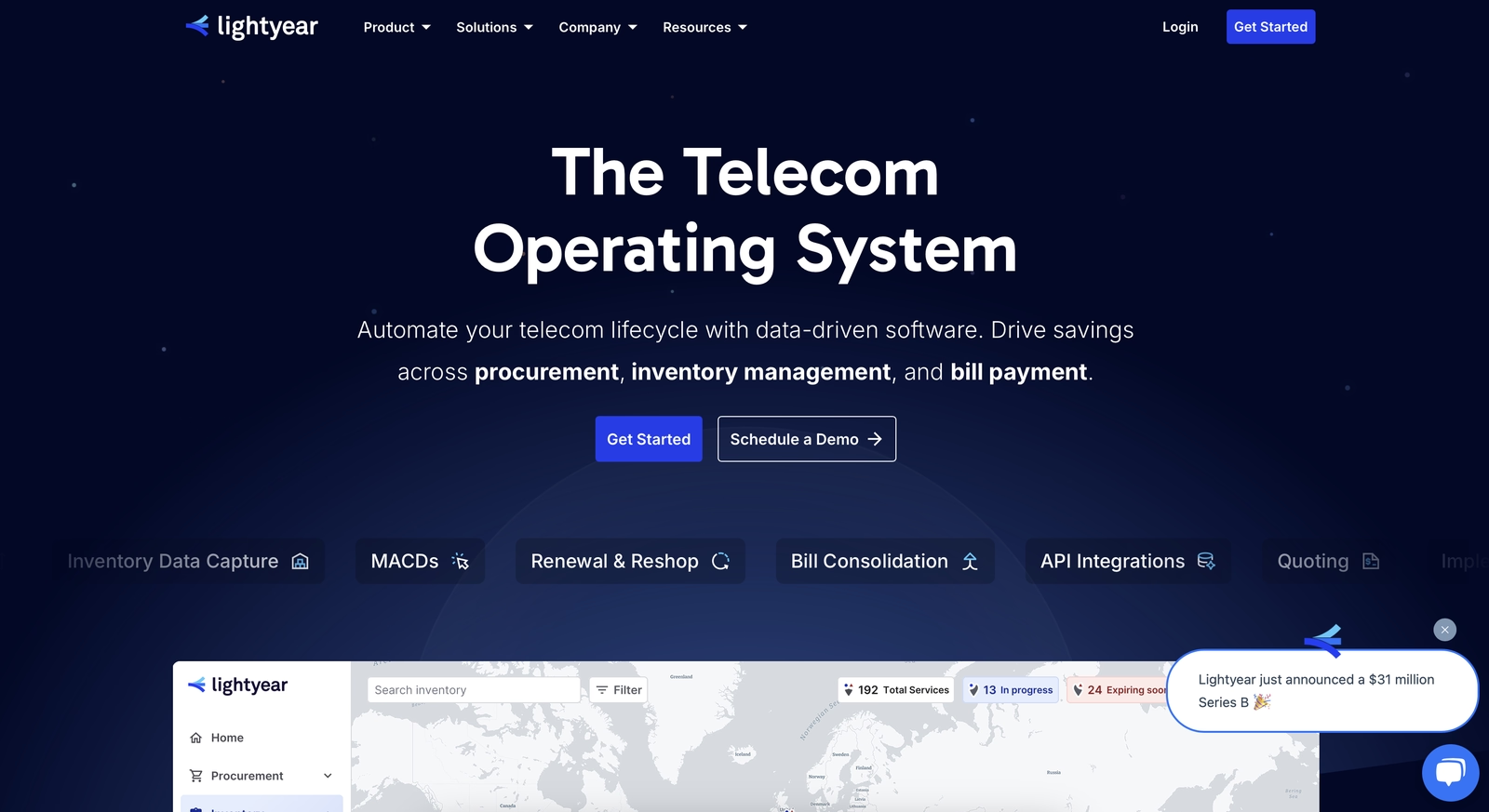
Whether you choose MPLS, a site-to-site VPN, or a hybrid WAN, Lightyear’s platform makes it easy to procure and manage your network services.
By automating network service procurement, inventory management, and bill consolidation, Lightyear takes the pain out of telecom infrastructure management. Enterprises using Lightyear save over 70% in time and 20% in costs on their network services.
Schedule a demo or get started with our questionnaire today.
Frequently Asked Questions about MPLS vs Site-to-Site VPN
Which is better for connecting to cloud services like AWS or Azure?
A site-to-site VPN is often more flexible for general cloud access since it uses the internet. However, for guaranteed performance, dedicated connections like AWS Direct Connect or Azure ExpressRoute are recommended, which function more like a private MPLS circuit to the cloud provider.
Does a site-to-site VPN slow down my internet connection?
The encryption process adds minimal overhead that modern hardware handles easily. Any noticeable slowdown is typically caused by public internet congestion or the speed of your underlying internet plan, not the VPN technology itself.
Is MPLS becoming obsolete?
Not entirely, but its role is evolving. While many businesses adopt more agile solutions, MPLS remains the standard for sites that require absolute reliability and guaranteed performance. It is now frequently used as part of a larger hybrid network strategy.
How does SD-WAN fit into this comparison?
SD-WAN is a technology that can manage both MPLS and VPN connections simultaneously. It intelligently routes traffic over the best path based on application needs, combining the reliability of MPLS with the cost-effectiveness and flexibility of internet VPNs.
Let us show you the product and discuss specifics on how it might be helpful.
Schedule a Demo





Revolutionize Your Telecom Experience
Learn how you can get one step closer to optimal business efficiency for all your telecom services.