Comparing RDMA Over Ethernet and InfiniBand
RoCE vs. InfiniBand: A clear comparison for IT leaders. Understand the key differences in performance, cost, and ease of use for your network.

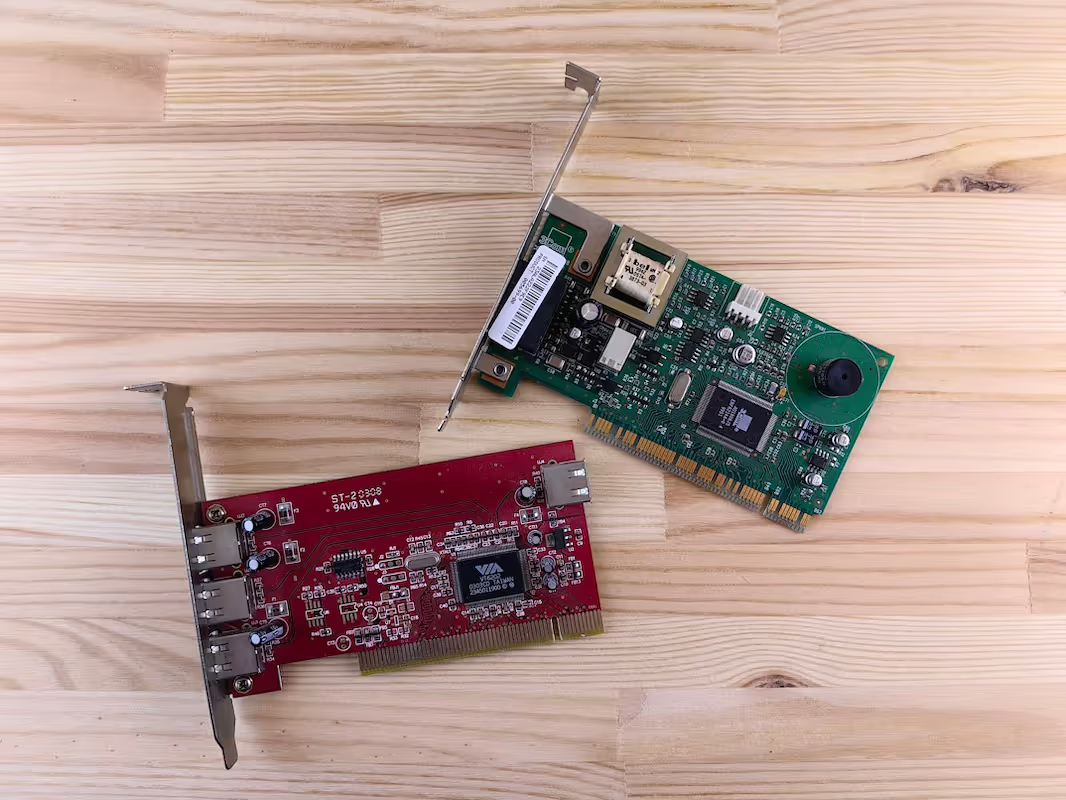
For IT teams managing demanding workloads like AI or big data analytics, the network fabric is a foundational choice. The decision often comes down to two powerful technologies: RDMA over Converged Ethernet (RoCE) and InfiniBand.
Both are designed for high-speed, low-latency communication, but they approach this goal with different architectures. Understanding their distinct features, performance characteristics, and management requirements is key to making an informed investment for your infrastructure.
What is RDMA Over Converged Ethernet (RoCE)?
RDMA over Converged Ethernet (RoCE) is a network protocol that allows Remote Direct Memory Access (RDMA) to run over standard Ethernet networks. Its main purpose is to lower latency and reduce CPU overhead by enabling direct memory access between servers. This bypasses the operating system for data transfers, making it a strong option for data-heavy applications. For IT teams, this means faster communication between machines without bogging down processors.
- Leverages Ethernet: RoCE operates on familiar Ethernet infrastructure. This can make adoption easier for organizations, as it works with existing Ethernet switches and network setups.
- Kernel Bypass: A key feature of RoCE is its ability to bypass the kernel. Network adapters transfer data directly into application memory, which accelerates data movement and frees the CPU to handle other computational work.
- Two Main Versions: RoCE is available in two versions. RoCEv1 is a Layer 2 protocol, meaning it is not routable and is confined to a single network segment. RoCEv2 operates at Layer 3, making it routable across different subnets and more suitable for complex, large-scale data center networks.
What is InfiniBand?
InfiniBand is a high-performance computing fabric designed from the ground up for maximum throughput and minimal latency. Unlike RoCE, which adapts RDMA for Ethernet, InfiniBand is a completely separate networking standard with its own dedicated hardware and protocols. It was created specifically for demanding environments like data centers, supercomputing, and enterprise AI clusters where data transfer speed is critical.
- A Complete Architecture: InfiniBand defines a full "fabric" from the physical layer up, including its own switches, host channel adapters (HCAs), and software protocols. This integrated design allows for extremely high levels of optimization.
- Switched Fabric Topology: It operates on a switched fabric topology, where endpoints connect to switches. This creates a network where multiple devices can communicate simultaneously at full wire speed without contention.
- Native RDMA: Remote Direct Memory Access is not an add-on for InfiniBand; it is a fundamental, built-in feature. This native integration is a primary reason for its characteristically low latency and efficient CPU usage.
Key Differences Between RoCE and InfiniBand
While both technologies enable RDMA, they differ significantly in their architecture and operational requirements. These distinctions are important when planning your network infrastructure.
1. Underlying Infrastructure and Hardware
RoCE is designed to work over standard Ethernet networks. This means you can use Ethernet Network Interface Cards (NICs) and switches, which your team is likely already familiar with.
InfiniBand, on the other hand, requires a dedicated network. It uses its own Host Channel Adapters (HCAs) and InfiniBand-specific switches, creating a separate fabric isolated from your primary Ethernet traffic.
2. Network Management and Complexity
Because RoCE runs on Ethernet, it can be managed using familiar Ethernet tools. However, it requires careful configuration of the underlying network to ensure lossless operation, often using features like Priority Flow Control (PFC).
InfiniBand management is handled through a Subnet Manager, which runs on a switch or a dedicated host. This manager discovers the topology and routes traffic, simplifying setup within its own fabric.
3. Scalability and Routing
RoCEv2 is routable over standard IP networks. This allows it to scale across large data centers using familiar Layer 3 routing protocols.
InfiniBand fabrics are typically managed as a single large Layer 2 domain. While they can scale to thousands of nodes, connecting separate InfiniBand networks often requires specialized gateways.
Performance and Speed Comparison
When it comes to raw performance, both RoCE and InfiniBand deliver impressive results, but their architectural differences lead to distinct advantages in certain metrics. For IT leaders, the choice often hinges on whether the absolute lowest latency or infrastructure flexibility is the priority.
- Latency: InfiniBand generally provides the lowest, most consistent latency. Because it is a complete, end-to-end fabric built specifically for RDMA, data transfers are extremely direct. RoCE latency is also very low but can be slightly higher and more variable, as its performance depends on a perfectly configured lossless Ethernet network to prevent packet drops.
- Throughput: Both technologies support very high data rates, with speeds of 200 Gbps and 400 Gbps widely available. InfiniBand has historically been first to market with the next generation of speed, but high-speed Ethernet for RoCE deployments is never far behind.
- CPU Overhead: Both are excellent at reducing CPU load by bypassing the kernel for data transfers. InfiniBand’s native RDMA integration often gives it a slight edge in CPU efficiency. RoCE achieves similarly low overhead, but its effectiveness is directly tied to the underlying Ethernet fabric’s configuration and features like Priority Flow Control (PFC).
Cost Considerations for Enterprises
When budgeting for a high-performance network, the financial implications extend beyond the initial hardware purchase. Total Cost of Ownership (TCO) is a critical factor that includes equipment, operational expenses, and required expertise.
- Initial Investment: RoCE generally has a lower upfront cost because it runs on standard Ethernet hardware, which is widely available and competitively priced. InfiniBand requires a dedicated fabric with its own switches and host channel adapters (HCAs), making the initial equipment purchase more expensive.
- Operational and Hidden Costs: While RoCE is cheaper to start, it can incur costs related to network tuning. Achieving the necessary lossless performance requires careful configuration and specific Ethernet switch features. InfiniBand’s integrated design simplifies fabric management, which can reduce long-term operational overhead for your team.
- Total Cost of Ownership (TCO): For RoCE, TCO depends heavily on your team's ability to manage a complex Ethernet environment effectively. InfiniBand’s higher entry price is often balanced by its predictable performance and more contained management ecosystem, which can lead to a more stable and foreseeable TCO.
Use Cases and Applications
The technical and cost differences naturally lead each technology to excel in specific environments. Here’s a look at where you’ll typically find RoCE and InfiniBand deployed.
RoCE: For Ethernet-Centric Data Centers
RoCE is often the choice for enterprise data centers that are heavily invested in Ethernet infrastructure and want to add RDMA capabilities without building a separate network.
It is well-suited for storage applications, such as connecting servers to storage arrays using NVMe-oF (NVM Express over Fabrics). You'll also find it in hyper-converged infrastructure (HCI) and private cloud environments where high-speed networking is needed, but a parallel fabric isn't practical.
InfiniBand: For High-Performance Computing and AI
InfiniBand is the standard in environments where performance is the absolute top priority, and cost is a secondary concern.
This includes large-scale high-performance computing (HPC) clusters used for scientific research and complex simulations. It is also the dominant fabric for training large artificial intelligence and machine learning models, where massive datasets must be moved between GPUs with the lowest possible latency. Financial services also depend on InfiniBand for its predictable, ultra-low latency in trading applications.
Making the Right Choice for Your Business
Choosing between RoCE and InfiniBand comes down to your specific business priorities and existing infrastructure.
If your organization is built on Ethernet and needs a performance boost for applications like storage or private cloud, RoCE offers a cost-effective path. It integrates into your current network, though it requires careful configuration to achieve lossless operation.
Conversely, for workloads where every microsecond of latency counts—such as large-scale AI training or HPC—InfiniBand provides the highest, most predictable performance. This comes with the cost of a separate, dedicated fabric.
The right decision aligns with your performance needs, budget, and your team's expertise in network management.
Need Help Managing Your Network? Lightyear Can Help
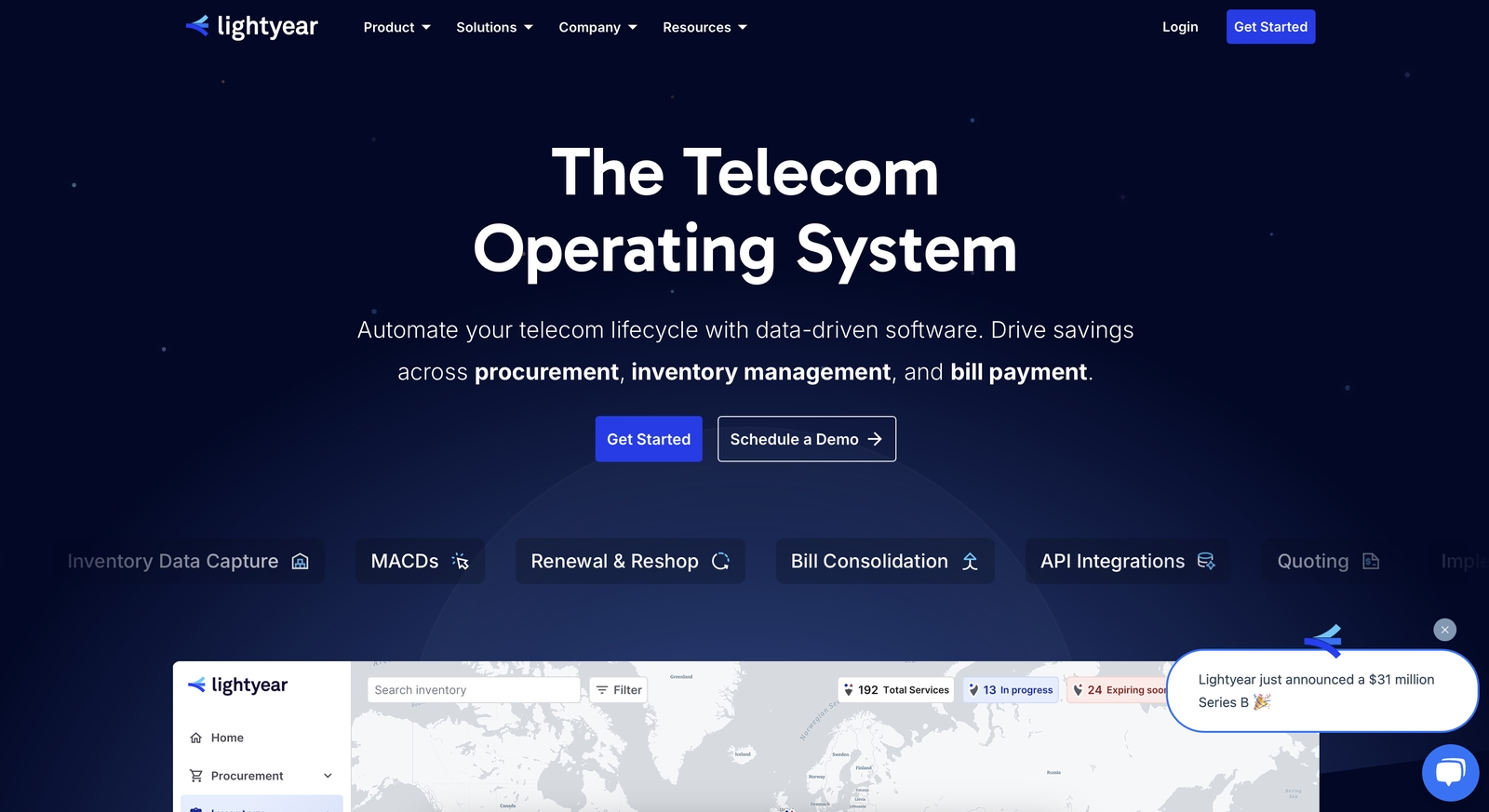
Whether you choose RoCE or InfiniBand, managing the network services that run on your infrastructure is the next critical step. By automating procurement, inventory management, and bill consolidation, Lightyear removes the complexity from telecom management, helping enterprises achieve over 70% time savings and 20% cost savings.
Our platform acts as a central system-of-record for your network, regardless of the underlying technology you choose. Schedule a demo or get started with our questionnaire today.
Frequently Asked Questions about RDMA Over Converged Ethernet vs InfiniBand
Can RoCE and InfiniBand interoperate?
No, they cannot directly interoperate. InfiniBand is a completely separate fabric with its own hardware and protocols, while RoCE runs on Ethernet. While they can exist in the same data center, they require gateways to communicate, which adds latency and complexity.
Does my application need to be rewritten to use RDMA?
Yes, applications typically need to be written to an RDMA API to take full advantage of either RoCE or InfiniBand. However, many standard protocols like NVMe-oF or MPI are already built to use RDMA, simplifying adoption for those use cases.
Is one fabric more secure than the other?
InfiniBand is often considered more secure by default because it's an isolated, dedicated fabric, reducing the attack surface. RoCE runs on Ethernet, so its security depends on the overall security posture of your existing network, including VLANs and access controls.
Which technology is better for GPU-to-GPU communication?
For large-scale AI training, InfiniBand is the preferred choice for GPU communication due to its extremely low and predictable latency. Technologies like NVIDIA's NVLink are often paired with InfiniBand to create the most efficient fabric for massive parallel processing workloads.
Let us show you the product and discuss specifics on how it might be helpful.
Schedule a Demo





Revolutionize Your Telecom Experience
Learn how you can get one step closer to optimal business efficiency for all your telecom services.