Seamless MPLS vs Segment Routing Explained
Seamless MPLS vs. Segment Routing: A plain-language guide to their key differences, helping you decide which network architecture is right for you.


If you're managing a growing enterprise network, you've likely encountered terms like Seamless MPLS and Segment Routing.
Both are methods for directing traffic across complex networks, but they operate on fundamentally different principles. This article breaks down what each technology does, how they compare, and what factors to consider when evaluating them for your infrastructure.
What is Seamless MPLS?
Seamless MPLS is a network architecture designed to extend MPLS capabilities across an entire network, from the access layer to the core. It creates a unified MPLS domain, which simplifies management and service delivery over large infrastructures. This approach helps service providers scale their networks without needing to run MPLS on every single device.
- It connects separate network segments—such as access, aggregation, and core—that might otherwise operate independently.
- The architecture uses Border Gateway Protocol (BGP) to distribute labels between these different segments, allowing traffic to flow smoothly from end to end.
- Its primary goal is to establish a scalable and manageable transport system for various services.
- This design separates the service layer from the transport layer, making it easier to add new services without altering the underlying network.
What is Segment Routing?
Segment Routing is a source-routing technology that simplifies how data packets are directed across a network. It works by embedding the path information directly into the packet header. This pre-determined path is an ordered list of instructions, known as "segments," that tells the network exactly where to send the packet, step by step. This method gives the source router full control over the forwarding path.
- It steers traffic using a sequence of segments that represent topological instructions (e.g., go to node X) or service instructions.
- This approach reduces the amount of state information that network devices need to maintain, simplifying network operations.
- Unlike traditional MPLS, it often removes the need for signaling protocols like Label Distribution Protocol (LDP).
- It can be deployed over an MPLS data plane (SR-MPLS) or an IPv6 data plane (SRv6), providing deployment flexibility.
Seamless MPLS vs Segment Routing: Key Differences
The core differences between these two technologies come down to how they handle traffic paths, network complexity, and overall flexibility.
1. Path Determination and Control
With Segment Routing, the entire path is determined at the source and encoded in the packet header. This gives the ingress router complete control over the route the packet takes.
Seamless MPLS uses a hop-by-hop forwarding model. Each router makes an independent forwarding decision based on the MPLS label it receives, without having visibility into the full end-to-end path.
2. Network State and Simplicity
Segment Routing significantly reduces the amount of state information that intermediate routers must maintain. Since the path is in the packet, transit nodes don’t need to store path information for every traffic flow, simplifying the control plane.
In contrast, Seamless MPLS requires routers to maintain label forwarding states established by signaling protocols like BGP and LDP, which adds to network overhead.
3. Flexibility and Traffic Engineering
Because it simplifies the control plane and centralizes path control, Segment Routing is inherently more flexible. It allows for highly granular traffic engineering that is easier to implement and modify.
While Seamless MPLS supports traffic engineering, its domain-based architecture can make implementing precise, end-to-end policies more operationally complex.
Benefits of Seamless MPLS
Seamless MPLS offers several advantages, particularly for organizations managing large, multi-domain networks. Its architecture is built for growth and operational stability.
- Proven Scalability: It allows networks to expand significantly by creating a unified MPLS domain across access, aggregation, and core segments. This prevents the need for complex, full-mesh protocols within the core.
- Simplified Service Provisioning: By separating the transport and service layers, you can introduce new services like L3VPNs or VPLS without re-engineering the underlying network infrastructure.
- Operational Consistency: It provides a single, end-to-end transport mechanism. This simplifies troubleshooting and management, as the same forwarding principles apply across the entire network.
- Investment Protection: The architecture builds upon existing MPLS technologies and operational knowledge, allowing teams to adapt without a steep learning curve or complete hardware replacement.
Benefits of Segment Routing
Segment Routing offers a modern approach focused on simplicity and direct control over traffic flow. Its design delivers several key operational advantages.
- Simplified Network Operations: By removing the need for signaling protocols like LDP, Segment Routing reduces network complexity. With fewer protocols to manage, the control plane is lighter and more stable.
- Precise Traffic Engineering: It provides granular, end-to-end path control directly from the source router. This makes it easier to direct traffic based on specific application requirements without configuring every device along the path.
- Improved Resilience: In case of a network failure, traffic can be rerouted very quickly. A central controller can calculate and enforce a new path almost instantly, minimizing downtime and service disruption.
- SDN and Automation Ready: The architecture integrates naturally with Software-Defined Networking (SDN) controllers. This enables centralized network visibility and automation, allowing for dynamic, programmable traffic management.
Choosing the Right Solution for Your Network
Deciding between Seamless MPLS and Segment Routing depends on your organization's specific needs, existing infrastructure, and future goals. Here are the key factors to consider.
1. Evaluate Your Existing Infrastructure
If your organization already runs a large MPLS network, Seamless MPLS is a practical choice. It extends your current setup and protects your existing hardware and knowledge investments.
For new network builds or complete overhauls, Segment Routing provides a more modern foundation without the baggage of legacy protocols.
2. Consider Your Operational Model
Seamless MPLS is well-suited for teams experienced with traditional MPLS operations who need to scale proven services reliably.
In contrast, Segment Routing is designed for organizations adopting automation and SDN. Its architecture simplifies the network and works well with centralized controllers for managing traffic.
3. Align with Your Long-Term Strategy
If your strategic roadmap includes deep network programmability and dynamic traffic management, Segment Routing is the more forward-looking choice.
However, if your primary goal is to scale a stable, multi-domain transport system for various services without a fundamental operational change, Seamless MPLS remains a very effective solution.
Final Thoughts on Seamless MPLS and Segment Routing
Both Seamless MPLS and Segment Routing are effective technologies for managing large-scale networks, but they address different operational needs. The decision between them is less about which is superior and more about which aligns with your network's current state and future direction.
Seamless MPLS provides a stable, scalable evolution for organizations already invested in MPLS. It extends existing infrastructure and operational knowledge, offering a reliable path for growth without a complete overhaul.
On the other hand, Segment Routing introduces a simpler, more direct method of traffic control. It is an excellent fit for networks moving toward automation and SDN, as it reduces complexity and offers granular path management.
Ultimately, your choice depends on your strategic goals. Consider whether you need to expand a proven system or build a more programmable foundation for the future.
Need Help Managing Your Network? Lightyear Can Help
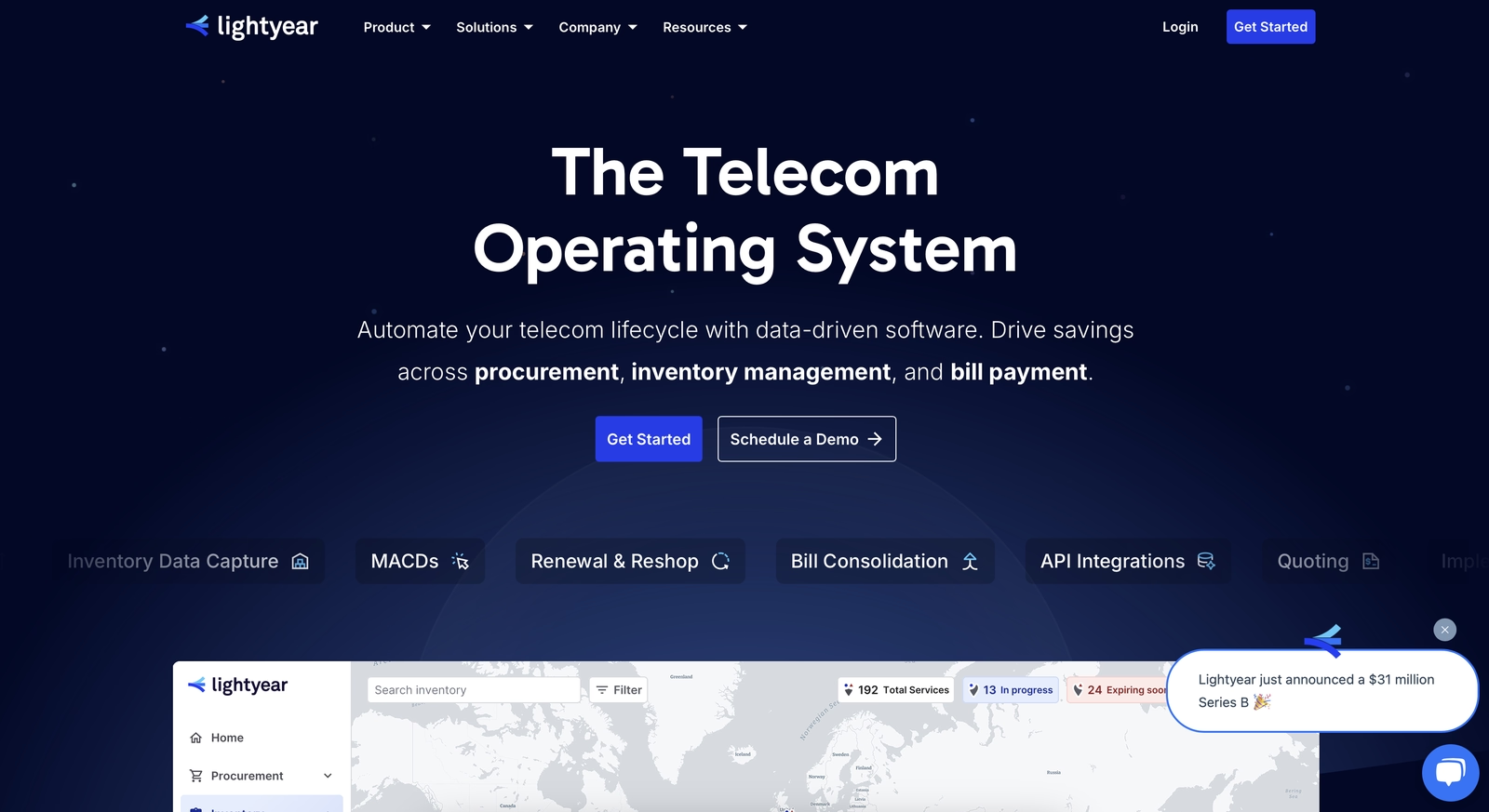
Whether your network relies on Seamless MPLS, Segment Routing, or a mix of technologies, managing the procurement and inventory for your circuits can be a major challenge.
By automating network service procurement, inventory management, and bill consolidation, Lightyear simplifies telecom infrastructure management. The hundreds of enterprises who trust our platform achieve over 70% time savings and 20% cost savings on their network services.
Schedule a demo or get started with our questionnaire today.
Frequently Asked Questions about Seamless MPLS vs Segment Routing
Can Seamless MPLS and Segment Routing coexist in the same network?
Yes, they can. Many networks migrate gradually by running Segment Routing over an existing MPLS data plane (SR-MPLS). This allows organizations to introduce SR's benefits in one part of the network while maintaining Seamless MPLS in others, facilitating a phased transition.
Does Segment Routing require a complete hardware upgrade?
Not necessarily. Many modern routers support Segment Routing with a software update. However, older hardware might lack the necessary capabilities. It's important to check your vendor's specifications to confirm compatibility before planning a deployment.
Which technology is better suited for 5G network slicing?
Segment Routing is generally preferred for 5G network slicing. Its ability to steer traffic along specific, programmable paths is ideal for creating the isolated, end-to-end virtual networks that network slicing requires for different services and applications.
Let us show you the product and discuss specifics on how it might be helpful.
Schedule a Demo





Revolutionize Your Telecom Experience
Learn how you can get one step closer to optimal business efficiency for all your telecom services.