SONET vs Ethernet: Comparing Network Technologies
SONET vs. Ethernet? Learn the key differences in cost, speed, and reliability to choose the right network technology for your business needs.


When building or upgrading a network, businesses often face a choice between two foundational technologies: Synchronous Optical Networking (SONET) and Ethernet. Both were developed to transmit large amounts of data, but they do so with different core designs and for different primary purposes.
For IT and finance leaders, understanding the differences in their architecture, cost, and scalability is critical to making the right infrastructure investment. This guide breaks down how each technology works, helping you decide which is the better fit for your business needs.
What is SONET?
Synchronous Optical Networking, or SONET, is a communication protocol developed for transmitting large volumes of data over fiber optic cables. Standardized by the American National Standards Institute (ANSI), it was originally designed to handle digital voice traffic from the public switched telephone network (PSTN) and other real-time services.
- Time-Division Multiplexing (TDM): SONET uses a TDM architecture, which dedicates specific time slots for data transmission. This structure provides a constant bit rate and predictable, low-latency performance, making it ideal for applications like voice calls.
- High Reliability: The protocol is known for its robust fault tolerance. SONET networks are often built in a ring topology that can automatically reroute traffic within milliseconds if a fiber link fails, ensuring high availability.
- Synchronized Network: As the name suggests, all network elements in a SONET system are synchronized to a single, highly accurate master clock. This is crucial for managing the flow of data across the network without data loss.
What is Ethernet?
Originally developed for local area networks (LANs), Ethernet has become the dominant technology for connecting devices in homes, offices, and data centers. Unlike SONET's rigid time-slot structure, Ethernet is designed for flexibility and efficiency in handling bursty data traffic, which is common in modern IP-based networks.
- Packet-Switching: Ethernet uses a method called packet-switching, where data is broken into smaller units (packets). Each packet is sent independently and can take different routes to its destination, making bandwidth usage more dynamic and efficient.
- Variable Bandwidth: It does not guarantee a constant bit rate. Instead, it offers statistical multiplexing, allowing multiple users to share bandwidth on a first-come, first-served basis.
- Scalability and Cost: As a widely adopted standard, Ethernet hardware is cost-effective and readily available. It supports a vast range of speeds, making it easy to scale network capacity up or down as business needs change.
Key Differences Between SONET and Ethernet
While both technologies move data effectively, their underlying methods create significant differences in performance, efficiency, and cost that directly impact network planning.
Bandwidth Efficiency and Flexibility
SONET dedicates fixed bandwidth channels using its TDM structure. This means capacity is reserved even if it's not being used, which can be inefficient for the bursty nature of modern internet traffic.
Ethernet allocates bandwidth dynamically. It's designed to handle variable data loads efficiently, ensuring that available capacity is used more effectively across shared networks.
Network Overhead
A notable portion of a SONET circuit's capacity is consumed by overhead for management and protection switching. This means an OC-3 circuit at 155 Mbps provides less usable bandwidth than the nameplate speed suggests.
Ethernet is a leaner protocol with significantly less overhead. This translates to a higher percentage of the connection's advertised speed being available for your actual data.
Quality of Service (QoS)
SONET’s synchronized, time-slotted design provides inherent Quality of Service. It delivers predictable, low-latency performance ideal for sensitive applications like uncompressed video or digital voice trunks.
Standard Ethernet operates on a "best-effort" delivery model and does not have native QoS. To prioritize traffic and guarantee performance, it must be paired with other technologies like MPLS.
Infrastructure Cost and Complexity
Deploying and managing SONET requires specialized, often proprietary, hardware that comes at a higher cost. Finding technicians with deep SONET expertise can also be a challenge.
Because Ethernet is a universal standard, its hardware is commoditized, more affordable, and interoperable between vendors. This simplifies deployment and lowers total cost of ownership.
Advantages of Using SONET
Despite being an older technology, SONET remains a powerful choice for specific use cases where its core strengths are paramount. For businesses with certain operational needs, its architecture provides clear benefits that modern packet-switched networks cannot natively match.
- Exceptional Reliability: SONET’s ring-based architecture offers outstanding fault tolerance. If a fiber link fails, traffic is automatically rerouted in milliseconds, providing the high availability required for operations that cannot afford downtime.
- Guaranteed Performance: The TDM structure dedicates a fixed amount of bandwidth to each channel. This guarantees predictable, low-latency performance with minimal jitter, making it ideal for real-time applications like digital voice and live video streams.
- Inherent Security: Operating over dedicated, point-to-point circuits means SONET is inherently more secure than shared networks. Data is isolated, reducing exposure to the vulnerabilities common on public internet infrastructure.
Advantages of Using Ethernet
Ethernet’s dominance in modern networking isn't accidental; it offers practical advantages that align perfectly with the needs of most businesses today. Its design prioritizes flexibility, cost-efficiency, and ease of use, making it the default choice for connecting offices and data centers.
- Lower Total Cost of Ownership: Because Ethernet is a universal standard, hardware is commoditized and affordable. This competition reduces equipment costs and simplifies procurement, directly lowering the overall expense of building and maintaining your network.
- Effortless Scalability: Upgrading your network speed is significantly simpler with Ethernet. Businesses can often increase bandwidth from 1 Gbps to 10 Gbps or higher with minimal changes to existing infrastructure, allowing for easy adaptation to future growth.
- Simplified Management: The technology is ubiquitous, meaning there is a vast talent pool of network engineers who are proficient in managing it. This eliminates the challenge and cost of finding technicians with specialized legacy skills.
Choosing Between SONET and Ethernet for Your Business
The right choice depends entirely on your specific application requirements, budget, and long-term network strategy. Here’s a straightforward breakdown to guide your decision.
Choose SONET for Specific, High-Stakes Applications
SONET remains the correct choice when performance guarantees are non-negotiable and your application cannot tolerate any latency fluctuations. Its architecture provides a dedicated, private line with predictable behavior.
Opt for SONET for critical infrastructure like high-frequency trading systems, transport for uncompressed broadcast video, or connecting to older public telephone network equipment. In these cases, the high reliability justifies the higher cost.
Choose Ethernet for Most Modern Operations
For the vast majority of business needs, Ethernet is the more practical and cost-effective solution. It is the global standard for data networking for good reason.
Select Ethernet for connecting your offices, providing employee internet access, linking to cloud providers, and building your internal LAN. Its flexibility handles typical bursty data traffic efficiently, and its scalability allows you to grow without major network overhauls.
Final Thoughts on SONET vs Ethernet
Choosing between SONET and Ethernet comes down to a fundamental trade-off: guaranteed performance versus cost-effective flexibility. SONET offers unmatched reliability for specific, real-time applications where latency and jitter are intolerable. However, its rigidity and higher costs make it a specialized tool.
For most businesses today, Ethernet provides the practical balance of speed, scalability, and affordability needed for general data networking. Understanding your specific application's requirements is the key to making the right investment for your infrastructure.
Need Help Managing Your Network? Lightyear Can Help
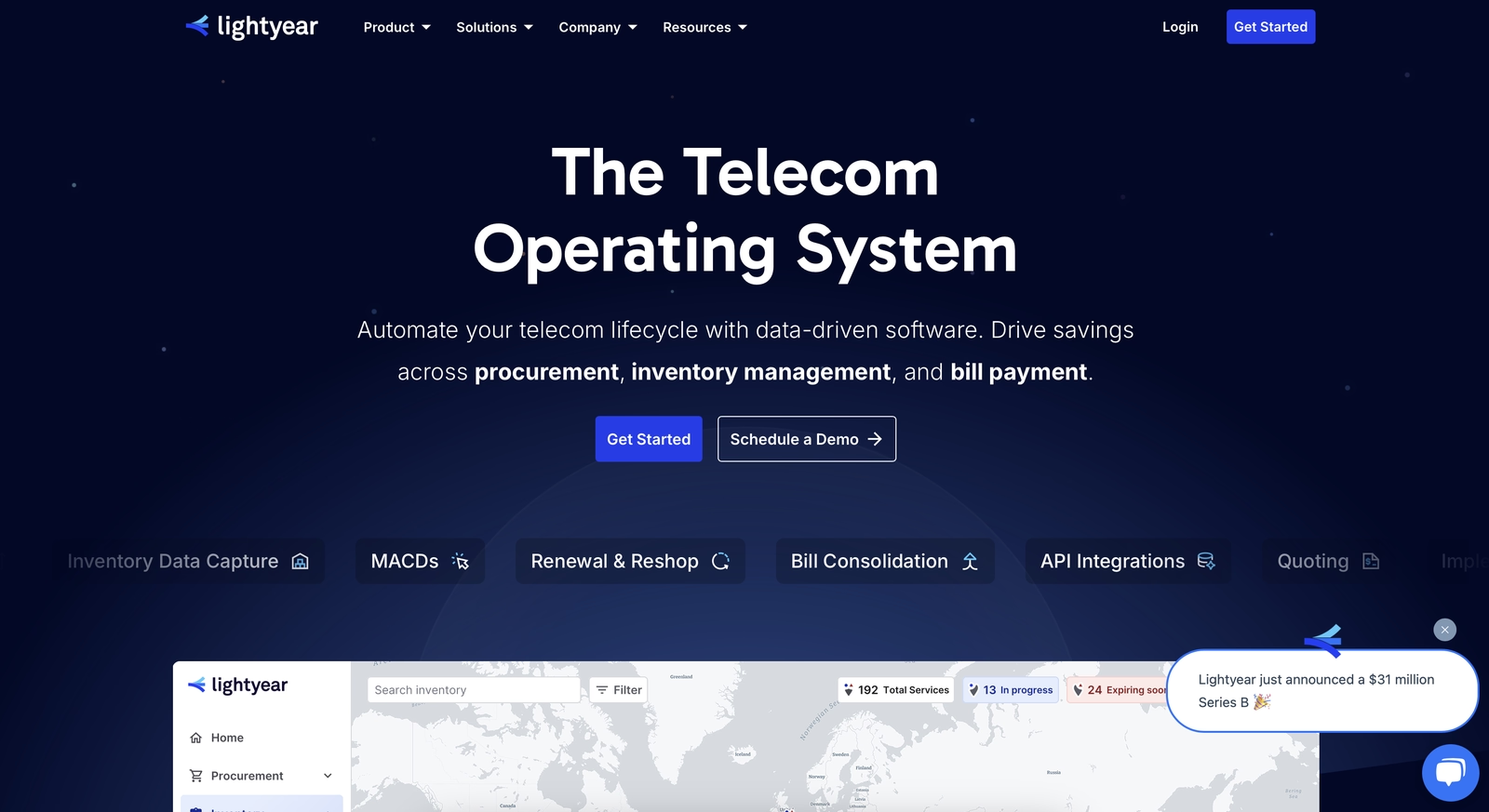
Whether you choose SONET for its reliability or Ethernet for its flexibility, managing the procurement and inventory for your network services remains a complex task. By automating network service procurement, inventory management, and bill consolidation, Lightyear takes the pain out of telecom infrastructure management.
The hundreds of enterprises who trust Lightyear achieve 70%+ time savings and 20%+ cost savings on their network services. Schedule a demo or get started with our questionnaire today.
Frequently Asked Questions about SONET vs Ethernet
Can SONET and Ethernet networks be interconnected?
Yes, they can be connected using special network devices like gateways or media converters. These devices translate between SONET’s TDM structure and Ethernet’s packet-based format, which is often necessary during phased network upgrades or when connecting to legacy systems.
Is SONET technology obsolete?
Not entirely. While Ethernet has replaced it for most data networking, SONET remains critical for specific applications. It is still used in telecommunications backbones, utility networks, and for services requiring guaranteed, real-time performance that Ethernet alone cannot provide.
What is the difference between SONET and SDH?
SDH (Synchronous Digital Hierarchy) is the international standard, while SONET is the North American standard. They are very similar and largely interoperable but have minor differences in their frame structure and overhead. Think of them as regional variations of the same core technology.
Let us show you the product and discuss specifics on how it might be helpful.
Schedule a Demo





Revolutionize Your Telecom Experience
Learn how you can get one step closer to optimal business efficiency for all your telecom services.