SONET vs Gigabit Ethernet: Network Comparison Guide
SONET or Gigabit Ethernet? Learn the key distinctions in speed, reliability, and cost to make the right choice for your enterprise network.

Choosing the right network technology is a critical decision for any business. Two names that often come up in these discussions are SONET (Synchronous Optical Networking) and Gigabit Ethernet.
While both are used for high-speed data transmission, they were developed for different purposes and have distinct advantages. This guide will compare SONET and Gigabit Ethernet to help you determine which is the appropriate choice for your organization's needs.
What is SONET?
SONET (Synchronous Optical Networking) is a communication protocol used for transmitting large volumes of data over fiber optic cables. Developed in the 1980s, it was originally created to standardize the transmission of voice and data across different equipment vendors, ensuring network reliability and interoperability.
Its design is centered on a few key principles:
- Synchronous Operation: All devices on a SONET network share a common clock source, which ensures data is transmitted in a predictable and orderly manner.
- Time-Division Multiplexing (TDM): It combines multiple lower-speed data streams into a single, high-speed signal for efficient transport over a single fiber.
- Fault Tolerance: SONET is known for its high reliability, often built with self-healing ring architectures that can automatically reroute traffic in case of a network failure.
- Standardized Hierarchy: It uses a defined set of data rates known as Optical Carrier (OC) levels, like OC-3 (155.52 Mbps) or OC-48 (2.488 Gbps).
What is Gigabit Ethernet?
Gigabit Ethernet is a version of the widely used Ethernet networking technology that supports data transfer rates of 1 gigabit per second (Gbps). It was developed as a faster, more scalable successor to earlier Ethernet standards and is the foundation for most modern local area networks (LANs).
Unlike SONET's focus on telecommunications carrier networks, Gigabit Ethernet was designed primarily for enterprise and data center environments. Its key characteristics include:
- Packet-Switching: Data is broken into smaller units called packets, which are sent independently and reassembled at the destination. This method is highly efficient for the variable data traffic common in LANs.
- Scalability: Ethernet standards are easily scalable, with versions like 10 Gigabit Ethernet and 100 Gigabit Ethernet available for higher bandwidth needs.
- Cost-Effectiveness: The hardware for Ethernet, such as switches and network interface cards (NICs), is mass-produced and generally less expensive than SONET equipment.
- Flexibility: It can run over both copper and fiber optic cabling, offering options for deployment based on distance and cost.
Key Differences Between SONET and Gigabit Ethernet
While both technologies move data quickly, they do so in fundamentally different ways, which impacts their performance, cost, and ideal use cases.
1. Network Design and Purpose
SONET was designed for telecommunications carriers to build wide area networks (WANs). Its primary goal was to reliably transport voice and data traffic over vast distances.
Gigabit Ethernet, on the other hand, was developed for local area networks (LANs). Its focus is on connecting computers, servers, and other devices within a single building or campus.
2. Data Transmission Method
SONET uses Time-Division Multiplexing (TDM), which allocates a fixed, predictable time slot for each data channel. This is ideal for constant data streams like voice calls but can be inefficient for bursty internet traffic.
Gigabit Ethernet uses packet-switching. It breaks data into small packets that are sent independently, making it highly efficient at handling the variable, on-demand traffic typical of modern data networks.
3. Cost and Availability
The hardware required for SONET is specialized and historically more expensive. It was built for carrier-grade deployments, leading to higher costs for equipment and implementation.
Because it's used in nearly every office and data center, Gigabit Ethernet equipment is a commodity. The hardware is mass-produced, widely available, and significantly more affordable.
4. Reliability and Failover
SONET is renowned for its built-in reliability. Its ring-based architecture offers automatic failover protection that can restore service in under 50 milliseconds, a critical feature for carrier networks.
While standard Ethernet can also be configured for high availability, its native failover mechanisms are typically not as fast or seamless as SONET's, though modern data center designs have improved this for enterprise use.
Advantages of SONET
While newer technologies have emerged, SONET continues to offer distinct benefits, particularly for applications where reliability is paramount. Its architecture was built from the ground up for carrier-grade performance.
- High Availability: SONET’s ring topology provides automatic failover protection, rerouting traffic in milliseconds if a fiber link is cut. This makes it a strong choice for critical infrastructure where downtime is not an option.
- Guaranteed Bandwidth: Because it uses TDM, SONET allocates a dedicated amount of bandwidth to each channel. This prevents network congestion and delivers consistent performance for sensitive applications.
- Low Latency and Jitter: The synchronous nature of the network results in extremely predictable, low-latency data transmission with minimal jitter, which is essential for high-quality voice and video streams.
- Long-Distance Stability: It was engineered to maintain signal integrity over very long distances, making it a proven choice for building robust wide area networks (WANs).
Advantages of Gigabit Ethernet
Gigabit Ethernet has become the standard for modern enterprise networks for several practical reasons. Its widespread adoption offers significant operational and financial benefits.
- Lower Total Cost: Because Ethernet equipment is a commodity, it’s not just the hardware that’s affordable. The technology is so common that finding IT professionals who can manage it is easy, which helps keep operational costs down.
- Simple Scalability: Upgrading network capacity is relatively straightforward. Moving from 1 Gbps to 10 Gbps or even 100 Gbps can often be done by swapping out switches and cards without a complete network redesign.
- Vendor Flexibility: As a universal standard, you are not locked into a single hardware provider. This allows you to mix and match equipment from different vendors, promoting competitive pricing and innovation.
- Ease of Integration: It integrates smoothly with nearly all business applications and existing IT systems, making it simple to expand the network or deploy new services without major compatibility issues.
Choosing Between SONET and Gigabit Ethernet for Your Business
The right choice depends entirely on your specific application, budget, and performance requirements. Here’s a straightforward breakdown to guide your decision.
When to Choose SONET
SONET is typically the appropriate choice for telecommunications carriers or organizations with very specific legacy needs. If your primary requirement is to transport multiple, constant-bitrate streams like T1 or E1 circuits over a wide area network, SONET’s TDM architecture is highly effective.
It also remains relevant for critical infrastructure where its sub-50ms failover protection is a non-negotiable requirement. However, for most businesses building a network today, SONET is considered a legacy technology.
When to Choose Gigabit Ethernet
For nearly all modern enterprise and data center applications, Gigabit Ethernet is the standard. If you are building a local area network (LAN) to connect employee computers, servers, and other devices, Ethernet is the clear winner.
Its packet-switching design is perfectly suited for the bursty nature of internet and data traffic. Given its lower cost, scalability, and the wide availability of compatible hardware and skilled technicians, Gigabit Ethernet is the practical and forward-looking choice for business connectivity.
Final Thoughts on SONET vs Gigabit Ethernet
The choice between SONET and Gigabit Ethernet ultimately comes down to your specific application. While SONET was once the gold standard for reliability in carrier networks, its role in modern business has become highly specialized.
For nearly any organization building a network today, Gigabit Ethernet offers a far more practical, affordable, and scalable solution. It is the clear path forward for connecting offices and data centers, providing the flexibility needed to support today's data-intensive applications.
Need Help Managing Your Network? Lightyear Can Help
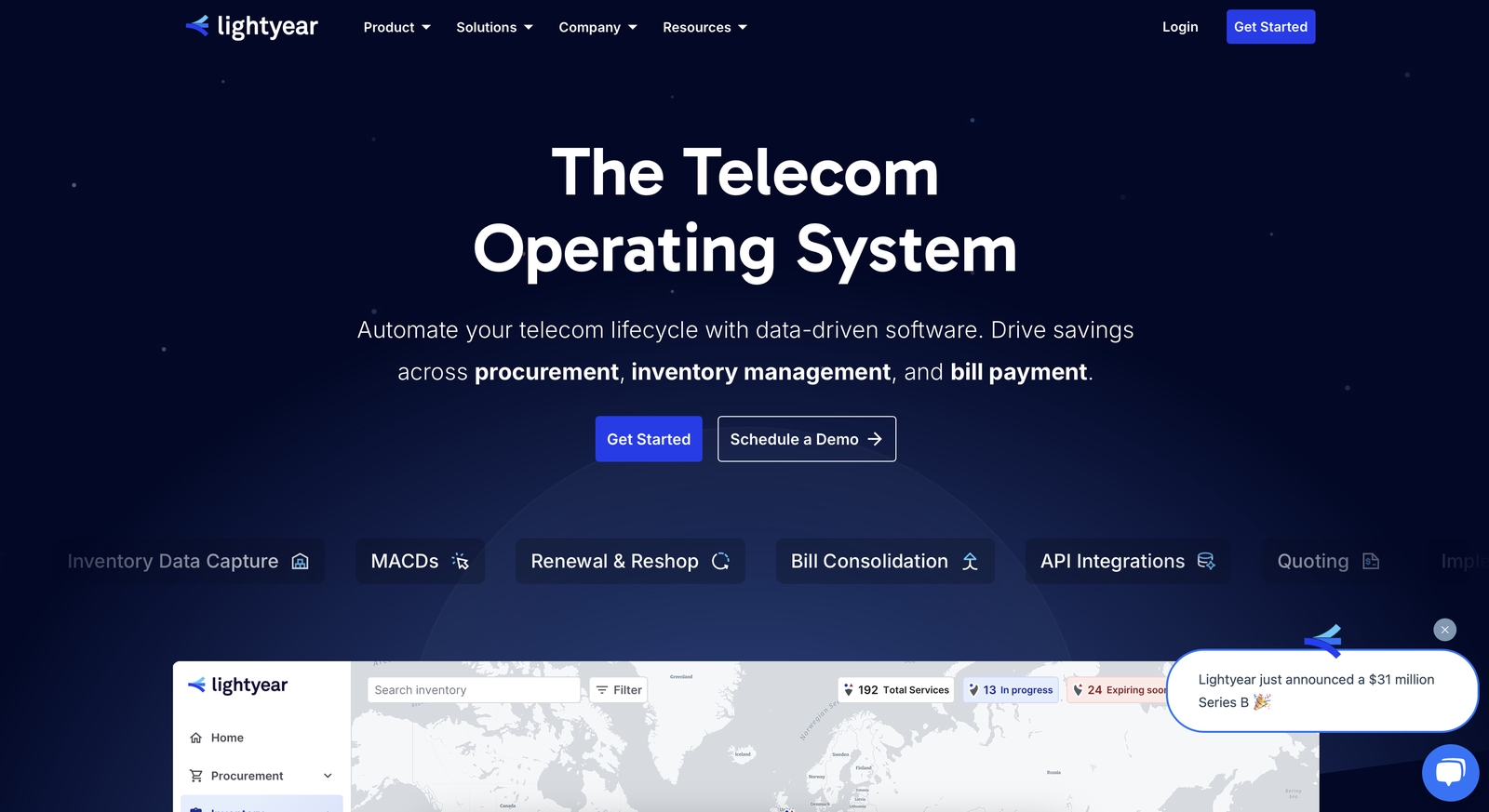
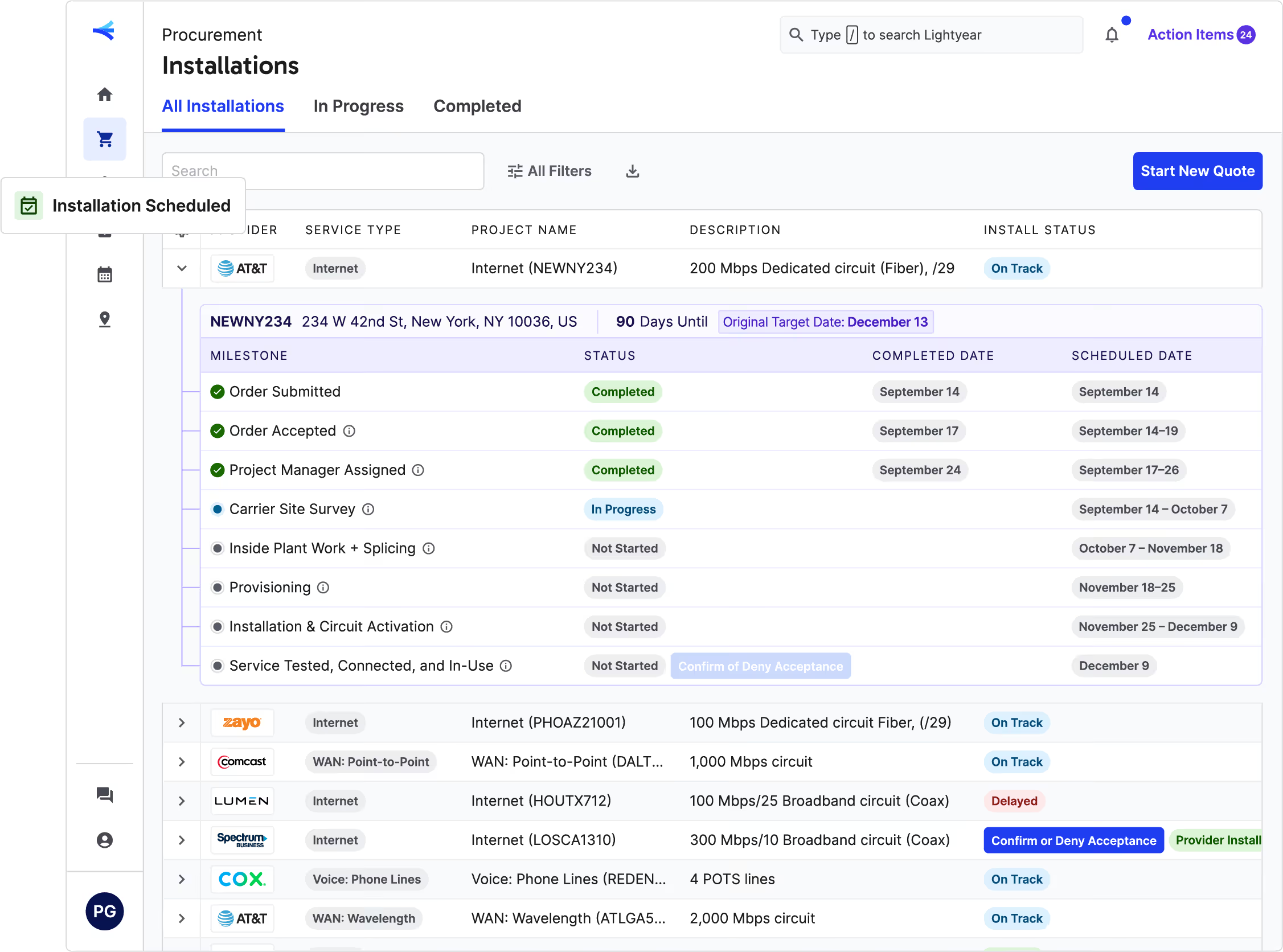
Whether you're choosing between SONET and Gigabit Ethernet or managing existing services, Lightyear simplifies the entire telecom lifecycle. By automating procurement, inventory, and bill consolidation, we help hundreds of enterprises save over 70% in time and 20% in costs.
Schedule a demo or get started with our questionnaire today.
Frequently Asked Questions about SONET vs Gigabit Ethernet
Can you run Ethernet traffic over a SONET network?
Yes, this is possible through a technology called Ethernet over SONET (EoSONET). It packages Ethernet frames for transport across a SONET network, combining Ethernet's flexibility with SONET's reliability. This is often used to connect LANs over a wide area.
Is SONET completely obsolete?
Not entirely. While Gigabit Ethernet is the standard for new enterprise networks, SONET is still used by carriers and in critical infrastructure where its guaranteed bandwidth and sub-50ms failover are essential. It is, however, considered a legacy system for most business applications.
Which technology offers better security?
Neither protocol has inherent encryption. Security depends on the equipment and additional layers, like MACsec for Ethernet or external encryptors for SONET. Both can be made secure, but it's not a built-in feature of the base technology itself.
How does latency compare for real-time applications?
SONET generally offers lower, more predictable latency due to its TDM architecture, which is ideal for constant voice streams. Modern Gigabit Ethernet, especially with Quality of Service (QoS) configurations, also performs very well for applications like VoIP and video conferencing.
Let us show you the product and discuss specifics on how it might be helpful.
Schedule a Demo





Revolutionize Your Telecom Experience
Learn how you can get one step closer to optimal business efficiency for all your telecom services.