Spectrum Enterprise vs Granite: Which ISP Is Better?
Is Spectrum Enterprise or Granite a better fit for your company? We look at their network services, customer support, and pricing options.


Spectrum Enterprise and Granite are two major players in the business internet space, each offering a distinct set of services and network capabilities.
To help you find the right fit for your business, we're comparing them head-to-head. Our comparison uses Lightyear's proprietary data from over 70,000 aggregated ISP quotes, providing benchmarks on pricing, installation timelines, and service delivery points.
Keep reading for our detailed comparison. Or, if you're ready to explore provider options, you can begin our questionnaire to receive real-time quotes.
Overview of Spectrum Enterprise
As the business division of Charter Communications, Spectrum Enterprise has been operating since 1993. The company is a major force in the U.S., ranking 76th on the Fortune 500 list and employing 89,000 people from its headquarters in Stamford, Connecticut.
The company operates on a nationwide fiber network and provides solutions tailored to specific industries and business sizes. A key differentiator is its 100% uptime SLA guarantee for certain fiber services, which is important for businesses that depend on constant connectivity.
Overview of Granite
Founded in 2002, Granite Telecommunications is based in Quincy, Massachusetts. The company has around 2,200 employees and serves businesses in the United States and Canada.
While not a Fortune 500 company itself, Granite provides services to a significant number of large enterprises, including over 85 Fortune 100 customers.
The company develops its own technology through an internal innovation hub called Granite Labs. It also offers a platform named Granite360, which is designed to help clients manage their telecom services.
ISP Products
Dedicated Internet (DIA)
Spectrum Enterprise provides its Dedicated Internet Access (DIA) directly over its own extensive fiber network. This allows them to offer a broad spectrum of speeds, from 20 Mbps to 100 Gbps, with a 99.99% uptime SLA.
In contrast, Granite operates as an aggregator through its Granite AccessExpress platform, bundling DIA services from multiple carriers. This means available speeds and service levels depend on the underlying provider at a given location, though Granite does offer a 99.99% SLA for its on-net services.
According to Lightyear's data, Spectrum's 1Gb DIA pricing is approximately 14% below the market average, while Granite's is about 21% higher. Installation times for both are slightly faster than the 77-day industry average, with Spectrum at 73 days and Granite at 72 days. Both providers offer add-ons like managed routers and wireless backup, with Granite also providing integrated security options like SASE.
Please note that these are aggregate figures, and your actual costs and installation times can vary.
Factors like your specific region and DIA configuration play a significant role in the final quote.
For an exact comparison of Spectrum Enterprise, Granite, and other top ISPs for your desired area, please fill out our questionnaire, which utilizes the most comprehensive data set in the industry.
DIA Pricing, Delivery and Install Days Compared
The data in this table comes from Lightyear’s aggregated ISP quotes collected in 2024 and 2025 YTD.
- Install Days: how long it typically takes to deliver service.
- 100Mb Price vs Avg / 1Gb Price vs Avg: shows whether this ISP is cheaper or more expensive than the market average.
- Delivery Point: “Suite” means the ISP delivers service all the way to the company’s server room; “MPOE” means the circuit stops at the building’s minimum point of entry (typically the building's utility basement) and the tenant must handle the inside wiring.
Wireless
Spectrum Enterprise's wireless product, Spectrum Mobile, is designed for phones and personal devices. It operates on Verizon's 5G network and is supplemented by a network of WiFi hotspots from Spectrum modems. The company does not list a fixed wireless access (FWA) product for business connectivity on its website.
In contrast, Granite acts as a wireless aggregator for businesses in the US and Canada, offering managed mobility, fixed wireless access, and multi-carrier SIMs. This model provides flexibility with access to both LTE and 5G networks from various carriers. It makes Granite a strong choice for businesses seeking cellular failover or primary FWA connectivity.
The main distinction is the intended business use. Spectrum's offering is more like a standard mobile plan, while Granite provides managed wireless solutions specifically for business connectivity. Because Granite works with multiple providers, any service level agreements (SLAs) will depend on the underlying carrier chosen for your location.
Security
Spectrum Enterprise offers a range of security products tailored to different business needs. Customers with Spectrum Business Internet receive a complimentary desktop security suite, while larger organizations can choose from managed security solutions built on platforms like Fortinet and Cisco Meraki. These services provide unified threat management (UTM), next-generation firewalls (NGFW), and cloud security, along with a separate subscription for DDoS protection.
In contrast, Granite integrates security directly into its managed network services, centering its strategy on a Secure Access Service Edge (SASE) framework. This model combines networking with security functions like SD-WAN and Zero Trust components, with security policy orchestrated through Granite’s own managed services platform.
The primary distinction lies in their delivery models. Spectrum provides a menu of separate security products for different business sizes, whereas Granite offers security as a built-in component of its core managed network solutions.
Broadband
Spectrum Enterprise provides its Spectrum Business Internet directly over its own hybrid fiber-coax network. This service offers asymmetrical speeds up to 1 Gbps download and 35 Mbps upload, backed by a 100% uptime SLA.
Granite operates as a managed aggregator, offering broadband access by bundling services from different carriers across the US and Canada. While this model can provide speeds up to 5 Gbps, the actual performance, transport type, and uptime SLA all depend on the specific underlying provider at your location.
Based on Lightyear's data, Spectrum's broadband pricing is approximately 43% below the market average, with a quick 26-day installation time. In contrast, Granite's pricing is about 29% higher than average, and installations take around 41 days, compared to the 28-day industry average. Another key difference is the delivery point: Spectrum delivers to the suite, whereas Granite delivers to the building's MPOE, requiring you to handle internal wiring.
Broadband Pricing, Delivery and Install Days Compared
The data in this table comes from Lightyear’s aggregated ISP quotes collected in 2024 and 2025 YTD.
- Install Days: how long it typically takes to deliver service.
- 500mb Price vs Avg: shows whether this ISP is more expensive than the market average.
- Delivery Point: “Suite” means the ISP delivers service all the way to the company’s server room; “MPOE” means the circuit stops at the building’s minimum point of entry (typically the building's utility basement) and the tenant must handle the inside wiring.
Ethernet
Spectrum Enterprise delivers services directly over its own network. The information for their Ethernet product points to their Spectrum Business Internet service, which runs on a hybrid fiber-coax network and offers asymmetrical speeds up to 1 Gbps with a 100% uptime SLA.
Granite, on the other hand, acts as an aggregator for Dedicated and Carrier Ethernet services. They partner with various underlying carriers across the US and Canada, so your options depend on the networks available at your specific location.
Granite delivers and manages these services through its own platforms, Granite360 and AccessExpress.
POTS Replacement
Spectrum Enterprise offers its Spectrum Business Voice service as a POTS replacement, providing a VoIP solution with unlimited calling and various business features. Granite’s EPIK product, however, is a specialized solution designed to support critical analog lines for systems like fire alarms, elevators, and point-of-sale devices.
The most significant difference lies in their intended use and compliance. Granite’s solution is NFPA 72 compliant, making it suitable for regulated life-safety lines. In contrast, Spectrum’s prohibited use policy explicitly forbids connecting its service to fire or medical alarms, positioning it strictly for standard voice communication.
Both providers include options for battery backup and wireless LTE failover to maintain service during outages. Granite's offering also allows LTE to be used as the primary connection, adding a layer of flexibility for locations that may lack stable wired internet.
Other Key Features Compared
Geographic Coverage
Spectrum Enterprise concentrates its services entirely within the United States. Their large, privately-owned network offers widespread availability, making them a solid choice for businesses with locations across the country.
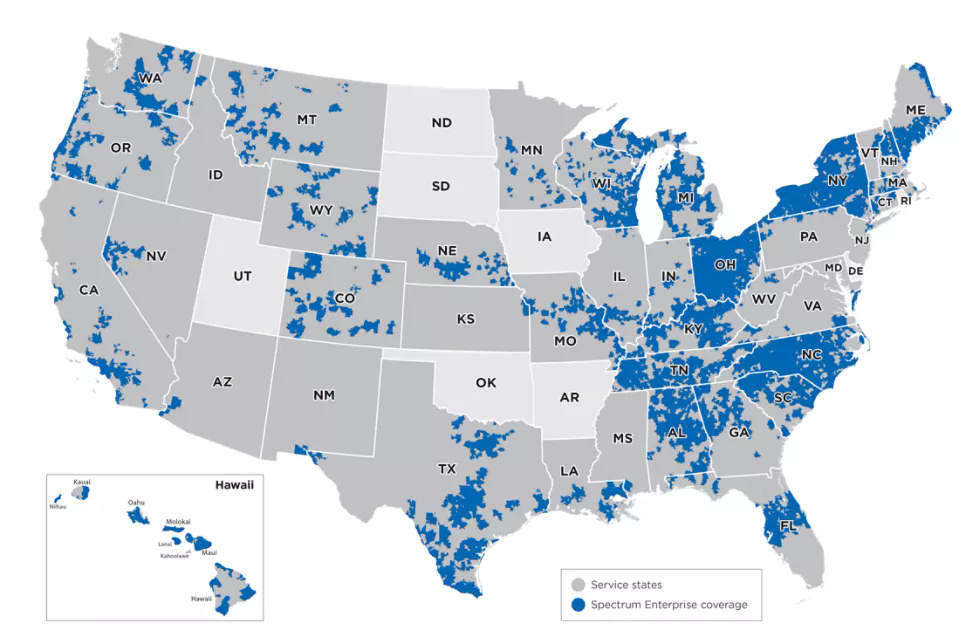
Granite, in contrast, offers services in the United States and Canada. As an aggregator, they don't have a single public coverage map, instead checking availability for each location through their AccessExpress platform.
SLA
Spectrum Enterprise offers a 100% uptime guarantee for its fiber internet and Ethernet services. This is a strong promise for businesses where every second of connectivity is critical.
Granite provides a 99.99% uptime SLA for its on-net services. For services from other carriers, the SLA will simply match that of the underlying provider.
In practical terms, a 100% SLA means you get a service credit for any amount of downtime. A 99.99% SLA allows for about 52 minutes of downtime per year before credits kick in.
Transport Types Available
Spectrum Enterprise runs its own fiber network, which covers 230,000 route miles. This lets them offer speeds from 20 Mbps to 100 Gbps, covering needs from basic business use to high-demand applications.
In contrast, Granite is an aggregator and doesn't own fiber routes. The speeds they offer depend on the underlying carriers available at your location, which can range from standard broadband to multi-gigabit fiber.
So, Spectrum is ideal for businesses within their large network footprint seeking consistent speed tiers. Granite provides flexibility by shopping multiple carriers to find a fit for your specific address.
Customer Support
Spectrum Enterprise provides customer support directly through its own U.S.-based teams. Since they own and operate their network, you'll be dealing with a single company for any service issues.
Granite acts as a single point of contact for all the services they bundle, even if they come from different carriers. Their support team coordinates with the underlying providers to resolve problems for you.
The main difference is who you talk to. With Spectrum, it's the network owner. With Granite, it's a team that manages your connections with multiple network owners, which can simplify vendor management.
Final Verdict: Spectrum Enterprise or Granite?
The choice between Spectrum Enterprise and Granite comes down to their fundamental business models. Spectrum is a direct network provider that owns its infrastructure, while Granite is a managed aggregator that bundles services from multiple carriers.
Spectrum is often a strong choice for businesses located within its large U.S. network footprint that want to work directly with the network owner. This can result in lower pricing on certain services and comes with a 100% uptime SLA on fiber.
Granite, on the other hand, is ideal for companies with locations across the U.S. and Canada or those needing specialized services like compliant POTS replacement. Their value lies in providing a single point of contact to manage various underlying providers.
The best provider depends on your specific locations and technical needs. At Lightyear, we can help you compare real-time quotes for both to find the right fit.
To make your decision a bit easier, here’s a quick side-by-side look at how Spectrum Enterprise and Granite stack up.
Choose the Right ISP Today With Lightyear
Choosing between a direct provider like Spectrum Enterprise and an aggregator like Granite comes down to your specific business needs and locations. While making that evaluation is key, getting clear, comparable quotes to inform your decision can be difficult.
Lightyear’s software gives you the data to choose confidently. We help by:
- Automating ISP Procurement: See best-fit providers and benchmarked rates side-by-side using our proprietary data.
- Negotiating for You: Our platform proactively negotiates quotes down to fair market value so you don’t overpay.
- Providing Full Support: A dedicated rep oversees installs and manages provider issues, so you’re never on your own.
Ready to simplify your telecom procurement? Get a demo of Lightyear.
Let us show you the product and discuss specifics on how it might be helpful.
Schedule a Demo





Revolutionize Your Telecom Experience
Learn how you can get one step closer to optimal business efficiency for all your telecom services.