Spectrum Wave 2 Router vs WiFi 6 Comparison
Confused by Spectrum's Wave 2 router vs. WiFi 6? Learn the key differences in speed, capacity, and performance to make the right network choice.

Choosing the right networking hardware is a critical decision for any business, directly impacting productivity and operations.
When evaluating your options, you'll often see terms like the Spectrum Wave 2 Router and the newer WiFi 6 standard.
Though both provide wireless connectivity, they represent different generations of WiFi technology with distinct features and performance levels. This article breaks down the key differences to help you understand which solution best fits your company's needs.
What is the Spectrum Wave 2 Router?
The Spectrum Wave 2 Router is a business-grade router built on the 802.11ac WiFi standard. The "Wave 2" designation indicates it's the second, more capable generation of that standard, designed to better handle the demands of a busy office environment with many connected devices.
It introduced several key technological upgrades over its predecessor. The most significant improvements include:
- Multi-User, Multiple Input, Multiple Output (MU-MIMO): This feature allows the router to communicate with multiple devices at the same time instead of in sequence. For a crowded network, this means less waiting and a smoother experience for everyone.
- Wider Channel Bandwidth: Wave 2 supports 160 MHz channels, doubling the potential channel width of Wave 1. Think of it like adding more lanes to a highway—it allows for faster data throughput to compatible devices.
- More Spatial Streams: It supports up to four spatial streams, providing more paths for data to travel between the router and devices, which helps increase capacity and overall performance.
What is WiFi 6?
WiFi 6, technically known as 802.11ax, is the current generation of WiFi technology. It's engineered specifically to improve performance in dense environments where many devices compete for bandwidth, from company laptops to IoT sensors. It introduces several core upgrades over previous standards to boost overall network efficiency and capacity.
- Orthogonal Frequency Division Multiple Access (OFDMA): This key feature divides a WiFi channel into smaller sub-channels, allowing the router to communicate with multiple devices at the same time. The result is lower latency and better performance in crowded networks.
- Enhanced MU-MIMO: Building on the technology in Wave 2, WiFi 6 expands MU-MIMO to handle both uploads and downloads. This increases the number of devices that can communicate with the access point simultaneously.
- Target Wake Time (TWT): An intelligent power-saving feature that lets the router schedule communication times with devices. This is especially beneficial for battery-powered IoT devices, as it can significantly extend their battery life.
- BSS Coloring: This technology helps reduce co-channel interference from nearby networks. It "colors" data packets, allowing devices to ignore transmissions from other networks, which improves reliability in dense office environments.
Key Differences Between Spectrum Wave 2 Router and WiFi 6
While both technologies aim to improve wireless connectivity, they do so using fundamentally different approaches and features. The primary distinctions lie in how they manage network traffic, device communication, and power consumption.
Core Technology and Efficiency
The Spectrum Wave 2 router improves efficiency primarily through wider channels and MU-MIMO, which allows it to communicate with a few devices at once. It’s like having a multi-lane highway, but each car gets its own lane for a short period.
WiFi 6 introduces OFDMA, a more significant technological shift. Instead of giving one device a whole channel, OFDMA partitions a channel into many smaller sub-channels, allowing the router to serve multiple devices with different bandwidth needs in a single transmission. This dramatically reduces latency and contention in environments with many active users.
Uplink and Downlink Communication
A key limitation of the Wave 2 standard is that its MU-MIMO feature only works for downloads (from the router to your device). This helps with streaming and browsing but doesn't address upload traffic.
WiFi 6 upgrades MU-MIMO to function for both uploads and downloads. This is a crucial improvement for modern business activities like video conferencing, cloud file synchronization, and VoIP calls, where two-way traffic is constant.
Device Power Management
The Wave 2 standard does not include specific features for managing the power consumption of connected devices. Devices simply stay connected, drawing power as needed.
WiFi 6 introduces Target Wake Time (TWT), a feature completely absent in Wave 2. TWT allows the router to schedule check-in times with devices, letting them "sleep" and conserve power in between. This is particularly valuable for battery-operated IoT devices, extending their operational life significantly.
Performance and Speed Comparison
When it comes to raw numbers and real-world experience, the newer WiFi 6 standard offers clear advantages over the Spectrum Wave 2 router. The differences are most apparent in how each handles network load and data-sensitive applications.
- Theoretical Speed: On paper, WiFi 6 has a much higher maximum speed of 9.6 Gbps, compared to the typical 3.5 Gbps for Wave 2. While real-world speeds vary, this demonstrates the greater bandwidth potential of the newer technology.
- Performance Under Load: This is where WiFi 6 truly separates itself. It is specifically designed to maintain consistent performance in crowded environments with many devices. A Wave 2 router will see more performance degradation as more users and devices connect and compete for bandwidth.
- Lower Latency: WiFi 6 architecture was built to reduce latency. For business applications where delays matter—such as VoIP, video conferencing, and cloud platforms—this results in a noticeably smoother and more responsive experience.
- Device Capacity: WiFi 6 supports a significantly higher number of concurrent devices without sacrificing performance. This makes it a more scalable and future-proof option for offices with a growing number of laptops, smartphones, and IoT sensors.
Security Features and Protocols
Security is a top priority for any business network. While both technologies offer robust protection, WiFi 6 introduces the latest security standard, providing significant advantages for enterprise environments.
The Spectrum Wave 2 router, like other 802.11ac devices, primarily relies on the WPA2 (Wi-Fi Protected Access 2) security protocol. For years, WPA2 has been the standard for securing wireless networks and remains a solid security measure.
In contrast, WiFi 6 mandates the use of WPA3, the next-generation security protocol. WPA3 addresses several vulnerabilities found in WPA2 and provides more resilient security features tailored for modern business needs.
- Stronger Encryption: WPA3 implements more advanced, 192-bit encryption, making it much harder for unauthorized users to crack network passwords through offline, brute-force attacks.
- Individualized Data Encryption: On open networks, WPA3 automatically encrypts the connection between each device and the router. This prevents others on the same network from snooping on traffic, a crucial feature for guest networks.
- Protection Against Eavesdropping: It uses a new key exchange protocol that protects against passive eavesdropping, even if an attacker manages to capture data packets.
- Simplified IoT Security: WPA3 makes it easier to securely connect devices that lack a screen or keyboard, a growing need for businesses deploying smart sensors and other IoT hardware.
Cost and Implementation Considerations
When planning a network upgrade, budget and deployment complexity are always key factors. The financial and logistical differences between a Wave 2 router and a WiFi 6 solution are significant.
- Upfront Cost: Hardware based on the 802.11ac Wave 2 standard is generally more affordable. Since the technology has been on the market longer, the equipment is less expensive to purchase, making it a budget-friendly option for immediate upgrades.
- Long-Term Investment: As the newer standard, WiFi 6 access points and routers carry a higher price tag. This cost reflects the advanced components and superior performance capabilities, positioning it as a forward-looking investment in your network infrastructure.
- Implementation and Compatibility: A key consideration for WiFi 6 is that client devices must also be compatible to unlock its full potential. While a Wave 2 router is often a simple replacement for older systems, a move to WiFi 6 may require a broader hardware refresh strategy to maximize your return on investment.
Making the Right Choice for Your Enterprise
Deciding between a Spectrum Wave 2 router and a full WiFi 6 upgrade depends on your company's specific needs and future growth plans.
A Spectrum Wave 2 router is a practical, budget-conscious choice for businesses with moderate network demands. It provides reliable performance for standard office tasks and is a solid upgrade from older WiFi standards.
In contrast, WiFi 6 is the clear choice for future-proofing your network. It is built to handle high-density environments with many connected devices, offering superior speed, lower latency, and stronger security with WPA3.
If your operations rely heavily on video conferencing, cloud applications, and a growing number of IoT devices, investing in WiFi 6 will provide a more stable and scalable foundation for your business.
Need Help Managing Your Network? Lightyear Can Help
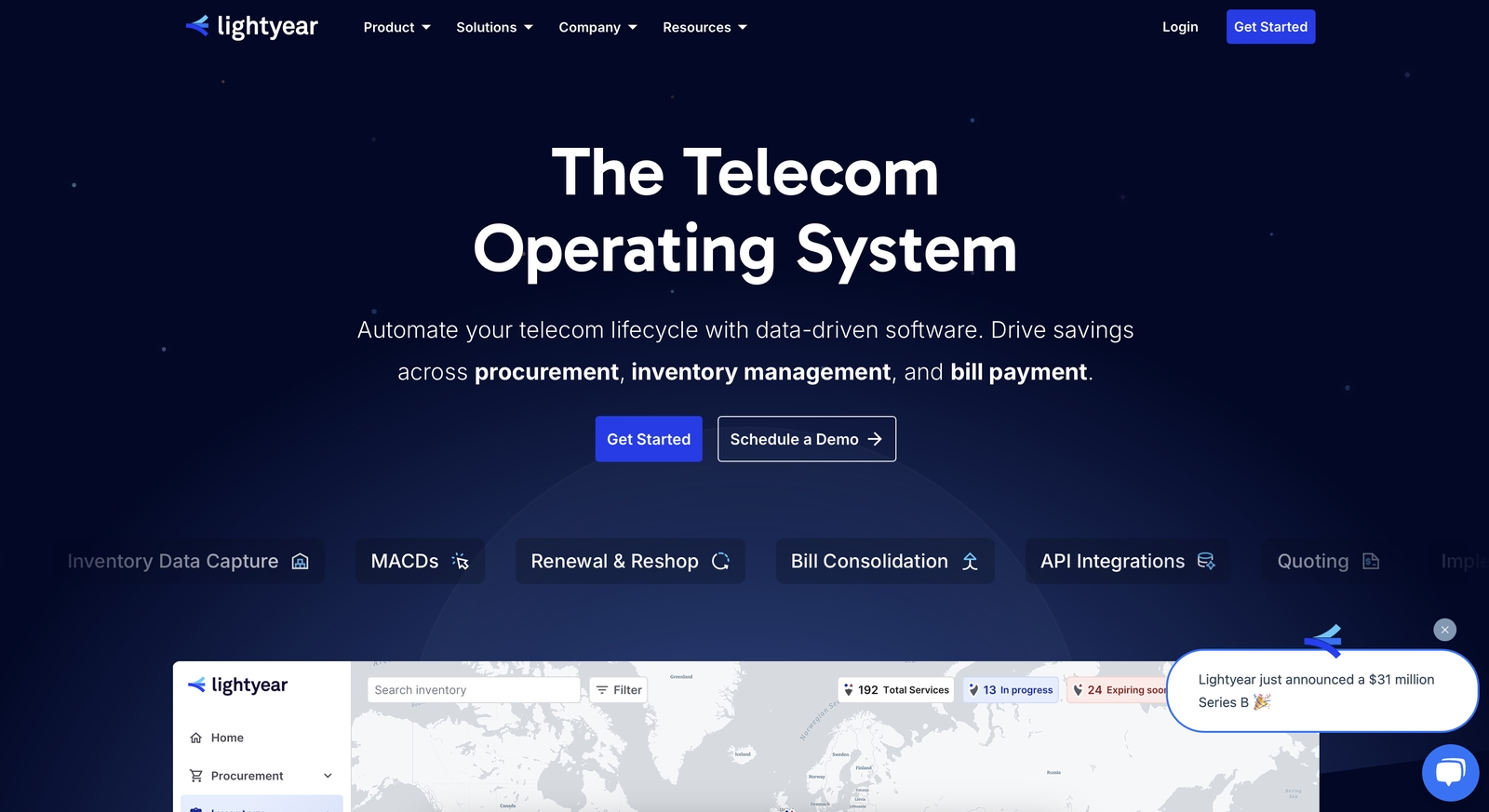
Choosing the right hardware is just the first step. Lightyear helps with what comes next by automating network service procurement, inventory management, and bill consolidation.
By taking the pain out of telecom infrastructure management, the hundreds of enterprises who trust Lightyear achieve over 70% time savings and 20% cost savings on their network services.
Schedule a demo or get started with our questionnaire today.
Frequently Asked Questions about Spectrum Wave 2 Router vs WiFi 6
Do I need new devices to use a WiFi 6 network?
Not at all. WiFi 6 is backward-compatible, so your older devices will connect just fine. However, to experience the full benefits like faster speeds and lower latency, your laptops and phones will also need to be WiFi 6 compatible.
Is a Wave 2 router still a good choice for a new network?
It certainly can be. For smaller offices with standard internet needs and fewer devices, a Wave 2 router provides solid, reliable performance at a more budget-friendly price point. It's a practical choice if you don't need the high-density capacity of WiFi 6.
Does WiFi 6 offer better range than a Wave 2 router?
The theoretical range is about the same. However, WiFi 6 is much better at managing signals in crowded areas. This means you'll likely experience a more stable and reliable connection at the edge of your network's range, especially in a busy office building.
Is "Wave 2" a technology that only Spectrum offers?
No, "Wave 2" is an official enhancement to the 802.11ac WiFi standard, available from many hardware manufacturers. While Spectrum offers a popular router using this technology, it is widely available across the industry and not exclusive to them.
Let us show you the product and discuss specifics on how it might be helpful.
Schedule a Demo





Revolutionize Your Telecom Experience
Learn how you can get one step closer to optimal business efficiency for all your telecom services.