Tangoe vs Brightfin vs Lightyear Compared Head-to-Head (2026)
Tangoe vs Brightfin: a head-to-head look at features, ServiceNow fit, procurement, inventory, and billing, plus how Lightyear runs the telecom lifecycle.


Tangoe and Brightfin both manage enterprise telecom invoices, inventory, and mobility, but they disagree on where that work should live.
Tangoe runs its own platform, Tangoe One, and pairs it with a large advisory practice that handles sourcing, audits, and contract negotiation as consulting work. Brightfin runs entirely inside ServiceNow, so invoices, contracts, and telecom inventory sit in the same system your IT team already uses for tickets and assets.
Brightfin also merged with Proven Optics in 2026 and now pitches itself as a combined technology expense and IT financial management platform. Buyers evaluating Brightfin today are looking at a different product than they would have seen a year ago.
Lightyear offers another approach, connecting procurement, network inventory, and expense management, with AI agents supporting quoting and implementation.
Here’s a quick summary of who each platform may suit best:
- Tangoe: Best for large global enterprises that want telecom, mobility, and cloud spend under one vendor, with an advisory team available for sourcing and audits.
- Brightfin: Best for ServiceNow-centric organizations that want telecom and mobile workflows, invoice data, and IT budgeting inside ServiceNow.
- Lightyear: Best for enterprises that want sourcing, installs, inventory, renewals, and invoice reconciliation in one platform, with AI agents handling much of the quoting and implementation work.
Next, we’ll cover each platform’s features, advantages, and shortcomings, then compare them across nine categories.
Tangoe Overview

Tangoe has been in the expense management business for more than 25 years, and it now markets itself as an IT Expense Management (ITEM) company rather than a telecom-only vendor, a label that fits the product.
Tangoe One handles fixed telecom, mobile, and cloud costs, and the company’s consulting arm, Tangoe Advisory Services, takes on sourcing projects, audits, and cost recovery for customers who would rather not run them internally.
Key Features
- Invoices are captured and validated against contract rates and usage. Tangoe holds 70+ patents, 37 of them tied to AI.
- Tangoe AI Assistant, new in 2026, answers natural-language questions and adds generative AI to Tangoe One Analytics.
- Quote and order management organizes the carrier responses your team collects, and an optional fulfillment team can place orders for you.
- Contracts and services sit in a central inventory with location maps and utilization monitoring.
- Renewal and expiration alerts come with benchmarking against market pricing.
- MACD (move, add, change, and disconnect) requests move through configurable approval chains.
- Managed mobility, inherited from the MOBI acquisition, now includes Multi-SIM management for reconciling devices and lines.
- Cloud and SaaS expense management extends to Kubernetes and GPU cost optimization through a 2026 partnership with Kubex.
- Tangoe Advisory Services covers RFPs, audits, and cost recovery, and the new Tangoe Tax Audit looks for incorrect telecom taxes and surcharges.
Advantages
- Tangoe covers the widest range of spend categories of the three platforms, with telecom, mobile, cloud, and SaaS spend under one contract.
- Benchmarks and audit rules draw on a large data set. Tangoe cites more than 25 years in TEM and a carrier ecosystem of 400+ providers.
- Companies without in-house sourcing staff can hand RFPs, audits, and tax recovery to the advisory team. In one example Tangoe shares, the team found $1.4M in potential tax savings for a customer within 30 days.
Shortcomings
- Tangoe One logs quotes and tracks orders, but deciding which carriers to approach and running competitive bids falls to the advisory team as paid work. Without that engagement, pricing pressure depends on your own team.
- Tangoe One is built from several acquired products, including Asentinel and MOBI. During demos, ask to see how telecom, mobile, and cloud data move between modules in daily use.
- Renewal support ends at alerts and benchmarks. Tangoe doesn’t automatically rebid services before notice dates.
Brightfin Overview

Brightfin builds its software on ServiceNow and holds the platform’s Built on Now designation. Its applications, along with the invoices, contracts, usage records, and inventory they manage, run inside each customer’s own ServiceNow instance.
The company started in mobility. Private equity firm Periscope Equity formed Brightfin in 2021 by combining MobiChord, Visage (maker of MobilityCentral), and Mobile Solutions.
In January 2026, Proven Optics, a ServiceNow-native ITFM vendor backed by Silversmith Capital and ServiceNow, acquired Brightfin's ServiceNow enterprise business. The combined company took the Brightfin name in April under CEO Joel Martins and now positions itself as an AI-native cost optimization partner for telecom expense management (TEM) and IT financial management (ITFM). You may still see the Proven Optics name in older analyst reports and materials.
Key Features
- Native ServiceNow apps cover mobile and fixed telecom, with inventory stored in the ServiceNow configuration management database (CMDB).
- More than 300 provider integrations bring carrier data and actions into ServiceNow.
- Invoice processing normalizes data across carriers and applies configurable audit rules.
- Integrated bill pay includes dashboards for payments, rebates, and approval flags.
- Fixed-line procurement workflows store carrier-specific ordering instructions down to the billing account, apply contracted rate plans to new orders, and create quotes automatically once a preferred provider is chosen.
- A rate change management flow quotes and validates the cost impact of a service change before it goes through.
- Disconnects, moves, and upgrades automatically generate billing validation tasks.
- Mobility lifecycle tools handle device procurement, unified endpoint management (UEM) integrations, and rules that can suspend or disconnect zero-usage lines.
- ITFM capabilities from Proven Optics add cost modeling, budgeting and forecasting, chargebacks, and capital planning.
- Employees submit requests through self-service portals inside ServiceNow.
Advantages
- ServiceNow shops keep telecom requests, tickets, and invoice data in one system, with no extra portal or sync job to maintain.
- Data stays in the customer’s own ServiceNow instance and follows its existing security model.
- The Proven Optics ITFM tools feed telecom and mobile costs into IT budgets, forecasts, and chargebacks, so finance teams can allocate spend by department or project.
Shortcomings
- Procurement is a ServiceNow workflow. Quotes are generated for providers you’ve already picked, so finding carriers, running competitive bids, and benchmarking prices remain your team’s job.
- Once an order is placed, Brightfin doesn’t manage the install or follow up with the carrier.
- Much of the appeal depends on ServiceNow. Companies on a different ITSM platform lose the main reason to choose Brightfin.
- Inventory accuracy depends on your CMDB and vendor data feeds, and both need regular upkeep.
- Most public reviews focus on mobility or older product versions. Brightfin’s TEM services listing on Gartner Peer Insights has only two reviews, so ask for fixed-line customer references.
- The merger leaves open questions about which products will be consolidated and whether your account team or pricing will change.
Lightyear Overview
Lightyear is telecom's system of action and the first agentic platform for enterprise telecom. It combines AI agents, proprietary telecom data, and telecom-specific software across Procurement, Network Inventory Management, and Expense Management.
Lightyear's agents handle sourcing and installation work directly and send the results into inventory and billing, while Tangoe relies on consultants and Brightfin relies on ServiceNow workflows.
Because those three products share one set of records, a circuit ordered through Lightyear becomes the inventory entry that its invoices are later audited against. Lightyear customers spend 70%+ less time on telecom management and reduce telecom spend by 20%+.
Key Features
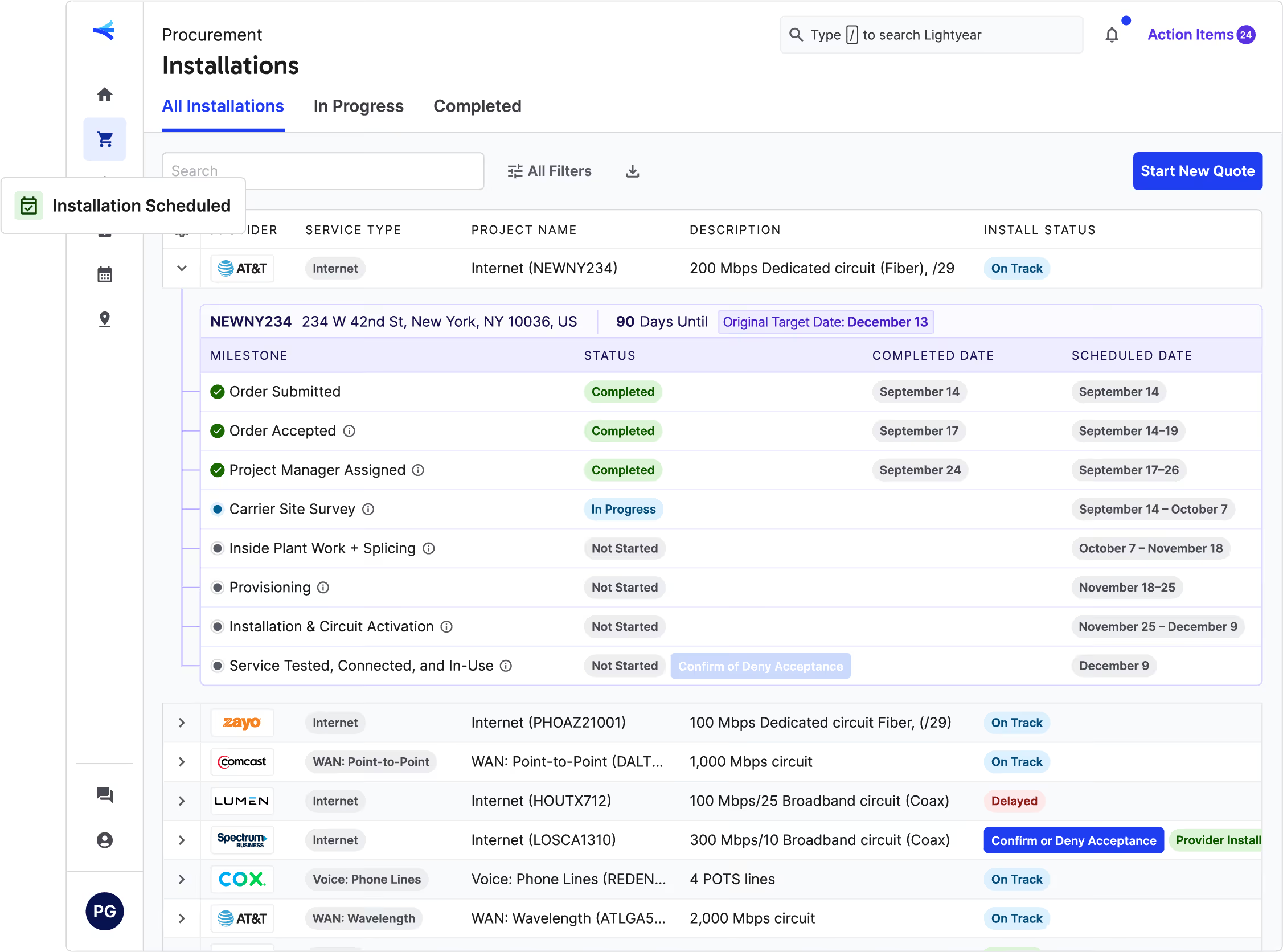
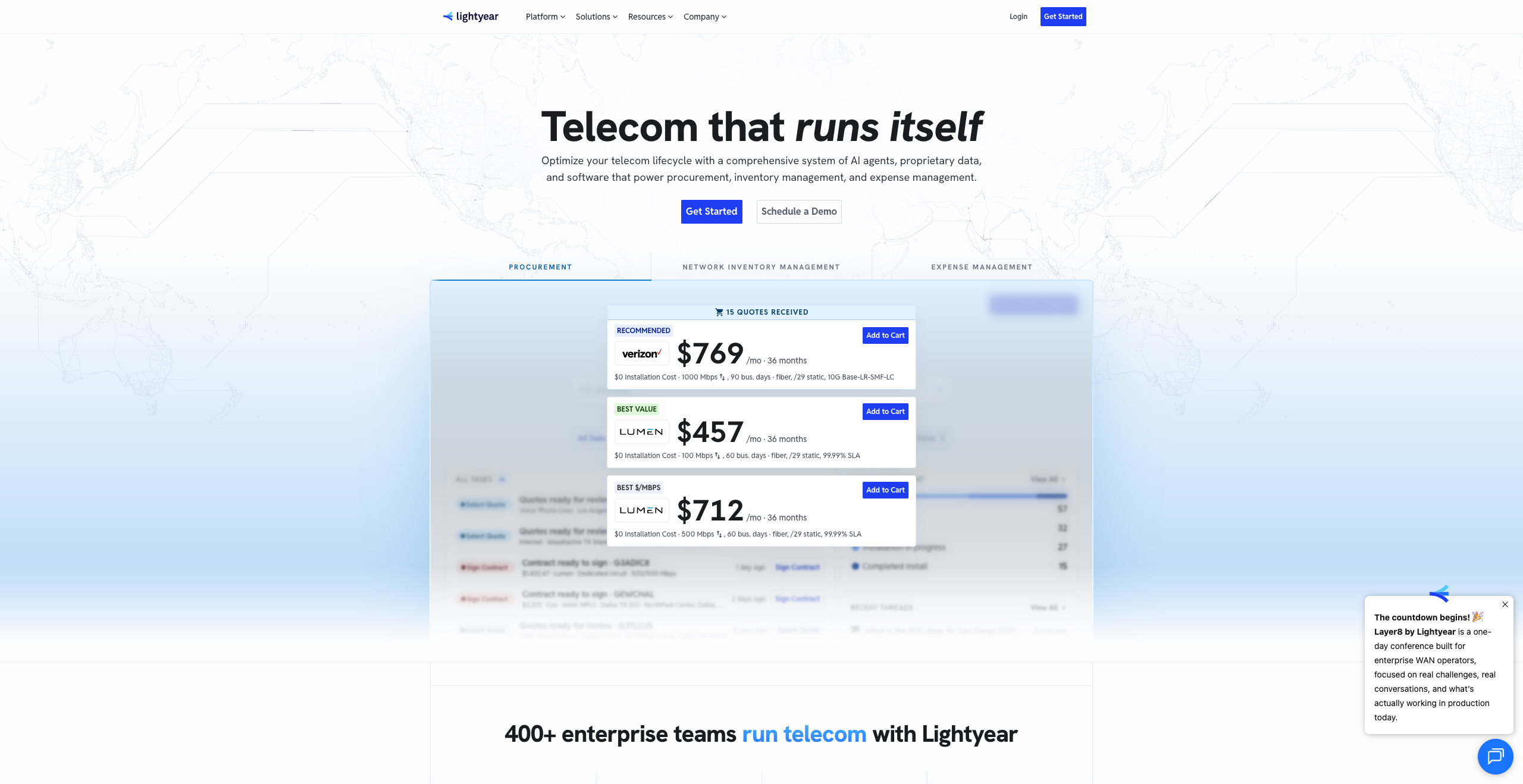
- Procurement automates the telecom RFP from request to install using proprietary pricing, serviceability, and provider data. It covers internet, WAN, voice, and colocation, including renewals, upgrades, moves, and bulk orders of 10+ services.
- The Quoting Agent picks best-fit carriers based on your requirements, sends quote requests, follows up with providers, and lines up bids for direct comparison.
- The Implementation Agent monitors active installs and carrier communications and flags risks before timelines slip.
- Network Inventory Management (NIM) keeps a self-updating record of 30+ data points per service, including static IPs, contract terms, costs, and configurations. Lightyear builds it during white-glove onboarding.
- Renewal rebidding evaluates costs on an ongoing basis and runs bulk rebid workflows before notice dates.
- MACD automation handles tickets for moves, adds, changes, and disconnects across every vendor.
- Expense Management uses telecom-trained AI to audit each invoice and reconcile line items to contracts and inventory, with dispute handling and multi-currency support.
- Bill pay options include a consolidated bill, individual invoice payment, or invoice management with no bill pay.
- Dispatch gives teams natural-language access to network and spend data, reports, and workflows.
- API sync pushes records to ServiceNow, Meraki, NetBox, and other systems.
- Network engineering support includes KMZ review, diversity evaluation, and carrier strategy.
Advantages
- With the Quoting Agent automating sourcing, quotes arrive 30-50% faster and bring in 15-25% more qualified bids.
- The Implementation Agent helps installs finish 5-10 days sooner.
- A new circuit moves from order to inventory to invoice reconciliation without anyone re-entering data.
- Inventory updates on its own, so invoice audits stay accurate long after onboarding.
- API sync keeps ServiceNow current, so ServiceNow users get accurate CMDB data without running telecom workflows inside it.
- NIM and Expense Management are priced per service rather than as a percentage of spend.
- Dispatch produces custom inventory and spend reports in a median of about one minute and two prompts.
Shortcomings
- Mobility and device management run through WEM partners.
- SaaS, IaaS, and ITFM budgeting fall outside the platform.
- Telecom workflows don’t run natively inside ServiceNow the way Brightfin’s do. Teams that want employees requesting telecom services from a ServiceNow catalog will depend on the API integration.
Comparing Tangoe, Brightfin, and Lightyear Head-to-Head
The three platforms overlap on paper, so the tables below focus on how each one carries out the work.
Procurement & Sourcing
Tangoe sources through paid consultants, Brightfin runs orders through ServiceNow for carriers you choose, and Lightyear’s agents choose carriers and run the bidding.
Tangoe
Quote comparison and order tracking. RFPs and negotiation handled by Tangoe Advisory Services as paid work.
Brightfin
ServiceNow ordering flows with carrier instructions, contracted rates, and auto-created quotes for a preferred provider. No automated carrier discovery or competitive bidding.
Lightyear
Quoting Agent selects carriers, sends requests, follows up, and normalizes bids. Implementation Agent tracks installs. Results flow into inventory and billing.
Inventory Management
Tangoe and Brightfin assemble inventory from carrier data and customer records, while Lightyear’s inventory updates from procurement activity.
Tangoe
Central contract and service inventory with location maps, often built through advisory services.
Brightfin
Inventory stored in the ServiceNow CMDB, combining vendor feeds with existing inventory sources.
Lightyear
NIM tracks 30+ data points per service, updates as services change, and syncs to ServiceNow, Meraki, and NetBox. Built for you at onboarding.
Invoice & Expense Management
All three process and pay invoices, but they differ on where the data lives and what each invoice is checked against.
Tangoe
Invoice capture and validation against contracts and usage across telecom, mobile, and cloud. Supports multi-currency.
Brightfin
Invoices stored in ServiceNow, audited with configurable rules, and paid through integrated bill pay.
Lightyear
AI audits every invoice and reconciles line items to contracts and self-updating inventory. Consolidated, individual, or no bill pay.
Audit & Cost Optimization
Tangoe and Brightfin focus on catching billing errors and unused services, and Lightyear also rebids renewals to lower contracted rates.
Tangoe
Rate and usage audits, disputes, benchmarking, and tax audits through advisory services.
Brightfin
Configurable audit rules, zero-usage line rules, and rate validation before service changes.
Lightyear
Proactive invoice flagging, contracted vs. actual spend tracking, and continuous renewal rebidding.
MACD & Lifecycle Workflows
Brightfin runs MACDs as ServiceNow tasks, and Tangoe routes them through approval chains. In Lightyear, every MACD updates inventory and billing directly.
Tangoe
MACDs with configurable approvals and an optional fulfillment team. Renewal alerts only.
Brightfin
MACDs as ServiceNow tasks, with automatic billing validation after disconnects, moves, and upgrades.
Lightyear
MACD tickets across all vendors in NIM. Changes update inventory and billing, and renewals are rebid before notice dates.
Platform Architecture & ServiceNow
Tangoe runs its own platform assembled through acquisitions, Brightfin runs inside ServiceNow, and Lightyear runs on one data model that syncs to ServiceNow.
Tangoe
Tangoe One, built through acquisitions including Asentinel and MOBI. Integrates with ERP and IT systems.
Brightfin
Built on Now. Apps and data live in the customer’s ServiceNow instance. Merged with Proven Optics in 2026 to add ITFM.
Lightyear
One platform linking quotes, orders, services, contracts, inventory, and invoices. API sync to ServiceNow, Meraki, and NetBox.
Mobility & Cloud Coverage
Tangoe and Brightfin both extend into mobility and broader IT spend, while Lightyear concentrates on enterprise telecom.
Tangoe
Managed mobility with Multi-SIM management, plus cloud, SaaS, and Kubernetes cost optimization.
Brightfin
Mobility lifecycle and UEM integrations, plus cloud and enterprise IT spend through the ITFM platform.
Lightyear
Internet, WAN, voice, and colocation. Mobility through WEM partners. SaaS, IaaS, and ITFM not covered.
Service & Support Model
Tangoe sells consulting alongside its software. Brightfin's ServiceNow apps come with a highly rated support team, and Lightyear includes managed help for installs and escalations.
Tangoe
24/7 support. Advisory services sold separately.
Brightfin
Client services team with strong support ratings. Managed mobility services available.
Lightyear
White-glove onboarding and inventory build, network engineering support, and managed help with implementations, changes, and escalations.
Pricing Model
None of the three publish full pricing, so ask each vendor how fees change as your network or telecom bill grows. Across the TEM market, fees commonly run 2-5% of telecom spend. Under that model, the vendor earns more as your bill rises.
Tangoe
Custom. Typically scales with spend under management or with device and account counts.
Brightfin
Custom per-line, per-month subscription, according to Capterra. Requires an existing ServiceNow instance.
Lightyear
Procurement is free to use. NIM and Expense Management are priced per service.
Which Platform Should You Choose?
Choose Tangoe if you want telecom, mobile, and cloud spend under one vendor and expect to buy advisory help for sourcing and audits. Budget for that consulting work up front.
Choose Brightfin if ServiceNow is your system of record and you want telecom, mobility, and IT budgeting to live inside it. Carrier sourcing will stay with your team.
Choose Lightyear if your priority is sourcing, installing, managing, and paying for network services in one platform, with agents handling quoting and install follow-up. Mobility, SaaS, and IT budgeting will need a partner or a second tool.
Questions to Ask While You’re Evaluating
Whichever platforms make your shortlist, these questions will help you see how each one handles the work behind the demo:
- Who picks the carriers on an RFP? Does the software identify and invite providers, does a consultant handle it as a separate engagement, or does your team build the vendor list and chase quotes itself?
- After you choose a provider, who manages the install? Ask whether the platform tracks milestones, follows up with the carrier, and creates the inventory record automatically, or whether someone on your team enters that data by hand.
- What keeps the inventory accurate six months after go-live? A clean inventory at onboarding is easy to promise. Find out whether records update on their own as services change, or depend on CMDB upkeep and carrier data feeds.
- Do procurement, inventory, and billing share one data model? If they sync between separate systems, ask how often mismatches occur and who resolves them.
- How do fees change as your network grows? Pricing tied to spend, lines, or devices rises with your telecom bill, so model what you’d pay at your projected size in two or three years.
- Is onboarding included? Some vendors build your inventory and configure workflows as part of the contract, while others bill implementation, inventory build, and account management separately.
- What happens before a renewal notice date? Ask whether the platform rebids the service to secure better pricing or simply sends an alert that a contract is expiring.
- If you use ServiceNow, what do you actually need from it? Decide whether telecom workflows have to run inside ServiceNow, or whether accurate telecom data synced into your CMDB is enough. The answer narrows the field quickly.
- How will the Proven Optics merger affect Brightfin customers? Ask which products are being consolidated, whether pricing or contract terms will change, and who will support your account going forward.
The choice depends on where your team spends the most time. Tangoe covers the widest range of IT spend and adds consulting for sourcing and audits. Brightfin keeps telecom, mobility, and IT budgeting inside ServiceNow for organizations that already run on it.
Lightyear goes further into the telecom lifecycle, with agents that source services and track installs, an inventory that updates itself, and invoices reconciled against that inventory. Lightyear customers spend 70%+ less time on telecom management and reduce telecom spend by 20%+. If sourcing, installs, and billing accuracy are where your team feels the most strain, see how Lightyear can run your network’s full lifecycle.
Let us show you the product and discuss specifics on how it might be helpful.
Schedule a Demo





Revolutionize Your Telecom Experience
Learn how you can get one step closer to optimal business efficiency for all your telecom services.