Tangoe vs Calero vs Lightyear Compared Head-to-Head (2026)
Tangoe vs Calero: a head-to-head comparison of features, procurement, inventory, and billing, plus how Lightyear approaches the telecom lifecycle differently.


Tangoe and Calero are two of the largest and most established names in telecom expense management (TEM).
Both platforms now cover broad territory across telecom, mobility, and cloud expense management. Yet each platform is really a collection of separately built products brought together under a single login. How well those pieces connect around procurement, inventory accuracy, and billing varies more than you might expect.
It's worth examining those differences closely if your priorities go beyond just paying invoices to manage the full telecom lifecycle. That's why we'll also cover how Lightyear compares as a platform built from scratch to connect procurement, inventory, and expense management in a single closed system.
Before we get into a deeper comparison, here's a quick summary of who each platform may be best suited for:
- Tangoe: Best for large global enterprises that need broad coverage across telecom, mobility, and cloud expense management, with advisory services and a large carrier ecosystem.
- Calero: Best for organizations that want unified technology expense management spanning telecom, mobility, SaaS, and market data, with network visualization and eBonding capabilities.
- Lightyear: Best for enterprises that want procurement, inventory, and expense management in one connected platform, with network changes flowing automatically from sourcing and installs into inventory, renewals, and invoice reconciliation.
With that, let's walk through each platform's key features, advantages, and shortcomings, then compare them head-to-head across the categories that matter most when evaluating TEM software.
Tangoe Overview
Tangoe provides IT expense and asset management software for telecom, mobile, and cloud services. Its Tangoe One platform gives enterprise organizations a central view of the services they have, who uses them, and what they cost, with what Tangoe describes as AI-driven invoice capture and validation. For companies that want hands-on help, Tangoe pairs the software with managed services and an advisory arm covering audits, contract negotiations, and cost analysis.
Key Features and Services
- AI-Powered Invoice Processing and Validation: Tangoe says its AI captures each invoice and links it to contract and usage data. The company claims patented verification then checks charges against contracted rates, catching billing errors and collecting credits when carriers miss service level agreements (SLAs).
- Quote and Order Management: Teams can gather pricing from several carriers at once, compare the responses, and follow every order without leaving the platform. Tangoe's fulfillment team can also manage orders and inventory updates for you.
- Centralized Inventory Management: The platform stores every telecom contract and its related service details in one place and tracks monthly utilization to flag waste. Interactive maps let you drill into infrastructure by location.
- Contract Management with Renewal Alerts: Automated alerts notify procurement teams of upcoming renewal cycles (however, re-shopping services are not supported). Tangoe Analytics benchmarks costs against market pricing to flag services worth renegotiating.
- MACD Processing: Users initiate, approve, and track moves, adds, changes, and disconnects (MACDs) through structured approval workflows.
- Managed Mobility Services: The mobility service covers the device lifecycle from procurement and deployment through repair, buyback, and recycling. Employees can order their own devices and accessories through a configurable catalog.
- Cloud Expense Management: The cloud module manages software as a service (SaaS), unified communications as a service (UCaaS), and infrastructure as a service (IaaS) spend. Supported providers include AWS, Azure, Google Cloud, and Oracle Cloud, alongside 300+ direct SaaS integrations.
- Dispute Management and Credit Recovery: Automation investigates anomalies, manages vendor disputes, and tracks credits across carriers. Data Requests gives real-time status updates on invoice exceptions.
- Advisory and Consulting Services: Consultants audit assets, run requests for proposals (RFPs), and negotiate contracts using market price indexes. They can also build a telecom inventory for clients that don't have one.
Advantages
- Managing telecom, mobile, and cloud spend through a single platform means fewer vendor contracts to negotiate and fewer systems for IT and finance teams to learn.
- Tangoe reports $15 billion in IT spend under management and 370,000 invoices processed monthly, with more than 25 years in the TEM category. This billing volume informs its benchmarking and audit automation.
- More than 70 patents back the platform's invoice verification and processing capabilities.
- For companies without in-house telecom sourcing expertise, Tangoe's consultants can run RFPs and negotiate carrier contracts using market price intelligence.
- The platform supports what Tangoe says are 400+ global providers across 206 countries and territories, with support in 19 languages and 129 currencies.
Shortcomings
- Tangoe's order module handles quotes you've requested and orders you've placed, but it doesn't identify vendors, run automated competitive bidding, or chase carriers for responses. RFP management and contract negotiation come through the advisory arm as consulting engagements, so pricing pressure depends on people rather than platform automation.
- Complex services such as SD-WAN may require a consulting engagement for solution design, provider selection, RFP management, and contract negotiation.
- Tangoe One brings together products from the Tangoe and Asentinel merger and the MOBI acquisition. Buyers should evaluate how consistently workflows and data move between the telecom, mobile, and cloud modules in practice.
- Some users find the portal cluttered and confusing at first, with limited interface customization and a learning curve that slows new users down.
- Some users rate customer service poorly. Support quality carries extra weight in TEM, since disputes, escalations, and implementation all run through the vendor's team.
Calero Overview
Calero offers technology business management software for enterprise organizations that want one system for their telecom, mobility, SaaS, and market data spending. The platform tracks each service and subscription, validates its costs, and automates workflows like ordering and dispute resolution. Managed services back the software, so Calero's team handles work like invoice loading and vendor coordination.
Key Features and Services
- Telecom Expense Management: The platform tracks invoices, automates receipt, validates charges, and handles bill payment. Invoices load in any format, language, or currency, with a dedicated team mapping carrier billing into the platform.
- Ordering and Procurement: Calero supports wireline service procurement, helping teams standardize quote requests, compare provider pricing and terms, and route orders through customizable approval workflows. Its team coordinates providers from quote through provisioning, confirms delivery, and syncs inventory and billing when services go live.
- Telecom Benchmarking: The benchmarking module evaluates vendor quotes against market data to support negotiations, RFPs, and renewals.
- Network Inventory Management: Visualization tools map services, carriers, and connections at every location in the telecom estate. Automated discovery normalizes asset data, and circuit tracking ties each service to a cost center and contract to catch services that keep billing after they should have been disconnected.
- Wireline eBonding: Automated data exchange connects the platform with telecom systems, reducing manual reconciliation between carrier and internal records.
- Auditing and Dispute Management: Automated reconciliation validates every charge against inventory, MACD activity, and contract terms, with customizable alert thresholds. When the system flags a billing discrepancy, invoice analysts and Calero's auditors manage the dispute through to credit, with reporting on recovered amounts and dispute aging.
- MACD Management: Change requests flow through order tracking and validation to prevent disconnect errors and keep inventory current.
- Managed Mobility Services: The mobility suite covers the device lifecycle from procurement through secure retirement, with unified endpoint management deployment and a global help desk staffed in-house and in-region. A self-service portal lets employees order approved devices.
- SaaS Management: Discovery tools flag shadow IT, measure how heavily each application gets used, and manage licenses and spend through customizable analytics reports.
- Market Data Management: A module built for financial services firms centralizes market data subscriptions, provisions licenses through vendor APIs, and manages compliance, renewals, and index license reporting.
Advantages
- Handling telecom, mobility, SaaS, and market data in one platform gives IT and finance teams a single vendor for nearly every recurring technology cost.
- Network visualization maps the entire telecom estate, which speeds up audits, consolidations, and migration planning.
- Calero says wireline eBonding automates data exchange with telecom systems, cutting the manual reconciliation work that drives billing errors.
- The Calero Benchmarking Module lets you check vendor quotes against market data before signing, strengthening your negotiating position.
- Calero says it operates independently and earns no agent commissions, a position the company presents as removing any incentive to steer you toward particular carriers.
Shortcomings
- Calero’s ordering and procurement capabilities are centered on standard wireline services. The platform is less suited to sourcing and competitively procuring more complex services such as SD-WAN, dark fiber, wavelength, colocation, and other specialty network solutions.
- The ordering module manages quote requests you initiate and orders you place, but it doesn't source vendors or drive competitive bidding through network and pricing intelligence. Calero's team coordinates with carriers after you decide whom to quote, so the sourcing legwork stays with your team.
- Calero combines products from more than five acquisitions. Buyers should ask how well the underlying systems connect before treating the platform as a single system of record.
- Some users describe reporting and interface issues that make trends hard to spot, with more time spent wrangling the tool than exploring the data. For teams buying the platform for visibility, friction in day-to-day analysis chips away at the value of that visibility.
- Customers who joined through Calero's acquisitions note slow data migrations and rougher transitions than expected. If you're coming over from an acquired product, plan for a settling-in period before the platform becomes a system of record you can rely on.
- Some users report slow turnaround on change requests, stretched account teams, and communication that runs through email when a call would serve better. This can translate to longer waits on MACDs and disputes.
- Calero pairs its ordering software with managed services for vendor coordination. Buyers should evaluate service levels, turnaround times, and how much of the process their teams can manage directly in the platform, particularly given user reports of slow change requests, stretched account teams, and email-heavy communication.
Lightyear Overview
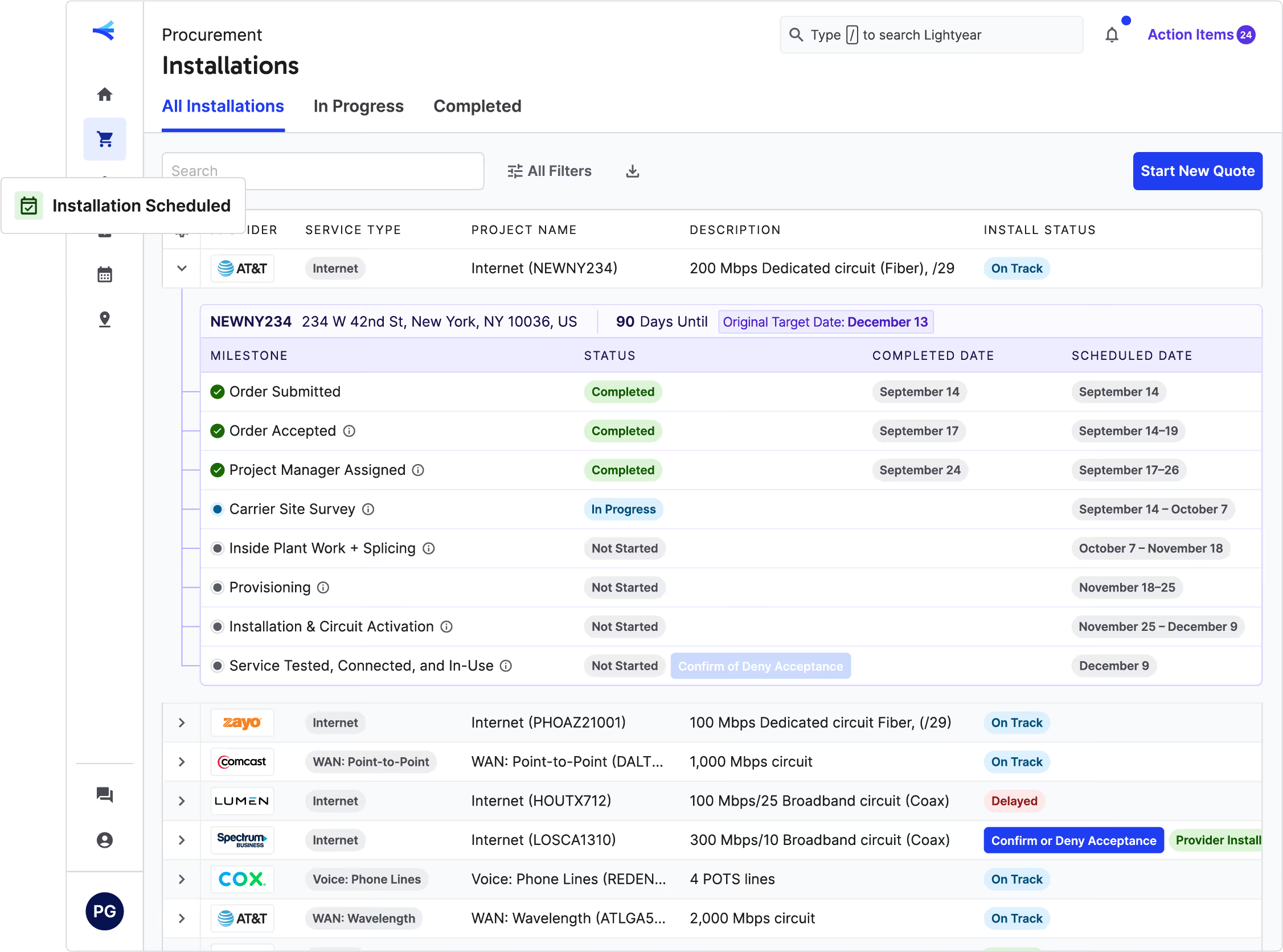
Lightyear is an AI-native platform for sourcing, implementing, managing, and paying for enterprise telecom services. Unlike legacy TEM suites assembled through acquisitions, Lightyear was built in-house around one telecom data model, keeping every quote, circuit, invoice, and renewal connected from purchase through payment.
The platform runs on three connected pillars. Procurement sources and quotes services, Network Inventory Manager tracks them, and Expense Management audits and pays the bills. Lightyear backs all three with white-glove support, from onboarding through ongoing dispute resolution.
Key Features and Services
- Native Procurement Automation: Lightyear uses proprietary provider, serviceability, and pricing intelligence from 1,200+ carriers and more than 1 million quotes to identify providers, run competitive RFPs, compare options, and manage implementation. The workflow continues from the initial request through service activation.
- Network Inventory Manager: This product acts as a digital system of record for every network service, tracking 30+ data points per service including account IDs, circuit IDs, static IPs, and contract details. Lightyear's onboarding team builds the inventory for you.
- Automated Renewal Reshopping: The platform rebids services before contract renewal notice dates, preventing auto-renewal traps and keeping pricing competitive over time.
- MACD Processing: Tickets for moves, adds, changes, and disconnects run through the Network Inventory Manager, with tracking across every vendor from one interface.
- AI-Native Expense Management: The platform receives and digitizes invoices from all global carriers in any format, including PDF, EDI, Excel, API, and mail. AI extracts and allocates every cost to validated inventory services, with human review backing 100% accurate allocation.
- Automated Audit and Variance Analysis: The audit engine checks every invoice line item against contracts, network inventory, and prior billing, then proactively flags billing discrepancies for resolution.
- Consolidated Bill Pay: Customers can pay one consolidated monthly bill, pay individual invoices, or manage invoices without bill pay, depending on their accounts payable workflow.
- Closed-Loop Lifecycle: A circuit procured through Lightyear flows automatically into inventory and from inventory into billing. No one re-keys data between systems.
- API Integrations: Data flows from Lightyear into enterprise systems including ServiceNow, Meraki, Splunk, and NetBox.
- White-Glove Support: Every customer gets dedicated onboarding, an implementations team, a customer success manager, and network engineering support at no additional cost.
Advantages
- Lightyear is the only platform in this comparison that turns proprietary provider, serviceability, and pricing intelligence across 1,200+ carriers into automated competitive sourcing and implementation.
- The closed-loop lifecycle eliminates the manual data handoffs between procurement, inventory, and billing that cause data drift and cost creep.
- Lightyear prices per service rather than as a percentage of spend, so its revenue doesn't grow when your telecom bill does. Customers keep 100% of identified savings.
- White-glove onboarding, including inventory build, implementation support, and a dedicated customer success manager, comes at no extra cost.
- A single in-house codebase keeps workflows and data consistent across procurement, inventory, and expense management.
- Documented customer outcomes include telecom cost reductions of more than 20% and management-time savings of more than 70%.
Shortcomings
- Lightyear delivers mobility and wireless device management through wireless expense management (WEM) partners rather than directly through its platform.
- The platform doesn't cover SaaS or IaaS expense management.
- Lightyear focuses on the enterprise telecom lifecycle rather than broad technology expense management spanning telecom, SaaS, cloud, and mobility. Companies that want every category behind one login will need Lightyear's partners for the rest.
Comparing Tangoe, Calero, and Lightyear Head-to-Head
The three platforms overlap on paper, but they handle the day-to-day work of telecom management differently. The comparisons below walk through nine categories to help you evaluate which TEM platform fits your organization's needs.
Procurement & Sourcing
The three platforms range from basic quote management to fully automated sourcing driven by proprietary network intelligence. This affects whether your team is still doing the legwork of identifying vendors and soliciting bids.
Inventory Management
All three platforms offer centralized inventory, though setup and upkeep differ, from customer-driven data input to white-glove onboarding where the vendor builds it for you.
Invoice & Expense Management
While all three platforms automate invoice processing, they handle cost allocation, format coverage, and payment options differently. The biggest differences are in how tightly billing ties back to validated inventory.
Audit & Cost Optimization
Each platform approaches auditing differently, from reactive dispute management to automated invoice auditing with proactive renewal reshopping.
MACD & Lifecycle Workflows
Each platform handles MACDs, and how tightly those changes flow into inventory and billing ranges from manual updates to fully closed-loop automation.
Platform Architecture
Tangoe and Calero have both grown through multiple acquisitions under private-equity ownership, while Lightyear was built as a single product in-house. The architectural difference is whether procurement, inventory, and billing operate from the same underlying service records or must be synchronized across products with different origins.
Mobility & Cloud Coverage
Tangoe and Calero both cover mobility and cloud alongside telecom. Lightyear focuses on the wireline telecom lifecycle and partners out mobility.
Service & Support Model
Onboarding and ongoing support range from standard account management with add-on consulting to white-glove onboarding where the vendor builds your inventory and manages implementations at no extra cost.
Pricing
All three platforms use custom pricing, so direct comparisons require a sales conversation. The key structural difference is whether the vendor charges a percentage of spend under management or a per-service fee.
Which Platform Should You Choose?
Your choice depends on what your organization needs most from a TEM solution.
Choose Tangoe if your organization needs the broadest category coverage across telecom, mobile, and cloud under one vendor relationship, and you value advisory services and a large global carrier ecosystem. Tangoe's scale and longevity make it a strong choice for large global enterprises managing complex, multi-category technology spend. Since the platform came together through acquisitions, evaluate how well the different modules connect in practice and whether the user experience meets your team's expectations.
Choose Calero if you need unified technology expense management that goes beyond telecom to include SaaS, mobility, and market data, and you value features like network visualization and carrier eBonding. Calero's benchmarking module and independent positioning are strengths for organizations focused on cost validation. As with Tangoe, Calero's M&A history means you should ask pointed questions during evaluation about data flow between modules and whether the platform runs as one integrated system or several tools behind one login.
Choose Lightyear if your primary need is sourcing, implementing, managing, and paying for enterprise telecom services through one connected platform. It's also a strong choice if you want procurement that goes beyond quote management to source, bid, and optimize pricing across 1,200+ carriers.
Lightyear is the only platform in this comparison with native procurement automation connected directly to inventory and expense management, which eliminates the manual handoffs that cause data drift and cost creep over time. Its per-service pricing model aligns its incentives with reducing your telecom spend, and white-glove onboarding means your team doesn't carry the burden of building and maintaining the inventory. If mobility or SaaS management are also priorities, Lightyear's partners cover those categories.
Questions to Ask While You're Evaluating TEMs
No matter which platform you're leaning toward, these questions can help you make a more informed decision:
- How does the platform handle procurement? Is it just quote management (submitting and comparing quotes you've solicited), or does it actively source vendors and drive competitive pricing through network intelligence?
- How is the inventory built and maintained? Does your team need to build and maintain it, or does the vendor handle onboarding and ongoing accuracy?
- How does data flow between procurement, inventory, and billing? Are these natively connected, or do they rely on manual handoffs or integration layers between separately built systems?
- What's the pricing model? A percentage-of-spend model means your TEM vendor's revenue increases when your bill goes up. Ask whether the vendor's incentive structure is aligned with actually reducing your costs.
- What does onboarding include, and what does it cost? Some vendors charge separately for implementation, inventory build, and dedicated account management. Others include it.
- What happens at contract renewal? Does the platform actively reshop services before renewal notice dates, or does it simply alert you that a contract is expiring?
- How are providers selected for an RFP? Through proprietary serviceability and network intelligence, a customer-provided vendor list, or a consulting team?
- What happens after a provider is selected? Does the platform manage implementation milestones and escalations and automatically create the resulting inventory record?
For IT and telecom teams evaluating these options, the central choice is between broad technology expense coverage across telecom, mobility, SaaS, and cloud, or deeper telecom procurement and lifecycle execution from provider selection through payment. If native sourcing, closed-loop lifecycle management, and a cost-aligned pricing model are priorities, learn more about Lightyear to see how it performs against your specific telecom challenges.
Let us show you the product and discuss specifics on how it might be helpful.
Schedule a Demo





Revolutionize Your Telecom Experience
Learn how you can get one step closer to optimal business efficiency for all your telecom services.