Tangoe vs Sakon vs Lightyear Compared Head-to-Head (2026)
Tangoe vs Sakon: a head-to-head comparison of features, procurement, inventory, and billing, plus how Lightyear approaches the telecom lifecycle differently.


Tangoe and Sakon are two of the most recognized names in telecom expense management, and both serve large enterprise customers managing thousands of services across global footprints.
The differences are in how they're built and what they prioritize. Tangoe covers the widest surface area, spanning telecom, mobility, and cloud expense management under one vendor. Meanwhile, Sakon has made enterprise integrations its signature, with native ServiceNow apps and a platform architecture that deliberately separates network service management from invoice processing.
Both approaches have strengths, but neither was designed to handle procurement, inventory, and billing as a single connected workflow. This comparison also includes Lightyear, a platform designed to manage the full telecom lifecycle from sourcing and installation through inventory, renewals, and invoice reconciliation in one closed system.
Before we get into a deeper comparison, here's a quick summary of who each platform may be best suited for:
- Tangoe: Best for large global enterprises that need the broadest category coverage across telecom, mobility, and cloud expense management, with consulting services and a large carrier ecosystem.
- Sakon: Best for organizations that run on ServiceNow and want their telecom data, workflows, and employee requests managed natively inside the ServiceNow platform, with a modular approach to network lifecycle and AP automation.
- Lightyear: Best for enterprises that want procurement, inventory, and expense management in one connected platform, where network changes flow automatically from sourcing and installs into inventory, renewals, and invoice reconciliation.
With that, let's walk through each platform's key features, strengths, and shortcomings, then compare them head-to-head across the categories that matter most when evaluating TEM software.
Tangoe Overview
Tangoe is one of the longest-tenured players in the TEM category, with a platform (Tangoe One) that spans telecom, mobile, and cloud expense management under a single vendor relationship. Tangoe supplements its software with an advisory practice that handles sourcing, contract negotiation, and cost optimization as consulting engagements.
Key Features
- Invoice Processing and Validation: Tangoe describes its invoice engine as AI-driven, matching incoming bills to contract rates and usage records to surface billing errors. The company holds more than 70 patents related to its verification and processing technology, and says the system automatically pursues credits when carriers fall short of SLA commitments.
- Quote and Order Management: Procurement teams can solicit pricing from multiple carriers, compare responses side by side, and convert selected quotes into tracked orders within the platform. Tangoe also offers a fulfillment team that can handle order placement and inventory updates on your behalf.
- Inventory and Utilization Tracking: All telecom contracts and associated service details are stored centrally, with monthly utilization monitoring designed to surface underused or redundant services. Location-based maps provide a visual breakdown of infrastructure across sites.
- Contract Lifecycle and Renewal Alerts: The platform flags upcoming contract expirations and renewal windows automatically, though it does not rebid services on your behalf. A benchmarking module compares your current pricing against market data to highlight renegotiation opportunities.
- MACD Workflows: Moves, adds, changes, and disconnects (MACDs) follow configurable approval chains, with status tracking at each stage of the request.
- Managed Mobility Services: Acquired through the MOBI deal, Tangoe's mobility practice covers device procurement, provisioning, repair, buyback, and recycling. A self-service catalog lets employees order devices and accessories directly.
- Cloud and SaaS Expense Management: The cloud module tracks spend across SaaS, UCaaS, and IaaS, with support for AWS, Azure, Google Cloud, Oracle Cloud, and over 300 direct SaaS integrations.
- Dispute Management and Credit Recovery: The platform automates anomaly detection across carrier invoices, manages the dispute process, and tracks recovered credits. A status dashboard provides visibility into open exceptions.
- Advisory and Consulting Services: Tangoe's advisory team conducts asset audits, manages RFP processes, and negotiates contracts using proprietary market pricing indexes. The team can also build an initial telecom inventory for organizations that lack one.
Advantages
- Covering telecom, mobile, and cloud expense management through one vendor reduces the number of contracts and systems that IT and finance teams need to juggle.
- With $15 billion in IT spend under management and more than 370,000 invoices processed monthly, Tangoe has over 25 years of billing data informing its benchmarking and audit capabilities.
- The platform's 70+ patents provide a layer of proprietary technology around its core invoice verification workflows.
- Organizations without dedicated telecom sourcing staff can lean on Tangoe's advisory arm for RFP management and carrier negotiations, using the firm's market pricing intelligence.
- Tangoe describes its carrier ecosystem as spanning 400+ providers across 206 countries and territories, with support for 19 languages and 129 currencies.
Shortcomings
- The order management module covers quotes you've already solicited and orders you've placed, but the platform itself does not identify which vendors to approach, automate competitive bidding, or follow up with carriers for responses. Sourcing and negotiation are handled by the advisory team as paid consulting engagements, so pricing pressure comes from consulting rather than platform automation.
- More complex deployments (SD-WAN, for example) typically require a separate consulting engagement for solution design, provider selection, and negotiation, adding both cost and timeline.
- Because Tangoe One was assembled through acquisitions rather than built as a single product, buyers should evaluate how smoothly data and workflows connect across the telecom, mobile, and cloud modules during day-to-day use.
- User reviews surface recurring friction around the portal's interface, describing it as cluttered with a learning curve that can slow adoption for new team members.
- Customer support quality receives mixed feedback. In TEM, support responsiveness matters more than in many software categories, since dispute resolution, carrier escalations, and implementation timelines all depend on the vendor's team.
Sakon Overview
Sakon provides telecom lifecycle and expense management software built around a modular architecture and deep ServiceNow integration. The company treats network service management and invoice processing as distinct IT and finance functions, separating them into dedicated products. For organizations that run on ServiceNow, Sakon's Telecom Connect apps (certified Built on Now) bring telecom data and workflows directly into the platform their IT teams already use.
Key Features
- Network Inventory (Network360): Sakon's inventory platform creates a system of record by pulling in carrier inventory (CSR-based), engineering inventory, and customer-provided inventory data, then reconciling them into a single view. The goal is a unified, authoritative record of what's installed, where, and under what contract terms.
- AP Automation: Invoice processing and bill payment run as a separate product from network management. Sakon uses a 3-way match technique to validate each bill against contract terms, and the company argues that keeping AP and network data in distinct systems avoids the data confusion that can arise when ordering and billing share the same platform.
- Telecom Connect for ServiceNow: Native ServiceNow apps (Built on Now certified) for both mobile and network telecom management. Organizations already running ServiceNow can manage telecom inventory, ordering, and employee service requests inside their existing ITSM environment, with real-time data syncing to the ServiceNow CMDB.
- Order Management and Vendor Quoting: Teams can submit quote requests, compare vendor responses, and track orders through the platform. The module also lets you invite vendors to bid on network services, though vendor sourcing and competitive bidding are not automated.
- MACD Processing: Moves, adds, changes, and disconnects are managed through Network360 with order tracking and validation. ServiceNow integration allows MACD requests to be initiated and tracked from within existing ServiceNow workflows.
- Managed Mobility Services: The wireless lifecycle product covers device procurement, expense management, and employee self-service ordering through a dedicated portal.
- AI-Powered Employee Support: Integrations with ServiceNow, Microsoft Copilot, Teams, and Salesforce provide AI-assisted support for telecom-related employee requests.
- Low-Code Architecture: IT teams can build custom integrations and modify workflows without waiting on Sakon's engineering team, giving technical organizations more control over how the platform fits their environment.
- Modular Deployment: Organizations can adopt Network Lifecycle, AP Automation, Wireless Lifecycle, Telecom Connect, or Telecom AI independently based on their needs, paying only for the capabilities they use.
Advantages
- For ServiceNow-centric organizations, native Telecom Connect integration means telecom workflows run inside the platform IT already uses, with no separate login or data synchronization required.
- The modular architecture lets organizations adopt only the capabilities they need and expand over time, while the low-code platform gives IT teams control over custom integrations without relying on Sakon's engineering team.
- Founded in 2003 and organically grown (not assembled through M&A like many TEM competitors), resulting in a more consistent underlying technology stack.
Shortcomings
- Sakon's ordering module supports quoting and vendor comparison, but the platform does not source vendors for you, run automated competitive bidding, or follow up with carriers using proprietary network intelligence. Procurement legwork remains with your team or requires Sakon's managed services to coordinate.
- The deliberate separation of network management and invoice processing means data must be synchronized between two distinct platforms. Some users have noted that the integration between inventory and billing could use more automation, and the team compensates with manual effort to keep records aligned.
- Reporting is an area where some users see room for improvement. The reporting module has been described as less intuitive than the rest of the platform, with limited flexibility for customizing views and extracting trends.
- Some users note that change requests and platform updates can take longer to implement than expected, though Sakon is described as thorough in researching and communicating the impact of changes.
- Does not cover SaaS or IaaS expense management. Organizations that need visibility into cloud application spend alongside telecom will need a separate solution or a broader TEM provider like Tangoe.
Lightyear Overview
Lightyear is a telecom management platform built to handle sourcing, implementation, ongoing management, and payment for enterprise network services. The platform was designed around a single telecom data model, so every quote, circuit, contract, invoice, and renewal stays connected from purchase through payment, rather than relying on integrations between separately built systems.
The platform runs on three connected pillars. Procurement sources and quotes services, Network Inventory Manager tracks them, and Expense Management audits and pays the bills. Lightyear backs all of it with white-glove support, from onboarding and inventory build through ongoing dispute resolution, at no additional cost.
Key Features and Services
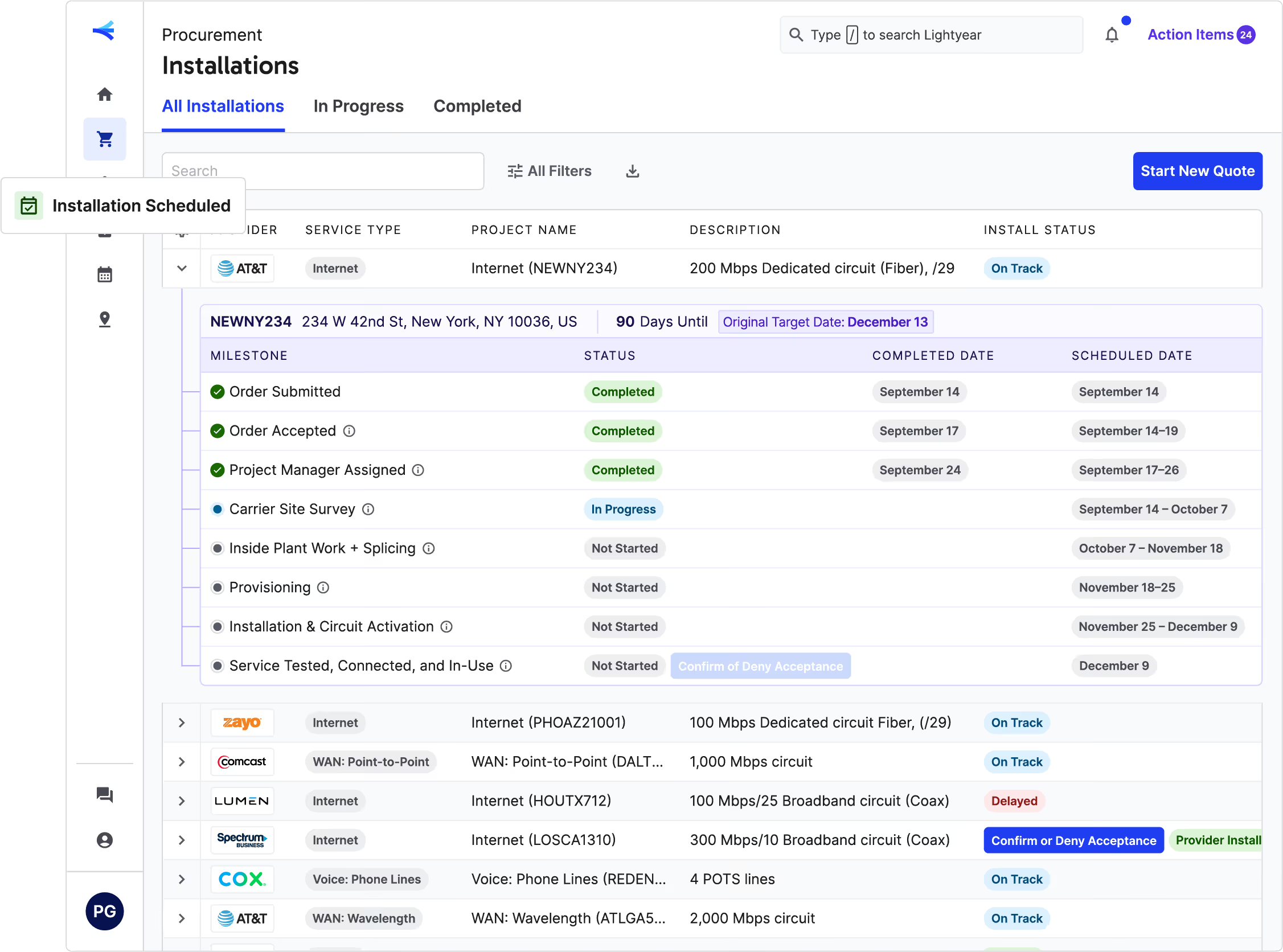
- Native Procurement Automation: Lightyear uses proprietary provider, serviceability, and pricing intelligence from 1,200+ carriers and more than 2 million quotes to identify providers, run competitive RFPs, compare options, and manage implementation. The workflow runs from the initial request through service activation, with Lightyear's team negotiating on your behalf.
- Network Inventory Manager (NIM): NIM acts as the digital system of record for every network service, tracking 30+ data points per service including account IDs, circuit IDs, static IPs, and contract details. Lightyear's onboarding team builds the inventory for you rather than handing your team a template.
- Automated Renewal Rebidding: The platform rebids services before contract renewal notice dates, preventing auto-renewal traps and keeping pricing competitive over time without requiring your team to track every expiration.
- MACD Processing: Tickets for moves, adds, changes, and disconnects run through NIM, with tracking across every vendor from one interface. Changes flow automatically into inventory and billing records.
- AI-Native Expense Management: The platform receives and digitizes invoices from all global carriers in any format (PDF, EDI, Excel, API, and mail). AI extracts and allocates every cost to validated inventory services, with human review backing 100% accurate allocation.
- Automated Audit and Billing Discrepancy Detection: The audit engine checks every invoice line item against contracts, network inventory, and prior billing, then proactively flags billing discrepancies for resolution rather than waiting for your team to spot them.
- Consolidated Bill Pay: Customers can pay one consolidated monthly bill, pay individual invoices, or manage invoices without bill pay, depending on their accounts payable workflow.
- Closed-Loop Lifecycle: A circuit procured through Lightyear flows automatically into inventory and from inventory into billing. No one re-keys data between systems, which eliminates the manual handoffs that cause inventory drift and billing errors.
- API Integrations: Data flows from Lightyear into enterprise systems including ServiceNow, Meraki, Splunk, and NetBox. A custom report builder with natural language query supports data exports.
- White-Glove Support: Every customer gets dedicated onboarding, an implementations team, a customer success manager, and network engineering support at no additional cost.
Advantages
- Lightyear is the only platform in this comparison that turns proprietary provider, serviceability, and pricing intelligence across 1,200+ carriers into automated competitive sourcing and implementation.
- A single in-house codebase and closed-loop lifecycle keep data consistent across procurement, inventory, and expense management, eliminating the manual handoffs that cause data drift and cost creep.
- Lightyear prices per service rather than as a percentage of spend, so its revenue doesn't grow when your telecom bill does. Customers keep 100% of identified savings.
- White-glove onboarding, including inventory build, implementation support, and a dedicated customer success manager, comes at no extra cost.
- Documented customer outcomes include telecom cost reductions of more than 20% and management-time savings of more than 70%.
Shortcomings
- Lightyear delivers mobility and wireless device management through wireless expense management (WEM) partners rather than directly through its platform.
- The platform doesn't cover SaaS or IaaS expense management.
- Lightyear focuses on the enterprise telecom lifecycle rather than broad technology expense management spanning telecom, SaaS, cloud, and mobility. Companies that want every category behind one login will need Lightyear's partners for the rest.
Comparing Tangoe, Sakon, and Lightyear Head-to-Head
All three platforms share a common set of capabilities on the surface, but they handle the actual work of telecom management differently.
Procurement & Sourcing
The three platforms cover a spectrum from basic quote management to fully automated sourcing. Tangoe and Sakon leave the sourcing legwork with the buyer's team or behind a consulting engagement, while Lightyear automates it.
Inventory Management
The three platforms all provide centralized inventory, but differ in who builds it, how it's maintained, and how tightly it connects to procurement and billing.
Invoice & Expense Management
All three automate invoice processing, but they approach cost allocation, format coverage, and the relationship between billing and inventory data differently. The key distinction with Sakon here is its deliberate separation of AP from network management, versus Lightyear's approach of tying billing directly to validated inventory in a closed loop.
Audit & Cost Optimization
The key differences are proactive vs. reactive cost optimization and whether the vendor's incentive structure aligns with finding savings.
MACD & Lifecycle Workflows
Each platform handles MACDs, but how those changes propagate into inventory and billing records is the key differentiator.
Platform Architecture & Data Model
Each platform was built differently, and the architectural choices affect how data flows between functions.
Enterprise Platform Integrations
The approach ranges from standard API connectivity to native ServiceNow apps that embed telecom workflows inside your existing ITSM environment.
Mobility & Cloud Coverage
Tangoe and Sakon both cover mobility alongside telecom. Lightyear focuses on the wireline telecom lifecycle and partners out mobility.
Service & Support Model
Support models range from standard account management with paid consulting add-ons to fully included white-glove onboarding.
Which Platform Should You Choose?
Your choice depends on what your organization needs most from a TEM solution.
Choose Tangoe if your organization needs the broadest category coverage across telecom, mobile, and cloud under one vendor relationship, and you have the budget for advisory services to handle sourcing and contract negotiation. Since the platform was assembled through acquisitions, evaluate how well the telecom, mobile, and cloud modules connect in practice, and whether the user experience meets your team's expectations.
Choose Sakon if your organization runs on ServiceNow and wants telecom management workflows to live natively inside that platform. Sakon's Telecom Connect integration and low-code architecture are strongly differentiated for ServiceNow-centric enterprises. The modular approach also makes sense if you want to start with one capability (like AP Automation) and expand over time. Ask specific questions during evaluation about how data synchronizes between the Network Lifecycle and AP Automation products, since users have noted that inventory-to-billing integration is an area where the team supplements with manual effort.
Choose Lightyear if your priority is sourcing, implementing, managing, and paying for enterprise telecom services through one connected platform, especially if you want procurement that extends past quote management to source, bid, and optimize pricing across 1,200+ carriers automatically.
Lightyear is the only platform in this comparison with native procurement automation connected directly to inventory and expense management. Its per-service pricing aligns Lightyear's incentives with reducing your costs, and white-glove onboarding means your team doesn't carry the burden of building and maintaining the inventory. If mobility or SaaS management are also priorities, Lightyear's partners cover those categories.
Questions to Ask While You're Evaluating TEMs
No matter which platform you're considering, these questions will help you make a more informed decision:
How does the platform handle procurement? Is it quote management (submitting and comparing quotes you've already solicited), or does it actively source vendors and use network intelligence to drive competitive pricing?
How is the inventory built and maintained? Does your team need to build and maintain the inventory, or does the vendor handle onboarding and ongoing accuracy? If the vendor builds it, what's the process and how long does it take?
How does data flow between procurement, inventory, and billing? Are these natively connected through a shared data model, or do they rely on synchronization between separately built or separately maintained systems?
How does the platform integrate with your existing IT environment? If you run ServiceNow, does the platform offer native integration or just API connectivity? If you use other enterprise systems (Meraki, Splunk, NetBox), how does data flow into those?
What's the pricing model, and does the vendor's incentive structure align with reducing your costs? Percentage-of-spend models mean the vendor's revenue increases when your bill goes up.
What does onboarding include, and what does it cost? Some vendors include implementation, inventory build, and dedicated account management. Others charge separately for each.
What happens at contract renewal? Does the platform actively reshop services before renewal notice dates, or does it just alert you that a contract is expiring?
What happens after a provider is selected? Does the platform manage implementation milestones and escalations and automatically update inventory records, or does that require manual data entry?
How does the vendor handle disputes and carrier escalations? Is that included in the base price or an add-on service?
The choice ultimately comes down to what you're optimizing for. Tangoe covers the broadest expense categories. Sakon brings differentiated ServiceNow integration and modular flexibility.
Lightyear goes deeper on the telecom lifecycle itself, connecting procurement, inventory, and expense management in a closed loop so that sourcing intelligence, competitive pricing, and accurate billing run as a single continuous process.
If native sourcing automation, a cost-aligned pricing model, and white-glove support without add-on fees are priorities for your team, see how Lightyear can help you manage the full telecom lifecycle.
Let us show you the product and discuss specifics on how it might be helpful.
Schedule a Demo





Revolutionize Your Telecom Experience
Learn how you can get one step closer to optimal business efficiency for all your telecom services.