Unifi Router vs FRITZ!Box: Enterprise Comparison
Unifi Router or FRITZ!Box for your enterprise? We compare the modular Unifi ecosystem against the all-in-one FRITZ!Box for IT decision-makers.

Choosing the right networking hardware is a critical decision for any business, directly impacting performance, security, and operational efficiency. Two popular names that often come up in this discussion are Ubiquiti's UniFi routers and AVM's FRITZ!Box.
While both offer robust features, they are designed with different philosophies and target environments in mind. This article provides a straightforward comparison to help you determine which solution is the better fit for your enterprise network.
What is a Unifi Router?
A UniFi router, from the manufacturer Ubiquiti, serves as the core gateway in a scalable networking ecosystem. It's designed for professional and enterprise environments, intended to be part of a larger, integrated system rather than just a standalone device.
The central idea behind UniFi is unified management. All UniFi hardware—including routers, switches, and Wi-Fi access points—is configured and monitored from a single software interface called the UniFi Network Controller. This provides IT teams with a holistic view and control over the entire network infrastructure.
- Ecosystem-Centric: It functions best when paired with other UniFi products, creating a cohesive and powerful network.
- Centralized Control: The UniFi Controller software is the single pane of glass for managing every device on the network.
- Scalability: The system is built to scale, making it suitable for small businesses that plan to grow or large enterprises with multiple sites.
- Advanced Features: Offers enterprise-grade capabilities, including VLANs, VPNs, and in-depth traffic analytics.
What is a FRITZ!Box?
A FRITZ!Box, from the German manufacturer AVM, is a versatile, all-in-one networking device. It’s primarily designed for home users and small offices, focusing on providing a wide range of features within a single, user-friendly package. Unlike systems built from separate, specialized components, a FRITZ!Box is engineered to be the central hub for internet, networking, and even telephony.
Its core philosophy is convenience and comprehensive functionality out of the box.
- All-in-One Design: Most models integrate a modem, router, Wi-Fi access point, and a complete telephone system (VoIP/DECT) into one unit.
- User-Friendly Interface: It runs on FRITZ!OS, an operating system known for its intuitive web interface that simplifies setup and daily management.
- Rich Feature Set: Often includes built-in functions like a media server, NAS capabilities via USB ports, and robust parental controls.
- Broadband Versatility: Renowned for its compatibility with various internet connection types, such as DSL, cable, and fiber.
Unifi Router vs FRITZ!Box: Key Differences
The fundamental differences between these two systems come down to their core design philosophy and how they approach building a network. Let's break down the main distinctions that matter for business buyers.
1. Hardware Approach: Modular vs. Integrated
UniFi operates on a modular, component-based model. You purchase the router, switches, and Wi-Fi access points as separate, specialized devices, allowing for a highly customized network build.
FRITZ!Box, on the other hand, is an integrated, all-in-one appliance. It combines the modem, router, switch, and access point into a single box, prioritizing convenience over granular hardware selection.
2. Ecosystem and Expansion
The UniFi ecosystem is designed for professional expansion. It extends beyond networking to include security cameras, door access systems, and VoIP phones, all managed centrally and built to scale across multiple sites.
The FRITZ!Box ecosystem is centered on the home or small office. It integrates well with DECT phones and smart home devices like plugs and thermostats, but its expansion capabilities are generally limited to a single location.
3. Cost Structure
A UniFi setup typically requires a higher initial investment because you are buying multiple pieces of hardware. However, the core management software is free from licensing fees.
With FRITZ!Box, the cost is a single, upfront purchase for one device. This makes the initial budget predictable, but significant expansion might mean replacing the central unit entirely.
Performance and Speed
When it comes to raw performance, the differences between UniFi and FRITZ!Box reflect their distinct architectural philosophies. Your choice directly impacts network speed and its ability to handle user load.
A UniFi router's performance is a function of the entire network stack. Because it's a dedicated device, its processing power is focused solely on routing, security policies, and managing traffic. This design excels in high-density environments where dozens or hundreds of users and devices require stable connectivity simultaneously.
A FRITZ!Box, by contrast, delivers strong, reliable performance for a small office or home environment. Its hardware is engineered to be a capable jack-of-all-trades. However, since a single processor handles routing, Wi-Fi, modem functions, and telephony, it can become a bottleneck under the heavy, constant load typical of a larger enterprise network.
- Throughput and Processing: UniFi routers are built to handle high-volume data traffic and complex tasks like deep packet inspection without a significant performance hit. A FRITZ!Box is optimized for general internet use and may struggle to maintain top speeds when managing a very high number of concurrent connections.
- Wi-Fi Performance: In a UniFi system, Wi-Fi speed and capacity are determined by separate access points (APs). This allows for strategic placement to eliminate dead zones and support a high density of wireless clients. The FRITZ!Box's integrated Wi-Fi is convenient but less flexible for covering large or multi-floor office spaces effectively.
- Load Handling: UniFi is designed to manage the demands of hundreds of devices, making it suitable for growing businesses. The FRITZ!Box performs best with the dozens of devices typically found in a smaller setting.
Security Features
Both systems take security seriously, but they approach it from different angles, reflecting their target audiences. UniFi provides a toolkit for professional network administrators, while FRITZ!Box offers comprehensive protection that is easy to manage for a small office.
- Firewall and Control: UniFi offers a highly configurable firewall, allowing for granular rule-setting and deep packet inspection. This gives IT teams precise control over network traffic. The FRITZ!Box features a strong, pre-configured stateful firewall that provides excellent protection with minimal setup.
- Network Segmentation: A core strength of UniFi is its support for Virtual LANs (VLANs). This allows businesses to segment the network, isolating sensitive departments like finance or HR from general traffic to enhance security. FRITZ!Box focuses on simpler separation, primarily through a guest network.
- Threat Management: UniFi security gateways include built-in Intrusion Detection and Prevention Systems (IDS/IPS) that actively scan for and block threats. FRITZ!Box relies on its firewall and regular firmware updates from AVM to protect against known vulnerabilities.
- VPN Capabilities: UniFi is built for robust business VPNs, supporting site-to-site connections to link multiple offices securely. FRITZ!Box provides easy-to-configure VPN access for individual remote users but is less suited for complex, multi-site architectures.
Ease of Use and Management
The management experience for each system is tailored to its intended user, which is a major point of comparison.
UniFi: Professional-Grade Control
Management is handled through the UniFi Network Controller, a powerful software platform that can be hosted locally or in the cloud. It provides deep visibility and control over every device in the ecosystem but comes with a steeper learning curve.
The interface is designed for IT professionals who are comfortable with advanced networking concepts and require granular configuration options for things like firewall rules and traffic shaping.
FRITZ!Box: Plug-and-Play Simplicity
The FRITZ!Box is managed via its FRITZ!OS web interface, which is widely recognized for its simplicity and clarity. Setup wizards and a clean layout make it accessible even for those without a dedicated IT team.
It prioritizes getting the network running quickly with minimal fuss, automating many complex settings behind the scenes. This approach is ideal for environments where straightforward operation is more important than detailed customization.
Making the Right Choice for Your Business
Ultimately, the decision between a UniFi router and a FRITZ!Box comes down to your business's scale and IT management style. The right choice depends entirely on your specific operational needs.
If your organization requires a scalable network that can grow across multiple locations and you have an IT team that needs granular control, the UniFi ecosystem is the logical path. Its modular design allows for a powerful, customized infrastructure.
Conversely, for a small office or a single-site business that values simplicity and an all-in-one solution, the FRITZ!Box is a highly effective option. It provides robust functionality with minimal setup and straightforward management.
Need Help Managing Your Network? Lightyear Can Help
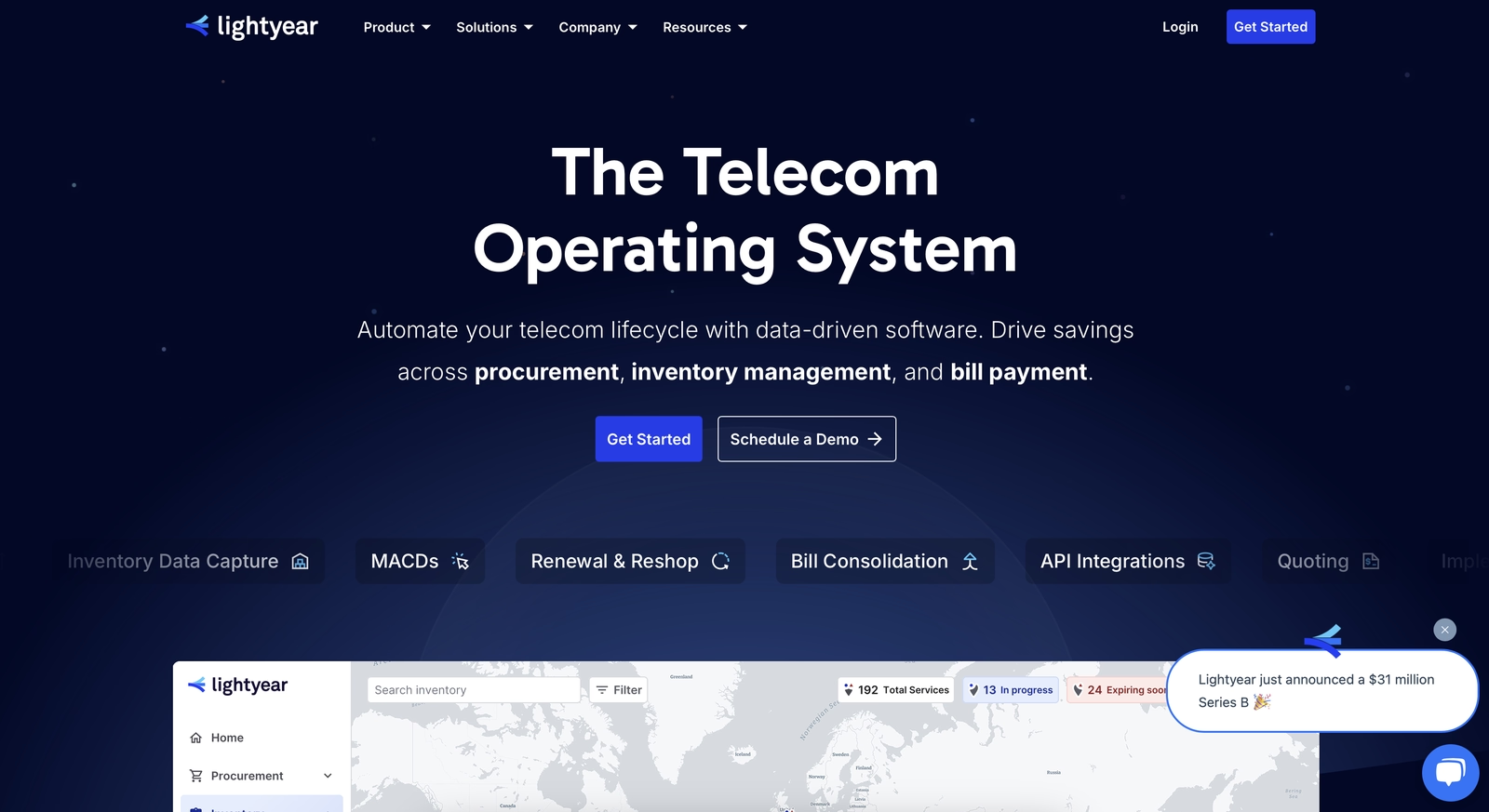
Choosing the right router is just one part of managing your enterprise network. Lightyear helps you handle the other side of the coin: procuring and managing the telecom services that power your hardware.
By automating network service procurement and inventory management, Lightyear removes the complexity from your telecom infrastructure. Enterprises using our platform achieve over 70% time savings and 20% cost savings on their network services.
Schedule a demo or get started with our questionnaire today.
Frequently Asked Questions about Unifi Router vs FRITZ!Box
Can I use a FRITZ!Box with UniFi access points?
Yes, but you would lose the primary advantage of the UniFi system: unified management. You would need to configure the FRITZ!Box and UniFi devices through separate interfaces, adding complexity and defeating the purpose of a cohesive ecosystem.
Do I need a separate modem with a UniFi router?
Yes. UniFi routers are dedicated gateways and do not have built-in modems. You will need to connect it to a separate modem (cable, DSL, or fiber ONT) provided by your internet service provider to get online.
Which system is better for a business with multiple locations?
UniFi is designed for multi-site management. Its controller can manage devices across different physical locations from a single dashboard, making it the clear choice for businesses with more than one office. FRITZ!Box is intended for single-site deployments.
How do firmware updates and long-term support compare?
AVM is known for providing long-term, stable firmware updates for FRITZ!Box. Ubiquiti also offers frequent updates for UniFi, but they are managed via the UniFi Controller, giving IT administrators full control over the timing of deployment.
Let us show you the product and discuss specifics on how it might be helpful.
Schedule a Demo





Revolutionize Your Telecom Experience
Learn how you can get one step closer to optimal business efficiency for all your telecom services.