Verizon Business vs Comcast Business: Which ISP Is Better?
Choosing a business internet provider? We compare the network, services, and pricing of Verizon and Comcast to help you find the right fit.


When selecting an internet service provider for your business, Verizon Business and Comcast Business are two of the most prominent names you'll encounter.
Choosing between them can be a challenge, so we're breaking down how they stack up to help you determine which is the right fit for your company.
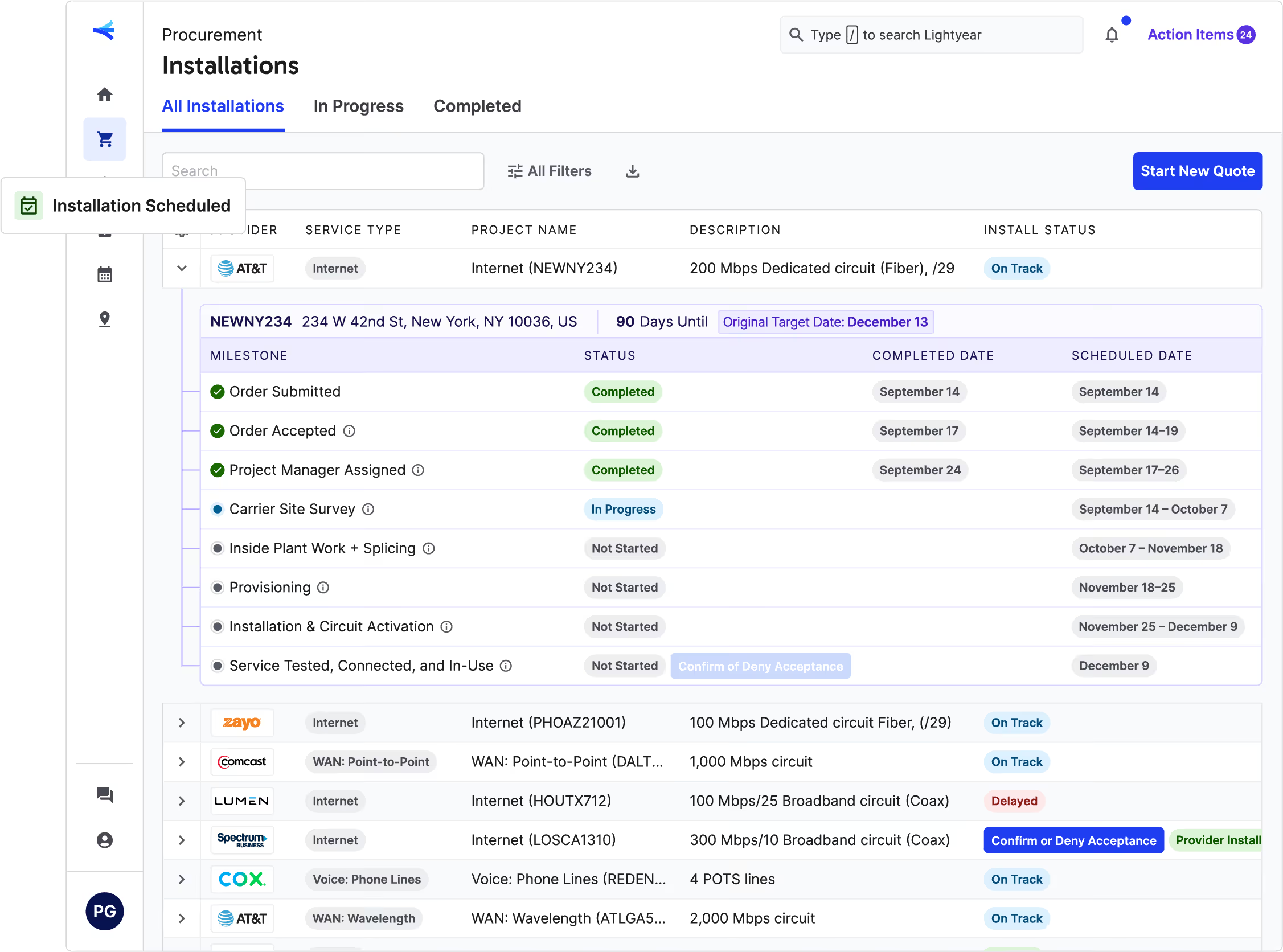
Our comparison is powered by Lightyear's proprietary data from over 70,000 ISP quotes, including aggregated benchmarks on pricing, installation timelines, and delivery points.
Keep reading for our detailed comparison, or if you're ready to explore provider options, you can begin our questionnaire to receive real-time quotes.
Overview of Verizon Business
Verizon Business, founded in 2000, is a major telecommunications provider headquartered in New York, New York. The company ranks 31st on the Fortune 500 list and operates in 39 countries with a workforce of over 105,000 employees.
The company provides solutions tailored to different business sizes, including small and medium businesses, enterprise, and public sector clients. It also focuses on innovations like private 5G networks and AI-powered business tools.
Overview of Comcast Business
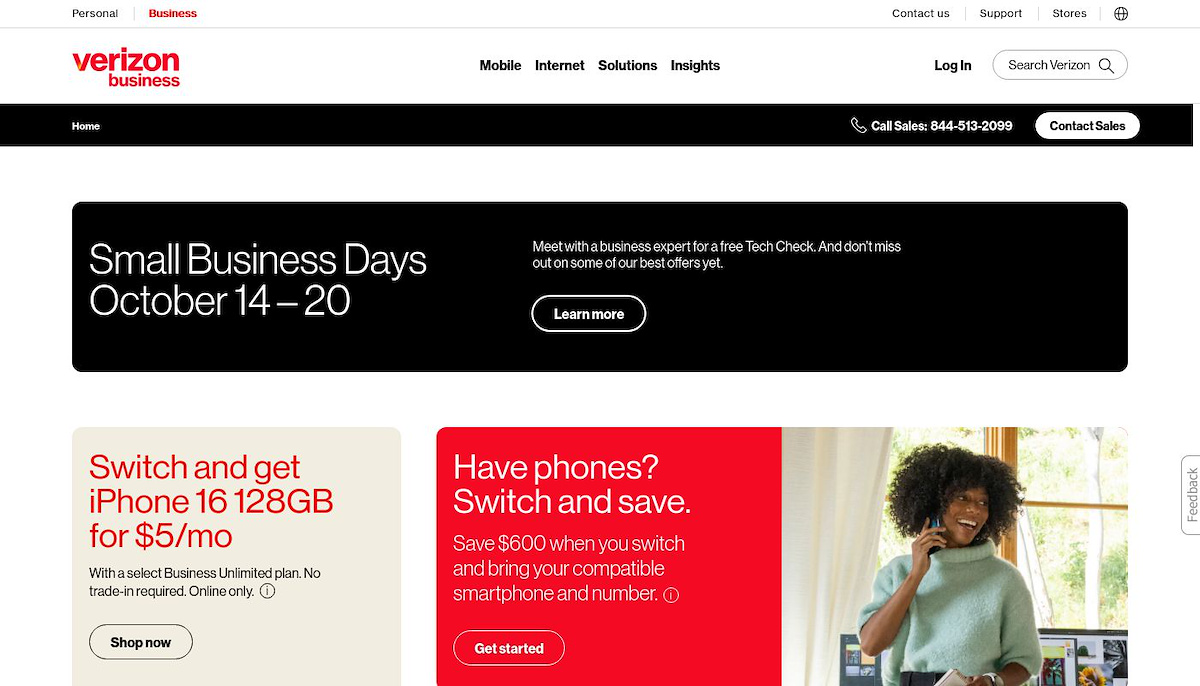
Comcast Business was founded in 1963 and is headquartered in Philadelphia, Pennsylvania. The company employs 190,000 people, ranks 33rd on the Fortune 500, and primarily serves customers within the United States.
The provider offers solutions for small businesses, large enterprises, and public sector clients. One of its notable innovations is integrating security features directly into its internet service, which removes the need for additional hardware. Comcast Business also operates what it describes as the largest and fastest network for small businesses.
ISP Products
Dedicated Internet (DIA)
Both Verizon's Dedicated Internet Access and Comcast's Ethernet Dedicated Internet (EDI) offer a wide range of symmetrical speeds, from 10 Mbps up to 100 Gbps. They also both guarantee 99.99% uptime and provide a similar set of add-on services like DDoS mitigation and managed security.
A key difference lies in their network infrastructure and delivery. Verizon primarily uses its extensive 900,000-mile fiber network and typically delivers service to a building's main point of entry (MPOE), while Comcast can deliver service via fiber, coax, or a hybrid and often brings the connection directly into your suite.
According to our data, installation times are comparable, with Verizon averaging 80 days and Comcast 82 days—both close to the 77-day industry average for DIA. Our data also shows Comcast is often more competitive on 100 Mbps circuits, while Verizon tends to be more cost-effective for 1 Gbps speeds.
Keep in mind, the installation times we've shared are averages drawn from our extensive data.
The actual timeline for your business can change depending on your location and the specific DIA setup you need.
To get a precise comparison of Verizon Business, Comcast Business, and other top providers for your area, we invite you to complete our questionnaire. It uses the industry's most comprehensive data to give you real-time, accurate quotes.
DIA Pricing, Delivery and Install Days Compared
The data in this table comes from Lightyear’s aggregated ISP quotes collected in 2024 and 2025 YTD.
- Install Days: how long it typically takes to deliver service.
- 100Mb Price vs Avg / 1Gb Price vs Avg: shows whether this ISP is cheaper or more expensive than the market average.
- Delivery Point: “Suite” means the ISP delivers service all the way to the company’s server room; “MPOE” means the circuit stops at the building’s minimum point of entry (typically the building's utility basement) and the tenant must handle the inside wiring.
Wireless
Verizon Business operates its own extensive 5G and LTE network for its wireless services, which cover the US and parts of Canada and Mexico. In contrast, Comcast Business provides its wireless service, Xfinity Mobile, by using Verizon's 5G network and supplementing it with a vast system of WiFi hotspots from existing modems.
This difference in infrastructure is reflected in their product focus. Verizon offers dedicated plans like 5G Business Internet and LTE Business Internet, designed to provide primary or backup service to a fixed business location. Comcast's plans are generally geared more toward phones and personal devices that can move between the cellular network and WiFi hotspots.
For businesses considering wireless as a primary connection, it's important to note that neither provider appears to offer a public Service Level Agreement (SLA) for their wireless products. This lack of a guaranteed uptime commitment is a significant distinction from their dedicated fiber services.
Security
Verizon Business offers a wide-ranging menu of individual security products, allowing companies to select specific solutions to fit their needs. Their catalog includes modern frameworks like Zero Trust Dynamic Access and SASE Management, alongside specialized services such as Mobile Device Management and DDoS Shield. This à la carte approach is ideal for businesses looking to build a highly customized security posture.
In contrast, Comcast Business packages its security into two primary tiers. SecurityEdge serves as a foundational layer of protection for most businesses, while the Managed Security suite is designed for enterprises needing services like managed firewalls, VPNs, and unified threat management (UTM). This bundled model can simplify procurement and management for companies that prefer an all-in-one solution.
Broadband
Verizon's Fios Internet runs on a full fiber network, delivering symmetrical speeds where uploads are as fast as downloads. In contrast, Comcast Business Internet uses a hybrid fiber-coax network, which provides asymmetrical speeds with significantly faster downloads than uploads. While both offer a 99.99% uptime guarantee, a key distinction is that Verizon offers unlimited data, whereas Comcast has a 1.2 TB monthly data cap.
Our proprietary data reveals further differences in performance and cost. Verizon broadband installs in an average of 24 days, which is faster than the 28-day industry average, and its pricing is about 5% below the market average. Comcast installations average 31 days, with pricing trending approximately 33% higher than the average for business broadband.
Broadband Pricing, Delivery and Install Days Compared
The data in this table comes from Lightyear’s aggregated ISP quotes collected in 2024 and 2025 YTD.
- Install Days: how long it typically takes to deliver service.
- 500mb Price vs Avg: shows whether this ISP is more expensive than the market average.
- Delivery Point: “Suite” means the ISP delivers service all the way to the company’s server room; “MPOE” means the circuit stops at the building’s minimum point of entry (typically the building's utility basement) and the tenant must handle the inside wiring.
Ethernet
Comcast Business offers a dedicated product called Ethernet Network Services (ENS), which is designed to connect multiple business locations. This service creates a fully meshed network across a metropolitan area, allowing different sites to operate as if they are on the same local network. With port speeds ranging from 10 Mbps to 100 Gbps and flexible bandwidth increments, it's built for businesses that need to manage high data traffic between their locations.
Verizon's approach to multi-site Ethernet connectivity is less about a single, off-the-shelf product. Instead, they typically provide custom Ethernet solutions for enterprise clients by leveraging their extensive fiber network. These are often tailored as part of their broader enterprise services to meet specific point-to-point or multipoint networking needs.
POTS Replacement
Comcast offers a direct POTS replacement solution called Comcast Business Voice, while Verizon does not have its own dedicated product. Instead, Verizon guides customers to specialized partners for these services.
Comcast's solution is designed for specialty lines like fax, alarm, and point-of-sale systems. It includes a 5-hour battery backup, optional LTE failover, and aligns with NFPA 72 code for fire alarm systems. To get the most value, it requires a Comcast Business Internet subscription, which provides unlimited talk and text.
With Verizon's partner-based approach, businesses work with providers like CSG or MarketSpark to handle the specific needs of fax, alarm, and elevator lines. This offers a different path for companies looking to upgrade their traditional phone lines by working with a third-party specialist.
Other Key Features Compared
Geographic Coverage
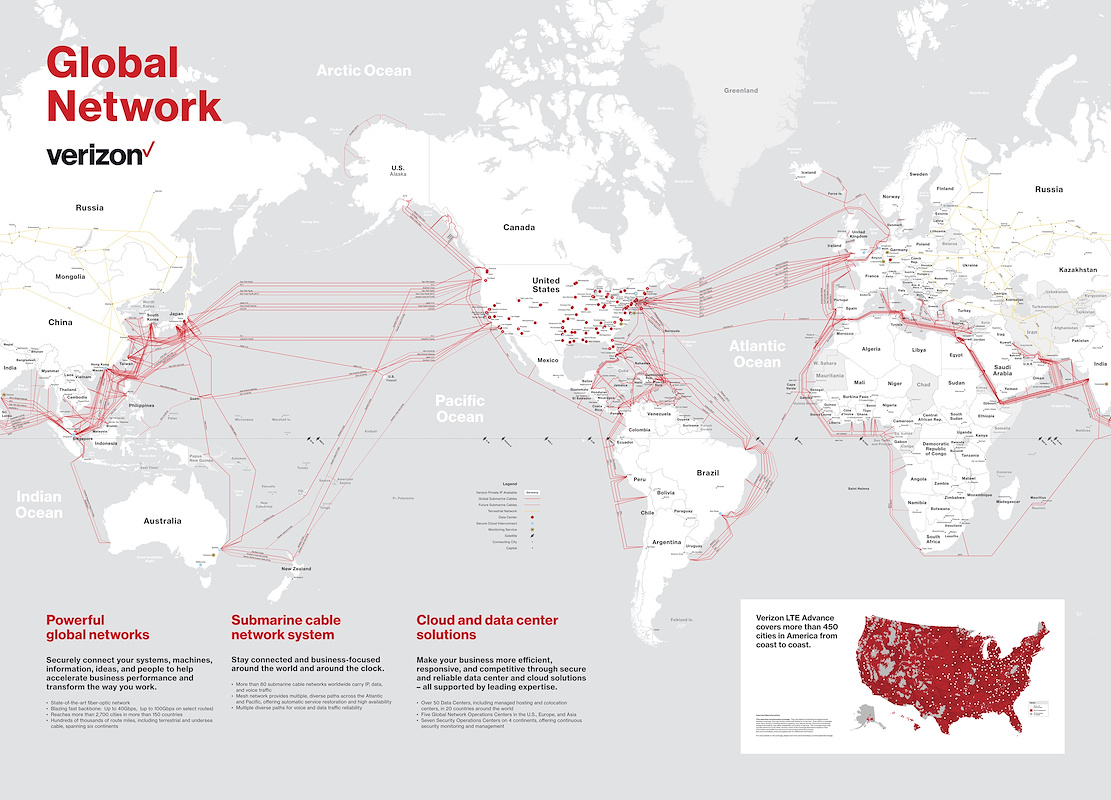
Verizon Business has a wide reach, with a network that spans 39 countries. This global footprint is a key advantage for businesses that operate internationally and need service in multiple regions.
In contrast, Comcast Business focuses its services primarily within the United States. This makes it a strong choice for companies with a domestic presence looking for a provider with deep national coverage.
SLA
Both Verizon and Comcast offer a strong 99.99% uptime Service Level Agreement (SLA) for their dedicated and broadband internet services.
This guarantee means your connection should be down for no more than about 52 minutes over the course of an entire year.
If their service doesn't meet this promise, you're typically entitled to a credit on your next bill, making it a key measure of reliability.
Transport Types Available
Verizon Business operates a massive 900,000-mile fiber optic network, delivering service primarily through fiber. This allows for consistent, high-speed connections.
Comcast Business uses a hybrid network of 200,000 fiber miles and coaxial cable. This mix helps them reach many locations, but the connection type can affect performance.
Both offer a range of speeds for different needs. Verizon's fiber provides symmetrical speeds, great for business tasks like video calls. Comcast's network is well-suited for downloading and streaming, though uploads may be slower.
Customer Support
When it comes to customer support, both Verizon and Comcast offer multiple ways to get help. You can reach them through online portals, phone calls, and dedicated support teams.
Verizon Business often assigns dedicated account managers to its enterprise customers. This gives larger businesses a single point of contact for handling issues and managing their services.
Comcast Business provides support that's easy to access for businesses of all sizes. Their online tools and customer service lines are set up to help you solve problems quickly.
Final Verdict: Verizon Business or Comcast Business?
Choosing between Verizon and Comcast really comes down to your company's specific needs, location, and priorities.
Verizon is often the stronger choice for international businesses or companies that require the symmetrical speeds of a pure fiber connection. Our data shows they tend to be more cost-effective for 1 Gbps dedicated internet.
Comcast is a solid option for US-based businesses, particularly those who can benefit from its bundled security and voice products. It's often more competitive for 100 Mbps dedicated circuits and typically delivers service directly to your suite.
To make things even simpler, here’s a quick side-by-side look at how Verizon and Comcast compare on the key features we've discussed.
Choose the Right ISP Today With Lightyear
Ultimately, the decision between providers like Verizon and Comcast depends on your specific business requirements. Making the right choice requires clear, objective data on pricing, installation times, and service availability for your locations. Our platform is built to give you that clarity, helping you confidently compare options for your exact needs.
Lightyear helps you move from comparison to decision by centralizing the procurement process. Here’s how:
- Automated ISP Procurement: We digitize the RFP process, using the largest proprietary pricing dataset to show you best-fit providers and benchmarked rates side by side.
- Transparent Pricing & Negotiation: Our platform proactively negotiates quotes down if they don’t align with market benchmarks, ensuring you never overpay.
If you're ready to simplify your telecom procurement, schedule a demo to see how Lightyear can help.
Let us show you the product and discuss specifics on how it might be helpful.
Schedule a Demo





Revolutionize Your Telecom Experience
Learn how you can get one step closer to optimal business efficiency for all your telecom services.