Verizon Business vs Frontier Communications: Which ISP?
Choosing between two major business ISPs? We compare network, services, and pricing for Verizon and Frontier to help you decide.


Verizon Business and Frontier Communications are two of the most prominent internet service providers available to businesses today. To help you find the right fit for your company, we're comparing them directly on the points that matter most.
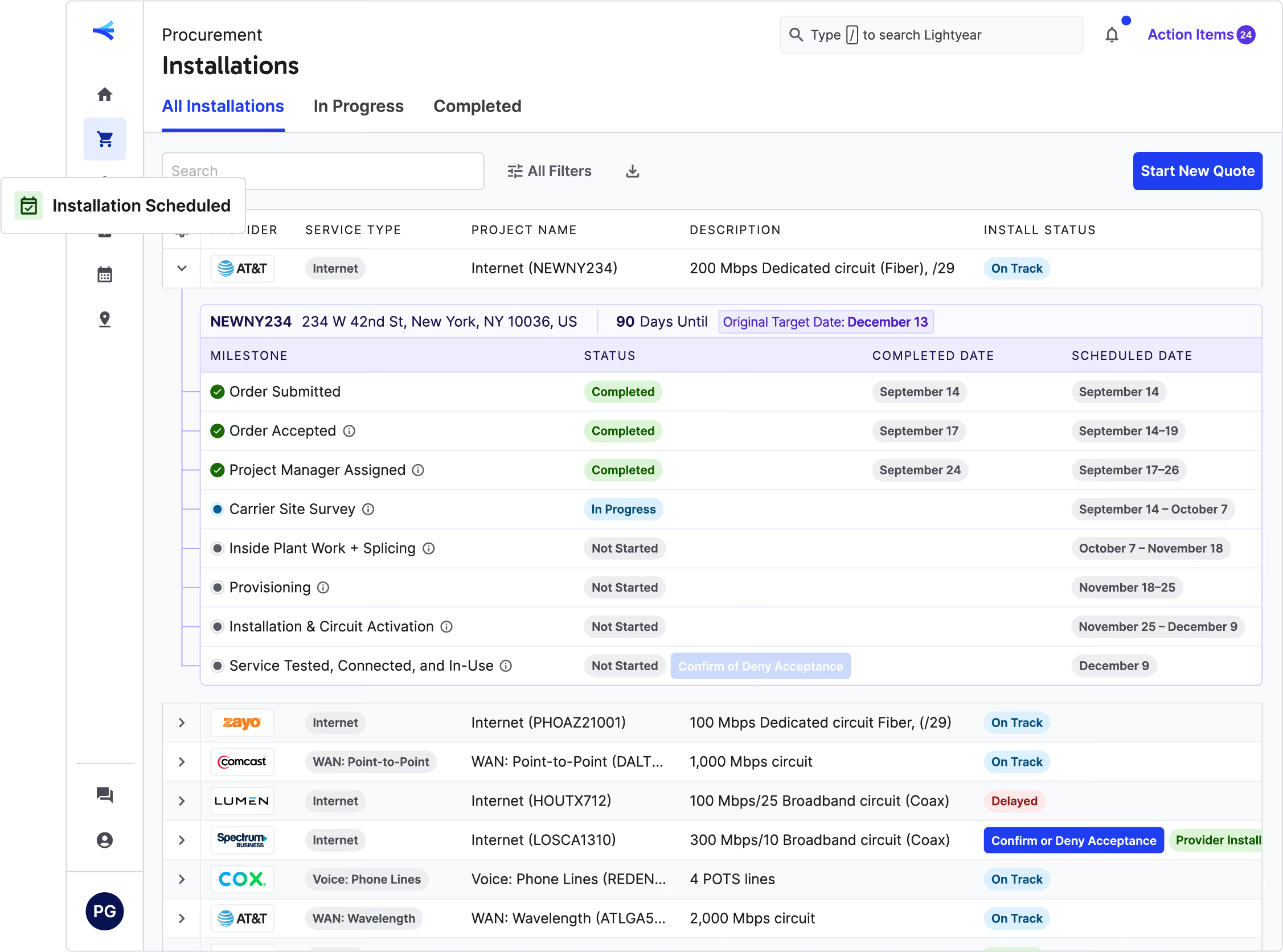
Our comparison leverages Lightyear's proprietary data, drawing on aggregated benchmarks for pricing, installation timelines, and delivery points from over 70,000 ISP quotes.
Keep reading for our detailed breakdown. Or, if you're ready to explore provider options, you can begin our questionnaire to receive real-time quotes.
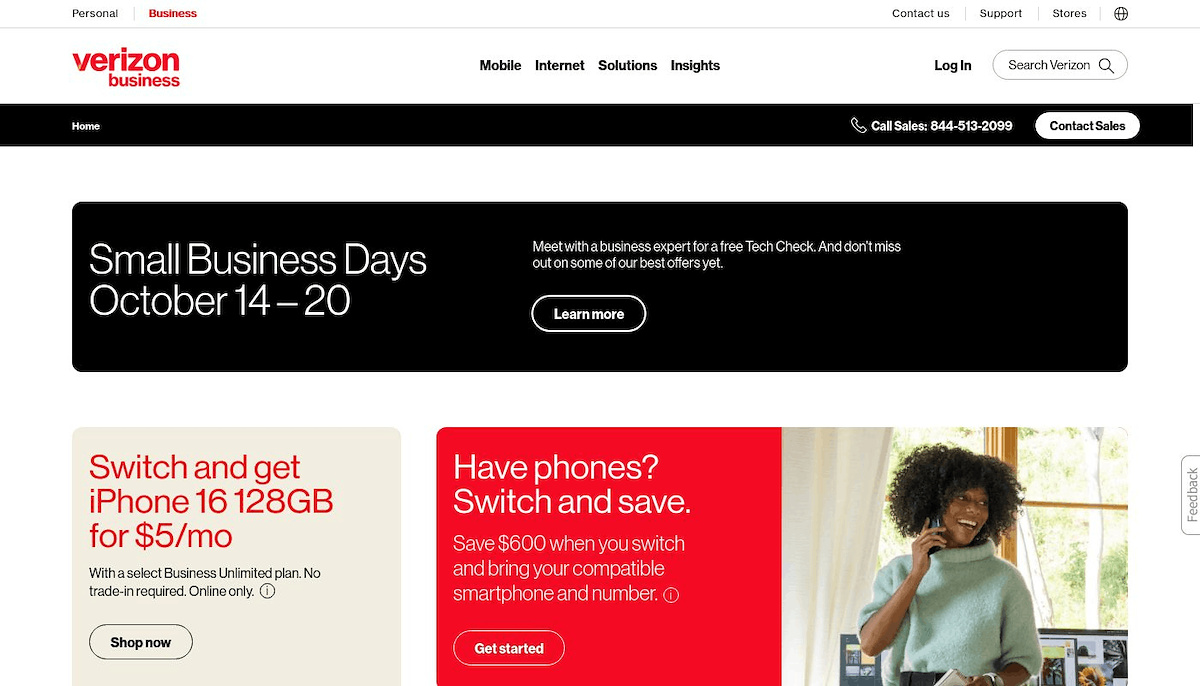
Overview of Verizon Business
Founded in 2000, Verizon Business is a major player in the telecommunications industry, headquartered in New York, New York. The company employs over 105,000 people, holds the 31st spot on the Fortune 500 list, and operates in 39 countries.
Verizon Business provides services for a wide range of customers, from small businesses to large enterprises and public sector organizations. They are known for their work in private 5G networks and have received industry recognition for network reliability and private mobile network services.
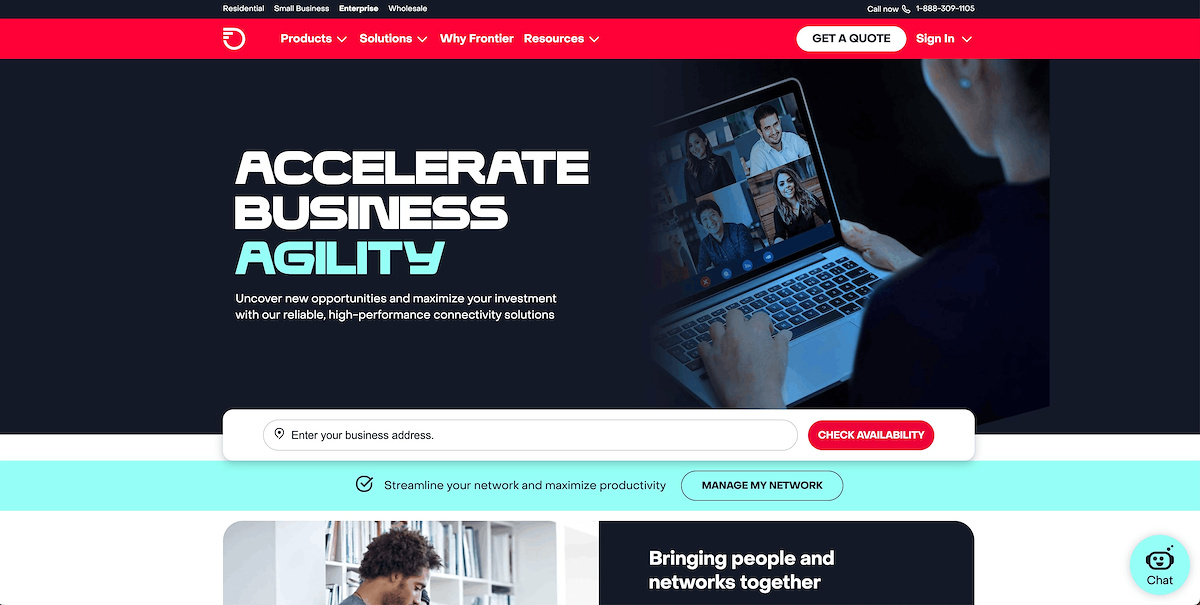
Overview of Frontier Communications
Frontier Communications has a long history, with corporate roots that trace back to 1935. The company is headquartered in Dallas, Texas, employs around 13,000 people, and operates across 25 states in the U.S.
The provider focuses on its 100% fiber-optic network, highlighting its 99.9% network reliability. For certain business plans, Frontier offers flexible month-to-month billing instead of long-term contracts.
ISP Products
Dedicated Internet (DIA)
Both Verizon and Frontier offer robust Dedicated Internet Access (DIA) products built on their respective fiber networks. Verizon's DIA product provides speeds from 10 Mbps to 100 Gbps, while Frontier's enterprise DIA offers a similar range from 5 Mbps to 100 Gbps. Both providers guarantee high reliability with a 99.99% uptime Service Level Agreement (SLA) and offer a suite of add-ons like managed routers and security.
Based on Lightyear's proprietary data, Frontier is often more competitive on price, with its 100 Mbps and 1 Gbps circuits priced 12% and 11% below the market average, respectively. In comparison, Verizon's pricing is 3% above average for 100 Mbps and 7% below average for 1 Gbps. Installation timelines are similar, with Frontier matching the 77-day industry average and Verizon coming in slightly longer at 80 days.
Keep in mind that these pricing and installation figures are aggregate benchmarks.
Actual timelines and costs can vary significantly based on your specific location and the DIA configuration you need.
For an exact comparison of Verizon Business, Frontier Communications, and other top ISPs for your desired area, we invite you to fill out our questionnaire.
It uses the most comprehensive data set in the industry to generate accurate, real-time quotes for your business.
DIA Pricing, Delivery and Install Days Compared
The data in this table comes from Lightyear’s aggregated ISP quotes collected in 2024 and 2025 YTD.
- Install Days: how long it typically takes to deliver service.
- 100Mb Price vs Avg / 1Gb Price vs Avg: shows whether this ISP is cheaper or more expensive than the market average.
- Delivery Point: “Suite” means the ISP delivers service all the way to the company’s server room; “MPOE” means the circuit stops at the building’s minimum point of entry (typically the building's utility basement) and the tenant must handle the inside wiring.
Wireless
Verizon Business is a major mobile network operator, offering primary wireless internet through its 5G and LTE Business Internet plans. These services are designed to be the main connection for a business, available for fixed locations or mobile use across the US and parts of Canada and Mexico.
Frontier takes a different approach. The company does not offer a standalone wireless internet product for primary connectivity, instead providing managed cellular failover as an add-on to its other network services.
This failover solution acts as a backup, automatically switching your connection to a cellular network if your primary internet line goes down. This ensures business continuity, but it's important to note that it's not intended to be the main source of internet for a business location.
Security
Verizon Business offers a broad portfolio of security products that can be purchased as standalone solutions or managed services. Their offerings range from network protection like DDoS Shield to advanced frameworks like SASE Management and Zero Trust Dynamic Access. The company also provides specific tools for mobile security, including Mobile Device Management and threat defense.
Frontier Communications, on the other hand, integrates security as a managed add-on to its connectivity products. Customers can add basic or advanced security bundles to their Dedicated Internet service. These packages include foundational security features such as a firewall, web filtering, and remote user VPN, all supported by Frontier's 24/7 monitoring and management.
Broadband
Both providers offer fiber-based business broadband with unlimited data. Verizon's Fios Internet provides symmetrical speeds up to 2 Gbps and includes a 99.99% uptime guarantee. Lightyear data shows Verizon's broadband pricing is about 5% below the market average, with a typical installation time of 24 days—four days faster than the industry average of 28 days.
Frontier’s Business Fiber offers symmetrical speeds that can reach up to 7 Gbps in select markets, backed by 99.9% network reliability. Due to limited quoting history for this specific product, we’re not able to provide benchmark pricing or installation timelines at this time.
To see the most current pricing and availability from Frontier, Verizon, and other providers for your address, you can get real-time quotes through our questionnaire.
Ethernet
Frontier Communications offers a formal Carrier Ethernet product line for its enterprise and wholesale customers. This includes MEF-compliant Ethernet Private Line (EPL) and Ethernet Virtual Private Line (EVPL) services, as well as optical transport solutions with speeds up to 100 Gbps.
Verizon Business provides high-speed connectivity over its fiber network with symmetrical speeds that can go up to 2 Gbps. These services feature a 99.99% uptime guarantee and unlimited data, making them a strong choice for businesses needing dependable, high-throughput connections.
While Frontier's offering is explicitly defined as Carrier Ethernet for point-to-point or multi-point connections, Verizon's fiber product provides very high-speed internet access suitable for a wide range of business applications.
POTS Replacement
Frontier Communications offers a direct solution called POTS Connect for its enterprise customers. This product is designed to replace traditional analog lines for services like alarms, faxes, and elevators, delivering a digital service over an LTE or wired connection. It also includes wireless (LTE) failover to maintain service during an outage.
Verizon Business takes a different approach, as it does not have its own dedicated POTS replacement product. Instead, Verizon directs customers to third-party partners who specialize in solutions for life and safety lines. For example, their POTS upgrade guide suggests partners like CSG or MarketSpark for these services.
This distinction is important for IT buyers. Choosing Frontier means getting a single, provider-managed solution, while the Verizon path involves coordinating with a separate vendor. For critical applications like fire alarms, it's also crucial to confirm that any solution is compliant with codes like NFPA 72.
Other Key Features Compared
Geographic Coverage
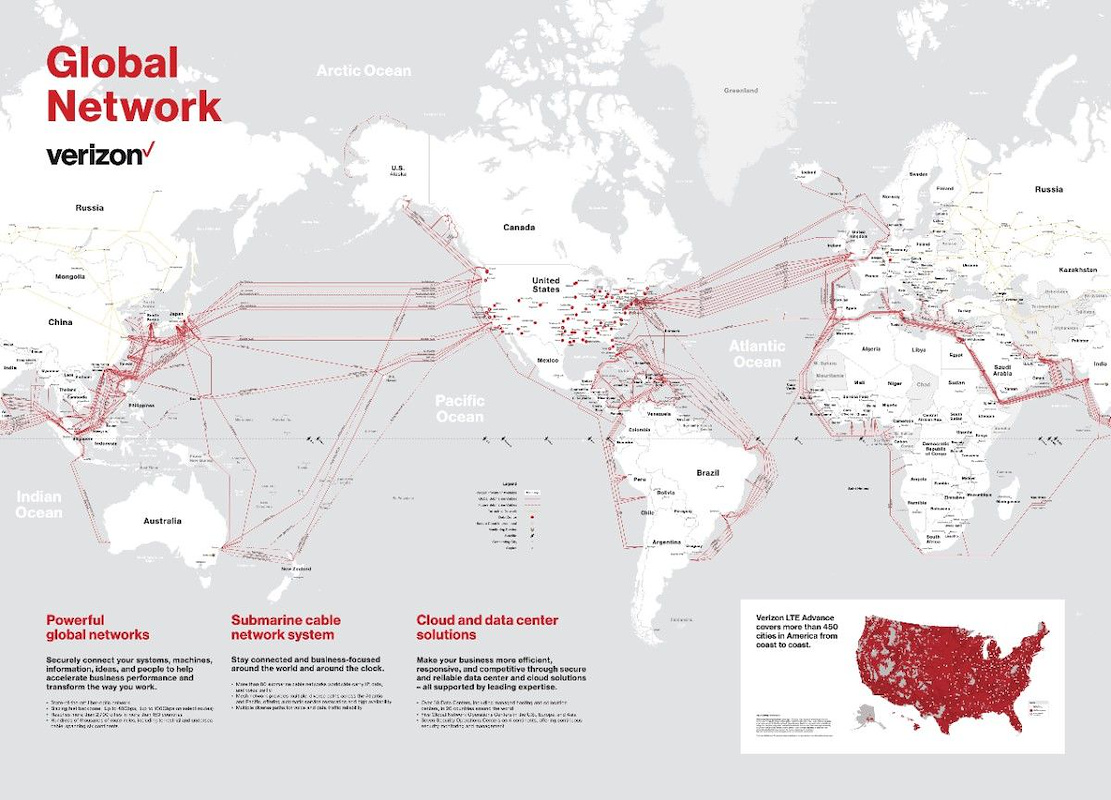
Verizon Business has a wide reach, operating in 39 countries. This makes them a solid choice for international companies that need consistent service across different locations.
Frontier Communications, in contrast, concentrates its operations entirely within the United States. Their network covers 25 states, which is ideal for companies with a national, rather than international, presence.
SLA
Both Verizon and Frontier offer strong uptime guarantees, known as Service Level Agreements (SLAs), for their key business products. For their Dedicated Internet Access (DIA) services, both providers promise 99.99% uptime, while Verizon extends this to its Fios broadband as well.
So, what does 99.99% uptime actually mean? It translates to a maximum potential downtime of just under 53 minutes over an entire year, which is a very high standard of reliability.
Frontier’s general fiber network is advertised with 99.9% reliability. While still dependable, this allows for more downtime—about 8.77 hours per year—making the "four nines" of a 99.99% SLA a significant step up for businesses that need constant connectivity.
Transport Types Available
Verizon Business primarily uses its own extensive fiber network, which spans over 900,000 route miles. This massive infrastructure allows them to offer a wide variety of speeds, from basic broadband to high-capacity dedicated internet suitable for any business.
Frontier Communications also operates its own fiber network, covering 180,000 route miles. While smaller, this network supports very high speeds, with some business fiber plans reaching up to 7 Gbps in certain areas.
Both providers offer speeds that can handle anything from daily tasks to heavy data use. Their dedicated internet products can scale up to 100 Gbps, providing powerful connectivity for large enterprises.
Customer Support
Verizon Business provides customer support for different business sizes. They have dedicated teams for small, medium, and large enterprise customers, so you get help that's right for your company's scale.
Frontier Communications offers 24/7 support for its business customers. Their support is often tied directly to their managed services, providing help whenever you need it.
The right choice really depends on your needs. Verizon offers a layered support structure for different business types, while Frontier provides around-the-clock monitoring for its core services.
Final Verdict: Verizon Business or Frontier Communications?
Ultimately, the right choice between Verizon Business and Frontier Communications comes down to your company’s geographic footprint and specific technical needs.
Verizon is an excellent option for international corporations that need a single provider across multiple countries. Its broad portfolio of standalone security products also makes it a good fit for businesses that want to purchase advanced security solutions separately from their connectivity.
Frontier is a compelling choice for US-based companies, especially those looking for competitive pricing on Dedicated Internet Access. It's also the go-to provider if you need a direct, integrated solution for replacing legacy POTS lines for alarms or elevators.
To help you see the differences at a glance, here’s a quick summary of how Verizon Business and Frontier Communications stack up.
For a detailed quote that compares these providers and others at your specific business locations, the best next step is to use Lightyear’s procurement platform. You can get started here.
Choose the Right ISP Today With Lightyear
Choosing between providers like Verizon and Frontier ultimately comes down to your company’s unique needs, from geographic footprint to technical requirements. Making the right decision can be a complex process, but you don't have to do it alone.
The Lightyear platform was built to bring clarity to telecom procurement. We give you the data and tools to confidently select the right services. Our software helps by:
- Automating procurement: We replace the traditional RFP process with a data-driven platform that shows you quotes from best-fit providers next to market benchmarks.
- Securing fair pricing: Our system automatically flags quotes that are above market rates, and we proactively negotiate them down for you.
- Centralizing your options: Compare DIA, broadband, 5G, and more from all available providers in a single, easy-to-use interface.
If you're ready to simplify how you source and manage your network services, we can help. Schedule a demo to see the platform in action.
Let us show you the product and discuss specifics on how it might be helpful.
Schedule a Demo





Revolutionize Your Telecom Experience
Learn how you can get one step closer to optimal business efficiency for all your telecom services.