Verizon Business vs Granite: Which ISP Is Better?
Deciding between Verizon Business and Granite? We compare their networks, services, and support models to help you find the right fit.


When sourcing business internet, you'll likely encounter major providers like Verizon Business and aggregators like Granite Communications. Both offer a wide range of connectivity services, but they operate on different models that can impact your procurement and management experience.
To help you decide which is a better fit for your business, we're comparing them based on Lightyear's proprietary data. Our analysis draws from over 70,000 real-world ISP quotes, giving us a unique view into benchmarks like pricing, installation timelines, and service delivery.
Keep reading for our detailed comparison of Verizon Business and Granite. If you're ready to explore provider options for your specific needs, you can begin our questionnaire to receive real-time quotes.
Overview of Verizon Business
Verizon Business is the enterprise-focused division of Verizon, a telecommunications company founded in 2000. Headquartered in New York, New York, it operates in 39 countries.
As a large-scale provider, it has 105,000 employees and currently ranks 31st on the Fortune 500 list.
The company provides solutions tailored to different business sizes and emphasizes its network performance, which has been noted by industry analysts. They are also involved in developing newer technologies like private 5G networks and AI-powered business tools.
Overview of Granite
Granite, founded in 2002, is a telecommunications aggregator based in Quincy, Massachusetts. While not a Fortune 500 company, it serves over 85 Fortune 100 clients.
With a team of 2,200 employees, Granite operates in the United States and Canada. The company manages a significant portfolio, servicing 700,000 locations and 1.75 million voice and data lines.
A key part of its model is a focus on innovation through its Granite Labs division. This is paired with a strong emphasis on customer service to manage complex telecom needs.
ISP Products
Dedicated Internet (DIA)
Verizon offers its own Dedicated Internet Access product directly over its vast 900,000-mile fiber network, with a standard 99.99% uptime SLA. They provide a wide spectrum of speeds, from 10 Mbps up to 100 Gbps. Based on Lightyear's data, Verizon's 1Gbps DIA pricing is competitive at 7% below the market average, while installations take approximately 80 days, slightly longer than the 77-day industry average.
Granite operates differently as an aggregator, sourcing DIA from multiple carriers through its Granite AccessExpress service. This means available speeds depend on the underlying provider at a given location. For its own on-net services, Granite provides a 99.99% uptime SLA, but off-net performance will align with the carrier partner being used.
The primary benefit of Granite's model is faster service delivery, with an average installation time of 72 days. However, this convenience comes at a price premium; our data shows Granite's 1Gbps DIA pricing is 21% higher than the market average, reflecting the value of their consolidated billing and management layer for multi-location businesses.
Keep in mind these figures are averages; actual pricing and installation timelines can differ based on your specific location and service configuration. For a precise, side-by-side comparison of Verizon Business, Granite, and other top providers for your business addresses, we recommend you fill out our questionnaire to receive quotes built on the industry's most comprehensive dataset.
DIA Pricing, Delivery and Install Days Compared
"Install Days" means the time to deliver service, "100Mb Price vs Avg" and "1Gb Price vs Avg" indicate whether the provider is more or less expensive than the market average, and "Delivery Point" defines whether the provider completes the inside wiring or leaves it to the tenant.
The data in this table comes from Lightyear’s aggregated ISP quotes collected in 2024 and 2025 YTD.
- Install Days: how long it typically takes to deliver service.
- 100Mb Price vs Avg / 1Gb Price vs Avg: shows whether this ISP is cheaper or more expensive than the market average.
- Delivery Point: “Suite” means the ISP delivers service all the way to the company’s server room; “MPOE” means the circuit stops at the building’s minimum point of entry (typically the building's utility basement) and the tenant must handle the inside wiring.
Wireless
Verizon Business provides wireless services directly through its own network, offering multiple 5G and LTE Business Internet plans. These services support phones, personal devices, and fixed or mobile base stations across the US, as well as parts of Canada and Mexico.
In contrast, Granite operates as a multi-carrier aggregator for its wireless solutions. The company provides managed mobility, fixed wireless access, and multi-carrier SIMs by sourcing service from various underlying providers in the US and Canada. This means their 5G and LTE offerings depend on the carrier available at a specific location.
The primary difference is in the delivery model. With Verizon, you get service directly from the network owner. With Granite, you get a managed solution that can combine services from different carriers, which is ideal for businesses needing diverse coverage under a single point of contact for billing and support.
Security
Verizon Business offers a comprehensive security portfolio covering network, cloud, and mobile environments. Their offerings include specific products like SASE Management and DDoS Shield, alongside managed options such as managed threat detection. This approach allows businesses to choose from a wide menu of security tools directly from the network owner.
In contrast, Granite’s security offerings are integrated with its core managed services as an aggregator. The company provides managed SASE and SD-WAN platforms, which include security policy orchestration across the different underlying carriers a business might use. This is designed for businesses that want a single point of contact to manage security across a multi-provider environment.
Broadband
Verizon Business provides its Fios Internet service directly over its own fiber network, offering symmetrical speeds up to 2 Gbps and a 99.99% uptime guarantee. Lightyear's data shows their broadband pricing is 5% below the market average, and installations are faster than typical, averaging 24 days compared to the 28-day industry standard.
Granite operates as a managed aggregator, offering its Broadband (Granite Access) solution by sourcing service from various carriers. This means available speeds (up to 5 Gbps), transport types, and uptime SLAs are all dependent on the underlying provider at a given location. This model offers flexibility but comes at a premium.
Our data indicates Granite's broadband pricing is 29% higher than the market average, with a longer installation timeline of 41 days. The primary advantage is simplified management, providing a single point of contact for businesses that need to coordinate broadband services from multiple carriers across different locations.
Broadband Pricing, Delivery and Install Days Compared
The data in this table comes from Lightyear’s aggregated ISP quotes collected in 2024 and 2025 YTD.
- Install Days: how long it typically takes to deliver service.
- 500mb Price vs Avg: shows whether this ISP is more expensive than the market average.
- Delivery Point: “Suite” means the ISP delivers service all the way to the company’s server room; “MPOE” means the circuit stops at the building’s minimum point of entry (typically the building's utility basement) and the tenant must handle the inside wiring.
Ethernet
Verizon Business provides Ethernet services directly over its own extensive fiber network. This approach gives businesses a single point of contact for a service that runs entirely on Verizon's infrastructure, from end to end.
Granite, in contrast, delivers its Ethernet solutions as a managed aggregator. The company sources Dedicated and Carrier Ethernet from various underlying network partners, which means service availability is location-dependent.
This model is designed to simplify procurement for multi-location businesses by consolidating services from different providers onto a single platform, Granite360, for ordering and management.
POTS Replacement
Verizon Business does not offer a dedicated POTS replacement product. Instead, the company directs customers to partners for solutions that can handle specialty lines like fax, alarms, and elevators.
They provide guidance on upgrading from traditional phone service but rely on third parties for the actual hardware and service.
Granite, on the other hand, provides its own solution called Granite EPIK. This product is specifically designed as a POTS replacement for life-safety and specialty analog lines, and it is compliant with National Fire Protection Association (NFPA) 72 standards. The solution includes features like LTE failover and internal battery backup, making it a comprehensive option for critical systems.
Other Key Features Compared
Geographic Coverage
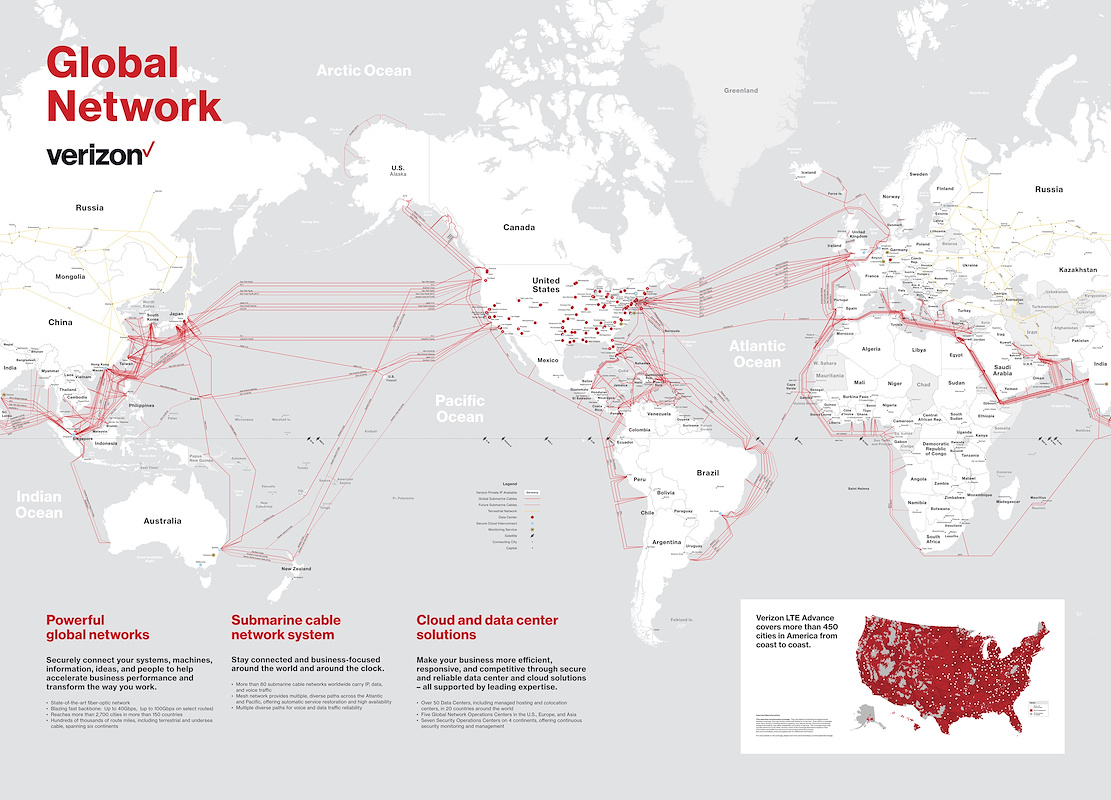
Verizon Business has a large global footprint, offering services in 39 countries. This makes them a solid choice for international companies that need consistent connectivity across multiple regions.
Granite's services are available in the United States and Canada. Since they work with many providers, there isn't one single coverage map. Instead, they check availability for each location using their AccessExpress platform.
SLA
Verizon Business offers a standard 99.99% uptime Service Level Agreement (SLA) for its direct fiber services. This is a promise of reliability for products like their Dedicated Internet and Fios.
Granite’s SLA works differently. Since they bring together services from many providers, the uptime guarantee you get will match that of the underlying carrier at your specific location.
In practical terms, a 99.99% uptime SLA means your service could be down for less than one hour over an entire year, giving you a clear expectation of network availability.
Transport Types Available
Verizon Business offers a wide range of speeds, from 10 Mbps to 100 Gbps, delivered directly over its own 900,000-mile fiber network. This supports everything from daily business operations to high-demand applications.
As an aggregator, Granite’s available speeds depend on the underlying carrier at your specific location. They don’t operate their own fiber routes, instead sourcing service from various providers to offer flexibility.
This makes Verizon a strong choice for consistent, high-speed service, while Granite is ideal for businesses wanting to manage options from multiple carriers through a single contact.
Customer Support
Verizon Business provides customer support through its own large, in-house teams. When you need help, you are speaking directly with the company that owns and operates your network service.
Granite’s model is different. As an aggregator, they provide a single point of contact for all the services they manage for you, even if those services come from different underlying carriers.
This means with Granite, you make one call for any issue, which can simplify support management for businesses using multiple providers across various locations.
Final Verdict: Verizon Business or Granite?
Choosing between Verizon Business and Granite depends entirely on your business's specific needs and priorities. The fundamental difference is that Verizon is a direct network provider, while Granite is an aggregator that bundles services from multiple carriers into one managed package.
Verizon is often a strong choice for businesses that want competitive pricing on high-speed circuits and prefer to work directly with the network owner. Their extensive global footprint also makes them a solid option for international companies.
On the other hand, Granite is ideal for multi-location businesses in the US and Canada that value simplified management above all else. They provide a single point of contact for procurement, billing, and support across various underlying carriers, though this convenience typically comes at a price premium.
Ultimately, your decision hinges on whether you prioritize the potential cost savings of a direct provider or the operational simplicity of a managed aggregator.
To help you see the differences at a glance, here’s a quick summary of how Verizon Business and Granite compare based on the data we've covered.
Choose the Right ISP Today With Lightyear
Deciding between a direct provider like Verizon and an aggregator like Granite comes down to what your business values most. If you're looking for a data-driven way to make that choice, Lightyear's software can give you the clarity you need. Our platform helps by:
- Automating ISP Procurement: We digitize the RFP process, using the largest proprietary pricing dataset in enterprise telecom to show you best-fit providers and benchmarked rates side by side.
- Offering Transparent Pricing: Lightyear proactively negotiates quotes down if rates don’t align with market benchmarks, so you don't overpay.
- Providing Human and Software Support: Our dedicated account reps oversee installs and escalate issues, so you’re not left alone to manage providers.
Instead of spending weeks gathering quotes and comparing options manually, you can use our platform to find the right services at the right price. To see how Lightyear can simplify your telecom procurement and management, schedule a demo with our team.
Let us show you the product and discuss specifics on how it might be helpful.
Schedule a Demo





Revolutionize Your Telecom Experience
Learn how you can get one step closer to optimal business efficiency for all your telecom services.