Verizon Business vs Zayo: Which ISP Is Better?
Choosing an ISP? We compare Verizon Business and Zayo on network performance, services, and pricing to help you find the right fit for your business.


Verizon Business and Zayo are two of the most prominent internet service providers for enterprises today. While both offer high-performance connectivity, they have distinct network footprints and service specialties.
Choosing between them can be a complex decision for any IT leader. Our goal is to clarify their differences to help you find the right fit for your business needs.
This comparison is built on our own proprietary data from over 70,000 real-world ISP quotes. We analyze aggregated benchmarks on pricing, installation timelines, and service delivery points to give you a clear picture of the market.
Keep reading for our detailed comparison of Verizon Business and Zayo. If you're ready to explore provider options, you can begin our questionnaire to receive real-time quotes.
Overview of Verizon Business
Verizon Business was founded in 2000 and is based in New York, New York. With over 105,000 employees and a rank of 31 on the Fortune 500 list, it is a major telecommunications provider with a presence in 39 countries.
The company offers solutions for a wide range of customers, from small businesses to large enterprises and public sector organizations. It is also known for its work in advanced technology, such as private 5G networks, AI-powered assistants, and IoT sensor management.
Overview of Zayo
Zayo was founded in 2007 and is headquartered in Boulder, Colorado. The company operates in 35 countries with a team of around 3,500 employees.
Zayo positions itself as a modern alternative to traditional network providers, focusing on simplifying network management. They give customers direct control over their network solutions through Zayo's own infrastructure.
A key part of their approach is a network-as-a-service (NaaS) platform called DynamicLink. This tool allows customers to design and deploy their own network solutions through a self-service portal.
ISP Products
Dedicated Internet (DIA)
Verizon's Dedicated Internet Access offers a broad spectrum of speeds, from 10 Mbps to 100 Gbps, backed by a 99.99% uptime SLA and an extensive 900,000-mile fiber network. In comparison, Zayo's DIA product focuses on higher bandwidths from 100 Mbps to 100 Gbps over its 146,000-mile network. Zayo's service level objectives start at 99.9% availability, with contractual SLAs defined per agreement.
Based on our proprietary data, installation timelines for both providers are slightly longer than the 77-day market average for DIA, with Verizon at 80 days and Zayo at 89 days. Pricing also shows interesting trends; for 100 Mbps circuits, both providers are priced slightly above average. However, at the 1 Gbps level, both become more competitive, with Verizon's pricing typically 7% below average and Zayo's 2% below average.
It's important to note that these are aggregate figures. Actual installation times and pricing can vary based on your location and specific circuit configuration.
For a precise comparison of Verizon Business, Zayo, and other top ISPs for your business needs, fill out our questionnaire. You'll get real-time quotes based on the most comprehensive data set in the industry.
DIA Pricing, Delivery and Install Days Compared
The data in this table comes from Lightyear’s aggregated ISP quotes collected in 2024 and 2025 YTD.
- Install Days: how long it typically takes to deliver service.
- 100Mb Price vs Avg / 1Gb Price vs Avg: shows whether this ISP is cheaper or more expensive than the market average.
- Delivery Point: “Suite” means the ISP delivers service all the way to the company’s server room; “MPOE” means the circuit stops at the building’s minimum point of entry (typically the building's utility basement) and the tenant must handle the inside wiring.
Wireless
The two companies serve entirely different roles in the wireless market. Verizon Business provides 5G and LTE Business Internet plans directly to companies across the US, Canada, and Mexico. In contrast, Zayo does not offer wireless services to business customers; it provides the foundational fiber backhaul and connectivity that wireless carriers use to build their networks.
This distinction makes the choice clear for IT buyers. If you need a primary or backup wireless internet connection for a fixed or mobile site, Verizon is the direct provider. Zayo operates further up the supply chain, making it a partner to carriers rather than a direct competitor to them in the enterprise wireless space.
Security
Verizon Business provides a comprehensive suite of security services that extend far beyond basic network protection. Their offerings include modern frameworks like Zero Trust Dynamic Access and SASE management. They also provide managed services such as Managed Detection and Response and advanced SOC support, acting as a full-service security partner.
Zayo, on the other hand, concentrates its security efforts on protecting network integrity. Their core offering is Zayo DDoS Protection, a service that monitors for and mitigates distributed denial-of-service attacks at the network edge to keep your connection stable.
This creates a clear distinction for IT leaders. If your organization is looking for a provider to manage a wide array of security functions, from endpoint protection to cloud security, Verizon has a solution. If your primary need is a robust defense against DDoS attacks that could disrupt your internet connectivity, Zayo offers a specialized tool for that purpose.
Broadband
Verizon Business offers broadband through its Fios Internet service, providing symmetrical fiber speeds from 200 Mbps up to 2 Gbps with a 99.99% uptime guarantee. Our data shows Verizon's broadband installation time is 24 days, slightly faster than the 28-day market average. Pricing is also competitive, typically coming in 5% below the average.
Zayo also provides broadband internet, though it is not their primary focus compared to their DIA services. Due to a limited quoting history for their broadband product in our database, we’re not able to provide benchmark pricing or installation timelines at this time. To find the latest pricing for your location, you can get a new quote by filling out our questionnaire.
Ethernet
Zayo provides dedicated Layer 2 Ethernet services, including Ethernet Private Line (EPL), EVPL, and E-LAN. These solutions are designed for creating private, high-capacity connections between business sites across North America and Europe.
Verizon, by contrast, offers its Fios service, which is a fiber-based broadband internet product. It delivers high-speed internet access to a business location, differing from the private, point-to-point or multi-point connectivity of Zayo's MEF-style Ethernet offerings.
This means the choice depends entirely on your use case. Zayo is the fit for building a private network between multiple locations, while Verizon Fios is a competitive solution for direct internet access.
POTS Replacement
Neither Verizon Business nor Zayo offers a first-party product for replacing Plain Old Telephone Service (POTS). Verizon instead guides customers toward partners for specialized lines like fax, alarms, and elevators, as detailed in their guide to upgrading telephone service.
Zayo’s focus remains on its core IP and data services, including SIP trunking for voice, and it does not provide a branded POTS replacement product. For IT buyers, this means a third-party specialist is necessary for POTS lines, but Verizon offers a more structured referral path to find one.
Other Key Features Compared
Geographic Coverage
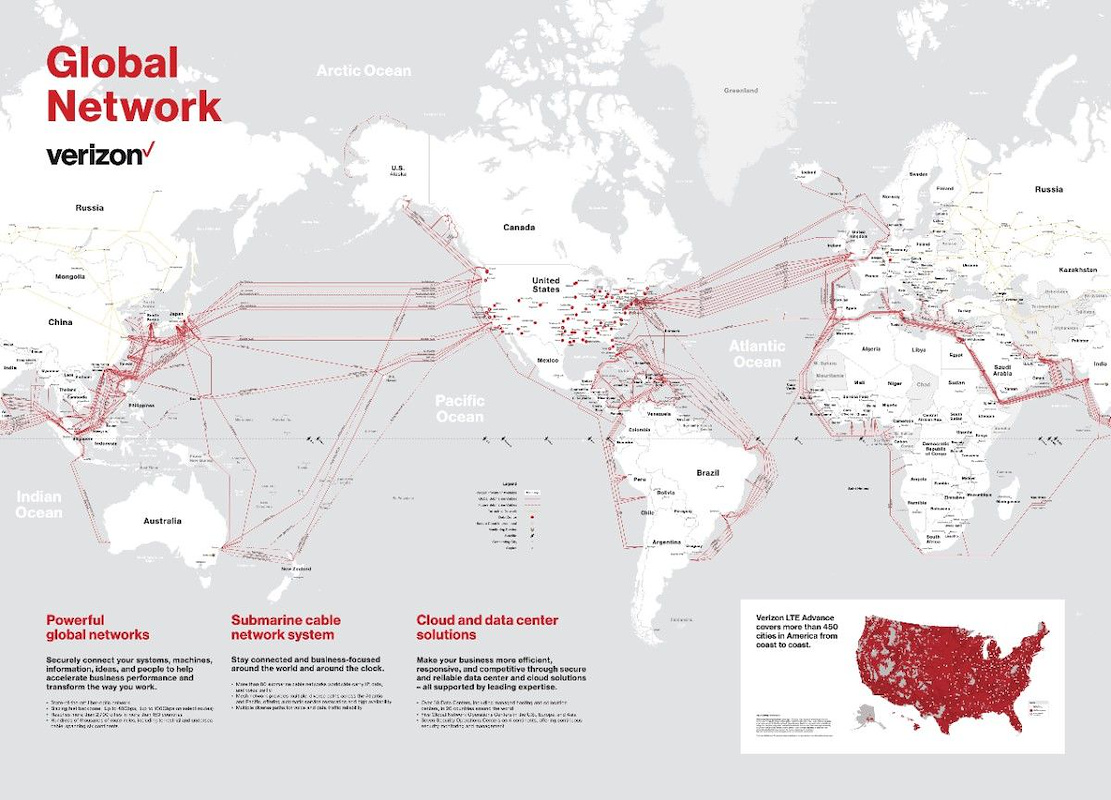
Verizon Business has a wide reach, with a network that spans 39 countries. This makes them a strong candidate for multinational businesses looking for a single provider across their global offices.
Zayo, on the other hand, operates a network in 35 countries. Their coverage is concentrated in North America and Western Europe, making them a solid choice for businesses with a presence there.
SLA
Verizon Business offers a 99.99% uptime guarantee on its main internet services. In practice, this means your connection should be down for less than one hour over an entire year.
Zayo’s service objectives start at 99.9% uptime, with the final SLA detailed in your contract. This base level allows for almost nine hours of potential downtime per year.
While both are reliable, Verizon's standard guarantee is stricter. For businesses needing constant connectivity, this difference in uptime is an important detail to review.
Transport Types Available
Verizon Business operates on a vast 900,000-mile fiber network, offering a wide array of speeds. This flexibility supports everything from standard business operations to data-heavy tasks.
Zayo provides services over its 144,000-mile fiber network, concentrating on high-speed connections. Their offerings are well-suited for companies that require significant bandwidth for their daily activities.
Essentially, Verizon's broad speed range serves a diverse set of business needs. Zayo, with its focus on higher bandwidth, is a strong choice for data-intensive enterprises.
Customer Support
Verizon Business provides a large, traditional customer support organization. You can expect multiple tiers of service and various contact methods, including a dedicated portal and phone lines for assistance.
Zayo, in contrast, centers its support around its self-service platform. This approach gives you more direct control over your network, with expert teams ready to help when you need them.
For IT buyers, the decision often comes down to what style you prefer: a large, structured support system or a more hands-on, portal-driven experience.
Final Verdict: Verizon Business or Zayo?
Choosing between Verizon Business and Zayo comes down to your company's specific needs. Verizon acts as a full-service telecommunications partner, while Zayo specializes in providing high-capacity network infrastructure.
Verizon is often the better choice for large, global enterprises that want a single provider for a wide array of services, including wireless internet and comprehensive security management. Their extensive network and traditional support structure are well-suited for complex organizational requirements.
In contrast, Zayo is an excellent fit for businesses that prioritize direct control over their network and require high-bandwidth private connectivity, such as Ethernet services. Companies that prefer a modern, self-service platform for network management will find Zayo's approach appealing.
Ultimately, the decision depends on whether you need a broad service partner or a specialized infrastructure provider.
Choose the Right ISP Today With Lightyear
Making the right choice between a comprehensive provider like Verizon and a network specialist like Zayo requires a clear view of your company’s priorities. Once you have defined your technical and business needs, the next step is to find the best provider and pricing for your specific locations.
Lightyear’s software platform was built to make this process data-driven and straightforward. We help you compare your options with real-time, benchmarked data. Our platform helps you:
- Automate ISP Procurement: We digitize the RFP process, showing you best-fit providers and benchmarked rates side by side from the industry's largest proprietary pricing dataset.
- Get Transparent Pricing: Our system proactively negotiates quotes down if they don't align with market data, so you don't overpay.
- Compare All Service Types: Whether you need DIA, broadband, 5G, or colocation, you can see all your connectivity options in one place.
If you're ready to simplify your telecom procurement and find the right services at the right price, schedule a demo of the Lightyear platform.
Let us show you the product and discuss specifics on how it might be helpful.
Schedule a Demo





Revolutionize Your Telecom Experience
Learn how you can get one step closer to optimal business efficiency for all your telecom services.