VPN MPLS vs IPsec: Enterprise Network Solutions
Confused about MPLS vs. IPsec VPNs? This article breaks down the differences in performance, security, and cost for your enterprise network.

Connecting multiple business locations securely and efficiently is a fundamental challenge for any modern enterprise. Two common technologies that address this are Multiprotocol Label Switching (MPLS) and Internet Protocol Security (IPsec) VPNs.
While both can create private, secure networks, they operate differently and offer distinct advantages in terms of performance, cost, and security. This article will break down the key differences to help you decide which approach is the right fit for your organization's network infrastructure.
What is VPN MPLS?
Multiprotocol Label Switching (MPLS) is a networking technology that service providers use to create private, high-performance networks for businesses. Think of it as a private highway system for your company's data, built and managed by a telecom carrier.
An MPLS VPN connects your various office locations into a single, cohesive network. Unlike VPNs that operate over the public internet, all traffic on an MPLS network remains within the provider's private infrastructure. This design offers several distinct characteristics:
- Private and Dedicated: Your data travels over a closed network, completely separate from the public internet, which provides inherent security.
- Quality of Service (QoS): It allows you to prioritize critical applications. This means real-time traffic like voice and video calls can be given precedence to ensure they run smoothly without jitter or lag.
- Guaranteed Performance: Because it's a managed service, providers offer Service Level Agreements (SLAs) that guarantee uptime, latency, and packet delivery.
- Simplified Connectivity: It enables an "any-to-any" traffic pattern, where every site can communicate directly with every other site without complex routing configurations.
What is IPsec?
Internet Protocol Security, commonly known as IPsec, is a secure network protocol suite that authenticates and encrypts data packets sent over an IP network. In simple terms, it creates a secure, private tunnel for your data to travel through the public internet.
Instead of relying on a carrier's private infrastructure like MPLS, IPsec applies a layer of security to your existing internet connections. This approach has its own set of core characteristics:
- Operates Over Public Internet: IPsec VPNs use your standard business internet connections to link sites, which makes it a widely available and generally more affordable option.
- Focus on Encryption: Its main purpose is to secure data in transit. It achieves this through strong encryption protocols that protect data confidentiality and authentication to verify the identity of the communicating devices.
- Creates Secure Tunnels: It establishes a secure connection, often called a "tunnel," between two endpoints (like a branch office and a data center), protecting all data that passes through it.
- Hardware Agnostic: IPsec is a standard protocol that can be configured on most modern routers and firewalls, giving you flexibility in your choice of hardware.
VPN MPLS vs IPsec: Key Differences
When you look closer, the fundamental differences between MPLS and IPsec come down to how they are built, managed, and scaled.
1. Network Foundation
The most basic difference lies in the underlying network. MPLS is a service delivered over a carrier's private, dedicated infrastructure, meaning your data travels on a network completely separate from the public internet.
IPsec, however, is an overlay technology. It functions by creating secure tunnels over the top of existing public internet connections, protecting data as it traverses the open web.
2. Management and Administration
Your IT team's involvement also differs greatly. With MPLS, the provider manages the end-to-end network, including routing, maintenance, and troubleshooting, making it a fully managed service.
Conversely, IPsec VPNs are typically configured, monitored, and managed by your in-house IT staff. This approach offers more direct control but requires internal resources and expertise.
3. Scalability and Deployment Speed
Adding a new site to an MPLS network involves ordering and provisioning a new circuit from the carrier, a process that can take weeks or months.
IPsec is far more agile. A new location can be added to the network as soon as it has an active internet connection, allowing for much faster deployment.
4. Geographic Availability
An MPLS network's reach is defined by the provider's physical footprint. If you need to connect an office in a region the carrier doesn't serve, it can be a significant challenge.
Because it runs over the internet, IPsec has a virtually unlimited geographic reach. It can connect any site anywhere in the world, as long as internet access is available.
Security Features of VPN MPLS and IPsec
While both technologies create private networks, their approach to security is fundamentally different. MPLS relies on network isolation, while IPsec focuses on data encryption.
- MPLS Security: The primary security feature of MPLS is that it operates on a private network, completely separate from the public internet. This isolation inherently protects your data from common external threats. However, it's important to know that MPLS traffic is not encrypted by default. Encryption can be added as a separate service, but the core security comes from being on a closed, provider-managed network.
- IPsec Security: IPsec's main function is to provide security over an insecure network like the internet. It achieves this through a suite of protocols that handle authentication and encryption. It verifies that devices are who they claim to be and encrypts all data in transit, making it unreadable to unauthorized parties. This means security is applied directly to the data itself, rather than relying on the privacy of the underlying network.
Performance and Reliability
When it comes to network performance, the difference between a private, managed service and one that runs over the public internet becomes very clear.
- MPLS Performance: Performance is predictable and backed by provider Service Level Agreements (SLAs). Because traffic travels on a private network, it avoids public internet congestion, resulting in consistent low latency and minimal packet loss.
- IPsec Performance: Performance is entirely dependent on the quality of the underlying public internet connections. It is a "best-effort" service, subject to fluctuations in latency and bandwidth that can affect real-time applications like voice and video.
- MPLS Reliability: Reliability is high, as the carrier manages the network and is contractually obligated to meet uptime guarantees. The network also supports end-to-end Quality of Service (QoS) to prioritize critical data.
- IPsec Reliability: Reliability is tied to the stability of your individual internet service providers. If an internet connection at any site fails, the VPN tunnel to that site goes down. There is no native, end-to-end QoS across the public internet.
Cost Considerations
Cost is often a deciding factor, and the financial models for MPLS and IPsec are quite different. Generally, MPLS carries a higher price tag, while IPsec is seen as the more budget-friendly alternative, though the total cost of ownership can be more complex.
MPLS is a premium, fully managed service. The higher monthly cost covers the private circuit, guaranteed performance via SLAs, and end-to-end management from the provider. This results in a predictable, all-inclusive operational expense.
IPsec VPNs have a lower direct cost because they utilize existing public internet connections. Your primary expense is the internet service itself, which is often significantly cheaper than a dedicated MPLS circuit.
However, IPsec introduces other costs. It requires internal IT resources for initial setup, ongoing monitoring, and troubleshooting. This means you must factor in the cost of your team's time and expertise, as well as any necessary hardware upgrades for your routers or firewalls.
Making the Right Choice for Your Business
Choosing between MPLS and IPsec comes down to your organization's specific priorities. There isn't a one-size-fits-all answer, but a clear understanding of your needs will point you in the right direction.
If your business relies on consistent, high-quality performance for applications like VoIP or video conferencing, MPLS is the stronger choice. Its private network and provider-managed SLAs offer guaranteed reliability that the public internet cannot match.
On the other hand, if your priorities are cost savings, geographic flexibility, and the ability to quickly add new locations, an IPsec VPN is likely the better fit. It provides robust security over standard internet connections, giving you control and agility.
Ultimately, the decision rests on balancing your requirements for performance, security, internal management resources, and budget.
Need Help Managing Your Network? Lightyear Can Help
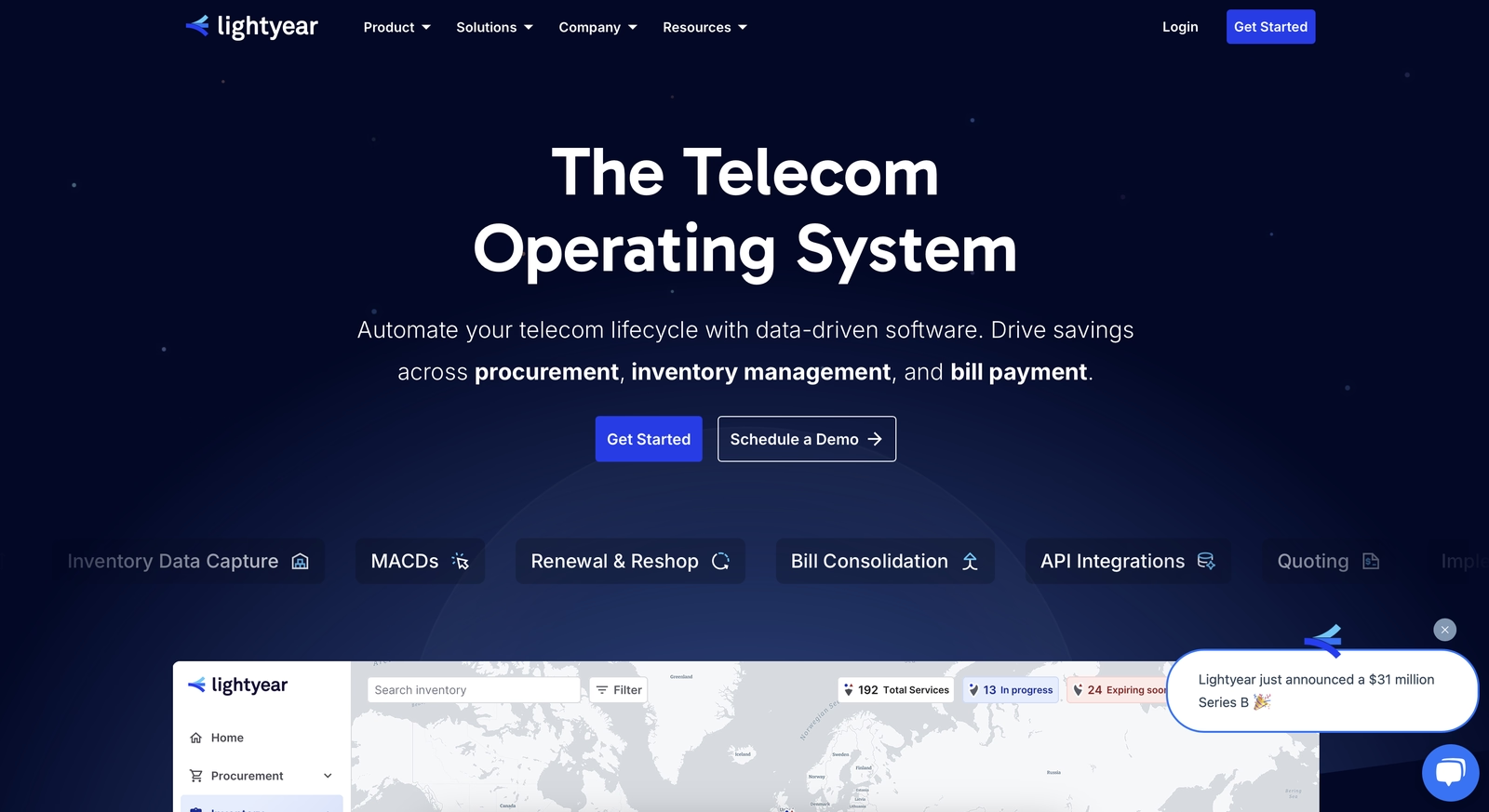
Whether you decide on MPLS, IPsec, or a hybrid approach, Lightyear's platform simplifies the entire process. By automating network service procurement, inventory management, and bill consolidation, we take the pain out of managing your telecom infrastructure.
Hundreds of enterprises trust Lightyear to find the right solutions, achieving over 70% in time savings and 20% in cost savings on their network services.
Schedule a demo or get started with our questionnaire today.
Frequently Asked Questions about VPN MPLS vs IPsec
Can I use MPLS and IPsec together?
Yes, this is often called a hybrid WAN. Many businesses use MPLS for primary sites needing guaranteed performance and IPsec VPNs for smaller branches or as a backup, balancing cost and reliability. This approach offers flexibility for diverse network needs.
Which is better for connecting to the cloud?
Both can connect to cloud services. IPsec is often simpler for direct internet-based cloud access. However, many cloud providers also offer dedicated connections that can be integrated with an MPLS network for private, high-performance access to your cloud environment.
Is MPLS becoming obsolete with the rise of SD-WAN?
Not necessarily. While SD-WAN often uses internet connections, many solutions can run over MPLS circuits. MPLS remains a strong choice for its reliability and guaranteed performance, often forming the underlay for a modern SD-WAN deployment.
Do I need to encrypt traffic on an MPLS network?
MPLS is private but not encrypted by default. While traffic is isolated from the public internet, adding an IPsec encryption layer on top of MPLS is a common practice for organizations that handle highly sensitive data and require end-to-end confidentiality.
Let us show you the product and discuss specifics on how it might be helpful.
Schedule a Demo





Revolutionize Your Telecom Experience
Learn how you can get one step closer to optimal business efficiency for all your telecom services.
