Wavelength vs Frequency Division Multiplexing Explained
Learn the difference between Wavelength (WDM) and Frequency (FDM) Division Multiplexing and which is right for your enterprise network.

In telecommunications, multiplexing is a fundamental technique that allows multiple data streams to travel over a single medium, like a fiber optic cable. This process is key to maximizing the efficiency of network infrastructure.
Two common methods for achieving this are Wavelength Division Multiplexing (WDM) and Frequency Division Multiplexing (FDM). While both technologies increase the capacity of a network, they operate on different principles, making each suitable for different applications.
What is Wavelength Division Multiplexing (WDM)?
Wavelength Division Multiplexing (WDM) is a technology used in fiber optic communications to transmit multiple data streams over a single fiber. It accomplishes this by assigning each data stream to a unique wavelength, or color, of light.
These different light signals travel together through the fiber optic cable at the same time without interfering with one another. At the receiving end, the signals are separated back out, allowing for a massive increase in the fiber's data-carrying capacity.
- Core Medium: WDM operates exclusively over fiber optic cables, using light as the transmission signal.
- Multiplexer (Mux): A device at the sending end combines the different light wavelengths into a single, composite signal to be sent down the fiber.
- Demultiplexer (DeMux): At the receiving end, a corresponding device separates the composite signal back into its original, individual wavelengths.
What is Frequency Division Multiplexing (FDM)?
Frequency Division Multiplexing (FDM) is an analog technique that allows multiple signals to be sent over a single communication channel simultaneously. It achieves this by dividing the channel's total bandwidth into a series of smaller, non-overlapping frequency bands. Each of these bands is then assigned to a separate data signal.
To prevent the signals from interfering with one another, they are separated by unused frequency strips known as guard bands. At the transmission end, a multiplexer combines these distinct signals, and at the receiving end, a demultiplexer separates them back out. This method is foundational to many forms of communication.
- Core Medium: FDM is most often used with analog signals and can be transmitted over media like coaxial cables and through wireless systems, such as radio waves.
- Signal Separation: Each signal is modulated onto a different carrier frequency, and guard bands ensure there is no crosstalk between adjacent signals.
- Classic Applications: FDM is the technology behind traditional AM/FM radio and broadcast television, where each station transmits on its own specific frequency.
Key Differences Between WDM and FDM
While both multiplexing methods aim to improve network efficiency, they achieve this in fundamentally different ways. The primary distinctions lie in the type of signals they handle, the medium they use, and their overall capacity.
1. Transmission Medium and Signal Type
The most significant difference is the physical medium each technology uses. WDM is designed exclusively for fiber optic cables, transmitting data as distinct wavelengths of light.
In contrast, FDM operates on electrical signals and is used with copper wiring, such as coaxial cables, or for wireless transmissions like radio and television broadcasting.
2. Data Capacity and Bandwidth
WDM offers substantially higher bandwidth and data-carrying capacity. Because light has a much broader frequency spectrum, WDM systems can support a massive number of channels, enabling data rates in the terabits per second (Tbps).
FDM operates on a much smaller scale. The bandwidth of copper or radio frequency channels is far more limited, making FDM suitable for lower-capacity applications like voice calls or broadcast signals.
3. Signal Separation and Interference
The methods for preventing signal interference also differ. FDM uses guard bands—unused frequency gaps—to separate adjacent data channels. This is a simple but somewhat inefficient approach, as the guard bands represent wasted bandwidth.
WDM separates signals by assigning each to a precise wavelength of light. These wavelengths do not interfere with one another, allowing for very dense channel spacing and maximum use of the available fiber capacity.
Advantages of Wavelength Division Multiplexing
Beyond its immense capacity, WDM brings several strategic advantages to enterprise networks, especially for organizations planning for growth and needing operational flexibility.
- Scalability and Cost-Effectiveness: You can multiply the capacity of existing fiber optic cables simply by adding new wavelengths. This allows for network expansion without the significant cost and disruption of laying more fiber.
- Protocol and Speed Independence: Each light channel operates independently. This allows you to transmit different types of traffic, such as Ethernet and Fibre Channel, at various speeds over the same fiber, supporting diverse IT needs.
- Enhanced Security: Data transmitted within a fiber optic cable is physically contained. This makes it much more difficult to intercept without detection compared to signals sent over copper wires or through the air, providing a higher level of security.
Advantages of Frequency Division Multiplexing
While it may not offer the sheer capacity of WDM, Frequency Division Multiplexing holds its own with a distinct set of advantages, particularly for specific applications where simplicity and cost are primary drivers.
- Lower Cost and Simplicity: FDM hardware is generally less complex and more affordable than the sophisticated equipment required for WDM. This makes it a cost-effective solution for applications that do not demand high data rates, such as analog voice and radio transmission.
- Media Flexibility: A key benefit of FDM is its ability to operate over various media, including copper wires and wireless airwaves. This versatility makes it indispensable for legacy systems and broadcast services where deploying fiber is not practical or necessary.
- Mature and Reliable Technology: Having been in use for decades in applications like radio and television, FDM is a well-understood and highly reliable technology. Its implementation is straightforward, and troubleshooting is often simpler compared to newer, more complex systems.
Choosing the Right Multiplexing Technique for Your Enterprise
Selecting the right multiplexing technology comes down to your specific operational needs, existing infrastructure, and long-term goals. The choice becomes clearer when you evaluate a few key factors.
1. Evaluate Your Infrastructure and Growth Plans
If your enterprise already has a fiber optic network or plans to build one, WDM is the logical path forward. It allows you to maximize the value of that investment by increasing its capacity as your data needs grow.
Conversely, if your applications are tied to existing copper wiring or wireless systems and you don't anticipate a need for massive bandwidth expansion, FDM remains a practical and viable option.
2. Consider Your Primary Applications
The type of traffic you're managing is a critical factor. WDM is designed for high-throughput digital data, making it ideal for data center interconnects, cloud connectivity, and large-scale enterprise backbones.
FDM is better suited for analog transmissions or lower-bandwidth digital signals. It is most effective for broadcast services, radio systems, or legacy voice circuits where massive data capacity is not the primary requirement.
3. Analyze Budget and Total Cost
While FDM systems often have a lower initial hardware cost, WDM can be more cost-effective in the long run for high-growth environments. The ability to scale capacity on existing fiber by adding new wavelengths avoids the major capital expenditure of installing new cables, making WDM's total cost of ownership attractive for expanding organizations.
Final Thoughts on WDM vs FDM
Wavelength Division Multiplexing and Frequency Division Multiplexing both solve the problem of sending multiple signals over one channel, but they belong to different technological eras and serve distinct purposes. The choice is not about which is better overall, but which is right for a specific job.
WDM is the standard for high-capacity data transmission over fiber optics. It is the technology that supports modern data centers, cloud services, and large-scale enterprise networks where performance and scalability are critical.
In contrast, FDM remains relevant for analog or lower-bandwidth applications like broadcast radio and legacy voice systems. Its strength lies in its simplicity and compatibility with non-fiber infrastructure.
Ultimately, your decision depends on your infrastructure, the applications you run, and your future bandwidth requirements. Understanding this fundamental difference is key to building a network that is both efficient and cost-effective for your organization's needs.
Need Help Managing Your Network? Lightyear Can Help
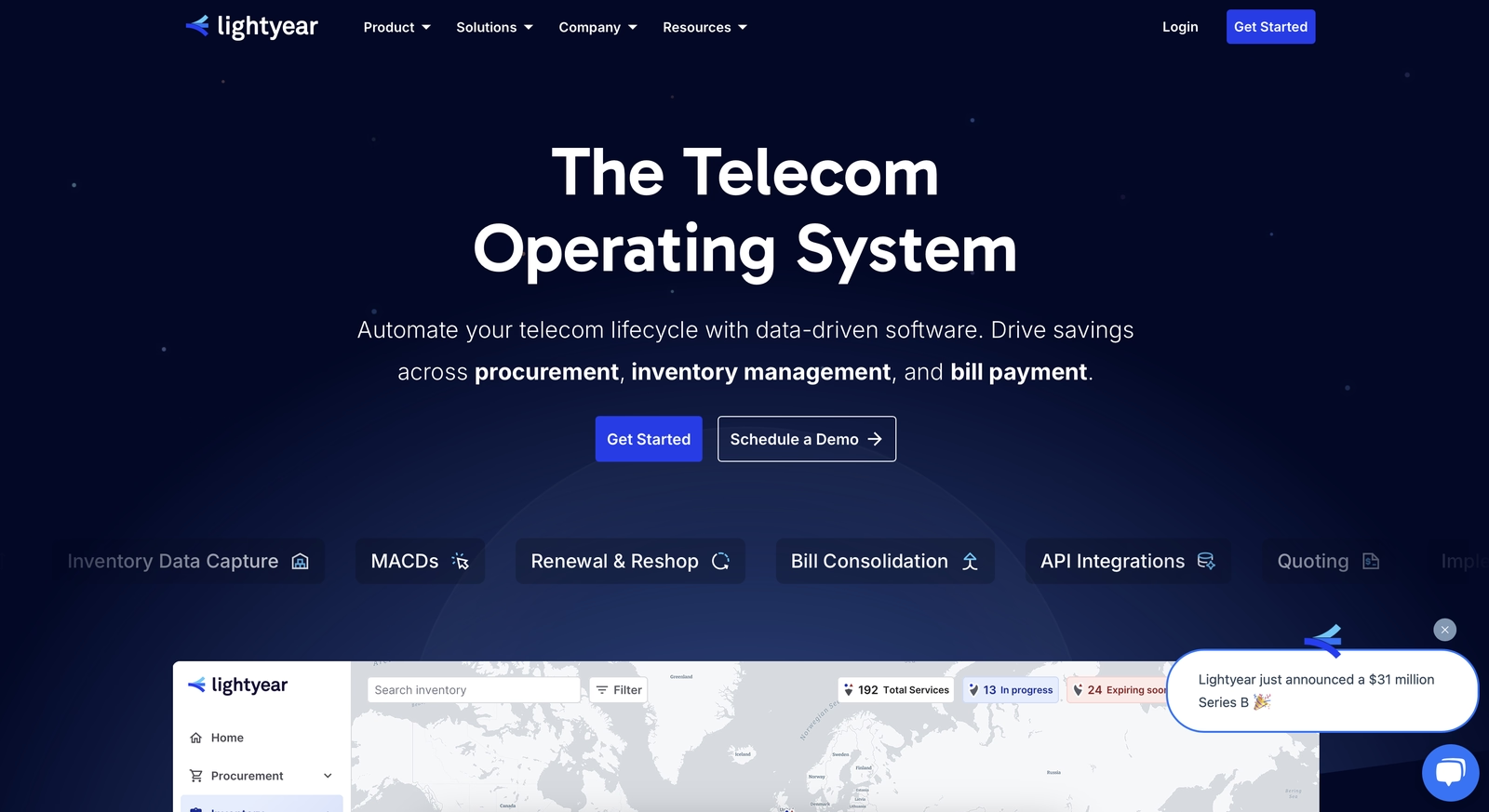
Whether your network relies on WDM, FDM, or a mix of technologies, managing the underlying services can be complex. By automating network service procurement, inventory management, and bill consolidation, Lightyear takes the pain out of telecom infrastructure management.
Hundreds of enterprises trust Lightyear to achieve over 70% in time savings and more than 20% in cost savings on their network services.
Schedule a demo or get started with our questionnaire today.
Frequently Asked Questions about Wavelength Division Multiplexing vs Frequency Division Multiplexing
Can WDM and FDM be used together in the same network?
Yes, but they typically operate in different parts of the network. A long-haul backbone might use WDM over fiber, while FDM could be used for final delivery over coaxial cable or for specific wireless links connecting to the main network.
What is the difference between CWDM and DWDM?
Both are types of WDM. Coarse WDM (CWDM) uses fewer channels with wider spacing, making it a lower-cost option for shorter distances. Dense WDM (DWDM) packs channels much closer together, providing massive capacity for long-haul and high-traffic networks.
Is FDM still relevant for business internet access?
While WDM is standard for fiber, FDM principles are used in technologies like DSL and cable internet (DOCSIS), which use different frequency channels over copper or coaxial lines. For dedicated, high-capacity enterprise circuits, however, WDM over fiber is the primary technology.
Let us show you the product and discuss specifics on how it might be helpful.
Schedule a Demo




Revolutionize Your Telecom Experience
Learn how you can get one step closer to optimal business efficiency for all your telecom services.