WebSocket vs RabbitMQ: Enterprise Communication Solutions
Confused about WebSocket vs. RabbitMQ? Learn when to use the real-time protocol vs. the message broker for your enterprise communication needs.


For IT leaders building applications that require data exchange, selecting the right communication architecture is a critical decision. Two technologies often considered in these discussions are WebSocket and RabbitMQ, but they serve fundamentally different purposes.
WebSocket is a communication protocol that establishes a persistent, two-way connection, typically between a client like a web browser and a server. In contrast, RabbitMQ is a message broker—an intermediary that helps different applications or services communicate with each other without being directly linked.
Understanding their distinct roles is key to designing an efficient and scalable system. This article will compare them directly to help you decide which is right for your project.
What is WebSocket?
WebSocket provides a full-duplex communication channel over a single, long-lived TCP connection. This allows for real-time data transfer between a client and a server, as both can send data independently at any time. Unlike the traditional HTTP request-response model where the client must initiate every request, WebSocket keeps the connection open, reducing latency and overhead. Key characteristics include:
- Persistent Connection: The connection remains open, eliminating the need to re-establish it for each data exchange.
- Bidirectional Communication: Both the client and server can send messages to each other simultaneously once the connection is established.
- Low Latency: It is well-suited for applications requiring instant updates, such as live chats, online gaming, or real-time financial data feeds.
- Reduced Overhead: After the initial handshake, data frames are smaller than bulky HTTP headers, making it more efficient for frequent messaging.
What is RabbitMQ?
RabbitMQ is a popular open-source message broker that functions as a middleman for your applications. It allows different parts of a system to communicate asynchronously, meaning they don't have to send and receive information at the same time. Instead of applications talking directly to each other, a "producer" sends a message to RabbitMQ, which then holds it until a "consumer" is ready to process it.
This approach is built on the Advanced Message Queuing Protocol (AMQP) and offers several key benefits:
- Decoupled Architecture: Producers and consumers operate independently, which improves system resilience and scalability.
- Asynchronous Communication: Applications can send messages and continue with other tasks without waiting for a reply.
- Message Queuing: It reliably queues messages, ensuring data is not lost even if the consuming application is temporarily unavailable.
- Flexible Routing: It can route messages to specific queues based on defined rules, allowing for complex communication patterns.
WebSocket vs RabbitMQ: Key Differences
While both technologies enable data exchange, they operate on different principles and solve distinct architectural problems. Here’s a direct comparison of their core differences.
1. Communication Model
WebSocket establishes a direct, stateful connection between two endpoints, typically a client and a server. This allows for immediate, two-way data flow over a persistent channel.
RabbitMQ facilitates indirect, asynchronous communication. Applications send messages to a central broker, which then delivers them to the appropriate recipients without requiring a direct link between them.
2. Architectural Role
WebSocket is a communication protocol, defining a standard for how data is exchanged. It is a component integrated into a client or server application to manage a specific connection.
In contrast, RabbitMQ is a standalone software application—a message broker that acts as a central hub. It is a piece of infrastructure that manages message queues, routing, and delivery between different services.
3. System Coupling
A key distinction lies in how they connect system components. WebSocket creates a direct link, meaning the client and server are tightly coupled for the duration of their session.
RabbitMQ is designed for loose coupling. Producers send messages to a queue without knowing which consumer will process them, and consumers retrieve messages without knowing the producer. This allows components to operate independently.
Use Cases for WebSocket
WebSocket is the go-to choice for applications where immediate, two-way data flow is essential. Its persistent connection makes it ideal for features that require real-time updates without user action. Common applications include:
- Live Chat and Support: It powers instant messaging in customer support tools and internal communication platforms, ensuring conversations flow smoothly without delays.
- Real-Time Dashboards: For monitoring systems that track application health or business metrics, WebSocket pushes live data to dashboards, eliminating the need for manual refreshes.
- Collaborative Workspaces: Applications that allow multiple users to edit a document or design together rely on WebSocket to sync all changes across every user's screen instantly.
- Financial Data Streams: Trading platforms use it to stream stock prices and market alerts directly to users, where even a millisecond of delay can be costly.
Use Cases for RabbitMQ
RabbitMQ excels where system components must communicate reliably without being directly connected. Its ability to queue messages makes it ideal for tasks that can be processed asynchronously, improving system resilience and scalability. Common applications include:
- Background Task Processing: For operations that don't need to happen instantly, like sending email confirmations or generating reports, RabbitMQ queues these tasks for processing without slowing the user-facing application.
- Microservices Communication: In systems built from many independent services, RabbitMQ acts as a communication backbone, allowing services to exchange data without direct dependencies.
- Data Ingestion: It is often used in data pipelines to handle high volumes of incoming data from various sources, queuing it for reliable processing by other systems.
- Order Processing: In e-commerce or financial systems, RabbitMQ can manage complex workflows by ensuring every step of an order—from payment to shipping—is reliably executed.
Choosing the Right Solution for Your Enterprise
Making the right choice depends less on which technology is "better" and more on what your system needs to accomplish. When deciding for your organization, consider these key operational factors.
1. Evaluate Your Architectural Goals
If your primary goal is to establish a direct, real-time communication channel between a client application and a server, WebSocket is the straightforward choice. It is built for immediate, stateful interaction.
Conversely, if you are designing a distributed system where different services must exchange information reliably without being directly linked, RabbitMQ provides essential decoupling and fault tolerance.
2. Consider Your Scalability Model
A system using WebSocket scales based on the server's ability to manage a large number of simultaneous, persistent connections.
RabbitMQ offers a different scaling path. You can add more consumer applications to process messages faster or cluster brokers to handle higher message volume, which is ideal for large-scale background processing.
3. Remember: It’s Not Always Either/Or
It's important to recognize that these technologies are not mutually exclusive and can be used together in a single architecture.
For instance, a user could receive a live notification through a WebSocket connection, and their response could trigger a complex workflow managed by RabbitMQ, such as an order fulfillment process.
Final Thoughts on WebSocket and RabbitMQ
Ultimately, the choice between WebSocket and RabbitMQ comes down to your specific architectural needs. WebSocket is a communication protocol designed for direct, real-time data exchange between a client and a server.
RabbitMQ, on the other hand, is a message broker that enables asynchronous communication between different parts of a system, promoting resilience and scalability. For IT leaders, understanding this fundamental difference is key. One handles immediate interaction, while the other manages background tasks and system-wide communication. Choose the tool that directly addresses the problem at hand.
Need Help Managing Your Network? Lightyear Can Help
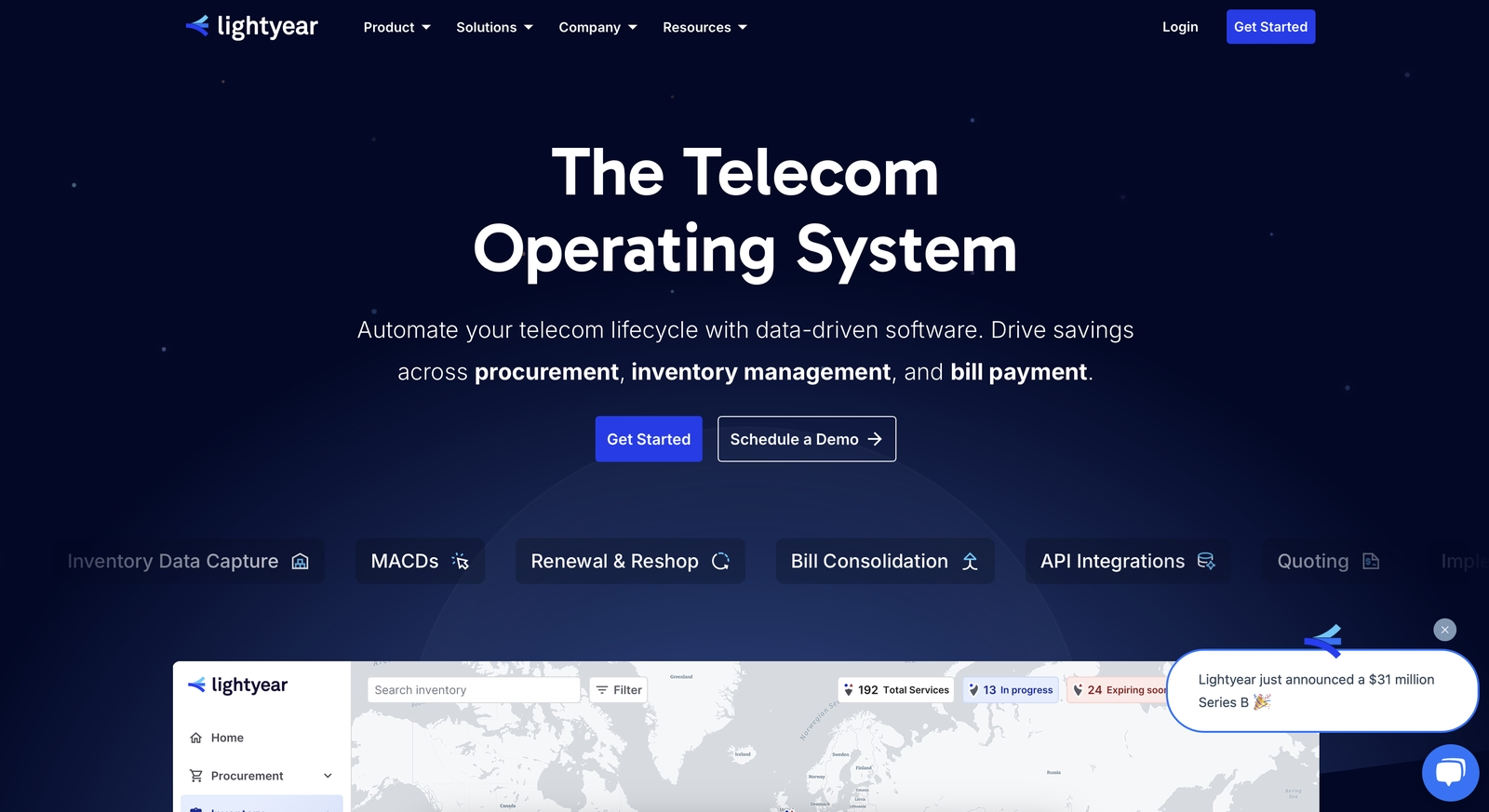
Choosing the right communication architecture is just one piece of the puzzle. Managing the underlying telecom services that support your applications presents its own set of challenges, from procurement to inventory tracking.
Lightyear automates network service procurement, inventory management, and bill consolidation. Enterprises that trust Lightyear achieve over 70% in time savings and 20% in cost savings on their network services.
Schedule a demo or get started with our questionare today.
Frequently Asked Questions about WebSocket vs RabbitMQ
Can RabbitMQ use WebSockets?
Yes, they can work together. RabbitMQ has a plugin that allows clients, like web browsers, to connect directly to the broker using the WebSocket protocol. This is useful for pushing real-time messages from your backend services to the user interface.
Which technology is more secure?
Both can be highly secure. WebSocket security is handled with WSS (WebSocket Secure) over TLS. RabbitMQ offers TLS for encryption, plus robust user authentication and access controls. Security depends on proper implementation rather than an inherent advantage in either technology.
Do I need a separate server for RabbitMQ?
Yes, RabbitMQ is a message broker that runs as a separate server or cluster. It is a distinct piece of infrastructure that your applications connect to, whereas WebSocket is a protocol implemented directly within your application server code.
Let us show you the product and discuss specifics on how it might be helpful.
Schedule a Demo





Revolutionize Your Telecom Experience
Learn how you can get one step closer to optimal business efficiency for all your telecom services.