WebSocket vs UDP: Enterprise Communication Comparison
Learn the key differences between WebSocket and UDP for enterprise networks. We compare reliability, speed, and use cases to help you choose the right one.

When building applications that require real-time data exchange, selecting the right communication protocol is a critical decision for any IT team. Two common options that often come up are WebSocket and the User Datagram Protocol (UDP).
While both handle data transmission, they operate very differently and are suited for distinct enterprise use cases. This article breaks down their key differences, from reliability to performance, to help you determine which protocol best fits your specific network requirements.
What is WebSocket?
WebSocket is a communication protocol that enables interactive, two-way communication between a client (like a web browser) and a server over a single, long-lived TCP connection. Once established, this connection stays open, allowing for a continuous, full-duplex data flow where both the client and server can send information independently and simultaneously.
- Persistent Connection: It maintains a single open connection, which reduces the latency and overhead caused by repeatedly establishing new HTTP connections for data exchange.
- Stateful Protocol: Unlike the stateless nature of HTTP, WebSocket is stateful. It keeps track of the connection state, eliminating the need to send headers or cookies with every message.
- HTTP Upgrade: The initial connection handshake uses HTTP before being "upgraded" to a WebSocket connection, making it compatible with existing web infrastructure like proxies and firewalls.
What is UDP?
User Datagram Protocol (UDP) is a core communication protocol used for time-sensitive transmissions where speed is prioritized over reliability. It operates on a simple, connectionless model, meaning it sends data packets (called datagrams) to a recipient without first establishing a dedicated connection or confirming that the recipient is ready to receive them.
- Connectionless Protocol: UDP sends data without a formal handshake process. This "fire-and-forget" approach minimizes setup delay, making transmissions very fast.
- Low Overhead: It has a minimal header and doesn't perform error checking, sequencing, or retransmission of lost packets. This makes it lightweight and efficient.
- Unreliable Delivery: UDP provides no guarantee that datagrams will arrive, arrive in the correct order, or arrive without duplication. Any necessary error correction must be handled by the application itself.
WebSocket vs UDP: Key Differences
While both protocols move data, their approaches to reliability, speed, and connection handling are fundamentally different. Let's break down the core distinctions that matter for enterprise networks.
1. Reliability and Packet Ordering
The biggest distinction lies in reliability. WebSocket runs on top of TCP, which includes built-in error checking and ensures packets arrive in the correct sequence.
If a data packet is lost in transit, TCP automatically requests a retransmission, guaranteeing data integrity. This makes WebSocket a dependable choice for applications where every piece of data matters.
UDP operates on a "best-effort" delivery model. It provides no guarantees on packet delivery or order, leaving error detection and correction entirely to the application layer.
2. Connection Management
WebSocket is connection-oriented. It requires an initial handshake to establish a persistent, two-way communication channel that stays open for the duration of the interaction.
In contrast, UDP is connectionless. It sends data in discrete packets without establishing a session, which removes any setup delay but means each packet is an independent event.
3. Speed and Overhead
UDP is prized for its speed, which comes from its minimal overhead. With no handshakes, acknowledgments, or sequencing, data can be sent with very little delay.
WebSocket carries more overhead, particularly during the initial HTTP/TCP handshake. However, after the connection is live, it becomes highly efficient for frequent messages, as it avoids the repetitive header overhead found in traditional HTTP requests.
Use Cases for WebSocket
Because of its reliable, two-way nature, WebSocket is the go-to protocol for applications where data integrity and real-time interaction are non-negotiable. Its persistent connection makes it ideal for services that require a constant flow of information from the server to the client.
- Live Financial Data Feeds: Trading platforms and financial dashboards rely on WebSocket to stream stock prices and market data to clients without delay. The protocol’s guaranteed delivery ensures that users are acting on accurate, up-to-the-second information where every packet counts.
- Real-Time Collaboration Tools: Applications for collaborative editing, such as shared documents or design platforms, use WebSocket to synchronize changes across all users instantly. When one person makes an edit, the update is broadcast to everyone else in the session.
- Chat and Messaging Applications: Enterprise chat platforms depend on WebSocket to provide a fluid messaging experience. It allows for instant message delivery and receipt notifications, ensuring conversations flow without the lag of traditional request-response models.
- Live Customer Support: Many modern customer support systems use WebSocket to power live chat features. This enables support agents and customers to communicate in real-time, creating a more responsive and interactive experience.
Use Cases for UDP
UDP's speed and low overhead make it the preferred choice for applications where a lost packet is less disruptive than a delay. It excels in scenarios where real-time performance is the top priority, and the application can tolerate minor data loss.
- Online Gaming: In multiplayer games, player positions and actions need to be updated instantly. UDP sends this data quickly, and if a packet is dropped, the game can simply ignore it and use the next update, preventing jarring pauses that would be caused by waiting for retransmissions.
- Voice over IP (VoIP) and Video Conferencing: For services like enterprise voice systems, maintaining a smooth, continuous conversation is essential. UDP transmits audio and video data rapidly, and a momentary glitch from a lost packet is far less noticeable than the buffering that TCP's error correction would introduce.
- Live Streaming: When broadcasting live events, delivering the most current video frames to viewers is critical. UDP allows streaming services to prioritize speed, ensuring the audience sees the action as it happens, even if it means an occasional dropped frame.
- DNS Lookups: The Domain Name System (DNS) relies on UDP for its quick, simple request-and-response queries. The process of translating a domain name to an IP address needs to be as fast as possible, and the small packet size makes UDP a very efficient choice.
Choosing Between WebSocket and UDP
The decision between WebSocket and UDP ultimately comes down to a fundamental trade-off: reliability versus speed. Your application's specific needs will point you to the right protocol.
When to Choose WebSocket: Prioritize Data Integrity
Opt for WebSocket when the integrity of your data is paramount. If your application requires every single packet to arrive in the correct order without fail, WebSocket's TCP foundation provides that guarantee.
This is the right choice for systems handling transactions, critical updates, or collaborative data where loss is not an option. The initial connection overhead is a small price to pay for this level of dependability.
When to Choose UDP: Prioritize Speed and Efficiency
Choose UDP when your primary concern is minimizing latency. For applications where real-time performance is critical and a dropped packet is less disruptive than a delay, UDP is the more efficient protocol.
This works well for streaming or real-time communication where the application layer can manage minor imperfections. If speed is the goal and your system can tolerate a "best-effort" delivery, UDP is the logical fit.
Final Thoughts on WebSocket and UDP
Ultimately, the choice between WebSocket and UDP is not about which protocol is superior, but which one aligns with your application's specific requirements. They serve fundamentally different purposes within an enterprise network architecture.
WebSocket, with its foundation in TCP, provides the assurance of reliable, ordered data delivery. It is the standard for applications where every piece of information must be accounted for, from financial data streams to real-time collaborative platforms.
In contrast, UDP prioritizes speed above all else. It is the ideal protocol for time-sensitive applications like VoIP or live video, where a slight data loss is an acceptable trade-off for maintaining a smooth, low-latency user experience.
For IT leaders, the decision comes down to a clear evaluation of your service's needs. By matching the protocol to the application, you can build a more efficient and effective network infrastructure.
Need Help Managing Your Network? Lightyear Can Help
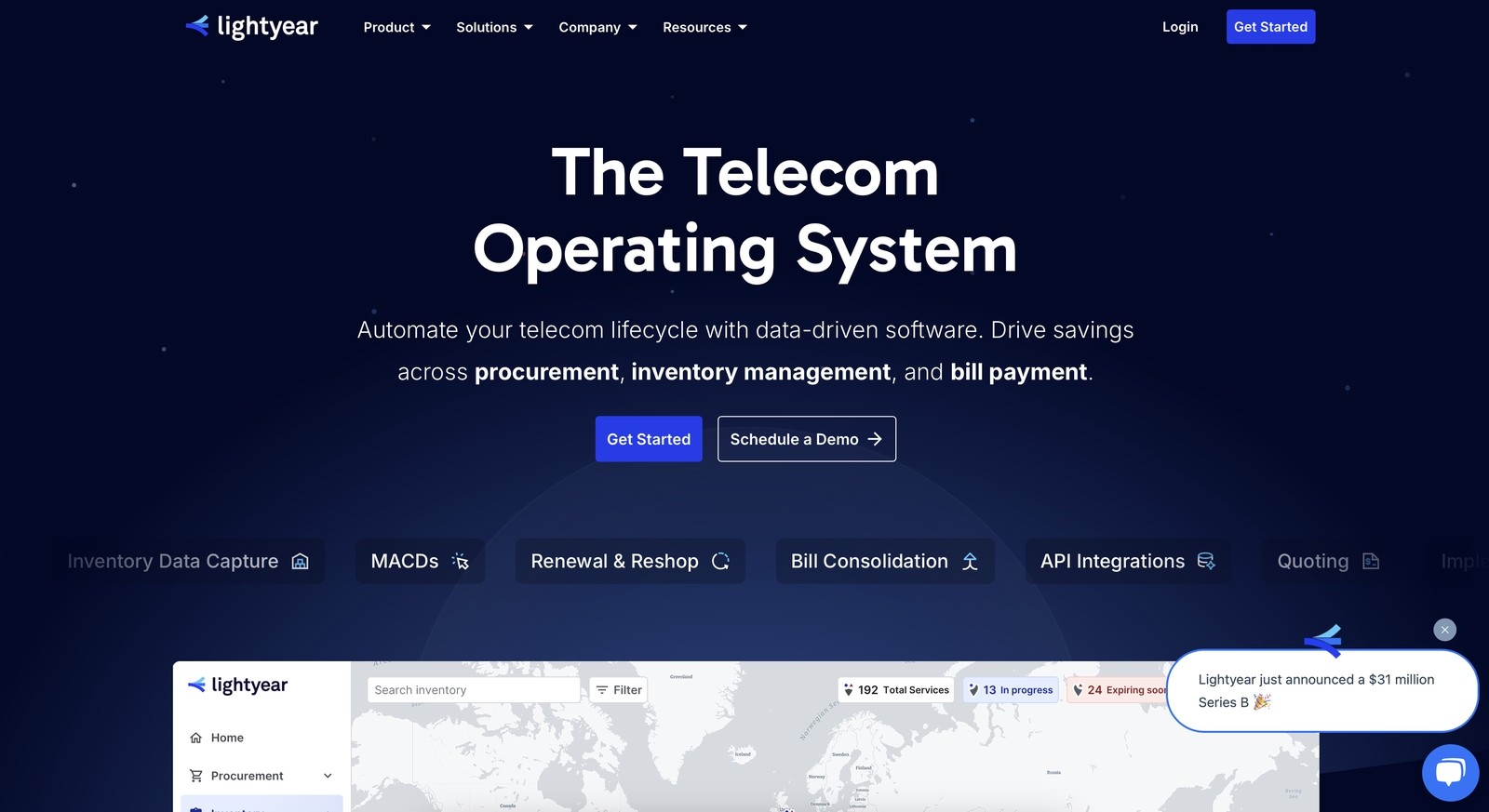
Whether your applications rely on WebSocket or UDP, managing the underlying network infrastructure is a complex task. By automating network service procurement, inventory management, and bill consolidation, Lightyear removes the friction from telecom management.
The hundreds of enterprises who trust Lightyear achieve 70%+ time savings and 20%+ cost savings on their network services.
Schedule a demo or get started with our questionnaire today.
Frequently Asked Questions about WebSocket vs UDP
Can WebSocket run over UDP?
No, WebSocket is designed to run exclusively over TCP. Its reliability guarantees, like ordered delivery and error correction, are dependent on TCP's stateful connection. UDP's connectionless model does not provide the necessary foundation for the WebSocket protocol to function as intended.
Which protocol is more secure?
WebSocket is generally more secure. It can be encrypted using Transport Layer Security (via the wss:// protocol), inheriting the security of HTTPS. UDP has no built-in security, so any encryption or authentication must be implemented separately at the application level.
How do firewalls handle WebSocket vs. UDP?
WebSocket often traverses firewalls more easily because its initial handshake uses standard HTTP/HTTPS ports (80/443). UDP traffic can be more difficult, as it may require administrators to open specific ports, which can complicate network security configurations.
Let us show you the product and discuss specifics on how it might be helpful.
Schedule a Demo





Revolutionize Your Telecom Experience
Learn how you can get one step closer to optimal business efficiency for all your telecom services.