Zayo vs Frontier Communications: Which ISP Is Better?
Making a choice between two big ISPs? Our guide breaks down their network reach, service offerings, and costs to make your decision easier.


Choosing a new internet service provider can be a complex decision for any business. In this guide, we're comparing two major players in the telecom space: Zayo and Frontier Communications.
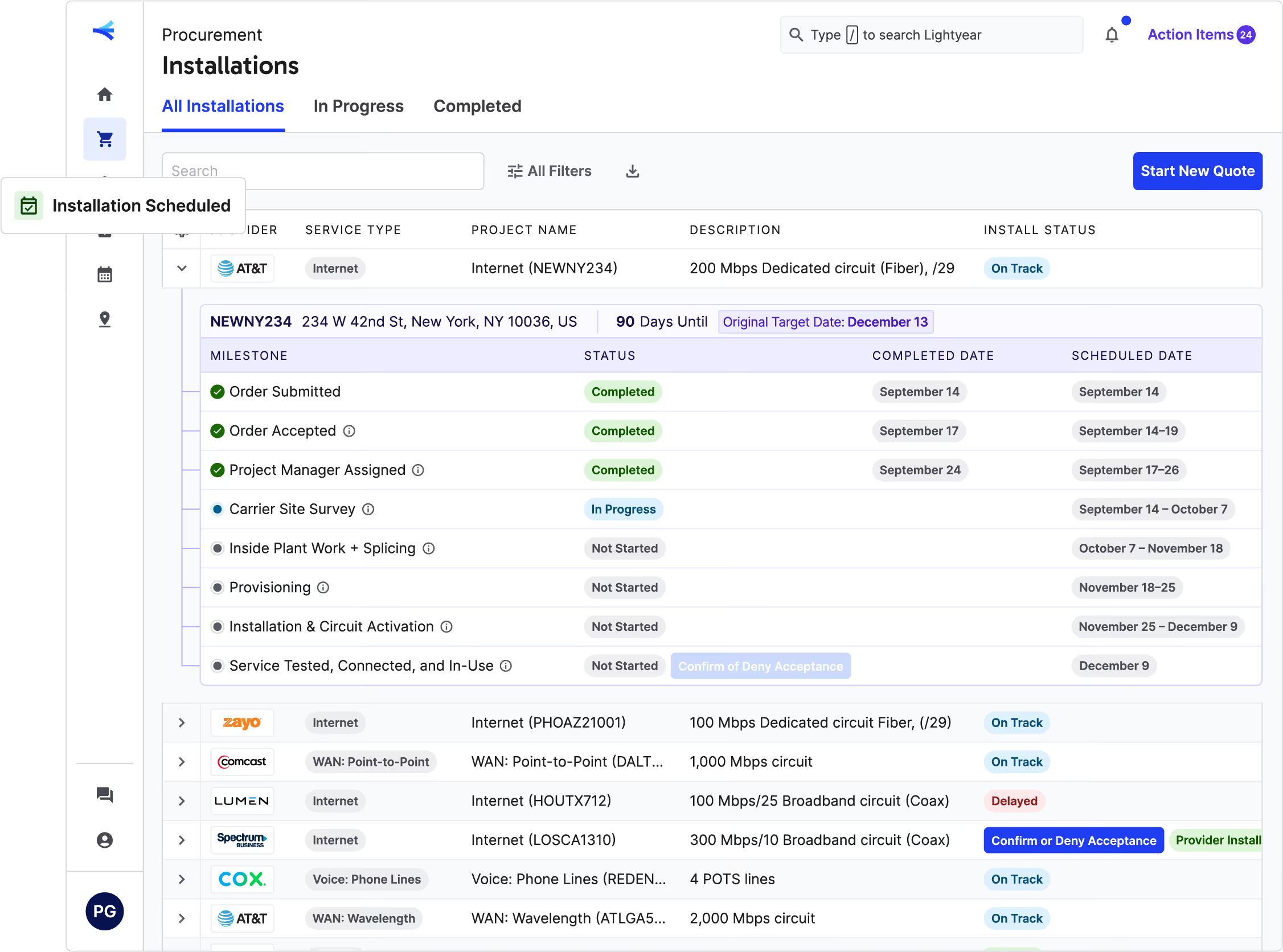
To help you find the right fit, we are comparing them using our own proprietary data from over 70,000 real-world ISP quotes. This information includes aggregated benchmarks on pricing, installation timelines, and service delivery points.
You can keep reading for our detailed comparison of Zayo and Frontier. Or, if you're ready to explore provider options, you can begin our questionnaire to receive real-time quotes.
Overview of Zayo
Founded in 2007, Zayo is a telecommunications infrastructure provider headquartered in Boulder, Colorado. The company has grown to approximately 3,500 employees and operates a network that spans 35 countries.
A key part of Zayo's approach is simplifying network management through automation and self-service tools. For example, their network-as-a-service (NaaS) platform allows customers to design and deploy their own network solutions.
Overview of Frontier Communications
Frontier Communications has a long history, with corporate roots that trace back to 1935. The company is now headquartered in Dallas, Texas, and operates with approximately 13,000 employees. It provides services to customers in 25 states across the United States.
A notable aspect of Frontier is its 100% fiber-optic network, which supports symmetrical upload and download speeds. The company also provides managed network services, allowing a business's internal IT teams to focus on strategic goals rather than daily network upkeep.
ISP Products
Dedicated Internet (DIA)
Zayo offers Dedicated Internet Access with speeds from 100 Mbps to 100 Gbps over its Tier-1 fiber network. Their service level objectives start at 99.9% availability, with specific SLAs detailed in individual service agreements.
Frontier's Dedicated Internet Access provides a slightly wider speed range, from 5 Mbps up to 100 Gbps. For its managed DIA services, Frontier offers a 99.99% availability SLA and add-ons like managed routers and cellular failover.
Our proprietary data shows Frontier is generally more competitive on price, with DIA costs running 11-12% below the market average. Zayo's pricing is closer to the average—about 7% above for 100 Mbps circuits and 2% below for 1 Gbps circuits.
Regarding installation timelines, Frontier meets the 77-day industry average for DIA. Zayo's installations, however, average around 89 days.
Please keep in mind that these are aggregate figures. Actual pricing and installation times can vary significantly based on your location and the specific DIA configuration you choose.
For a precise comparison of Zayo, Frontier Communications, and other top ISPs in your area, we invite you to fill out our questionnaire. It draws from the most comprehensive data set in the industry to deliver accurate, real-time quotes for your business.
DIA Pricing, Delivery and Install Days Compared
The data in this table comes from Lightyear’s aggregated ISP quotes collected in 2024 and 2025 YTD.
- Install Days: how long it typically takes to deliver service.
- 100Mb Price vs Avg / 1Gb Price vs Avg: shows whether this ISP is cheaper or more expensive than the market average.
- Delivery Point: “Suite” means the ISP delivers service all the way to the company’s server room; “MPOE” means the circuit stops at the building’s minimum point of entry (typically the building's utility basement) and the tenant must handle the inside wiring.
Wireless
Zayo's focus is on fiber infrastructure, so they do not offer wireless broadband services like LTE or 5G directly to businesses. Instead, they provide the essential fiber backhaul and connectivity that wireless carriers use to power their own networks.
Frontier, on the other hand, offers a wireless solution in the form of a managed cellular failover. This is not a primary internet connection but a backup service that keeps you online if your main connection fails.
This failover service is available as part of Frontier's Managed Network Services, adding a layer of reliability for business sites. For a business seeking a primary fixed wireless connection, neither Zayo nor Frontier are direct providers in the way a mobile network operator is.
Security
Zayo’s security products are centered on its DDoS Protection service, which comes in Basic, Standard, and Advanced tiers. This service offers network-based monitoring and mitigation at the Zayo edge, using proactive detection and scrubbing to defend against attacks.
Frontier, in contrast, bundles security into its Managed Services packages that are integrated with their Dedicated Internet. These bundles provide a suite of features like a firewall, Unified Threat Management (UTM), remote user VPN, and web filtering, all with 24/7 monitoring and management by Frontier's team.
Broadband
Zayo’s broadband offering is structured as a Dedicated Internet (DIA) product, tailored for enterprise-level requirements rather than mass-market service. This provides businesses with symmetrical speeds from 100 Mbps up to 100 Gbps over Zayo’s extensive fiber network.
In contrast, Frontier offers Frontier Business Fiber, a service aimed at small to medium-sized businesses. It delivers symmetrical speeds up to 7 Gbps in certain markets, backed by a stated 99.9% network reliability.
While the industry average for broadband installation is 28 days, we have limited quoting history for these specific products. Because of this, we’re not able to provide benchmark pricing or installation timelines at this time. To find the latest pricing for your location, you can get a real-time quote through our questionnaire.
Ethernet
Zayo provides a suite of Ethernet services, including Ethernet Private Line (EPL), Ethernet Virtual Private Line (EVPL), and E-LAN. These Layer 2 services run over the company's extensive MPLS and optical network, providing connectivity across North America and Europe.
Frontier Communications offers MEF-compliant Carrier Ethernet with both EPL and EVPL configurations. They also provide Optical Transport services capable of speeds up to 100 Gbps for high-bandwidth needs.
Both companies deliver reliable, standards-based Ethernet for connecting business sites. A key distinction is their geographic coverage: Zayo has a broad international presence, whereas Frontier's Ethernet services are concentrated within its US network footprint.
POTS Replacement
Frontier offers a dedicated product called Frontier POTS Connect for businesses needing to replace their old analog lines.
This service is designed specifically for specialty lines like alarms, fax machines, POS systems, and elevators, delivering service over an LTE or wired connection with built-in wireless failover.
Zayo, in contrast, does not provide a native POTS replacement product, as its focus is on IP and data services.
Instead of a direct analog line replacement, Zayo offers SIP trunking for voice needs and may work with partners for cellular POTS alternatives.
Other Key Features Compared
Geographic Coverage
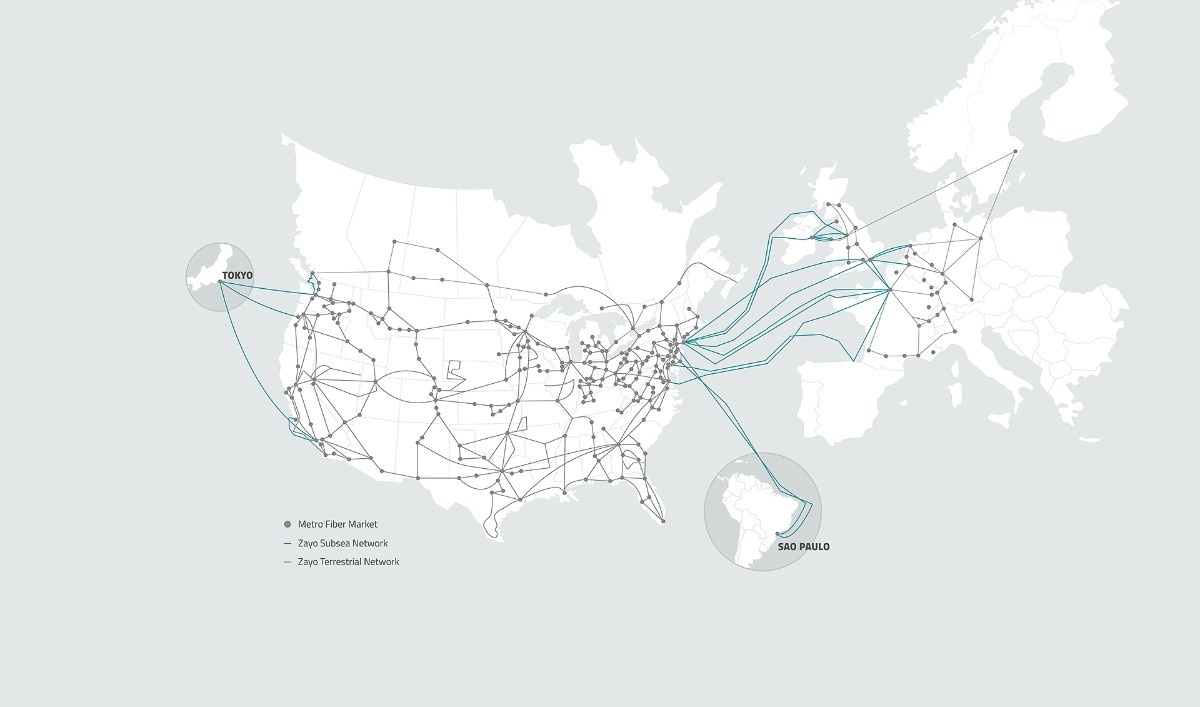
Zayo has a wide reach, with a network that spans 35 countries.
Their strongest coverage is in North America and Western Europe, connecting many key business centers.
Frontier Communications, on the other hand, concentrates its network within the United States.
They provide services to customers across 25 states, focusing their operations domestically rather than internationally.
SLA
Zayo’s service level objectives begin at 99.9% availability. This is a common starting point for enterprise services, but it's important to check your specific contract for the final guarantee.
For its managed DIA services, Frontier offers a higher 99.99% availability SLA. That extra "9" represents a significant increase in guaranteed uptime for your connection.
In practical terms, a 99.9% SLA allows for up to 8.7 hours of downtime per year, while a 99.99% SLA reduces that to just 53 minutes. This difference can be critical for businesses that depend on constant connectivity.
Transport Types Available
Zayo operates on a fiber-only network, which spans 144,000 route miles. This extensive infrastructure supports high-capacity data transport for large businesses and carriers.
Frontier also relies on a fiber-optic network, but with an even larger footprint of 180,000 route miles. This allows them to offer services across a wide domestic area.
Both providers offer speeds up to 100 Gbps, suitable for heavy business use. However, Frontier's offerings start as low as 5 Mbps, making them a potential fit for smaller businesses, while Zayo focuses on higher-speed enterprise connections.
Customer Support
Zayo's customer support is centered on its online portal, Tranzact. Here, you can manage your services and create support tickets. For more immediate problems, Zayo operates a 24/7 Network Control Center (NCC).
Frontier also provides around-the-clock technical support for its business clients. You can reach their team by phone or through their online portal for assistance with your services.
The choice between them often depends on your needs. Zayo's model is great for teams that like self-service, while Frontier offers support that can be more hands-on, especially with their managed service plans.
Final Verdict: Zayo or Frontier Communications?
Choosing between Zayo and Frontier often comes down to your company's scale and specific service needs. Zayo is a strong contender for large, multinational enterprises that require high-capacity fiber connectivity across North America and Europe.
If your business has a sophisticated IT team that can manage its own network, Zayo’s self-service platform and extensive fiber backbone offer a great deal of control and performance.
On the other hand, Frontier is an excellent fit for US-based businesses of all sizes, particularly those seeking managed services. With more competitive DIA pricing and a higher availability SLA, Frontier provides a reliable and cost-effective option for companies that prefer a more hands-on provider.
Ultimately, the right choice depends on your specific locations and requirements. To get a clear picture, we recommend using our questionnaire to compare real-time quotes from these and other providers.
To make your decision easier, here’s a quick side-by-side look at how Zayo and Frontier Communications compare on the key points we've covered.
Choose the Right ISP Today With Lightyear
The decision between Zayo and Frontier ultimately depends on what your business needs. A company with a global footprint and a hands-on IT team might lean toward Zayo, while a US-based business looking for a managed solution at a competitive price could find Frontier to be a better match.
Lightyear's platform is built to give you clarity in this process by helping you compare providers based on your specific requirements. Here’s how we help:
- Automated ISP Procurement: We digitize the RFP process, using the largest proprietary dataset in telecom to show you best-fit providers and benchmarked rates side by side.
- Transparent Pricing & Negotiation: Our software proactively negotiates quotes down if rates don’t align with market data, ensuring you never overpay.
- Human + Software Support: You get dedicated account reps to oversee installs and manage escalations, so you’re never left navigating the provider maze alone.
Ready to simplify your telecom procurement? Schedule a demo with Lightyear to get started.
Let us show you the product and discuss specifics on how it might be helpful.
Schedule a Demo





Revolutionize Your Telecom Experience
Learn how you can get one step closer to optimal business efficiency for all your telecom services.