What Is a PRI Trunk? Managing Enterprise Voice Services
Learn what a PRI trunk is, how it works, and why enterprises still use it. Compare PRI vs SIP, pricing, and management with Lightyear’s platform.


Are you evaluating robust voice communication solutions for your enterprise? Understanding the intricacies of a Primary Rate Interface (PRI) trunk is fundamental.
A PRI trunk represents a cornerstone technology in business telephony, providing dedicated digital lines for voice calls, phone numbers, and data transmission. While newer options, such as SIP trunking and UCaaS, have gained traction, PRI remains essential for many enterprises with on-premises PBXs and compliance-driven environments.
In this guide, we’ll dissect PRI trunks, detailing their operation, applications, and the process of sourcing and managing them effectively within an enterprise environment.
What is a PRI Trunk?
A PRI trunk is a standardized telecommunication interface, part of the Integrated Services Digital Network (ISDN) family, designed to carry multiple voice and data channels simultaneously over a single physical circuit. It provides a reliable, high-capacity connection between a business’s internal phone system and the public switched telephone network (PSTN).
How Does a PRI Trunk Work?
How does a single cable support numerous simultaneous conversations? The answer lies in how PRI trunks divide digital lines into multiple channels.
A T1 line, common in North America, Japan, and South Korea, is a digital transmission standard that provides 24 total channels, each capable of carrying 64 Kbps. In a PRI configuration, 23 of these are B-channels (bearer channels) used for voice calls or data transmission, while 1 is a D-channel (data channel) dedicated to signaling tasks such as call setup, management, and teardown.
An E1 line, used in Europe and most other parts of the world, is a similar standard but with 32 total channels. Of these, 30 are B-channels and 2 are D-channels. This structure enables more simultaneous calls compared to T1 and offers greater built-in redundancy for signaling.
| Feature | T1 PRI | E1 PRI |
| Channels | 24 total (23 B + 1 D) | 32 total (30 B + 2 D) |
| Bandwidth per channel | 64 Kbps | 64 Kbps |
| Max simultaneous calls | 23 | 30 |
| Typical regions | North America, Japan, South Korea | Europe, most other regions |
By dedicating a D-channel to signaling, both T1 and E1 PRI circuits avoid the call quality issues that can arise with in-band signaling. This channelization is what allows a single PRI circuit to handle dozens of simultaneous phone calls with consistent, high-quality performance.
Why Do Businesses Use PRI Trunks?
PRI trunks offer several distinct advantages that cater to enterprise-level communication requirements.
First, they provide unparalleled voice quality and reliability, as each call travels over a dedicated line with built-in redundancy and quality of service (QoS) protections, minimizing latency and packet loss. This ensures crystal-clear audio and consistent call connectivity.
Second, PRI trunks offer robust scalability; businesses can add additional PRIs as their call volume increases, expanding capacity in manageable increments of 23 or 30 channels.
Third, they support advanced features such as Direct Inward Dialing (DID), which allows external callers to reach specific extensions directly, bypassing an attendant.
PRI trunks integrate seamlessly with enterprise PBX systems, making them a practical choice for organizations balancing legacy infrastructure with modern needs. They also facilitate caller ID and automated call routing, enhancing operational efficiency.
For organizations with significant call center operations or a large number of concurrent voice users, PRI trunks deliver the dedicated bandwidth and consistent performance necessary for mission-critical communications.
Key Components of a PRI System
Implementing a PRI system requires the integration of several essential hardware and service components. Each element plays a crucial role in establishing and maintaining the digital connection between your business and the PSTN.
1 - The PRI Line Itself
What exactly constitutes "the PRI line"? The PRI line is the physical digital circuit provided by a telecommunications carrier, typically delivered over copper wires, copper lines, or fiber optic cabling as part of the business’s physical infrastructure.
This line terminates at your business premises and is engineered to transmit data at a high, consistent rate. It carries the channelized digital signals that facilitate multiple concurrent communications. The integrity and quality of this physical line are paramount to the performance of your entire voice communication system. It represents the backbone upon which all subsequent components build.
2 - The Channel Service Unit/Data Service Unit (CSU/DSU)
The Channel Service Unit/Data Service Unit (CSU/DSU) is a critical piece of hardware that acts as an interface between the digital local loop (the PRI line) and your internal network equipment, specifically the Private Branch Exchange (PBX).
The CSU portion terminates the digital line from the carrier, performing functions like line conditioning, error correction, and loopback testing.
The DSU portion formats the data for transmission to the PBX, ensuring compatibility and proper data flow.
Think of the CSU/DSU as a translator, ensuring that the signals from the carrier's network are correctly interpreted and formatted for your PBX, and vice versa. It is essential for maintaining signal integrity and synchronization across the digital circuit.
3 - The Private Branch Exchange (PBX)
How do internal calls and external connections converge? The Private Branch Exchange (PBX) is the central switching system within your organization that manages all internal and external telephone calls.
When integrated with a PRI trunk, the PBX routes incoming calls from the PSTN to the appropriate internal extension via DID, and it routes outgoing calls from internal users through the PRI to the PSTN.
The PBX handles advanced call features like call forwarding, conferencing, and voicemail. It is the intelligence hub of your telephony system, orchestrating communication flows and enabling the full suite of telephony functionalities that businesses require.
PRI vs. SIP Trunking: What's the Difference?
In the landscape of business telecommunications, PRI trunks are often compared with SIP (Session Initiation Protocol) trunking. While both facilitate external voice communication, their underlying technologies and operational paradigms differ significantly.
PRI (Primary Rate Interface)
PRI utilizes dedicated, circuit-switched digital lines. Each call occupies a specific, reserved channel for its duration, guaranteeing bandwidth and call quality. This fixed allocation model means that if a business has a 23-channel PRI, it can support a maximum of 23 concurrent calls, regardless of actual demand fluctuations.
PRI systems typically connect directly to a physical PBX on the premises. This architecture provides high reliability and predictable performance, making it suitable for environments where consistent call quality is non-negotiable and bandwidth is explicitly provisioned.
SIP (Session Initiation Protocol) Trunking
SIP trunking, in contrast, leverages IP networks to transmit voice over internet protocol (VoIP). It connects directly with IP phones and unified communications platforms, creating a flexible virtual connection for simultaneous calls.
It is a form of Voice over IP (VoIP) that allows businesses to connect their PBX (either physical or virtual) to an Internet Telephony Service Provider (ITSP) over the internet.
Instead of dedicated channels, SIP trunks use "sessions" over a shared data connection. This offers greater flexibility and scalability, as the number of concurrent calls is limited only by available internet bandwidth and the service agreement with the ITSP.
SIP trunking can reduce costs by consolidating voice and data onto a single network infrastructure and eliminating the need for separate physical lines for each call.
Many organizations pair SIP trunking with broader WAN modernization. Our SD-WAN Buyer’s Guide and breakdown of SASE vs. SD-WAN can help you understand where voice fits into a modern network stack.
When to Choose PRI or SIP
The decision between PRI and SIP trunking hinges on specific business requirements and existing infrastructure.
Choose PRI if:
- You prioritize maximum call quality and reliability above all else.
- Your business requires a dedicated, guaranteed bandwidth for voice communication.
- Your existing PBX is older and lacks IP capabilities, making a direct SIP integration complex or impossible without significant upgrades.
- You have stringent regulatory or compliance requirements that necessitate a circuit-switched, non-internet-dependent voice solution.
- Your internet connection stability or available bandwidth is a concern.
Choose SIP if:
- You seek cost savings by consolidating voice and data services over a single internet connection.
- You require greater flexibility and scalability, easily adjusting the number of "lines" (sessions) as your business needs change, without the need for physical installation.
- You utilize a modern, IP-enabled PBX or a cloud-based communication system.
- Your business operates across multiple locations, facilitating centralized call management and inter-office communication over IP.
- You have a robust, reliable, and high-bandwidth internet connection.
If you’re evaluating which carriers best support multi-site deployments, check out our provider comparisons:
- Spectrum Enterprise vs. Lumen Technologies
- Comcast Business vs. Spectrum Enterprise
- Lumen Technologies vs. Cox Communications
Sourcing a PRI Trunk for Your Business
Acquiring a PRI trunk involves a systematic process, ensuring that the chosen service aligns precisely with your business's operational demands and financial parameters.
1. Assess Your Business Needs
What is your actual communication demand?
- Begin by conducting a thorough assessment of your current and projected voice communication needs.
- Determine the maximum number of concurrent calls your business typically handles during peak hours.
- Consider future growth, new locations, and potential changes in call volume.
- Evaluate any specific feature requirements, such as extensive DID numbers, international calling capabilities, or integrations with existing CRM systems.
A clear understanding of your needs will prevent under-provisioning or over-provisioning, optimizing both performance and cost.
2. Research Providers
Next, you’ll need to identify reputable telecommunications providers that offer PRI trunk services in your geographical region. You can also leverage a platform like Lightyear, which automates this research across 200+ vetted carriers.
Focus on providers with a proven track record of reliability, strong network infrastructure, and positive customer reviews. Investigate their network coverage, particularly for your specific business locations.
It’s also wise to look for providers that specialize in enterprise solutions, as they often possess the expertise and support structures necessary for complex business deployments.
3. Understand Pricing Models
How will you be charged for your PRI service? PRI pricing models typically involve a recurring monthly fee for the PRI line itself, which often includes a set number of channels (e.g., 23 or 30).
There may be additional charges for usage (per-minute rates for outbound calls, especially long-distance or international), DID numbers, and specialized features. Some providers offer bundled packages that include a certain amount of minutes or unlimited local calling.
Because pricing structures can vary widely across carriers, it’s essential to obtain detailed quotes from multiple providers, carefully comparing line costs, per-minute rates, and any hidden fees. Lightyear simplifies this process by pulling real-time data from 200+ carriers, optimizing quotes before they hit your inbox, and helping you identify the most cost-effective option for your business.
→ Ready to see how much you could save? Explore PRI trunk options with Lightyear.
4. Review Service Level Agreements (SLAs)
What guarantees do you have regarding service performance? A Service Level Agreement (SLA) is a critical document that outlines the guaranteed performance metrics and reliability of the PRI service.
Lightyear also makes SLA review easier by presenting terms side-by-side, so you can compare uptime guarantees, response times, and penalties without digging through carrier fine print.
Scrutinize the SLA for uptime guarantees, maximum allowable downtime, response times for service interruptions, and compensation mechanisms for non-compliance.
A robust SLA protects your business by ensuring the provider is contractually obligated to maintain a certain level of service quality and responsiveness. Neglecting to review this document can expose your business to significant operational risks.
5. Consider Installation and Support
What level of support can you expect? Inquire about the provider's installation process, estimated timelines, and whether they offer professional installation services. Understand the scope of ongoing technical support, including availability (24/7 support is often critical for businesses), methods of contact, and the typical resolution times for issues.
A provider offering comprehensive installation assistance and responsive, knowledgeable technical support can significantly reduce deployment complexities and minimize business disruption during outages.
Managing Your Enterprise Voice Services with PRI
Effective management of your PRI trunks is crucial for maintaining optimal performance, controlling costs, and ensuring business continuity.
Monitoring Usage
Are you effectively utilizing your PRI capacity? Regularly monitor your PRI usage to ensure that your allocated channels align with your actual call volume. Track peak call times, average call duration, and the number of concurrent calls.
Most PBX systems provide reporting tools that can generate these metrics. Consistent monitoring helps identify if you are approaching capacity limits, requiring an additional PRI, or if you are consistently under-utilizing channels, suggesting potential cost savings through optimization. Proactive monitoring prevents call blocking and ensures adequate service availability.
Troubleshooting Common Issues
What should you do when problems arise? Common PRI issues include dropped calls, static on lines, inability to make or receive calls, or issues with Caller ID.
Initial troubleshooting often involves checking the physical connection to the CSU/DSU and PBX, verifying power status, and reviewing PBX system logs for error messages.
If the issue persists, contact your PRI provider with detailed information, including specific symptoms, time of occurrence, and any error codes.
Effective troubleshooting relies on clear communication and systematic diagnosis. Maintain an up-to-date diagram of your PRI system architecture to aid in fault isolation.
Planning for Future Expansion
How will your PRI system scale with your business? As your business grows, your communication needs will evolve. Plan for future expansion by regularly revisiting your call volume data and assessing the need for additional PRI trunks. Consider the physical space requirements for additional hardware and ensure your PBX can support increased capacity.
Strategic planning for expansion avoids last-minute scrambling when call volumes increase unexpectedly and ensures a seamless transition to greater capacity without service interruption. Evaluate emerging technologies like SIP trunking as part of your long-term communication strategy to determine if a hybrid or full migration is warranted in the future.
How Lightyear Helps You Source and Manage PRI Trunks
Sourcing and managing PRI trunks is rarely straightforward — pricing models vary by carrier, SLAs can be opaque, and implementation often drags. Lightyear removes that friction with a platform purpose-built for enterprise telecom procurement and management.
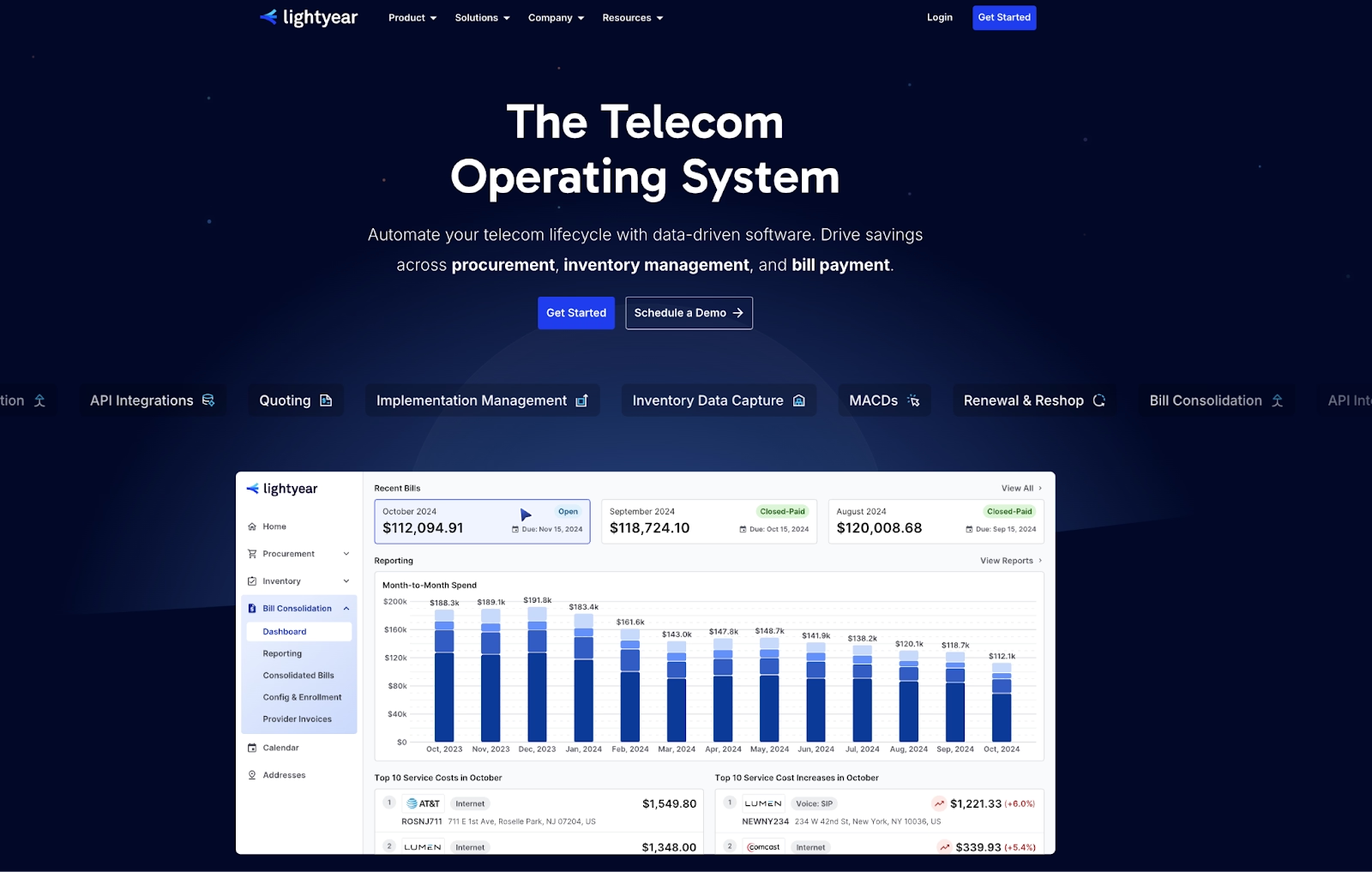
Through Lightyear, you can:
- Define your requirements (channels, DIDs, calling patterns) directly in our platform.
- Access 200+ vetted providers and automatically solicit competitive quotes.
- Compare options side by side with transparent pricing models, SLAs, and contract terms.
- Leverage benchmark data from thousands of past quotes to ensure you’re getting fair pricing upfront.
Once your PRI trunks are live, Lightyear doesn’t stop at procurement. Our platform provides:
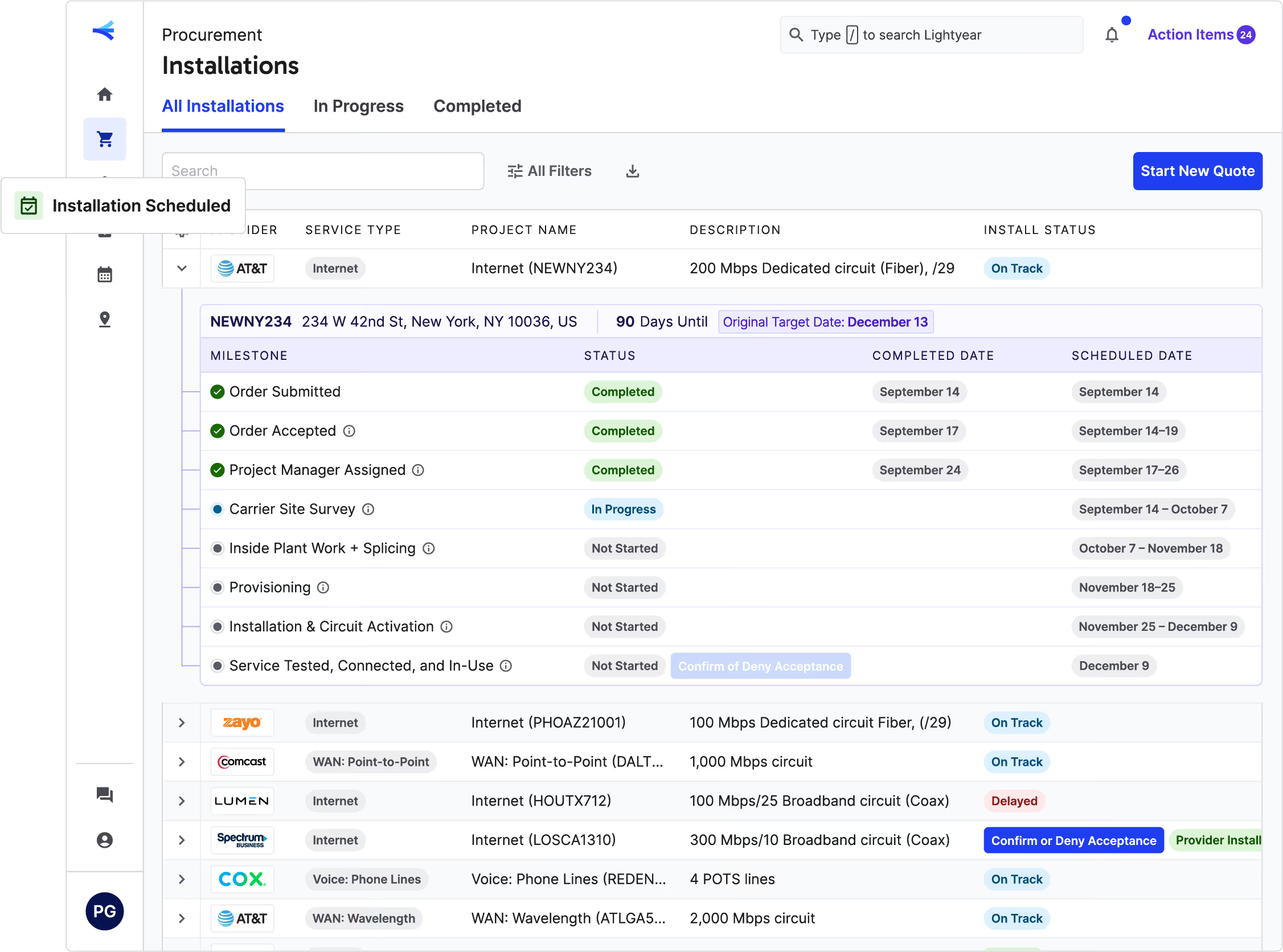
- Centralized service management — a single repository for all PRI contracts, order details, and invoices.
- Lifecycle tracking and support — automated reminders for renewals, plus direct ticketing for service issues.
- Performance visibility — tools to monitor usage, track spend, and plan future capacity or SIP migration.
With Lightyear, enterprises streamline the full lifecycle of PRI trunking — from sourcing and negotiation through implementation, management, and eventual upgrades.
Get a PRI trunk quote from Lightyear or talk to an expert about sourcing enterprise voice services today — and see how our platform helps you compare 200+ providers with transparent pricing, SLAs, and full lifecycle management.
Let us show you the product and discuss specifics on how it might be helpful.
Schedule a Demo





Revolutionize Your Telecom Experience
Learn how you can get one step closer to optimal business efficiency for all your telecom services.